A low science GPA is not a death sentence for medical school—unless you respond with a vague, unfocused plan. The students who recover do something different: they treat the problem like a clinical case and design a targeted, data-driven “rescue plan” instead of just taking more random classes.
You are not trying to “take a few more sciences.”
You are trying to change the story your transcript tells.
This guide will show you, step by step, how to:
- Diagnose how bad the damage really is
- Calculate exactly what numbers you need to hit
- Choose between formal vs. DIY post-bacc options
- Design a course plan that admissions committees actually respect
- Avoid the common traps that waste time and money
(See also: How to Use Your Post-Bacc Year to Build a Stronger Med School Narrative for more details.)
Step 1: Diagnose the Problem Precisely (Not Emotionally)
“I have a low GPA” is useless as a planning statement. You need hard numbers.
1. Pull your complete academic record
Gather:
- Unofficial transcript(s) from every college you attended
- List of all courses with:
- Course name
- Course level (100/200/300/400 or equivalent)
- Credits
- Letter grade
Do not rely on your school’s GPA breakdown if you have multiple institutions. Medical schools recalculate everything.
2. Calculate your key GPAs
There are three numbers that matter:
- Cumulative GPA (cGPA) – All undergraduate coursework
- Science GPA (sGPA) – Biology, Chemistry, Physics, Math (and usually statistics)
- Recent/Trend GPA – Last 30–45 credits, especially science
Use:
- An online AMCAS GPA calculator, or
- A spreadsheet where you manually enter:
- Quality points: A = 4.0, A- = 3.7, B+ = 3.3, etc.
- Multiply quality points × credits
- Sum and divide by total credits
Do this separately for:
- All BCPM (Bio/Chem/Phys/Math/Stats) courses
- All courses combined
3. Define “low” in the context of your goals
For MD (AMCAS) applicants:
- Competitive cGPA: 3.6+
- Competitive sGPA: 3.5+
- Minimum realistic “floor” to have a viable shot: ~3.2 overall, with a clear upward trend
For DO (AACOMAS) applicants:
- Competitive cGPA: 3.4+
- Competitive sGPA: 3.3+
- Realistic “floor” to be considered: ~3.0+, with strong recent performance
If you are:
- cGPA 3.4, sGPA 3.0 → Science GPA rescue needed
- cGPA 3.0, sGPA 2.8 → Both need work
- cGPA 3.6, sGPA 3.2, last 40 credits 3.8+ → Less rescue, more “trend proof”
Write your three numbers down. Those are your baseline.
Step 2: Quantify the Rescue: How Much Can You Actually Move the Needle?
Hope is not a strategy. Math is.
You need to understand how much new coursework it would take to reach target GPAs.
1. Understand GPA momentum
GPA behaves like a huge ship: the more credits you already have, the harder it is to turn.
Basic formula:
New GPA = (Current quality points + New quality points) ÷ (Current credits + New credits)
Where:
- Quality points = GPA × credits
Example:
- Current science GPA: 2.7
- Science credits: 60
- You plan 30 new science credits at 3.8
Current quality points:
2.7 × 60 = 162
New quality points:
3.8 × 30 = 114
Combined:
Total quality points = 276
Total credits = 90
New sGPA = 276 ÷ 90 = 3.07
So 30 credits of excellent work move you from 2.7 → ~3.1. That is a real rescue, but not a miracle.
2. Do your own projection
Take your:
- Current sGPA and science credits
- Choose realistic credit loads:
- 24 new credits (two heavy semesters)
- 36 new credits (one year full-time + summer)
- 45+ credits (1.5–2 years)
Assume you can earn:
- 3.7–3.9 in post-bacc science work (you must aim for this; 3.3 does not “fix” a low GPA)
Run the math with each scenario. You will see:
- How high you can reasonably climb
- How many credits you need to make the story believable to adcoms
If:
- You already have 140+ credits and a 2.6 GPA
- Even 40 credits of straight A work will not get you above ~3.1
In that situation, you should seriously consider:
- Starting in a DO-focused path
- Or planning a longer multi-year rebuild
3. Set concrete numeric targets
Based on your calculation and goals:
MD-focused target (typical):
- Improve sGPA to ≥3.3
- Improve cGPA as close to ≥3.4 as possible
- Last 30–40 credits: ≥3.7, mostly upper-level science
DO-focused target (typical):
- Improve sGPA to ≥3.2
- Improve cGPA to ≥3.2
- Last 30–40 credits: ≥3.6
Write your targets clearly. Your post-bacc rescue plan exists to hit those numbers, not to “take more courses.”
Step 3: Choose the Right Type of Post‑Bacc Strategy
Not all post-bacc options are created equal. The wrong format can trap you in more debt without changing your numbers or your narrative.
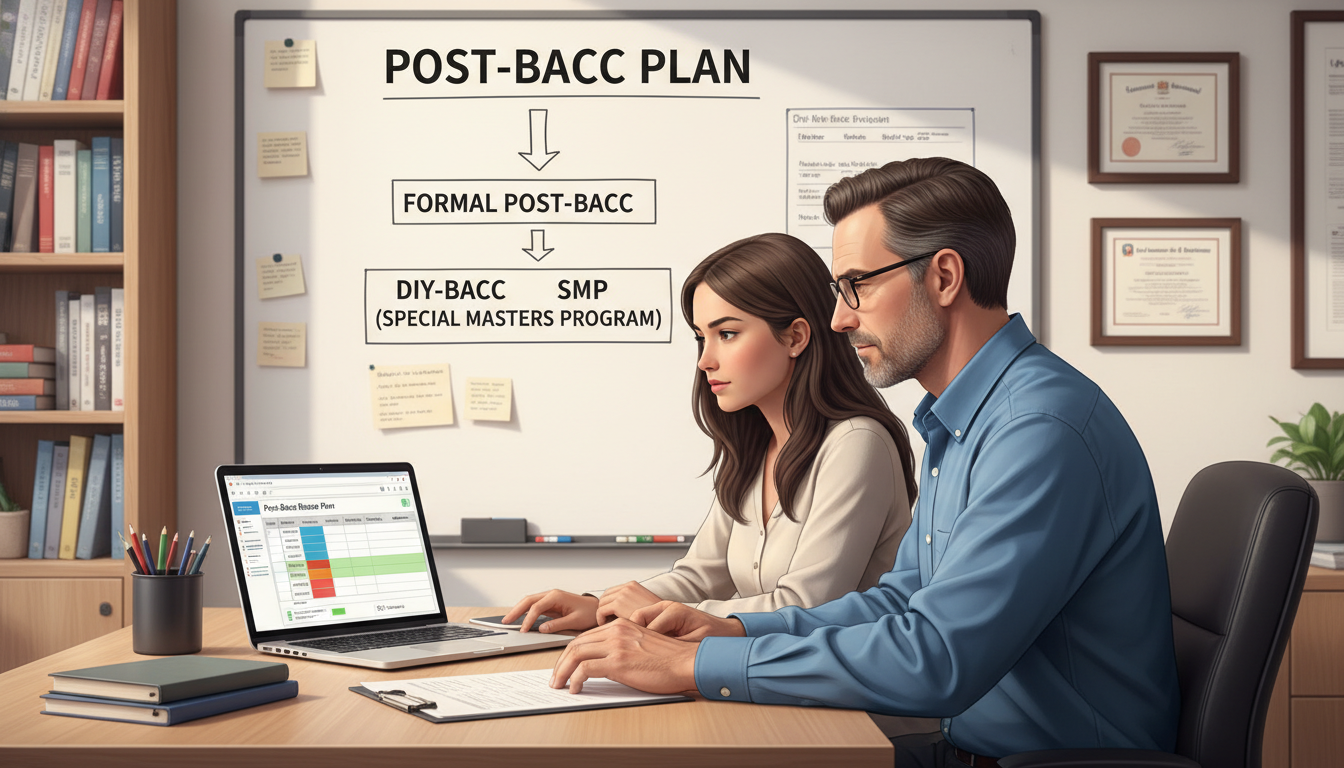
1. Know the main categories
Formal undergraduate post‑bacc programs (career changer or academic enhancer)
- Structured curriculum
- Advising and committee letters
- Often cohort-based, with linkage options
- Typically at 4-year universities
DIY / informal post‑bacc
- You enroll as a non-degree or second‑degree student
- You design your own schedule using regular university courses
- Maximum flexibility, minimal handholding
Special Master’s Programs (SMPs) and science MS degrees
- Graduate-level work
- Often mirror first-year med school curriculum
- Some have linkages to specific med schools
You are in the POSTBAC PROGRAMS space here, but SMPs are adjacent and relevant for some low-GPA applicants.
2. Match option to your profile
A. Best candidates for formal post‑bacc (academic enhancer)
- cGPA 3.0–3.3, sGPA 2.8–3.2
- Core prereqs completed but with many B‑ and C grades
- Need strong advising, structure, and a committee letter
- Can afford higher tuition and possibly relocations
Typical programs:
- Johns Hopkins Post-Baccalaureate Premedical Program (more career-changer but good structure)
- Temple ACMS / PCOM post-bacc
- UC Berkeley Extension Post-Bacc (structured tracks)
B. Best candidates for DIY / informal post‑bacc
- Have access to a local 4‑year or strong state university
- Need to work part‑time while taking classes
- Feel confident planning their own curriculum
- Want to keep costs lower
You enroll as:
- “Non-degree seeking”
- “Second bachelor’s student”
- Or “continuing education” student
This is the most common and often most efficient path for GPA rescue.
C. Best candidates for SMP / graduate programs
You consider an SMP if:
You already did a strong undergraduate post-bacc (or have a large number of undergrad credits)
Your GPA after post-bacc is still on the lower end (e.g., 3.1–3.3), but your trend is strong
You need to demonstrate you can handle medical‑school level coursework
You have at least:
- cGPA ~2.9–3.1+
- Solid MCAT (ideally ≥508 for MD‑oriented SMP, ≥502 for DO‑oriented)
For most students starting with a low science GPA, you should fix the undergraduate record first with a post‑bacc before jumping into an SMP.
Step 4: Design a Targeted Post‑Bacc Course Plan
Now you know your numbers and your format. Time to design the actual semester‑by‑semester plan.
Your guiding principles:
- Prioritize upper‑division sciences
- Be realistic about workload
- Craft a clear upward trend that committees cannot ignore
1. Fix versus replace: what to do with bad grades
Look at your science transcript and mark:
- D/F grades
- C/C+ grades
- Any withdrawals (W) in core prereqs
For each:
- Core prereqs (Gen Chem, Org Chem, Bio, Physics, Calculus, Stats):
- If C- or below: strongly consider repeating
- If C/C+: consider repeating if:
- It was more than 5–7 years ago
- Or you know the foundation is weak
- Upper-level sciences:
- Do not waste time repeating a B- in Cell Biology.
- Take a new, tougher course and crush it.
Note: MD schools average all attempts. DO schools used to replace grades, but most now follow AMCAS-like averaging. So repeating a C helps only if you are confident you can turn it into an A; the goal is net quality point gain.
2. Choose the right courses
Your post-bacc rescue plan should include a mix of:
Prerequisite repair / completion:
- General Biology I & II
- General Chemistry I & II
- Organic Chemistry I & II
- Physics I & II (algebra- or calculus-based)
- Statistics (often counts toward science GPA)
Upper‑division sciences that impress:
- Biochemistry (high yield, near-mandatory now)
- Genetics
- Cell Biology
- Physiology
- Microbiology
- Immunology
- Molecular Biology
- Neuroscience
- Pathophysiology (if offered at undergrad level)
Avoid padding with:
- Too many non-rigorous health sciences (e.g., “Nutrition for Non‑Majors,” “Wellness Studies”)
- Repeated “easy A” courses in unrelated areas
Admissions committees want to see:
- Sustained A-level performance in difficult, medically relevant science.
3. Plan realistic credit loads
You must not only survive your plan. You must dominate it.
Guidelines:
- Working 20+ hours/week:
- 6–8 science credits per semester (2 courses + labs)
- Working <10 hours/week or not at all:
- 9–12 science credits per semester (3–4 courses, labs included)
Sample 1‑year intensive DIY post‑bacc (already have basic prereqs):
Fall:
- Biochemistry (3–4 cr)
- Cell Biology (3–4 cr)
- Physiology (3–4 cr)
Total: 9–12 credits
Spring:
- Genetics (3–4 cr)
- Microbiology with lab (4 cr)
- Neuroscience or Immunology (3–4 cr)
Total: 10–12 credits
Summer (if needed):
- Statistics (3 cr)
- Research methods or another upper‑level biology (3–4 cr)
If your earlier record is quite weak, plan on 3–4 semesters, not 2.
4. Timeline relative to the MCAT
Two general strategies:
Strategy A: Fix GPA first, MCAT later
Best for severely low GPAs:
- Year 1: Post‑bacc coursework
- Summer after Year 1: MCAT dedicated study (3 months)
- Apply at the end of Year 2 with:
- Full year of strong grades on the transcript
- At least one semester of additional strong work in progress
- MCAT score in hand
Strategy B: Overlapping MCAT and post‑bacc
Only for those with:
- Moderately low GPA (e.g., 3.1–3.3)
- Strong time management
- Light work hours
Example:
- Fall–Spring: Post‑bacc courses + light MCAT prep
- Summer: Full‑time MCAT study, take exam
- Next cycle: Apply with 2 semesters of strong post‑bacc grades and MCAT complete
You cannot execute a rescue plan if you drown. Do not overload yourself with 14 science credits and full‑time MCAT prep. Choose a strategy and commit.

Step 5: Set Non‑Negotiable Academic Performance Standards
A post‑bacc rescue plan only works if your new performance is dramatically better than your past record. You are not aiming for “B‑average improvement.” You are aiming for evidence of transformation.
1. Define your performance goals
Non‑negotiables:
- Overall post‑bacc GPA: ≥3.7
- Science post‑bacc GPA: ≥3.7
- No grades below B+ in sciences if at all possible
- No withdrawals unless there is a true emergency, and you can explain it succinctly
This is not about perfectionism. It is about changing what admissions committees think when they see your name.
Old narrative:
“2.8 science GPA, inconsistent performance, some Cs in core courses.”
New narrative after rescue:
“Early struggles, then 36 credits of A/A- work in advanced biology and chemistry, 3.8 trend, MCAT 511. Student clearly turned a corner.”
2. Build the support system around your target
Do not simply “try harder.” Change your environment and strategy:
- Use office hours weekly, not just before exams
- Attend tutoring or supplemental instruction sessions
- Form a small study group (2–4 serious students)
- Block your schedule:
- 2–3 hours of focused study per day per science course
- Use active learning:
- Practice problems
- Teaching concepts out loud
- Flashcards spaced repetition (Anki or similar)
If you previously struggled for non‑academic reasons (health, mental health, family), build supports for those before stacking 12 credits of hard sciences.
Step 6: Integrate Your Rescue Plan With the Rest of Your Application
The post‑bacc is one piece of the puzzle. To be competitive, you must coordinate it with your MCAT, clinical experiences, and application timing.
1. Clinical and non‑clinical experience during post‑bacc
You are in the “PREMED AND MEDICAL SCHOOL PREPARATION” phase. You cannot ignore everything else.
Minimum concurrent activities:
- Clinical exposure:
- Medical scribe, EMT, CNA, MA, or hospital volunteering
- Aim for 4–8 hours/week consistently
- Non‑clinical service:
- Work with underserved populations (shelters, tutoring, crisis hotlines)
You do not need 20 hours/week of each. You need consistent, longitudinal exposure that runs parallel to your academic rescue.
2. MCAT timing relative to rescue
Your MCAT score must match the new narrative:
- If you rescue your GPA but score a 498, committees will doubt you have truly fixed your academic foundation.
- Use your upper‑division post‑bacc courses as built‑in MCAT prep (e.g., Biochem, Physiology, Genetics).
Target scores:
- MD-focused:
- Aim ≥510 if your GPA is sub‑3.4
- ≥512–515 makes a lowish GPA more forgivable
- DO-focused:
- Aim ≥502
- ≥505 strengthens your case with a 3.2–3.3 GPA
3. Choose the right application cycle
You want:
- At least 2 semesters of strong post‑bacc grades completed
- Ideally 3+ semesters if your starting GPA was <3.0
If your post‑bacc runs:
- Fall 2025 – Spring 2026 – Fall 2026
- Plan to apply in Spring 2027 for matriculation in Fall 2028
This way:
- Fall 2025 + Spring 2026 grades are visible when you apply
- Fall 2026 grades will be updated mid‑cycle
- Your full upward trend is captured
Rushing to apply with only one semester of improved grades is one of the fastest ways to waste a cycle.

Step 7: Anticipate and Avoid Common Post‑Bacc Rescue Traps
Many students with low science GPAs make the same avoidable mistakes.
Trap 1: Taking random extra courses without a strategic plan
Examples:
- Adding “Anatomy for Allied Health” and “Nutrition 101” and expecting adcoms to be impressed
- Taking mostly online, lower‑division, non‑majors courses
Fix:
- Build a written plan that shows:
- Specific courses
- Levels (200/300/400)
- Credit counts
- Projected GPA impacts
Trap 2: Underestimating how many credits you need
Beliefs like:
- “I just need one good semester and I’m fine.”
- “If I get straight As for 12 credits, my 2.7 becomes a 3.5.”
Reality: A 1–2 semester plan only works if:
- Your starting GPA is not extremely low
- You have relatively fewer total credits
Fix:
- Do the math early
- Accept that serious rescue may require 24–45+ new science credits
Trap 3: Overloading to “prove” you can handle it
Students think:
- “Adcoms need to see 16 science credits at once.”
What they actually care about:
- A sustained record of excellence in rigorous courses
Fix:
- Choose course loads you can dominate, not just survive
- If you have a history of burn‑out or poor time management, start slightly lighter and build confidence
Trap 4: Ignoring institutional rigor and course selection
A 4.0 in questionable online credit mills or ultra‑soft community college courses, especially after you already completed a 4‑year degree, will not carry the same weight.
Fix:
- Prioritize a regionally accredited 4‑year university for upper‑division work
- Use community college strategically only for:
- Logistics
- Certain repeats
- Or earlier in your path, not for the main rescue
Trap 5: Poor documentation and explanation of your turnaround
Even if you execute a brilliant rescue, if you cannot explain:
- What went wrong
- What changed
- How your new record reflects who you are now
…then committees may still hesitate.
Fix:
- Keep a brief log as you go:
- Key changes in your study habits
- Life circumstances you addressed
- How you managed full schedules successfully
- Use that log later to craft:
- A focused personal statement
- Secondary essays about “academic challenges” and “resilience”
Step 8: Convert Your Rescue Plan Into a Clear Narrative
Your transcript will show numbers. Your application must connect the dots.
1. Craft the academic turnaround story
The effective structure:
Past – Brief, specific description of what went wrong
- Overcommitted to work
- Poor time management
- Undiagnosed ADHD or health issue
- Family crisis
Intervention – Concrete changes you made
- Reduced work hours
- Sought medical/psychological evaluation and treatment
- Changed study strategies, repeated key courses
- Built support systems (tutoring, advising)
Evidence – Show, not tell, that change is real
- “After implementing these changes, I completed 32 credits of upper‑division biology and chemistry with a 3.8 GPA while working 10 hours/week as a scribe.”
Connection to medicine – How this experience relates to being a physician
- Resilience
- Insight
- Ability to adapt and improve
2. Align your letters of recommendation
Ask for letters from:
- Post‑bacc science professors who:
- Taught you in challenging courses
- Saw your work ethic and improvement
- Can explicitly state: “This student is capable of medical school‑level work.”
Ideally at least:
- 2 science faculty from your post‑bacc
- 1 from clinical or research environment
Letters that say “X got an A” are less powerful than:
- “X sought feedback regularly, improved exam performance over the term, and worked through challenging material with maturity and perseverance.”
Final Tight Summary
Diagnose and quantify before you act. Know your exact cGPA, sGPA, recent trend, and how many high‑grade credits you need to hit realistic MD or DO targets.
Design, do not drift. Choose the right type of post‑bacc (formal, DIY, or eventually SMP), build a precise course plan centered on upper‑level sciences, and commit to ≥3.7 performance.
Integrate and execute. Coordinate your post‑bacc with MCAT timing, clinical experiences, and a clear narrative about your turnaround so that admissions committees see not just more credits, but a transformed, medically capable applicant.