Medical schools do not reject you because you failed; they reject you because you never convincingly showed that the failure is behind you.
If you have multiple W’s on your transcript, you are not automatically finished. You are, however, under scrutiny. Your entire strategy must shift from “how do I check boxes?” to “how do I build an undeniable pattern of reliability, maturity, and academic strength?”
(See also: How Admissions Committees Really Read Post-Bacc Transcripts for insights on transcript evaluation.)
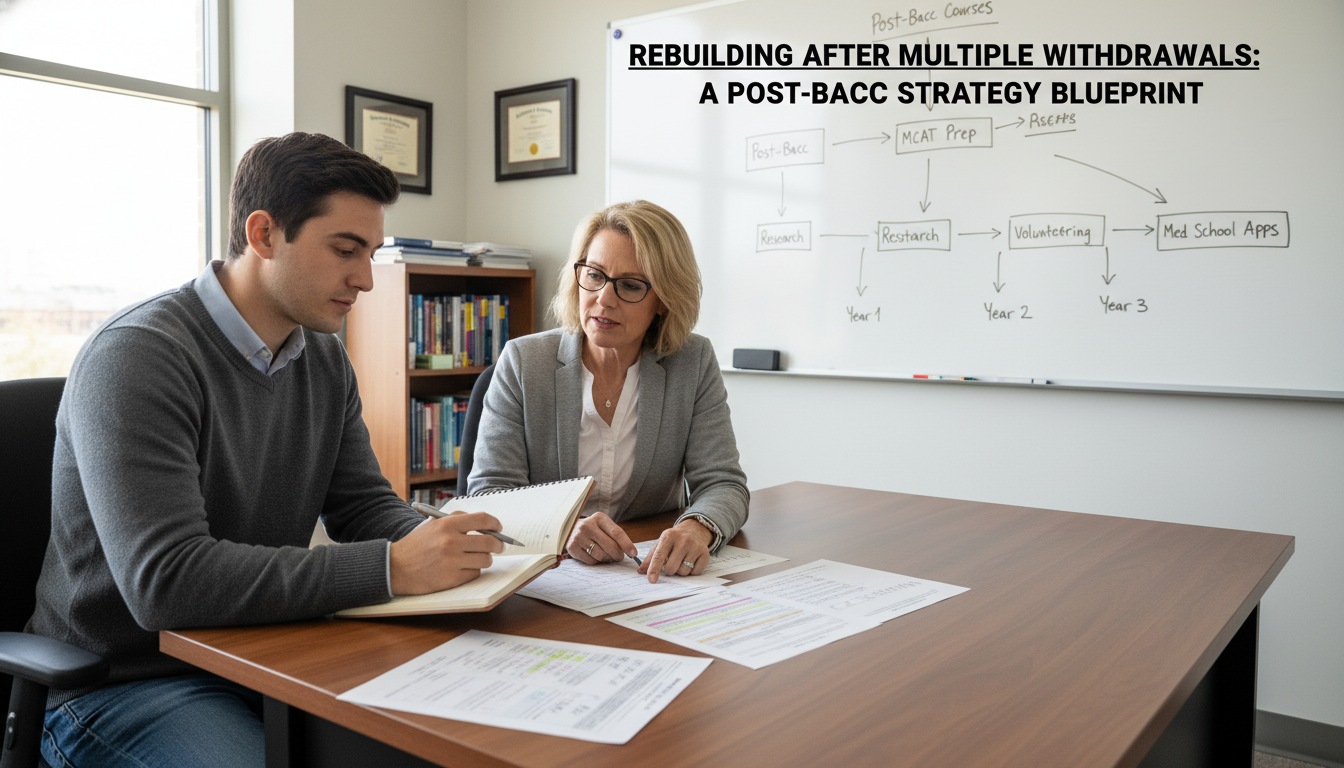
This blueprint will walk you step by step through that rebuild.
Step 1: Face the Transcript Head-On (No Storytelling Yet)
Before you talk about “context” or “extenuating circumstances,” you need a cold, data-driven understanding of your record. That is the foundation of any serious post-bacc plan.
1. Collect and organize every piece of data
Do not guess. Get the primary sources.
Request official transcripts from:
- Every college or university you have attended
- Community colleges where you took summer or dual-enrollment courses
- Any online or extension programs that may appear on a transcript
Build a master spreadsheet with:
- Course name
- Course number
- Credit hours
- Grade (or W / P / NP / AU)
- Term and year
- Institution
Mark:
- All withdrawals (W, WF, WP)
- All prerequisite sciences (Bio, Chem, Orgo, Physics, Biochem, Stats)
- Any repeats of the same course
You want one clean view of your academic life.
2. Calculate how medical schools will see you
Use AMCAS-style GPA calculations (for MD) and AACOMAS-style (for DO). Key points:
Separate:
- Cumulative GPA
- BCPM (science) GPA – Biology, Chemistry, Physics, Math
- All other GPA
Identify:
- Trend by year (Year 1, 2, 3, 4, post-bacc)
- Number of withdrawals per term
- Any terms with ≥2 W’s or any “academic meltdown” semester
If you struggle, use:
- Online AMCAS GPA calculators
- Pre-health advising office
- A premed consultant for a one-time transcript evaluation
The goal: define the actual problem, not the emotional version of it.
3. Clarify how bad the withdrawals actually look
Not all W’s are equal. You need to categorize:
Less problematic W’s:
- Early in college, then never again
- Single W in a heavy major (e.g., engineering) with otherwise good grades
- W with a later successful completion at A or B+
Red flag patterns:
- Multiple W’s in the same course or subject (e.g., Organic Chemistry twice)
- Clusters of W’s in multiple semesters
- W’s in upper-division sciences or key prerequisites
- W’s paired with mediocre grades in remaining courses
Write down, in one sentence:
“The story my transcript tells right now is: ______.”
Examples:
- “I struggled with time management for two years and cut classes when overwhelmed.”
- “I had unaddressed health issues and kept withdrawing instead of seeking help.”
- “I avoided challenging sciences and bailed when things got hard.”
You cannot build a credible repair plan until you name the pattern explicitly.
Step 2: Diagnose the Root Causes Before You Add More Classes
The worst mistake is jumping into a post-bacc thinking, “I will just get A’s this time,” without changing the systems that failed before.
1. Identify what really drove the withdrawals
Be brutally specific. Common categories:
-
- Weak foundations in math or general chemistry
- Poor study strategies (rewriting notes instead of active recall)
- Cramming rather than spaced repetition
Executive function / time management issues
- Chronic procrastination
- Taking on too many credits or jobs
- Poor planning around exams and major assignments
Health or mental health
- Depression, anxiety, ADHD, chronic illness
- Burnout from family obligations, caregiving
Life instability
- Housing insecurity
- Work schedule changes
- Care responsibilities for parents or siblings
Professional immaturity
- Dropping classes the moment a B seemed likely
- Avoidance of uncomfortable conversations with professors or advisors
Next to each pattern of W’s, write which category applied. If you had W’s for multiple reasons in different semesters, label them separately.
2. Set non-negotiable fixes before enrolling again
For each root cause, you need a concrete intervention before you sign up for a rigorous post-bacc:
Academic skill gaps:
- Commit to 1–2 prerequisite refreshers (e.g., algebra, intro chem) at a community college or online before retaking higher-level sciences.
- Learn and practice evidence-based study methods (Anki, practice problems, teaching material to others).
Executive function:
- One semester with a reduced course load and a structured planner system (paper or digital).
- Weekly planning blocks (e.g., Sunday 60-minute review).
- Use tools: Google Calendar, task managers, Pomodoro timers.
Health / mental health:
- Establish care with a physician and/or therapist.
- If medication is part of treatment (e.g., for ADHD, depression), stabilize dosage and routine before full-time rigorous science.
- Develop explicit accommodations plan if eligible (through disability services).
Life instability:
- Stabilize work hours where possible.
- Secure predictable housing.
- If caregiving demands are heavy, commit to lighter course loads with a longer timeline.
Professional immaturity:
- Set a rule: “No withdrawals unless I have met with the professor, advisor, and tried tutoring for at least 3 weeks.”
- Decide in advance what “struggling” will trigger: increased effort, not escape.
Document these changes. You will later use them in your personal statement and secondaries.
Step 3: Choose the Right Type of Post-Bacc (Not All Programs Help You)
With multiple withdrawals, the structure of your repair program matters as much as your grades. You want the environment most likely to show a sustained, disciplined upward trend.
1. Understand your options
A. Formal undergraduate-level post-bacc (career-changer or academic enhancer)
- Examples:
- UC Berkeley Extension Post-Baccalaureate Health Professions Program
- Temple ACMS
- UPenn Pre-Health Programs
- Pros:
- Structured advising, linkage possibilities in some cases
- Cohort of premed students
- Cons:
- Can be expensive
- Rigid course sequencing
B. Informal post-bacc at a local 4-year university
- You enroll as non-degree or second bachelor’s, choose your own upper-level courses.
- Pros:
- Flexibility
- Often cheaper than formal programs
- Cons:
- Requires more self-planning
- Less advising support
C. Community college science coursework
- Better as:
- Academic warm-up
- Filler for non-core prerequisites, or early repair work
- Not ideal as the main evidence of readiness for medical school. Medical schools want to see upper-division science at a 4-year institution if your record is already shaky.
D. Special Master’s Program (SMP)
- Graduate-level biomedical science programs often connected to medical schools.
- Examples:
- Georgetown SMP
- Boston University MAMS
- Cincinnati MAMS
- Extremely high risk if your undergraduate foundation is weak or W’s show poor follow-through. Fail or underperform in an SMP and you close doors permanently.
- Only consider if:
- You already have a solid upward trend in advanced undergrad sciences.
- You understand the stakes and can commit to near-full academic focus.
2. With multiple withdrawals, what usually works best?
For most applicants with ≥3 W’s across premed-related courses:
Phase 1 – Controlled rebuild:
- Informal or formal post-bacc at a 4-year institution.
- Start with 6–9 credits of science while you prove stability.
- Use tutoring and office hours from week 1.
Phase 2 – Full-strength demonstration:
- 12–15 credits / term of upper-level sciences.
- Target at least 3–4 consecutive terms of A/A- level work.
Committing straight to a high-risk SMP with a history of withdrawals usually backfires. Your goal is not to be impressive on paper; your goal is to be believable.
3. Selection filters that matter for you
When evaluating programs, prioritize:
Grade repair suitability
- Do they allow retaking courses that you withdrew from?
- How are repeats documented on transcripts?
Access to upper-level sciences
- Can you take courses like:
- Biochemistry
- Cell biology
- Physiology
- Microbiology
- Genetics
- Can you take courses like:
Advising quality
- Dedicated pre-health advisor?
- Historical data on students with prior academic issues?
Schedule flexibility
- Evening or part-time options if you work
- Summer courses to accelerate if, and only if, you can handle them
If a program advisor cannot clearly explain how their structure helps applicants with prior W’s and low GPAs, treat that as a warning signal.
Step 4: Build a Concrete Academic Plan That Blanks Out the Old Story
You are not just “taking more classes.” You are constructing a clean, consistent pattern that medical schools can trust.
1. Define your academic targets
You need explicit numeric goals, not vague ambitions. For most students with multiple W’s:
- Aim for:
- ≥3.7 GPA in post-bacc coursework
- All A/A- in core sciences and upper-division courses
- Trend:
- No withdrawals
- No grades below B+ in science
If your current cumulative GPA is:
- <3.0: You may need 40–60+ post-bacc science credits
- 3.0–3.2: Aim for 30–45 strong credits
- 3.2–3.4: Usually 24–36 credits can demonstrate a clear upward trend
These are guidelines, not rules, but planning around them keeps you honest about how much work you must do.
2. Sequence courses intelligently
Design your sequence in three tiers:
Tier 1 – Stability and rebuild (Semester 1)
- 6–9 credits science + 0–3 credits lighter coursework
- Example:
- Biochemistry (3–4 credits)
- Physiology (3–4 credits)
- Maybe 1 non-science elective (if needed for balance)
Tier 2 – Full load, proving consistency (Semesters 2–3)
- 12–15 credits per term
- Example:
- Cell biology
- Microbiology
- Genetics
- Statistics or psychology
- Each term should show readiness for med school workload: 3–4 demanding courses, all strong grades.
Tier 3 – Polishing and gap-filling (Semester 4, if needed)
- Any missing pre-reqs
- Additional advanced sciences (e.g., immunology, neurobiology)
- Opportunities to TA or do research if available
Plan withdrawal-avoidance into your schedule:
- Do not overload with:
- Full-time work + full-time science course load
- Multiple lab-heavy courses if you have never handled them successfully before
- Build one “safety valve” into each semester (like a slightly lighter 2-credit course) rather than adding a class you will be tempted to drop.
Step 5: Implement a No-Withdrawal Academic Protocol
You cannot afford more W’s. You must treat every semester like a professional contract.
1. Build a pre-semester systems checklist
Before classes begin:
- Obtain all syllabi.
- Enter every exam date, quiz, and major assignment into a calendar.
- Map backward:
- When will you start studying for each exam?
- When will you complete pre-lab assignments?
- Identify “crunch weeks” with multiple exams and plan reduced work or obligations.
2. Weekly execution protocol
Use a simple weekly rhythm:
Sunday planning (45–60 minutes):
- Review coming 7–10 days.
- Block study time using timeboxing:
- Specific subject + specific task + specific time (e.g., “Tues 4–6 PM: Biochem problem sets 3–4, Anki review”).
- Adjust for work shifts or appointments.
Daily anchors:
- Set 2–3 non-negotiable academic tasks each day.
- Use active learning:
- Practice problems
- Self-quizzes
- Teaching concepts out loud or on a whiteboard
Early warning rule:
- If you score <80% on any quiz/exam:
- Within 48 hours:
- Review the test.
- Attend office hours.
- Contact tutoring center.
- Within 48 hours:
- If you score <80% on any quiz/exam:
You want intervention within one week, not at midterm.
3. Define strict withdrawal criteria
You cannot trust “I feel like I might fail.” You need objective rules.
Example policy for yourself:
I will only consider withdrawing if ALL are true:
- My current grade is mathematically below 65% and the syllabus weightings make an A/B impossible even with perfect scores.
- I have:
- Met with the professor at least twice to review performance.
- Completed all offered tutoring sessions for ≥3 weeks.
- I have discussed my situation with:
- An academic advisor or pre-health advisor.
- Financial aid (if withdrawals impact aid).
I will not withdraw:
- To avoid a B or B+.
- Because I feel overwhelmed but have not changed my study process.
Document this policy and share it with someone you respect (advisor, mentor) so you feel accountable to it.
Step 6: Integrate MCAT Strategy With Your Post-Bacc (Not Against It)
Many students with prior withdrawals panic and rush the MCAT. You need the opposite: a carefully staged approach that builds on your repair work.
1. Decide timing based on coursework, not emotion
You should not start serious MCAT prep until:
You have completed:
- General chemistry
- Organic chemistry
- Biochemistry
- Physics
- Intro biology
- Intro psychology and sociology (or equivalent content familiarity)
You have shown:
- At least 1–2 consecutive terms of A/A- science grades.
Rushing the MCAT with shaky fundamentals risks another visible failure on your record.
2. Structure MCAT prep around your new habits
Once the prerequisites and early repair terms are done:
- Allocate 4–6 months of structured prep.
- During that time:
- If you are in classes, aim for a slightly lighter load (e.g., 9–12 credits).
- Protect 15–20 hours per week for MCAT work if you are also in school, more if not.
Use the same systems you built for your post-bacc:
- Weekly planning
- Active recall
- Frequent practice tests with honest review
A strong MCAT does not erase withdrawals, but it is powerful supporting evidence that your new trajectory is real.
Step 7: Document the Turnaround Story While You Are Living It
You will eventually have to explain your withdrawals to admissions committees. The worst time to construct that story is the night before you write secondaries. Start now.
1. Keep a running “evidence log”
Create a document where you record:
Semester by semester:
- Courses taken
- Grades earned
- Hours of work per week
- Key challenges and how you handled them (without quitting)
Specific examples of:
- Times you went to office hours regularly
- Times you sought help early instead of withdrawing
- Adjustments you made to study strategies or schedules
When writing personal statements and secondaries, these concrete examples will make your story credible instead of generic.
2. Frame your withdrawal history strategically
You will need a cohesive narrative that does three things:
Acknowledges the problem directly:
- “Earlier in my academic career, I withdrew from multiple courses when I felt overwhelmed, rather than seeking help.”
Specifies what changed and how:
- Diagnosed issues (e.g., untreated ADHD, poor time management, lack of structure).
- Concrete interventions (treatment, therapy, study system changes, reduced work hours).
Demonstrates sustained improvement with data:
- “Since beginning my post-bacc program in Fall 2023, I have completed 36 credits of upper-division biology and chemistry with a 3.85 GPA, while working 15 hours per week and volunteering consistently.”
Your goal is to move an admissions reader from “red flag” to “resolved issue with robust evidence.”
Step 8: Build Professional Endorsements That Validate Your New Pattern
Multiple withdrawals create doubt about follow-through. Strong letters and relationships can help counter that.
1. Target letter writers strategically
You want letters from people who can say:
- They have seen you:
- Consistently in class
- Engaged in office hours
- Take feedback and improve
- Manage heavy workloads without flaking
Best sources in a post-bacc rebuild:
- Upper-level science professors (Biochem, Physiology, Microbiology)
- Research mentors (if you do research and show reliability)
- Clinical supervisors who can speak to your professionalism and consistency
2. Cultivate relationships intentionally
Practical approach:
- Attend office hours at least twice before the first exam and regularly after.
- Ask content questions and process questions:
- “How would you recommend studying for your exams?”
- “Can we review my last test and discuss where my reasoning went wrong?”
- After the course ends:
- Continue occasional updates (e.g., one email each semester).
When asking for letters:
- Provide:
- Transcript with old W’s and new grades
- A short summary of your turnaround journey
- Specific examples of your work in their class
You want your letter writers to echo the same story you present in your application.
Step 9: Decide When You Are Actually Ready to Apply
Your application timing is part of the repair strategy. Applying too early, with an incomplete trend, can waste cycles and money.
1. Minimum readiness checklist
You should not apply to medical school until all of the following are true:
Academic:
- At least 24–30 credits of recent (last 1–2 years) science coursework at a 4-year institution with GPA ≥3.6–3.7.
- No withdrawals in the last 2–3 years.
MCAT:
- Score within or above the median of your target schools (for many applicants, 510+ for MD; high 500s can be competitive for DO depending on GPA and school list).
Non-academic:
- Consistent clinical exposure (e.g., 150–300+ hours).
- Some non-clinical service and at least one long-term commitment (work, volunteering, or research) since the rebuild.
Narrative:
- Clear, specific explanation of withdrawals and subsequent changes.
- Evident alignment between your new habits and the demands of medical training.
If you cannot check all of these yet, the correct move is to delay, not “see what happens.”
2. Strategize your application type
Given a history of withdrawals, consider:
- MD and DO both on your list (if GPA/MCAT fit).
- A realistic mix:
- Some schools known to value reinvention and upward trends.
- Fewer “reach for prestige” choices and more “mission fit” programs.
You are not just selling numbers. You are selling the trajectory.
Step 10: Protect Your Long-Term Identity From the “W” Label
Multiple withdrawals can make students internalize a false story: “I am unreliable.” Part of the rebuild is psychological.
Concrete ways to reinforce your new identity:
Track wins:
- Keep a record each term of:
- Assignments finished early
- Times you showed up despite stress
- Exams where your preparation paid off
- Keep a record each term of:
Surround yourself with the right people:
- Study groups with serious students.
- Mentors who understand nontraditional or red-flag backgrounds.
Maintain sustainable habits:
- Sleep, exercise, and nutrition are not optional extras.
- Burnout is a frequent precursor to academic collapse and new withdrawals.
Regular self-audits:
- At midterm each semester, ask:
- Am I slipping into old patterns?
- What concrete step can I take this week to correct course?
- At midterm each semester, ask:
This is not motivational fluff. It is relapse prevention for the behaviors that led to your earlier W’s.
The Core Takeaways
You must repair the system, not just the transcript. Identify why the withdrawals happened and implement specific fixes before committing to heavy science coursework.
Your post-bacc needs to be structured proof. Choose a setting where you can deliver 24–40+ credits of rigorous science with excellent grades, no withdrawals, and a clear upward trend.
Everything must align toward one message: the problems that caused your withdrawals are identified, addressed, and demonstrably resolved through your recent performance, MCAT score, and professional behavior.
Build that pattern, document it, and your history of W’s becomes a chapter in your story, not the ending.