Most students waste their post-bacc year trying to “check boxes.” You are going to use it to build a story admissions committees cannot ignore.
A post-bacc year is not just about GPA repair or more science credits. It is a one-year narrative accelerator. Used correctly, it can transform a scattered premed record into a coherent, compelling explanation of who you are, why you belong in medicine, and how you will operate as a physician.
Used poorly, it becomes: “I took more classes and did some volunteering.”
You are not going to let that happen.
Below is a step-by-step blueprint for turning your post-bacc year into a strategic narrative engine that:
- Fixes concrete weaknesses (grades, MCAT, clinical gaps)
- Builds a focused, believable story of your path to medicine
- Produces exactly the evidence admissions committees want to see
Step 1: Define the Narrative Before You Touch Your Schedule
Most post-bacc students start with: “What classes do I need?”
Wrong first question.
You start with: “What story do I need to be able to tell 12–18 months from now?”
A. Identify your narrative category
You do not need a gimmick. You do need clarity. Most strong applicants fall into one or two narrative “types”:
The Academic Redeemer
- Earlier poor or average performance
- Post-bacc used to demonstrate high-level academic capability and discipline
The Career-Changer
- Prior career or degree in a non-science field
- Post-bacc used to prove science aptitude and genuine, informed commitment to medicine
The Contextual Striver
- Significant life responsibilities, economic hardship, or non-traditional path
- Post-bacc used to show what you do when given focused time and support
The Future [X]-Focused Physician
- Clear interest in something specific (primary care in underserved areas, psychiatry, global health, health policy)
- Post-bacc used to align activities, coursework, and mentors with that interest
Pick the 1–2 categories that fit you best. This is not branding. It is your decision rule for everything you choose during this year.
B. Perform a brutally honest gap analysis
Open a blank document and build three columns:
What my current record says
- GPA trends
- Course difficulty
- MCAT (real or practice)
- Clinical exposure
- Long-term commitments
- Leadership / initiative
What I want my med school narrative to say
Example end-state statements:- “When given a second chance academically, I excelled in rigorous upper-division science.”
- “I did not pivot to medicine impulsively; I tested this career through real patient-facing roles.”
- “I commit deeply to a few things and stay with them, even under stress.”
What is missing or contradicts that story
- Inconsistent grades
- No sustained clinical work
- Disconnected shadowing
- No evidence of resilience or follow-through
Be specific. “Need more volunteering” is useless. “Need 1–2 year-long patient-facing roles with progressive responsibility” is useful.
This document becomes your post-bacc action blueprint.
Step 2: Build a Post-Bacc Schedule That Proves Your Story
Once you know what your story must show, you design your schedule to demonstrate it.
A. Structure your academic plan with intention
Your transcript during the post-bacc year should answer one core question for admissions:
“Can this person handle a medical curriculum now?”
To show that, you design around:
Course level and rigor
- Prior weak science foundation → prioritize:
- Upper-division biology (e.g., Physiology, Cell Biology, Microbiology)
- Biochemistry (required or strongly recommended at many schools)
- Statistics or biostatistics
- Strong but outdated sciences (5–7+ years old) → take:
- 1–2 key refreshers (e.g., Physiology, Biochemistry) to show current readiness
- Prior weak science foundation → prioritize:
Credit load
- If you are repairing GPA:
- Aim for 12–15 credits / semester of challenging coursework
- Goal: 3.7–4.0 post-bacc GPA to demonstrate a clear academic shift
- If you worked full-time previously and are now part-time:
- Be ready to explain the tradeoff: fewer credits, but more clinical responsibility or family obligations
- If you are repairing GPA:
Consistency
- No new pattern of withdrawals or C+/B- grades
- If you must drop a class, build a clear, defensible reason (major health event, family crisis, documented work overload) and show the pattern stops there
B. Coordinate the MCAT strategically with your narrative
Your MCAT plan must fit your story, not fight it.
If your narrative is “I fixed my academics,” then:
- MCAT should confirm that
- Detailed plan:
- Start content review as you take upper-level sciences, not before
- Block 3–4 uninterrupted months (full-time), or 6–7 months part-time
- Target: at or above your target schools’ median score
If you already took the MCAT and scored poorly:
- Your post-bacc year should explain:
- What changed in your study strategy
- How your improved coursework and time management directly affected performance
- You want a visible link:
- “I improved from a 503 to 511 after my structured post-bacc with demonstrated A-level science work.”
- Your post-bacc year should explain:
Tie MCAT timing to the application cycle. If you want to apply in June 2027, you should aim for an MCAT by March–April 2027 so your score is ready and your narrative includes your improvement.

Step 3: Select Activities That Directly Reinforce Your Narrative
Random activities kill strong narratives. Intentional ones make your file unforgettable.
Use a simple rule: if an activity does not clearly reinforce your story, you either reshape it or drop it.
A. Clinical experience: the backbone of credibility
You need patient-facing roles and you need them consistently.
Strong options during a post-bacc year:
- Medical assistant (MA) in primary care or specialty clinics
- Scribe (in ER, outpatient, or inpatient settings)
- Certified nursing assistant (CNA) in hospital or long-term care
- Emergency department tech or patient care tech
- Hospice volunteer with direct patient interaction
Target structure:
- 8–16 hours/week during the academic year
- More during breaks or summer if possible
What this does for your narrative:
Academic Redeemer:
- Shows your improved time management under real clinical stress
- Provides concrete examples of maturity vs your earlier undergrad self
Career-Changer:
- Proves you understand daily clinical realities
- Lets you test your interest against the actual grind of medicine
Contextual Striver:
- Demonstrates that even with life constraints, you can maintain clinical commitment
B. Shadowing: focused, not scattershot
Shadowing alone is weak; shadowing with a clear purpose is powerful.
Design your shadowing based on your narrative:
If you emphasize underserved care:
- Shadow at FQHCs, free clinics, or county hospitals
- Seek primary care, internal medicine, or family medicine physicians who practice in resource-limited settings
If you emphasize a previous field:
- Engineer → consider orthopedics, radiology, interventional specialties
- Psychology → psychiatry, integrated behavioral health models
You do not need 200 hours. You need:
- 3–5 physicians
- 10–30 hours each
- A few longer, repeated experiences where you see continuity of care
Goal: by the end of the year you can say, “I saw enough different realities of medicine to make an informed decision, and here is what I learned.”
C. Non-clinical service: prove you actually serve people
Most schools differentiate between clinical and non-clinical service. Your post-bacc year is your chance to show that you work with people in hard situations, not just in academic comfort zones.
High-yield service options:
- Homeless shelters or housing support
- Food banks with client-facing roles
- Refugee resettlement support
- Prison education or reentry support
- Long-term tutoring or mentoring for under-resourced students
Minimum goal:
- One consistent non-clinical service role with 6–12+ months of continuity
Align this with your narrative:
- Underserved focus → choose populations that match your stated interests
- Resilience story → choose roles that show emotional stamina and commitment, not one-off events
D. Academic or scholarly projects: targeted, not forced
Not everyone needs research. Some strongly benefit from it.
You benefit if:
- You are applying MD-PhD, research-heavy schools, or want to emphasize critical thinking and curiosity
- You had little or no prior research in undergrad
- Your previous research does not match your narrative and you want to pivot
Smart ways to integrate research quickly:
- Join a small clinical or outcomes project with a physician you scribe or MA for
- Work on a quality improvement (QI) project in a hospital setting (chart audits, process improvement)
- Ask to help on IRB applications, data collection, or chart review
Aim for:
- 1 project where you materially contributed over at least 6 months
- A clear, explainable role: “I extracted data from 200 charts and helped analyze readmission patterns for heart failure patients.”
Step 4: Create a Coherent Timeline that Shows Growth, Not Chaos
Admissions committees do not just read your activities; they read your timeline. They are asking:
- Did this person move with intention?
- Did they recover from setbacks in a structured way?
- Does the overall trajectory point upward?
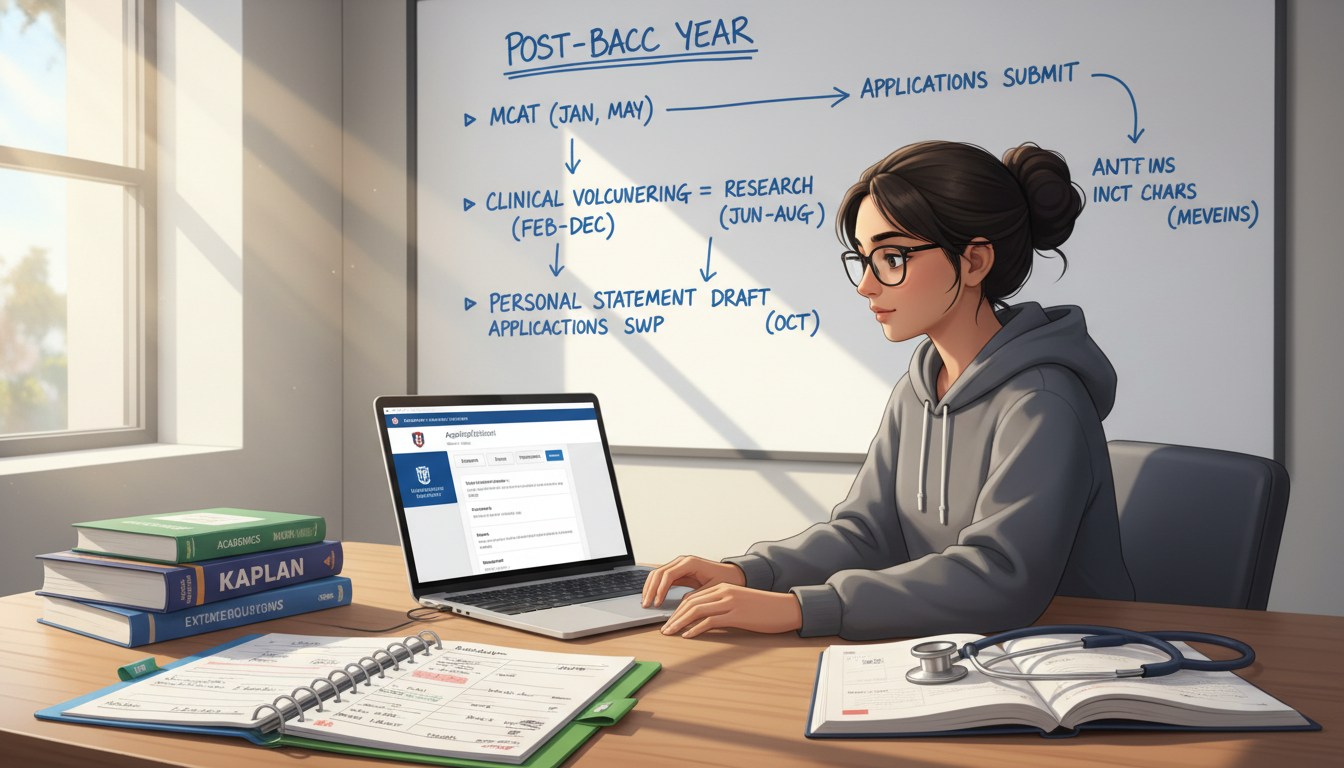
A. Map out the entire post-bacc year on one page
You need a visual.
Draw (or digitally build) a 12–18 month timeline:
- Mark semesters and summer blocks
- Under each, list:
- Courses (with credit load)
- Primary clinical role(s)
- Non-clinical service role(s)
- MCAT study windows
- Major personal obligations (family care, work hours)
This does two things:
- Forces you to see overload risk before you burn out
- Helps you plan narrative milestones: by month X, I need Y story to be true
B. Build deliberate “story points” into your year
A story point is an experience you know you want to write or talk about later. You do not just wait for these to appear; you create the conditions for them.
Examples:
- Working a night shift as an ED tech where you managed three high-acuity patients with limited staff
- Serving as the main coordinator for a monthly community health event
- Leading a small QI change that reduces wait time or improves patient education materials
Plan to:
- Take on more responsibility in 1–2 key roles after 3–6 months
- Ask for feedback and new tasks once you have proven reliability
- Journal those turning points as they occur (details fade fast)
Step 5: Capture Your Growth in Real Time
A strong narrative is not built from memory at 2 a.m. the night before you submit AMCAS. It is documented as you go.
A. Use a narrative log system
Set up a simple structure:
- Tool: Google Doc, Notion, OneNote, or a dedicated journal
- Sections:
- Clinical Experiences
- Non-Clinical Service
- Academics
- Personal / Resilience
After each week (10–15 minutes):
- Log:
- Date and location
- What you did
- One patient or person you remember (de-identified)
- What you felt and what you learned
- Any moment that changed how you think about medicine or yourself
Over 6–12 months this gives you:
- Dozens of potential personal statement seeds
- Specific examples for “Tell me about a time…” interview questions
- Evidence of your own evolving perspective
B. Track objective indicators of improvement
Narratives must be supported by data. Track:
- Semester GPAs (overall and science)
- Practice MCAT score progression (with dates)
- Total clinical hours (broken down by role)
- Total non-clinical service hours
- Leadership or advancement milestones (e.g., “promoted to lead scribe”)
You will use these selectively in secondaries and interviews:
- “My early undergraduate GPA was X. During my structured post-bacc, I completed Y credits of upper-division science with a Z GPA, while working N hours per week in a clinical role.”
- “Over 7 months, my MCAT practice scores rose from 503 to 511 as I implemented spaced repetition and cut back work hours.”
Step 6: Align Your Application Materials with the Post-Bacc Story
A brilliant year is wasted if your application does not clearly reflect it.
A. Rebuild your personal statement around transformation and clarity
During or right after your post-bacc year, your personal statement should:
- Acknowledge, briefly, the “before” version of you
- Highlight the decision point that led to your post-bacc or reorientation
- Spend the majority of its space on:
- What you did during your post-bacc year
- What those experiences revealed about medicine and about you
- Concrete examples that illustrate your clinical maturity and resilience
Avoid:
- Over-explaining old failures
- Vague claims like “I learned to work hard” without demonstrating how
Do:
- Show progression:
- “At the start of my post-bacc I thought medicine was primarily about diagnosis. After months working as an MA in a safety-net clinic, I realized that building trust in 15 minutes with a patient who has every reason to distrust the system is a different kind of clinical skill.”
B. Curate your activity list to emphasize continuity and depth
When you fill out AMCAS/AACOMAS:
- Do not list every minor job or one-day event
- Highlight:
- Your core clinical role(s) from the post-bacc year
- Your main non-clinical service role
- Any long-standing commitments that predate the post-bacc and show you are not just a “one-year wonder”
For each activity description:
- Use the CAR framework:
- Context: where and what you did
- Action: what you specifically were responsible for
- Result/Reflection: what changed (for patients, systems, or yourself)
C. Prepare to explain your post-bacc in interviews
You should be able to answer, without hesitation:
- “Why did you pursue a post-bacc?”
- “How is the student you are now different from the one you were previously?”
- “What did you learn about medicine during this year that you did not understand before?”
Use a 3-part structure:
- Before: brief, factual, not defensive
- During: specific, example-rich, with numbers and details
- After: how those experiences shaped the kind of medical student and physician you aim to be

Step 7: Avoid the Common Post-Bacc Narrative Traps
Several patterns consistently weaken otherwise decent post-bacc years. Avoid them deliberately.
Trap 1: Overloading and falling apart mid-semester
Fix:
- When you build your initial schedule, apply the 80% rule:
- If your maximum sustainable load is 16 credits + 20 hours of work, start with 12–14 credits + 12–16 hours
- Add intensity only after you prove you can maintain excellence for one full semester
Trap 2: Activity tourism
Jumping between 5–6 short roles looks unfocused.
Fix:
- Commit early to:
- 1 primary clinical role
- 1 primary non-clinical service role
- Allow only 1–2 secondary short-term experiences (e.g., a brief research project, special event clinic)
Trap 3: Ignoring your own limits and burning out
Burnout does not impress admissions committees. Poor grades and erratic activity patterns make them doubt your readiness.
Fix:
- Build non-negotiable rest into your calendar:
- At least one half-day each week with no academic or application work
- Protect sleep as fiercely as exams; sleep debt will destroy MCAT performance and memory consolidation
Trap 4: Treating the year as image repair instead of identity building
If you see your post-bacc year as “fixing my record,” your narrative will sound performative.
Fix:
- Focus weekly reflection on:
- What you are actually discovering about your motivations and limits
- What kind of physician environments you do or do not want
- Use those insights to adjust your path, not just decorate your application
Step 8: Translate Your Post-Bacc into a Confident, Coherent Story
By the time you are submitting applications, you should be able to summarize your post-bacc year in 4–5 sentences that tie everything together.
Template you can adapt:
“After recognizing that my early undergraduate performance did not reflect my potential or commitment, I undertook a structured post-bacc year. I completed [X] credits of upper-division science with a [Y] GPA while working [Z] hours per week as a [clinical role] in [setting]. Over [duration], I also volunteered consistently with [population] and participated in [research/QI/project] focused on [topic]. These experiences confirmed my decision to pursue medicine, developed my ability to [specific skills: communicate under pressure, navigate vulnerable patient interactions, integrate scientific learning with clinical realities], and prepared me to contribute as a resilient, reflective medical student.”
If your actual lived year can truthfully fill in that template with concrete numbers, settings, and populations, you have used your post-bacc year correctly.
Final Takeaways
- Design your post-bacc year backwards from the narrative you want admissions committees to see, not from a generic checklist.
- Align courses, MCAT timing, clinical work, and service so they collectively demonstrate growth, resilience, and informed commitment, not last-minute scrambling.
- Document your experiences and shifts in real time, then deliberately translate that evidence into your personal statement, activity descriptions, and interview stories.