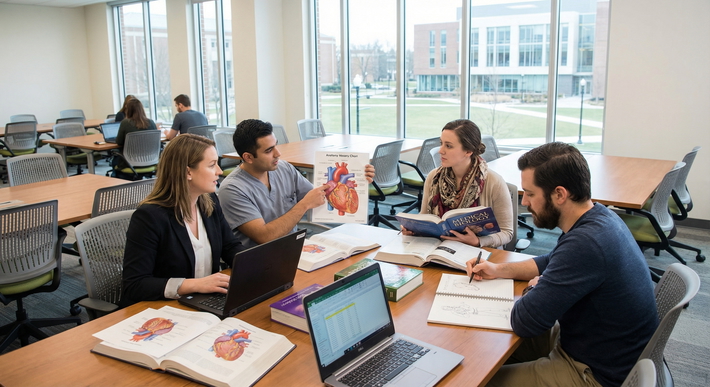
You are clocking out of a 4–10 pm shift at the hospital. Your organic chemistry exam is in 36 hours. You still need to finish a problem set, review spectroscopy, and somehow sleep more than four hours. Your advisor keeps saying “protect your GPA,” but your rent does not care about your GPA.
This is where most post-bacc students break: not because they cannot handle the content, but because their schedule is structurally impossible.
You do not need more motivation. You need a schedule that actually works.
This guide walks through specific, realistic scheduling models and decision rules so you can work, take post-bacc classes, and keep your grades in the “med-school-competitive” zone.
1. Start With Hard Limits: How Much Can You Really Work?
Before choosing any schedule, you must define your non-negotiable constraints. If you skip this and go straight to “I think I can handle 30 hours and 12 credits,” you will usually find out the hard way that you were wrong.
Step 1: Identify the 4 Hard Constraints
Write these down:
- Academic load
- Credits per term
- Course difficulty:
- Light: intro psych, sociology, medical terminology
- Moderate: general biology, general chemistry
- Heavy: organic chemistry, physics with lab, biochemistry
- Work requirement
- Minimum hours you must work to cover:
- Rent
- Food
- Transportation
- Fixed bills (loans, insurance, etc.)
- Minimum hours you must work to cover:
- Commute and logistics
- Commute time to:
- Work
- Campus
- Lab times that are completely fixed
- Commute time to:
- Sleep/health minimums
- Non-negotiable:
- 7 hours sleep on most nights
- 3 real meals per day (even if some are simple)
- At least one “no-school, no-work” half-day every 1–2 weeks
- Non-negotiable:
If you are planning a schedule that breaks #4, you are not planning a life; you are planning a burnout.
Step 2: Use a Simple Load Formula
Use this rule for post-bacc with work:
- For each credit of a STEM lecture with lab:
- Assume 3–4 hours/week of work outside class
- For each credit of a STEM lecture without lab:
- Assume 2–3 hours/week outside class
- For each credit of non-STEM:
- Assume 1.5–2 hours/week outside class
Then check:
(Total class hours + estimated study hours + work hours + commute hours)
≤ 65–70 hours/week
If you are above 70, your schedule is already in the “GPA risk” zone.
Example
You want:
- Organic Chemistry I with lab (4 credits)
- Physics I with lab (4 credits)
- Psychology (3 credits)
Estimate hours:
- Orgo: 4 hours class + ~12–16 study = 16–20
- Physics: 4 hours class + ~12–16 study = 16–20
- Psych: 3 hours class + ~5–6 study = 8–9
Total academic time: 40–49 hours/week
That leaves room for 10–20 hours of work if you want a sustainable week.
If you must work 30–35 hours, you probably cannot take both orgo + physics in the same term without serious GPA risk. That is not a character flaw. It is math.
2. Choose the Right Model: Three Scheduling Templates That Actually Work
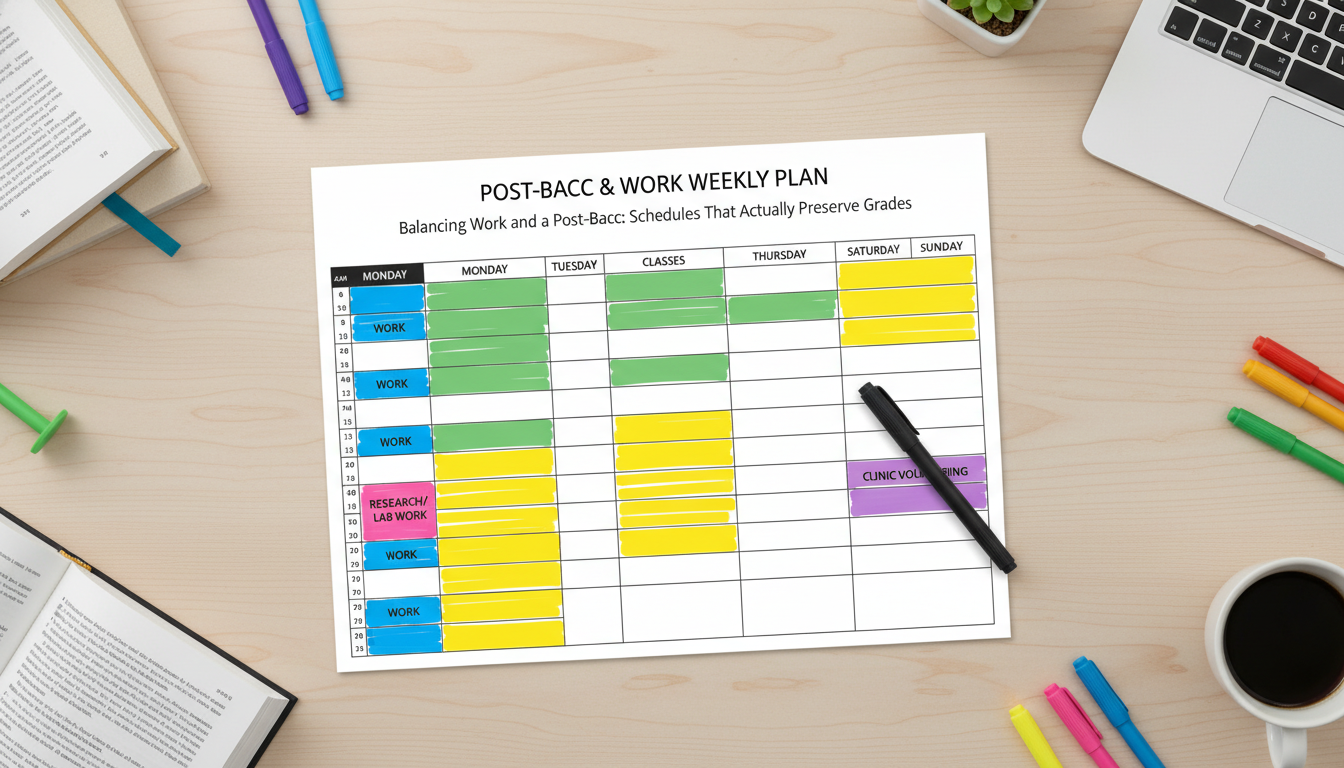
Here are three tested models that work for post-bacc students who need to work and keep grades high. I will walk through who each is for, then give step-by-step construction.
Model A: The “20-Hour Cap” Work Schedule (Best for Heavy Sciences)
Who this fits:
- Taking ≥ 8 credits of hard sciences (e.g., orgo + physics, biochem + physiology)
- Need to work for income, but can survive on 15–20 hours/week
- Goal: ≥ 3.7 post-bacc GPA for MD / DO competitiveness
Core principle: Cap work at 20 hours/week, even if that means:
- Moving to cheaper housing
- Temporarily decreasing savings
- Taking an extra semester
How to Build this Schedule
Lock in fixed academic commitments first
- Put all:
- Lectures
- Labs
- Mandatory review sessions
- In a weekly calendar (Google Calendar or paper, does not matter—but use one).
- Put all:
Choose 3 “Power Study” blocks
- 3 blocks per week, each 3–4 hours
- Ideally:
- One the day before problem set is due
- One 3–4 days before an exam
- One 6–7 days before an exam
- Mark them as non-movable commitments, like a lab.
Place 20 hours of work in non-competing time
- Preferred pattern:
- 4-hour shifts on M/W/F evenings or
- Two 8-hour weekend shifts + one 4-hour weekday shift
- Rules:
- No closing shifts the night before an exam
- No back-to-back late night work + 8 am exam days
- Preferred pattern:
Fill in short “maintenance” study blocks
- 45–75 minute pieces:
- 1 block before class for preview
- 1 block after class for review
- Your brain learns more from 45 daily minutes than from one 6-hour desperate cram.
- 45–75 minute pieces:
Week Example: Model A
- Courses:
- Organic Chemistry + Lab (Mon/Wed lecture, Fri lab)
- Physics + Lab (Tue/Thu lecture, Thu lab)
- Work:
- Mon/Wed/Fri 5–9 pm
- Sat 9–5 pm
Schedule highlights:
- Mon
- 9–10: Orgo preview + Anki
- 10–11: Orgo lecture
- 11–12: Physics review
- 5–9: Work
- Tue
- 9–10: Physics preview
- 10–12: Physics lecture
- 1–4: Power study block #1 (problem sets)
- Thu
- 9–12: Lecture + lab
- 1–4: Power study block #2 (exam prep)
- Sat
- 9–5: Work
- Evening off except light Anki
Notice: work never cannibalizes those 3–4 hour daytime study blocks. That is not by accident. That is the design.
Model B: The “30-Hour Worker, 1 Heavy Science at a Time”
Who this fits:
- Need to work 25–35 hours/week
- Cannot cut hours further without serious financial harm
- Still want to improve GPA and complete prereqs
- You are willing to take longer: 2–3 years for your post-bacc, not 1 year.
Core principle: Never carry more than one heavy STEM course at a time. Pair that with lighter courses.
Realistic Course Patterns for Model B
Each term:
- One of:
- General Chem I/II
- Organic Chem I/II
- Physics I/II
- Biochemistry
- Plus:
- 1–2 light/moderate courses
- e.g., Psych, Sociology, Public Health, Medical Ethics
- 1–2 light/moderate courses
Example term:
- Organic Chemistry I + Lab (4 credits, heavy)
- Psychology (3 credits, light/moderate)
- Medical Ethics (3 credits, light)
You are at 10 credits, but only one will demand true crisis-level focus.
Work Pattern That Survives
To preserve grades with 30 hours:
- Ideal:
- 3 shifts of 8 hours + 1 shift of 6 hours
- Or 5 shifts of 6 hours
- Anchor heavy study blocks on your non-work days.
Week Example: Model B
Let’s say:
- Work:
- Mon 3–11 pm
- Wed 3–11 pm
- Fri 3–11 pm
- Sun 7 am–3 pm
- Classes:
- Orgo: Tue/Thu 9–10:30 am lecture, Fri 1–4 pm lab
- Psych: Tue 1–4 pm
- Ethics: Thu 1–3 pm
Your key adjustments:
Protect Tue/Thu mornings
- 7:30–8:45 Tue: Orgo preview/Anki
- 10:45–12:30 Tue: Orgo problem practice (you stay on campus)
- 7:30–8:45 Thu: Orgo review
- 10:45–1: Orgo deep work block (pre-lab + problem sets)
Use non-work parts of Sun for light classes
- After 3 pm on Sun:
- Psych reading, Ethics essays, admin tasks
- After 3 pm on Sun:
Absolute rule:
- No large assignments left for Mon/Wed because those days are almost fully consumed by work.
If you structure around your heavy course like this, you can realistically hit A-/A in orgo while working 30 hours. But you cannot run two heavy STEMs simultaneously and expect the same.
Model C: Full-Time Work + Part-Time DIY Post-Bacc

Who this fits:
- 35–40 hour/week job you cannot scale back in the short term
- No formal structured post-bacc program requirement
- You are willing to take 1–2 courses at a time, evenings or online
- Long-term horizon: 3–4 years to finish prereqs
Core principle: Treat each course like a second part-time job. Progress slowly, but do not wreck your GPA.
Basic Load Limits
While working full-time:
- 1 heavy STEM course per term
or - 2 lighter/moderate courses (e.g., psych + stats)
Trying to take orgo + physics on top of a 40-hour job is one of the most common catastrophic mistakes.
Sample Weekly Pattern
- Work: Mon–Fri 9–5
- Course:
- General Chemistry I, evening section M/W 6–8 pm
Schedule it:
Mon
- 9–5: Work
- 5–6: Dinner + short walk
- 6–8: Class
- 8:30–9:15: Quick review + a few practice problems
Tue
- 6–7 am: Chem problem set (yes, mornings)
- Lunch break: 20 min Anki/flashcards
Wed
- 9–5: Work
- 5–6: Coffee + decompress
- 6–8: Class
- 8:30–9:15: Post-class review
Thu
- 6–7:30 am: Deep work block (new chapter)
- Lunch: Flashcards
Sat
- 9–12: Big study block: practice exam problems
- Afternoon free
This is not glamorous, but it is durable. And durable wins.
3. The Non-Negotiable Rules That Protect Your Grades
There are a few operating rules that turn a “busy schedule” into a high-GPA, sustainable routine.
Rule 1: Protect “Cognitive Prime Time”
Most people have 2–4 hours/day when their brain is sharpest. For many:
- 8 am–12 pm
- Or 9 am–1 pm
Those hours should be:
- Heavy problem-solving (physics, orgo)
- Practice exams
- Learning new material
Those hours should not be:
- Low-yield tasks (email, errands, random club meetings)
- High-volume work shifts, if avoidable
If you must work during your cognitive prime (e.g., day job), then you protect an alternate block rigidly (6–9 am or 7–10 pm, depending on your body and life).
Rule 2: Exams Trump Shifts (Plan Weeks in Advance)
As soon as you get syllabi:
Map all exam dates for:
- Orgo
- Physics
- Any other science courses
Then:
- Request lighter shifts or days off:
- Night before exam
- Day of exam (after exam) if possible
- Request lighter shifts or days off:
If you are in a hospital / service job with posted schedules, do this at the beginning of the term, not the week before.
If you cannot get the actual day off, then avoid closing shifts before exams at all costs. Ask to switch with a coworker early.
Rule 3: Labs and Work Cannot Collide
Never schedule:
- Lab ending at 5 pm
- Work at 5 pm across town
Labs overrun. Traffic happens. You show up late. Stress spikes. Studying that evening is wrecked.
Leave:
- At least 60 minutes buffer between lab end and work start
This is the kind of margin that keeps your “one bad week” from turning into “one bad semester.”
4. Daily Routines That Stop Creep and Chaos

A decent weekly schedule can still fail if your day-to-day execution is random. These micro-routines plug the leaks.
The 3–Block Day Structure
Even on your busiest days, organize into three blocks:
Block 1 – Foundation (30–60 min)
- Morning:
- Preview slides
- Skim chapter
- Do 5–10 Anki cards
- Purpose: reduce “first exposure” in lecture
- Morning:
Block 2 – Capture (during class)
- Focus on:
- Worked examples
- Professor emphasis
- “This will be on the exam” comments
- Do not try to transcribe every word. Mark concepts you do not understand for later.
- Focus on:
Block 3 – Consolidation (45–75 min)
- Same day or next morning:
- Rewrite/annotate notes
- Do representative practice problems
- The goal: move new info from “I’ve seen this” to “I can use this without notes.”
- Same day or next morning:
If you hit these three consistently, even 20-hour work weeks become much less dangerous for your GPA.
Fast Daily Planning Protocol (10 Minutes)
Each evening:
Look at tomorrow’s:
- Class times
- Work shift
- Commute windows
Pick one primary academic target:
- “Complete Orgo problem set 6”
- “Do 25 physics practice problems on kinematics”
Block that first into your schedule, then fit everything else around it.
You want one non-negotiable win per day. Not ten vague priorities.
Managing Fatigue: “Tiered Productivity”
You will be tired. Some days you cannot do 3 hours of hard orgo. Do not confuse “too tired to do maximum” with “too tired to do anything.”
Create 3 tiers:
- Tier 1 (High energy):
- Full problem sets
- Practice exams
- Lab write-ups
- Tier 2 (Moderate):
- Easier problems
- Flashcards
- Reviewing notes
- Tier 3 (Low):
- Organizing files
- Updating planner
- Printing slides
On bad days, do Tier 2 or 3, not zero. This keeps you from falling behind without burning you out.
5. Deciding When to Drop a Class or Reduce Work
Sometimes the answer is not “optimize schedule.” It is “change load.”
Here is a decision framework you can apply by Week 3–4 of the term.
Red Flags for Dropping a Class
Consider dropping if:
You are working ≥ 25 hours/week and:
- Score <70% on the first major exam in a heavy STEM, and
- Your study hours were already ≥ 10–12 hours/week for that course
You are chronically:
- Sleeping < 6 hours/night
- Missing > 1 assignment/week in any class
You cannot protect even two 3-hour study blocks/week for your hardest class.
Dropping a class early and retaking with a better schedule is far less damaging than a C or D on your transcript.
Red Flags for Cutting Work Hours
Consider reducing work (if at all possible) when:
- You are consistently earning:
- B-/C+ range in science courses despite:
- Good attendance
- Actual studying, not just rereading
- B-/C+ range in science courses despite:
- You have:
- No full day off in ≥ 3 weeks
- Mood and focus are crashing
If this is you, run a financial triage:
- Can you:
- Move to cheaper housing?
- Share a room?
- Reduce discretionary spending?
- Can you:
- Take an extra semester and spread courses out more?
- Are there:
- Scholarships, small grants, or family loans that could support a one-semester hour reduction?
This is where a 3.9 vs 3.4 post-bacc GPA is often decided.
6. Practical Examples: What Works vs. What Fails
To make this concrete, compare two sample weeks.
Scenario 1: GPA-Destructive Week
- Courses:
- Orgo + Lab
- Physics + Lab
- Biostats
- Work:
- 30 hours: random shifts based on employer schedule
Week pattern:
- Mon: Class 9–3, work 4–11
- Tue: Work 7–3, class 4–7, then “study”
- Wed: Repeat Mon
- Thu: Lab + class 9–5, exhausted by 6
- Fri: Work 8–4, tired
- Sat: Work 9–5
- Sun: “Catch up” but actually crash
Result:
- Study is pushed into 10 pm–1 am low-quality blocks
- Labs get rushed
- Exams arrive; you wing them
- Outcome: B-/C+ range, chronic stress
Scenario 2: GPA-Protective Week
- Same courses
- Work:
- Reduced to 18–20 hours: predictable periods
Week pattern:
- Mon:
- 9–3: Class/lab
- 3:30–6: Orgo study block
- Tue:
- 9–12: Physics block
- 1–5: Work
- Wed:
- 9–3: Class/lab
- 3:30–6: Biostats + orgo problems
- Thu:
- 9–5: Class/lab
- Evening light review only
- Fri:
- 9–1: Work
- 2–5: Physics problem block
- Sat:
- 9–5: Work
- Sun:
- 10–1: Power exam prep
- Afternoon off
Same courses. Fewer work hours. Structured heavy blocks. GPA trajectory shifts from 3.1 to 3.7+.
7. Talking to Employers and Programs About Your Schedule
You often have more leverage than you think, especially in healthcare-adjacent jobs that like premeds.
With Your Employer
Use this script framework:
“I am starting a rigorous academic term with organic chemistry and physics, which are critical for my medical school path. I want to stay here and do good work, but to maintain both, I need a more predictable schedule. Could we try a fixed pattern of [X days, Y times] for the semester, ideally avoiding [specific conflict times like labs / exam days]?”
Offer specifics:
- “I can work every Sat/Sun open-to-close.”
- “I am free any weekday after 4 pm except Thu.”
You are easier to schedule if you are consistent. That helps them and you.
With Your Post-Bacc Advisor
Be direct:
- Show:
- Your proposed work hours
- The credit load you are considering
- Ask:
- “Given this, which maximum combination of sciences do you consider safe if my goal is a 3.7+ GPA?”
Do not downplay your work hours. Many advisors underestimate how draining a 30-hour job is.