
The biggest pre‑med mistake at community college is waiting until transfer to start acting like a future doctor.
You cannot treat community college as a “warm‑up” and university as the “real start.” Medical schools will read your story from your very first credit. At each semester and each break, you either move your application forward—or you drift.
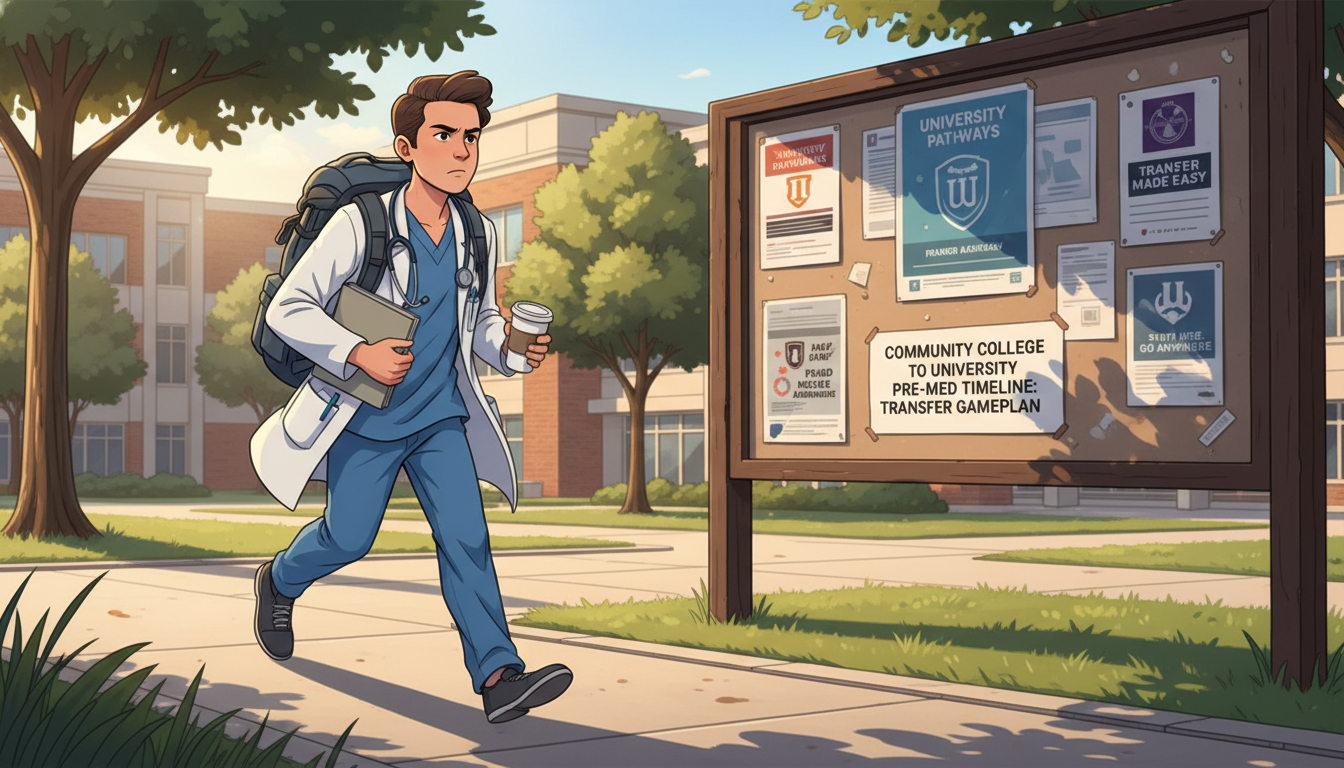
This is your semester‑by‑semester, week‑by‑week transfer gameplan from community college to university as a pre‑med.
(See also: Senior Year as a Pre‑Med: Month‑by‑Month Plan Before Matriculation for more details.)
Big‑Picture Timeline: Where You Should Be When
Before we drill down, anchor yourself to the major milestones.
At this point you should…
End of High School / Before CC (0–3 months before starting)
- Know you’re pre‑med or seriously exploring it
- Have a rough 4‑year academic map (including transfer)
- Understand the basics: prereqs, GPA importance, MCAT timing
Community College Year 1 (Freshman)
- Fall: Confirm you actually want pre‑med; start strong academically
- Spring: Lock in transfer targets; start basic clinical exposure
- Summer: Shadowing, first real volunteering, or clinical job training
Community College Year 2 (Sophomore)
- Fall: Finish key prereqs; apply to transfer by posted deadlines
- Spring: Maintain 4.0 behavior; deepen clinical & service experiences
- Summer: Transition prep—MCAT study foundation, research search
University Year 3 (Junior, post‑transfer)
- Fall: Hit the ground running; adjust AND excel academically
- Spring: Finish main prereqs, lock in 2–3 strong letter writers
- Summer: MCAT + primary application (if not taking a gap year)
University Year 4 (Senior)
- Gap‑year bound: Strengthen app, finish degree, apply after graduation
- Non‑gap‑year: Finish secondaries, interviews, keep grades high
This guide assumes you’ll transfer after 2 years at community college, then either:
- Apply at the end of your first year at university (no planned gap year), or
- Apply at the end of your second year at university (one gap year).
We’ll walk chronologically from just before community college through the transfer and into early university.
Phase 0: 0–3 Months Before Community College Starts
At this point you should be setting the foundation, not coasting through the summer.
0–1 Month: Confirm the Path and Learn the Rules
Clarify your goal
- Decide: “I am strongly interested in medicine” vs “I am exploring health careers.”
- If unsure, that’s fine. But plan as if you’re aiming for med school so you don’t close doors.
Learn basic pre‑med requirements
- Typical med school prereqs:
- 2 semesters Gen Chem + lab
- 2 semesters Gen Bio + lab
- 2 semesters Physics + lab (algebra‑ or calc‑based)
- 2 semesters Organic Chem + lab (sometimes Biochem instead of Org II)
- 1 semester Biochemistry
- 1–2 semesters of English/writing
- 1–2 semesters of math/statistics
- Identify what your community college offers and what must be taken at the university (often Biochem, sometimes upper‑level Bio).
- Typical med school prereqs:
Study your state’s transfer ecosystem
- Look up articulation agreements (e.g., ASSIST.org in California) to see exactly:
- Which CC courses = which university equivalents
- Which are accepted for your desired major (Biology, Chemistry, Neuroscience, etc.)
- Make a short‑list of 2–4 likely transfer universities.
- Look up articulation agreements (e.g., ASSIST.org in California) to see exactly:
1–3 Months: Build Your 4‑Year Skeleton Plan
At this point you should sketch a tentative 4‑year plan (flexible, but concrete enough to guide course choices).
Map out:
- CC Year 1 & 2 courses (general ed + core sciences)
- University Year 3 & 4 courses (upper‑level science, Biochem, electives)
- Target MCAT window (usually:
- Spring of university junior year if no gap year
- Spring of senior year if 1‑year gap)
Have a 30‑minute meeting with:
- A CC academic counselor, and
- If available, a pre‑health advisor (even at a nearby university by email)
Phase 1: Community College Year 1 – Proving You Can Do It
This year you are building academic credibility and testing your interest in medicine.

Fall Semester (CC Year 1, Months 1–4)
At this point you should be starting like a 4.0 student, not “warming up.”
Week 0–2 (Before/just after classes start)
- Lock in a reasonable but rigorous schedule:
- If your background is solid:
- General Chemistry I + lab
- College Writing / English Comp
- College Algebra / Pre‑Calc (if needed)
- 1 general education course (e.g., Psychology or Sociology)
- If you’re academically rusty:
- Start with 1 lab science + math + 2 non‑lab courses
- If your background is solid:
- Introduce yourself to every professor in office hours:
- State your goal (transferring, aiming for pre‑med)
- Ask: “What do your strongest students do differently?”
Week 3–8
At this point you should:
- Be tracking grades weekly; adjust early if you’re below an A in a science course.
- Attend office hours at least 2x/month for your toughest class.
- Do a low‑commitment clinical exposure:
- 1–2 shadowing days with a family doctor or pediatrician
- Or begin the process of hospital volunteer onboarding (often takes weeks or months)
Week 9–15
- Maintain exam averages at A level; drop non‑essential commitments if needed.
- Explore 1 non‑clinical service opportunity:
- Food bank, tutoring, crisis text line, etc.
- End of semester:
- Aim for 3.7+ GPA, ideally 3.9–4.0 especially in sciences
- Reflect: Did you enjoy the science? Did clinical exposure increase or decrease your interest?
Winter Break (3–6 Weeks)
At this point you should consolidate and plan, not zone out completely.
- Review your courses:
- What study methods worked? What failed?
- Adjust for next semester (e.g., start problem sets earlier, use study groups strategically).
- Add 10–20 hours of:
- Shadowing, or
- Hospital volunteering (if you’ve cleared onboarding), or
- Self‑guided exploration of medicine (podcasts, reading physician memoirs).
- Revise the 2‑year CC course map based on actual performance.
Spring Semester (CC Year 1, Months 5–9)
This term you confirm your ability to handle more science and continue exploring medicine.
Week 0–2
At this point you should:
- Register for:
- General Chemistry II + lab
- General Biology I + lab
- Math (Pre‑Calc or Calculus I, depending on major/requirements)
- 1 GE course (e.g., Speech, Humanities)
- Re‑connect with professors early. Mention your transfer and pre‑med goals again.
Week 3–8
- Integrate regular clinical/service hours:
- 3–5 hours/week hospital volunteering
- Or 3–5 hours/week non‑clinical service (homeless shelter, adult literacy, etc.)
- Keep science labs organized:
- Maintain a meticulous lab notebook
- Start reviewing older material weekly; med schools like to see mastery over time.
Week 9–15
At this point you should:
- Be on track for A/A‑ in all science courses.
- Identify potential letter writers:
- 1–2 science professors who know you by name and performance
- Begin informal research on transfer applications:
- Deadlines, GPA cutoffs, major prerequisites
- Universities with strong pre‑health advising and relationships with local hospitals
Summer After CC Year 1
This summer is your experience accelerator.
Months 1–2
- If you need money:
- Look for clinical‑adjacent jobs: CNA, EMT, phlebotomist, medical scribe (some may require prior training).
- If training is needed, complete a short CNA/EMT course now.
- If you can volunteer more:
- Aim for 50–100 hours of:
- Hospital volunteering
- Free clinic volunteering
- Non‑clinical community service with underserved populations
- Aim for 50–100 hours of:
Months 2–3
At this point you should:
- Clarify your likely major at the university (e.g., Biology, Biochemistry, Neuroscience, Public Health).
- Check exactly which CC science courses that major expects for junior‑year standing.
- Draft a 1‑page academic + activities snapshot:
- Current GPA
- Courses taken
- Clinical/volunteer/shadowing hours
- Early interests (e.g., peds, primary care, health disparities)
Phase 2: Community College Year 2 – Transfer Execution
This year you’re executing the transfer plan and solidifying your pre‑med readiness.
Fall Semester (CC Year 2, Months 12–16)
At this point you should be behaving like a future transfer applicant, not like a sophomore drifting.
Week 0–2
- Course load (typical):
- General Biology II + lab
- Organic Chemistry I + lab
- Statistics or Calculus (if not completed)
- 1–2 GE courses required for transfer (e.g., History, Social Science)
- Immediately schedule:
- Meeting with CC counselor: verify you’re on track for transfer
- Meeting (or email) with pre‑health advisor: confirm your med school prereq sequencing
Week 3–8
At this point you should:
- Begin transfer applications if your universities use:
- Early deadlines (e.g., some state systems, honors colleges, special programs).
- Deepen responsibilities in 1–2 activities:
- Take a “lead volunteer” or shift leader role if possible.
- Keep Organic Chem a top priority:
- Do problem sets the same day they are assigned.
- Use a study group that actually works problems, not just re‑reads.
Week 9–15
- Finalize all transfer applications:
- Personal statements (emphasizing academic growth, resilience, and direction)
- Activities list (volunteering, work, leadership)
- Transcripts and recommendation letters as required
- Ask 2–3 CC professors for letters of recommendation for:
- Transfer applications
- Future pre‑med committee letter or individual med school letters (they can save them via Interfolio or similar letter storage)
Winter Break (Mid‑Year 2)
At this point you should be fine‑tuning your story and prepping for university.
- Update your CV or activities log (dates, hours, responsibilities).
- Continue light but consistent clinical/service:
- 2–4 hours/week to maintain continuity.
- Research:
- Premed clubs & research labs at your likely universities.
- Which professors take undergraduate researchers.
- Draft cold‑email templates to future research mentors:
- 3–4 sentences: who you are, your transfer status, your interests, why their work.
Spring Semester (CC Year 2, Months 17–21)
This term you finish your CC work strong and prepare to hit the ground running at university.
Week 0–2
- Likely course load:
- Organic Chemistry II + lab (or Biochem if Org II not required)
- Physics I + lab
- Remaining GE courses for AA/transfer
- If you’re behind on science prereqs, you may need:
- Physics I + Organic I + Biology II all at once—be cautious and ready to sacrifice non‑essential commitments.
Week 3–8
At this point you should:
- Keep GPA high; ** upward trend** is powerful if early grades were weaker.
- If you’ve been accepted to multiple universities:
- Compare:
- Proximity to hospitals/clinics
- Pre‑med advising quality
- Research opportunities for transfers
- Decide by their commitment deadline.
- Compare:
Week 9–15
- Confirm:
- Final transcripts sent
- Financial aid / scholarships finalized
- Housing planned
- Ask 1–2 CC professors to update letters later for med school (or store them now).
- Celebrate, but do not slack academically—med schools will see these grades.
Summer Between CC and University
This is your bridge summer.
Months 1–2
At this point you should:
- Complete any remaining clinical training (CNA/EMT if not done).
- Increase direct clinical exposure if possible:
- 8–12 hours/week as scribe, CNA, ER tech, or clinic volunteer.
- Start light MCAT prep foundations (only if your MCAT is <12–18 months away):
- Learn content outlines
- Review Gen Chem, Bio, Physics formulas/concepts
- No full‑throttle studying yet—just priming.
Month 3
- Connect with future university resources:
- Email:
- Premed advisor
- Transfer student services
- Potential research PIs (attach unofficial transcript + 1‑page CV)
- Email:
- Plan your first university year course schedule:
- Target:
- Physics II (if needed)
- Biochemistry (often at university)
- Upper‑division Bio that interests you
- 1–2 non‑STEM courses to balance
- Target:
Phase 3: University Year 1 (Post‑Transfer) – Proving You Belong
This year is where many transfer pre‑meds either flourish or get overwhelmed. You need both academic excellence and smart pacing.
Fall Semester (University Year 3, Months 24–28)
At this point you should be showing med‑school‑level competence in a new, more competitive environment.
Week 0–2
- Attend every transfer & pre‑health orientation.
- Meet with:
- Premed advisor: verify course sequencing and MCAT timing.
- Major advisor: ensure you’ll graduate on time.
- Register for a manageable but serious load:
- Biochemistry (if prepared)
- Physics II + lab (if still needed)
- 1 upper‑division Bio (e.g., Cell Bio, Genetics) or major requirement
- 1 lighter elective/GE
Week 3–8
At this point you should:
- Establish new professor relationships:
- Sit near the front
- Ask 1–2 thoughtful questions in or after class each week
- Visit office hours early
- Secure 1 primary extracurricular base:
- Research lab
- Hospital/clinic role
- Significant community service program
Week 9–15
- Protect your university GPA—adcoms watch whether you can handle university science loads.
- Decide on your application timing:
- If MCAT + primary app will be this coming summer (no gap year), your MCAT study must begin no later than:
- Late fall/early spring.
- If MCAT + primary app will be this coming summer (no gap year), your MCAT study must begin no later than:
Spring Semester (University Year 3, Months 29–33)
This term, you complete core prereqs and position yourself for applications.
Week 0–2
At this point you should:
- Finalize schedule:
- Heavy science: 2–3 upper‑level Bio/Chem courses
- 1 non‑STEM class
- Start formal MCAT planning (if applying this coming summer):
- Choose a test date (ideally Jan–April following this semester if no gap year, or next year if taking a gap).
Week 3–8
- Begin serious MCAT prep (if in that cycle):
- 8–12 hours/week content review and light practice.
- Track experiences:
- Keep a running document of stories from clinical and service work; these will become application essays.
Week 9–15
At this point you should:
- Identify 2–3 university letter writers:
- Sciences: Biochem/upper‑level Bio/Chem
- Non‑science: Humanities or social science instructor who knows your writing and engagement
- Supervisor: clinical, research, or long‑term service
- Ask about letter policies and timelines.
Summer After University Year 1
Your actions now differ depending on whether you’re applying immediately or planning a gap year.
If applying this cycle (no gap year):
- MCAT: Most students test between January–May of this year; if not done, this summer is too late for an optimal first‑try score.
- Applications:
- May–June: Submit AMCAS/AACOMAS/TMDSAS
- June–August: Complete secondaries
- Experiences: Maintain 5–10 hrs/week in meaningful clinical/service.
If planning a gap year:
- Use this summer to:
- Increase responsibility in existing roles
- Solidify a research project or community initiative
- Continue light MCAT prep or begin it seriously for a test date 9–12 months out
- Use this summer to:
Closing Snapshot: What Matters Most on This Timeline
By the time you hit the “submit” button on your med school applications, your community college to university transfer journey should show three things:
- Relentless academic strength with an upward or stable high trajectory from CC through university, especially in sciences.
- Continuity of commitment: clinical exposure, service, and perhaps research that build over years, not scattered last‑minute hours.
- Deliberate planning at each phase: you always knew roughly where you were headed next semester, and you made choices—courses, activities, timing—that support that long arc.
Follow this gameplan semester by semester, and you’re not just “a transfer.” You’re a transfer who looks like they’ve been preparing for medical school from day one.