
Introduction: Why Your Medical School Resume Matters More Than You Think
Your medical school application is more than GPA, MCAT, and recommendation letters. It’s a narrative about who you are, how you’ve grown, and why you’re ready for the rigor and responsibility of Medicine. Your resume (or CV) is the concise, structured version of that story—and often the first snapshot an admissions committee member sees.
A strong medical school resume does three things:
- Summarizes your academic record and experiences clearly
- Highlights professional skills and personal qualities essential for physicians
- Differentiates you from hundreds of applicants with similar metrics
This guide walks you through how to build an impressive, well-organized resume for Medical School, with practical Resume Tips, real examples, and actionable Admissions Advice. Whether you’re early in your premed journey or polishing your application this cycle, you’ll learn how to present your Career Development and Professional Skills in a way that resonates with admissions committees.
Understanding the Purpose of a Medical School Resume
Before you format anything, get clear on what your resume is—and is not—meant to do.
What Admissions Committees Use Your Resume For
Medical schools use resumes to:
- Verify and contextualize what you list on AMCAS/AACOMAS/TMDSAS
- Quickly scan your trajectory: what you’ve done, for how long, and at what depth
- Spot patterns of commitment: sustained service, growth in responsibility, long-term interests
- Identify talking points for interviews (your resume is often in front of them when you walk in)
- Evaluate “fit” with their mission (primary care, research, community service, rural health, etc.)
Think of your resume as a professional highlight reel, not a data dump. It should be organized, skimmable in 30–60 seconds, and easy for a busy faculty member or admissions dean to understand.
Key Principles: Brevity, Relevance, and Authenticity
Brevity is still key
For most traditional applicants, a one-page resume is ideal. If you are a nontraditional applicant with multiple degrees, several years of work, or extensive research, a two-page academic CV can be appropriate. More than that is rarely needed at the premed level.Tailor content to the school and stage You may emphasize different elements depending on:
- Research-heavy vs. community-focused schools
- Early exploration vs. final application
- MD vs. DO vs. combined programs (MD/MPH, MD/PhD, etc.)
Show your character, not just your checklist Your activities should reflect:
- Empathy and service
- Curiosity and problem-solving
- Resilience and accountability
- Teamwork and communication
In Medical School Admissions, your resume supports the central question:
Does this applicant look like someone who will thrive in medical training and become a responsible, compassionate physician?
Core Structure: Essential Components of a Strong Medical School Resume
While formats vary, most effective medical school resumes share a similar structure. Below are the key sections to include, with examples and Resume Tips tailored to premeds.
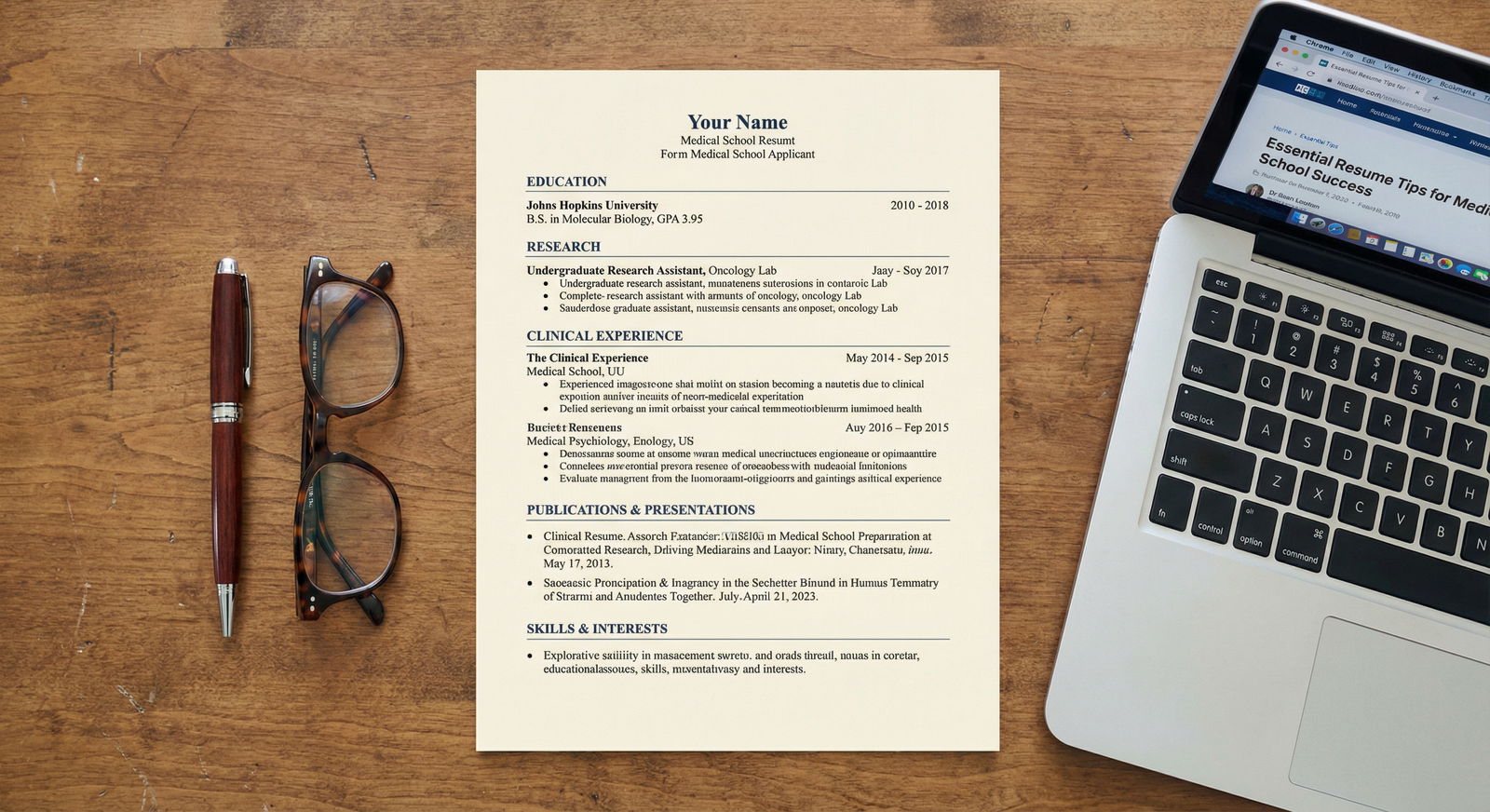
1. Contact Information: Professional and Clear
Place this at the top, easy to locate.
Include:
- Full name (bold, slightly larger font)
- Phone number (mobile, with reliable voicemail)
- Professional email (e.g., firstname.lastname@domain.com)
- City, State (full mailing address is optional)
- LinkedIn profile and/or personal academic website (if polished and up to date)
Avoid:
- Casual emails (e.g., medschoolbound99@…)
- Multiple phone numbers
- Social media links (unless professionally curated and directly relevant)
2. Objective Statement or Professional Summary (Optional but Strategic)
An objective or summary is brief (1–3 lines) and can be useful if:
- You’re a nontraditional applicant (career-changer, military, second degree)
- You have a clear, mission-aligned focus (rural health, global health, health equity)
- You want to highlight a unifying theme across diverse experiences
Example – Traditional Applicant:
Aspiring medical student with a strong foundation in biological sciences, extensive volunteer experience in community health, and a commitment to patient advocacy and health equity.
Example – Nontraditional Applicant:
Former registered nurse transitioning to medicine, bringing five years of bedside experience, interprofessional collaboration, and leadership in quality improvement projects.
Keep it honest and concise. Avoid vague clichés (“hard-working team player”) and unsupported claims.
3. Education: Your Academic Foundation
This section usually comes near the top for premeds.
Include for each institution:
- Degree (e.g., Bachelor of Science in Biology)
- Institution name, City, State
- Graduation date (month, year) or “Expected May 2026”
- Overall and/or science GPA if strong and not already heavily featured elsewhere
- Honors (Latin honors, Honors Program, etc.)
Example:
Bachelor of Science in Biology, Minor in Public Health
XYZ University, City, State
Expected Graduation: May 2025
GPA: 3.82/4.00; Dean’s List (5 semesters)
Optional: Relevant Coursework or Academic Highlights
You can add a line of select relevant coursework if:
- You want to demonstrate preparation (e.g., Biostatistics, Epidemiology, Neuroscience)
- You have unusual or advanced courses (e.g., Graduate-level Immunology)
Example:
Relevant Coursework: Organic Chemistry I & II, Biostatistics, Human Anatomy & Physiology, Medical Ethics
Avoid listing every required premed class; focus on those that showcase rigor or alignment with your interests.
4. Research Experience: Demonstrating Curiosity and Analytical Thinking
Research is not mandatory for every Medical School, but it’s increasingly valued, especially at academic and research-intensive programs.
For each research role, include:
- Position title (e.g., Research Assistant, Undergraduate Fellow)
- Lab or project name; institution; City, State
- Dates (month/year – month/year)
- Mentor/PI (optional, helpful for well-known faculty)
- 2–4 bullet points focusing on your contributions and what you learned
Example:
Research Assistant, Cardiovascular Physiology Lab
XYZ University, City, State
August 2023 – Present
- Assisted with data collection and analysis for a study on exercise tolerance in heart failure patients using SPSS and Excel.
- Performed literature reviews and contributed to a manuscript submitted to the Journal of Cardiac Failure.
- Presented a poster at the XYZ Undergraduate Research Symposium, receiving Honorable Mention.
Tips for Strong Research Bullet Points
- Start with strong action verbs: analyzed, designed, implemented, presented, collaborated.
- Indicate outcomes where possible: posters, abstracts, publications, conference presentations.
- Show increasing responsibility if you stayed in one lab long term.
If you lack formal bench research, you can still include:
- Quality improvement projects
- Public health or epidemiologic projects
- Data analysis work
- Independent honors thesis projects
5. Clinical Experience: Showing Exposure to Patient Care
Clinical experience signals that you understand, at least at an introductory level, what it means to work in healthcare.
Common clinical roles:
- Medical assistant
- Scribe
- EMT
- Hospital volunteer (with patient contact)
- Patient care technician
- Hospice volunteer
- Shadowing (often listed in its own subsection or under Clinical)
For each clinical experience, list:
- Role title
- Organization; City, State
- Dates
- 2–4 bullets highlighting patient interaction, teamwork, and insights
Example:
Emergency Department Scribe
City General Hospital, City, State
June 2022 – Present
- Documented patient histories, physical exam findings, and ED course for physicians in a high-volume emergency department.
- Observed clinical decision-making in a wide range of acute presentations, including trauma, sepsis, and cardiac emergencies.
- Enhanced understanding of medical terminology, workflow, and interprofessional communication.
Shadowing: How to Include It
Shadowing is important but often more passive, so it can be grouped separately:
Example:
Physician Shadowing
Various Locations, City, State
January 2022 – December 2023
- Shadowed a family medicine physician (45 hours), observing chronic disease management and continuity of care.
- Shadowed a general surgeon (30 hours), observing pre-op counseling, OR procedures, and post-op rounds.
- Gained insight into physician-patient communication, informed consent, and multidisciplinary collaboration.
Be honest with hours. Admissions committees know typical ranges and can spot exaggeration.
6. Leadership and Campus Involvement: Evidence of Initiative
Leadership showcases your ability to take responsibility and influence others positively—core qualities in physicians.
Common leadership roles:
- Officer positions in student organizations (President, VP, Treasurer)
- Peer mentor or RA
- Committee chair
- Orientation leader
- Team captain
Example:
President, Pre-Medical Society
XYZ University, City, State
September 2021 – May 2023
- Led a 60-member organization, coordinating bimonthly events, physician panels, and MCAT preparation workshops.
- Increased active membership by 40% through revised recruitment strategies and a structured mentorship program.
- Collaborated with the Office of Diversity to host an annual Health Careers for First-Gen Students event.
Emphasize impact: growth, new initiatives, improved processes, increased engagement, or measurable outcomes.
7. Volunteer Work and Community Service: Demonstrating Service Orientation
Service is central to medicine. Long-term, meaningful community engagement is powerful on a medical school resume.
Include both medical and non-medical service, especially if it reflects:
- Work with underserved communities
- Commitment to health equity or social justice
- Longitudinal involvement
Example:
Volunteer Coordinator
Community Homeless Health Initiative, City, State
January 2020 – Present
- Coordinated 50+ volunteers for monthly mobile health clinics providing blood pressure screenings, vaccinations, and resource referrals.
- Developed bilingual educational materials on nutrition, diabetes prevention, and hypertension for clients.
- Helped expand clinic reach from one to three neighborhoods through partnership building with local shelters.
Aim to show depth over breadth—a few multi-year commitments carry more weight than dozens of short, unrelated activities.
8. Certifications, Technical Skills, and Professional Skills
This section supports your readiness for clinical settings and academic work.
Consider including:
Certifications:
- Basic Life Support (BLS)
- Advanced Cardiovascular Life Support (ACLS) if you have it
- EMT, CNA, MA certifications
- HIPAA, OSHA training
Technical / Academic Skills:
- Data analysis (SPSS, R, STATA, Excel)
- Programming (Python, MATLAB) if relevant
- Lab techniques (PCR, Western blot, flow cytometry)
- Electronic health record systems (Epic, Cerner)
Professional Skills:
- Languages (with proficiency level: conversational, fluent, native)
- Teaching/tutoring
- Public speaking
Example:
Certifications
- Basic Life Support (BLS), American Heart Association, valid through 2026
- HIPAA Compliance Training, XYZ University, 2023
Skills
- Data analysis: SPSS, Excel
- Laboratory: PCR, gel electrophoresis, ELISA
- Languages: Fluent in Spanish; conversational in Mandarin
Avoid generic soft skills lists like “hard-working, organized, team player” without context. Instead, demonstrate those traits through your bullet points.
9. Honors, Awards, and Scholarships: Recognizing Excellence
This section reinforces your academic and extracurricular achievements.
Include:
- Academic honors (Dean’s List, honor societies, cum laude)
- Competitive scholarships or fellowships
- Recognition for service or leadership
- Poster or presentation awards
Example:
Honors & Awards
- Dean’s List, XYZ University (2019–2023)
- XYZ University Merit Scholarship (full-tuition academic scholarship, 2020–2024)
- Best Undergraduate Poster, State Public Health Conference (2023)
Be specific about criteria when it adds value (e.g., “awarded to top 5% of class”).
Professional Formatting Tips: Making Your Resume Easy to Read
Your content may be strong, but poor formatting can sabotage your first impression. Medical School Admissions readers are busy; design your resume for fast comprehension.
Layout and Design
- Length: 1 page for most traditional applicants; 2 pages acceptable for substantial experience.
- Margins: 0.5–1 inch on all sides for readability.
- Font: Professional and clean—Calibri, Arial, Garamond, Times New Roman (10–12 pt for body text, 12–14 pt for your name).
- Consistency: Use the same style for:
- Dates (e.g., “May 2022 – Present” throughout)
- Bullet points
- Heading styles (bold, ALL CAPS, etc.)
Bullet Point Strategy
Effective bullets are:
- Concise: 1–2 lines each
- Action-oriented: Start with strong verbs
- Outcome-focused: Include results or skills gained
Better:
“Organized a campus-wide health fair attended by 300+ students, offering free screenings and education on diabetes and hypertension.”
Versus:
“Helped with a health fair.”
File Format and Naming
- Always submit as a PDF to preserve formatting.
- Use a clear, professional file name:
FirstName_LastName_MedSchool_Resume.pdf
Common Resume Mistakes to Avoid in Medical School Applications
Avoiding pitfalls is just as important as doing things right. These are frequent issues seen by advisors and admissions reviewers:
Being too generic
- Problem: Looks interchangeable with any other premed.
- Solution: Include specific details, outcomes, and your role. Tie activities to meaningful impact and growth.
Overstuffed or too long
- Problem: Dense text, tiny fonts, crowded margins.
- Solution: Prioritize. Focus on depth, recency, and relevance. Remove outdated, minor high school items unless truly exceptional.
Typos and grammatical errors
- Problem: Signals carelessness and lack of attention to detail.
- Solution: Proofread multiple times. Ask a mentor, pre-health advisor, or writing center to review.
Inflated roles or hours
- Problem: Misrepresentation can be caught and severely harm your credibility.
- Solution: Be accurate and honest. Quality and reflection matter more than inflated numbers.
Overusing jargon and abbreviations
- Problem: Readers from different backgrounds might not understand specific program acronyms or lab terms.
- Solution: Spell out terms at first mention; keep bullet points understandable for a broad academic audience.
Lack of alignment with your personal statement and application
- Problem: Disjointed story or conflicting information.
- Solution: Ensure your resume, personal statement, and activity descriptions complement each other and support a coherent narrative about your path to medicine.
Strategic Career Development: Building Experiences Before You Write the Resume
Your resume is only as strong as the experiences behind it. Early in Medical School preparation, think proactively about how to develop meaningful experiences.
Plan Your Experiences Intentionally
Consider these pillars when planning your premed journey:
- Academics: Solid GPA, challenging but manageable course load, academic support when needed.
- Clinical Exposure: Scribing, volunteering, shadowing, or patient-facing jobs.
- Service: Long-term involvement serving others, especially underserved populations.
- Leadership: Roles that stretch your skills in organizing, communicating, and problem-solving.
- Research (optional but valuable): Especially important for research-focused schools or MD/PhD interests.
- Professional Skills: Communication, teamwork, cultural humility, time management.
Reflect and Document as You Go
Keep a simple experience log:
- Organization name
- Supervisor/PI
- Dates and approximate hours
- Key responsibilities
- Significant stories or lessons learned
When it’s time to construct your Medical School resume, your log will help you write accurate, compelling bullet points—and later, thoughtful secondary essays and interview answers.
FAQs: Medical School Resume and Application Strategy
1. How far back should I include experiences on my medical school resume?
Generally, focus on experiences from the start of college onward. You can include late high school experiences if they are:
- Highly significant (e.g., starting a non-profit, extensive EMT work)
- Continued into college
- Directly relevant to medicine or demonstrate major leadership/service
If space is tight, prioritize college and recent experiences first.
2. Can I use the same resume for medical, dental, or other health profession schools?
You can use a similar core template, but you should tailor:
- The objective or summary (if included)
- The order/emphasis of sections (e.g., dental-specific shadowing higher for dental applications)
- Highlight experiences that align with each profession’s values and skills
Admissions Advice: Even small adjustments can signal genuine interest in that specific field.
3. Should I list references directly on my medical school resume?
No. Typically:
- Do not include “References available upon request” or list referees on the resume.
- Instead, have a separate reference document or contact list ready if a program or research mentor requests it.
- For Medical School Admissions, letters of recommendation are usually submitted through centralized application services rather than via your resume.
4. Is it acceptable for my resume to be two pages if I have a lot of experience?
Yes, two pages can be acceptable if:
- You are a nontraditional applicant with a prior career or graduate degree
- You have extensive research, publications, or presentations
- You have several years of full-time work or military service
If you extend to two pages, ensure:
- Content remains relevant to Medicine, Professional Skills, or Career Development
- Formatting is clean and readable
- The most important information appears on page 1
For most traditional students, aim to keep it to one carefully curated page.
5. Should someone else review my resume before I submit it with my applications?
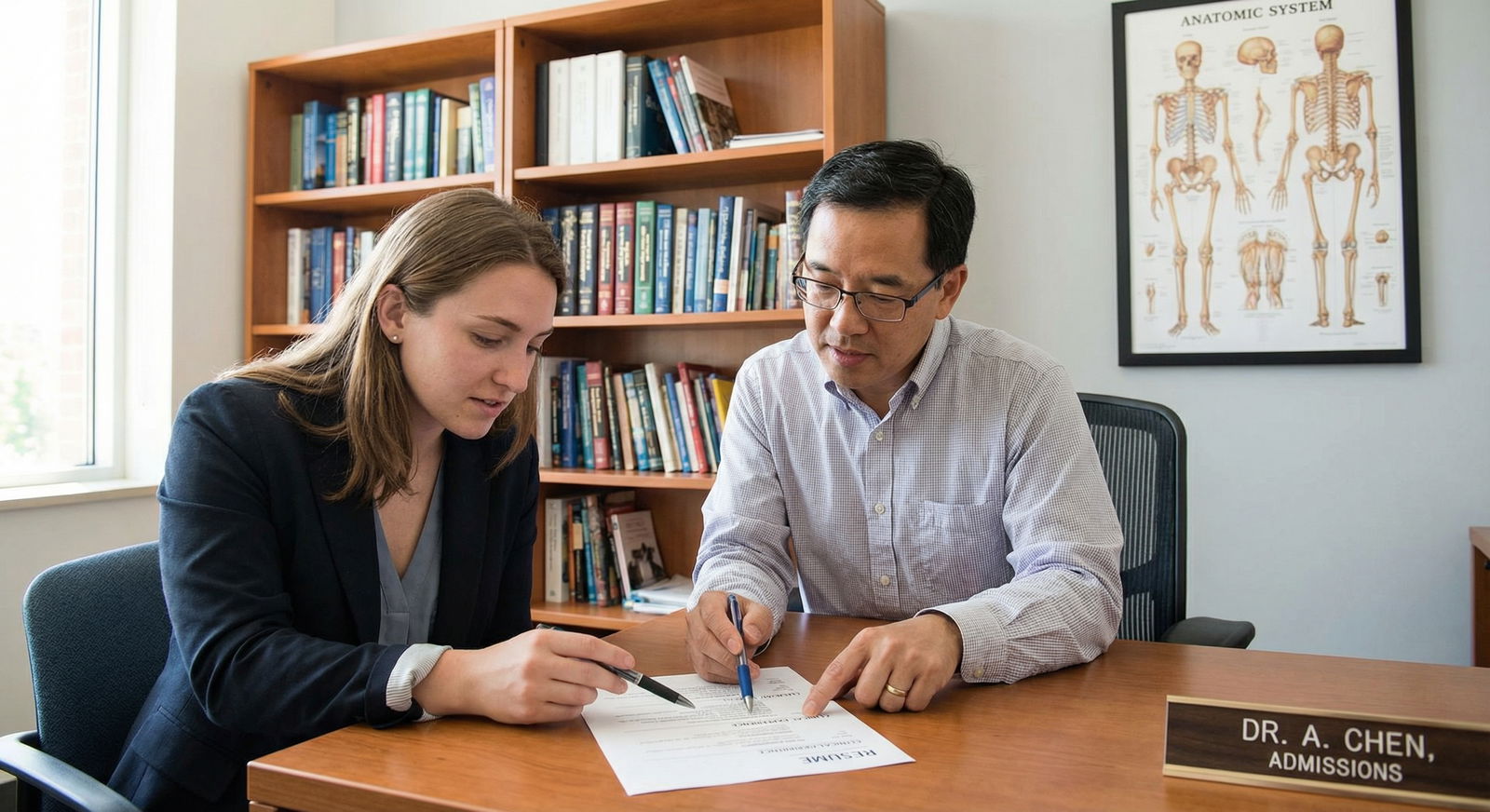
Absolutely. Have at least one or two knowledgeable reviewers:
- A pre-health or career adviser (for structure and admissions expectations)
- A mentor, physician, or research PI (for accuracy and emphasis)
- A peer with strong writing skills (for clarity and grammar)
They may catch:
- Typos or unclear phrasing
- Experiences that deserve more emphasis
- Sections that could better reflect your strengths
By approaching your resume as a strategic, honest summary of your growth and readiness for Medical School, you move beyond just listing activities. You demonstrate a coherent narrative of how your education, experiences, and Professional Skills have prepared you to serve patients and thrive in medical training.
Use this guide as a roadmap, revisit it as your experiences grow, and treat your resume as a living document that evolves with your journey into medicine.