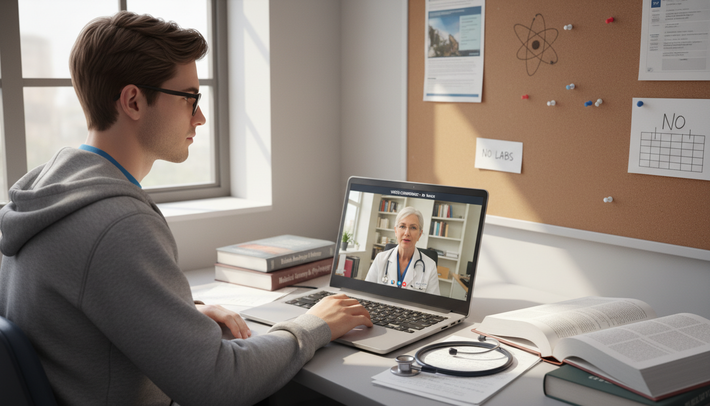
Most premeds are worrying about the wrong thing: the platform of your prereqs matters less than the context and quality of where and how you took them.
The loud narrative on forums is simple and wrong:
“Online prereqs = red flag. In‑person prereqs = legitimate.”
That’s outdated, exaggerated, and often flatly incorrect.
The reality is messier, more nuanced, and—if you understand it—much more in your favor.
Let’s tear apart the myths and get down to what MD and DO schools are actually doing with online vs in‑person prerequisites, especially in the post‑COVID world.
Myth #1: “Med schools don’t accept online prereqs.”
This was never fully true, and it’s definitely not true now.
What actually exists are three different tiers of policies:
(See also: Do Medical Schools Prefer Traditional Science Majors? Data‑Driven Look for more details.)
Schools that fully accept online coursework, including prereqs
These schools usually care far more about:- Your overall GPA and science GPA
- Rigor of your institution (4‑year vs community college vs extension)
- MCAT scores
- Trend over time (did you improve? choke? recover?)
Schools that accept online somewhat but with caveats
Common patterns:- “We accept online lecture, but labs must be in person.”
- “We accept online courses from regionally accredited institutions, but not from unaccredited/for‑profit programs.”
- “We strongly prefer in‑person, especially for upper‑division science.”
Schools that restrict or discourage online prereqs, especially pre‑COVID
A limited subset of schools historically said:- “Online science prerequisites are not accepted.”
- Or: “We review these on a case‑by‑case basis.”
Here’s the twist: COVID blew a hole in a lot of rigid policies.
When every campus in the country suddenly went online in 2020, schools had no choice but to accept online coursework—including labs, exams, and entire majors—if they wanted to continue filling their classes.
Many schools used language like:
- “Online coursework completed during the COVID‑19 pandemic will be accepted.”
- “We will accept online science coursework from Spring 2020 onward.”
Did some schools later tighten back up? Yes.
Did they return to 2015‑style “no online ever” rules? Not really.
The honest pattern now:
- Few schools absolutely ban any online content.
- Many tolerate or accept some of it, especially if from a solid institution.
- A small but important chunk still prefer or require in‑person labs.
So when someone says “med schools don’t accept online prereqs,” what they really mean is: “Some schools are picky, especially about where and how you did them.”
Myth #2: “Online prereqs look bad everywhere.”
No, context is king. Two applicants can both have “online” on their transcript and be viewed very differently.
Scenario A: Red flag territory
- All or almost all prereqs done online at:
- Low‑rigor for‑profit universities
- Unaccredited or nationally (not regionally) accredited schools
- Random online platforms that convert to transcript credit through obscure partners
- Weak MCAT performance, especially in the science sections
- No in‑person upper‑division science to demonstrate lab skills or academic resilience
To an adcom, this looks like:
- You might be avoiding academic rigor.
- You might not have real lab experience.
- You might not be prepared for the intensity of medical school.
Scenario B: Neutral or even perfectly acceptable
- A few online prereqs mixed with mostly in‑person coursework
- Classes taken through:
- Your main 4‑year university’s online sections
- A well‑known state university’s online program
- A reputable post‑bacc or extension program (e.g., UC Extension, Harvard Extension)
- MCAT scores that match or exceed your grades
- Evidence of successful in‑person lab work elsewhere
Here, “online” is simply a delivery mode, not a red flag.
Scenario C: Actually respected by some committees
- You worked full‑time or had major responsibilities and used online courses to keep progressing
- You picked rigorous, graded online courses (not pass/fail fluff)
- You did well in them (A/A‑ range), then:
- Crushed the MCAT, and
- Performed strongly in any in‑person upper‑division courses you did take
This can read as:
- Time‑management skills
- Self‑discipline
- Academic resilience
- Ability to learn independently—which is a huge part of medical school
The myth is “online automatically = bad.”
The reality is “weak, low‑rigor patterns of coursework = bad, regardless of delivery mode.”
What Schools Actually Care About (Beyond the Hype)
Strip away the noise and admissions committees are obsessing over three questions:
Can you handle rigorous science?
Evidence:- Hard science courses (Gen Chem, Org Chem, Physics, Bio) with strong grades
- Upper‑level biology (e.g., Biochemistry, Physiology, Microbiology)
- MCAT performance, especially BB and CP sections
Do your grades match your test performance?
If you have:- 3.9 science GPA from easy online courses
- 500 MCAT
Adcoms will question how real that GPA is.
Flip it:
- 3.4–3.5 GPA with a tough curriculum
- 517 MCAT
Suddenly you look under‑graded, not over‑inflated.
Did you take meaningful, real labs?
Medicine is hands‑on. Schools care whether you’ve:- Been in a physical lab
- Worked with real equipment
- Handled safety protocols
- Troubleshot experiments that didn’t work
Some highly traditional schools still lean on a simple heuristic:
“In‑person labs at a 4‑year institution = safer bet than trying to parse every online platform.”
That’s not anti‑online. It’s risk management.
The Lab Question: The Part Schools Actually Guard
Here’s where the real hard line often shows up: labs.
You’ll see a lot of policies that sound like:
- “Online lecture may be accepted; lab must be taken in person.”
- “We prefer in‑person labs for core prerequisites.”
- “Virtual, at‑home, or simulation‑based labs may not satisfy this requirement.”
Why?
Because:
- Lab skills are physical, procedural, and team‑based.
- Integrity and supervision are harder to ensure online.
- Med schools still trust in‑person labs more as a proxy for basic hands‑on competence.
If you’re planning a path heavy on online work, the safest compromise is:
- Take lectures online if needed,
- But do labs in person at:
- A community college
- Your 4‑year institution
- A reputable post‑bacc program
Yes, it’s less convenient. But this is the piece most likely to trigger policy issues across schools.
Myth #3: “If AMCAS or AACOMAS counts it, med schools must accept it.”
No. AMCAS and AACOMAS are transcript processors, not admissions policy enforcers.
They will:
- Classify your course
- Put it in your GPA calculation
- Mark whether it’s BCPM (biology, chemistry, physics, math)
They will not:
- Override a school’s objection to a specific course type
- Force a program to accept online Organic Chemistry labs from a sketchy platform
- Guarantee that “prereq met” on your transcript = “requirement satisfied” in the school’s eyes
Individual schools still interpret:
- Whether your specific course counts as “equivalent”
- Whether online format is acceptable
- Whether your institution is reputable enough for that requirement
That’s why two applicants with technically similar online courses can get different answers from different schools.
How COVID Actually Changed the Rules
Many premeds assume COVID “normalized” online coursework forever. Not exactly.
What actually happened:
Emergency tolerance:
Schools had no realistic option but to accept online courses from 2020–2021 and often 2022.Policy updates:
Many schools rewrote admissions pages to say things like:- “Online coursework and labs taken during the COVID‑19 pandemic period will be accepted.”
Permanent partial relaxation:
Once faculty saw they could survive online coursework, a lot of them stopped insisting on blanket bans. The most common landing point:- Online lecture is fine from accredited institutions
- Labs in person are still preferred or required
- Evaluation is holistic and pattern‑based, not “one online course = rejection”
But here’s the nuance:
Some schools time‑limit their leniency.
They may say:
- Online labs during the COVID academic years (e.g., 2020–2022) are accepted,
- But returning applicants taking new prereqs in 2024–2025 are encouraged or required to do labs in person.
So no, COVID didn’t grant permanent immunity to all future online prereqs. It mainly destroyed the old argument that “online automatically means low quality,” because everyone—including Ivy League premeds—was forced into it.
Where Online Prereqs Work Best (Strategically)
Online is not your enemy. Used well, it can actually make your application stronger.
Online formats make the most sense when:
You’re a career changer working full‑time
- Taking evening online Gen Chem while working as an engineer, nurse, or teacher
- Later adding in‑person labs when your schedule allows
You already have a degree and are filling just a few gaps
- Example: You were a Philosophy major, took Bio and Chem in college, now need Physics I/II online through a reputable university
You can pair online coursework with clear external validation
- Strong MCAT (especially CP and BB)
- Good letters from science faculty (online or in‑person)
- Solid performance in any later in‑person science courses
The people who get into trouble are the ones who stack:
- 100% online
- Lowest‑cost, lowest‑rigor schools
- Weak MCAT
- No in‑person labs
Then try to argue that med schools “hate online.” No—med schools hate brittle academic foundations.
How to Actually Vet Whether Your Online Course Will Count
Here’s the part almost no one does correctly.
Most premeds:
- Ask anonymous strangers on Reddit if “XYZ Online Org Chem” is accepted.
- Get 20 conflicting answers.
- Panic.
Reality check: schools themselves tell you what they think—if you ask the right way.
Stepwise strategy:
Check the school’s admissions website
Look for pages or PDFs labeled:- “Prerequisite coursework”
- “Admission requirements”
- “Technical standards”
- “COVID‑19 academic adjustments”
Specific wording like:
- “We accept online coursework from regionally accredited institutions.”
- “We do not accept online lab courses except during the COVID‑19 period.”
Verify accreditation of your online provider
- Is it regionally accredited? (This is usually what matters.)
- Is it a known university with a physical campus and established programs?
- Or a standalone online provider using a credit‑granting partner?
Email the admissions office with a precise, concise question
Instead of:- “Do you accept online classes?” (Too vague)
Try:
- “I am planning to take Organic Chemistry I and II with labs through [Institution], a regionally accredited university that offers these as online courses with proctored exams and synchronous components. Would these satisfy your Organic Chemistry with lab prerequisite?”
Include:
- Course numbers
- Institution name
- Whether the labs are online or in‑person
Save their response
If a school says “Yes, that will count,” save the email.
It’s not a contract, but it carries weight if questions come up later.
This beats debating strangers who are quoting policies from 2014.
Patterns That Actually Raise Red Flags
Here’s what tends to bother committees more than “online” itself:
Grade inflation with no external proof of rigor
- 4.0 in 100% online sciences
- 504 MCAT
- Weak or generic letters
That combination feels brittle.
Institutional hopping
- Bio I at random online provider
- Bio II at different online school
- Chem I at community college online
- Chem II through another state university
It looks like you’re shopping for the easiest path, not building depth.
Lack of any in‑person scientific experience
- No in‑person labs
- No bench research
- No structured, graded, hands‑on science
Obvious avoidance of rigor
Taking only the minimum, lowest‑level, least challenging versions of requirements will hurt you whether online or in person.
Online is simply easier to abuse, so it draws more scrutiny when abused.

So What Should You Actually Do?
If you want your prereq plan to be both accepted and respected:
Anchor your science foundation in real rigor
At least some:- In‑person upper‑division biology
- In‑person labs for core sciences
Use online as a tool, not a loophole
Online is for:- Flexibility
- Access
- Making progress when life is complicated
Not for dodging hard work.
Prioritize reputable institutions
Regionally accredited universities and recognized post‑baccs beat obscure standalone online brands every time.Cross‑check your plan with actual schools early
Before you commit to a whole year of online Org Chem II + Physics II, sanity‑check with a sample of target schools.Let the MCAT validate your choices
If you did heavy online coursework but then post a strong MCAT, admissions committees become far less anxious about your preparation.
The Bottom Line
Two truths to walk away with:
- Online vs in‑person is not the real dividing line. Quality, context, and patterns are.
- Most med schools will accept some online coursework; what they do not respect is a flimsy, convenience‑driven academic record with no evidence you can handle real scientific rigor.
Build your plan around those facts, and the delivery mode becomes a secondary detail, not your downfall.