
Most non‑STEM students are wasting time and credits they do not need to lose when they pivot to pre‑med. You do not have to start over.
If you are in English, History, Economics, Psychology, Philosophy, Art, Business, or any other non‑science major and thinking about medicine, you are not behind. You are just undocumented. The raw material is there; the structure is not.
This guide gives you the structure.
You will see exactly:
- What to do in the next 2–4 weeks
- How to build a pre‑med course plan on top of your current major
- How to avoid the “fifth‑year trap” and unnecessary second degrees
- How to fix weak science preparation and still become competitive
No vague pep talks. Concrete actions.
1. First, Diagnose Your Starting Point (1–2 Weeks)
Before you enroll in anything else, you need a snapshot of where you stand. Otherwise you burn time and money.
Step 1: Pull Every Official Document
Collect these:
- Current transcript (unofficial is fine for planning)
- Degree audit / program plan from your major
- Catalog year requirements for:
- Your major
- Your institution’s general education (GE) or core
- Any AP/IB/dual enrollment score reports
Make a simple folder: “Premed Pivot”. Keep everything there.
Step 2: List What Medical Schools Actually Require
You are not guessing here. Nearly every MD and DO school wants some version of the following minimum coursework:
Core science prerequisites:
- 2 semesters General Biology with labs
- 2 semesters General Chemistry with labs
- 2 semesters Organic Chemistry with labs
- 1 semester Biochemistry
- 2 semesters Physics with labs (algebra‑based is fine for many schools, but calculus‑based works too)
- 1–2 semesters of Math (often:
- Statistics
- And sometimes Calculus I)
Core non‑science prerequisites / strongly recommended:
- 2 semesters of English / writing‑intensive courses
- 1–2 courses in Psychology / Sociology (for MCAT and some school lists)
Different schools vary slightly, but if you plan for that set, you will cover 90%+ of medical schools. Later you can fine‑tune for specific schools.
Step 3: Map What You Already Have
Create a simple table (spreadsheet or notebook). Columns:
- Requirement (e.g., “1 semester statistics”)
- Course(s) that can satisfy it at your school
- Completed? (Y/N)
- Grade/GPA impact (A, B+, etc.)
- Notes (AP credit, may retake, etc.)
Now:
- Check off:
- First‑year writing / English composition
- Any math (especially statistics or calculus)
- Any psych/soc
- Note AP/IB credits:
- Many med schools accept AP for math or English
- Some accept AP science only if you take a higher‑level course in that subject in college
- You may choose to retake science even with AP credit to build your GPA and foundation
Step 4: Get a Brutally Honest GPA Snapshot
Calculate:
- Cumulative GPA (cGPA) – from your transcript
- Science GPA (sGPA) – using only biology, chemistry, physics, and math courses (BCPM)
Many non‑STEM students have:
- Reasonable cGPA (3.5–3.9)
- Either:
- Almost no BCPM yet or
- A handful of mixed grades from a rough early semester
Write those numbers down. You are going to plan around them.
2. Build a Pre‑Med Course Plan Without Restarting Your Degree
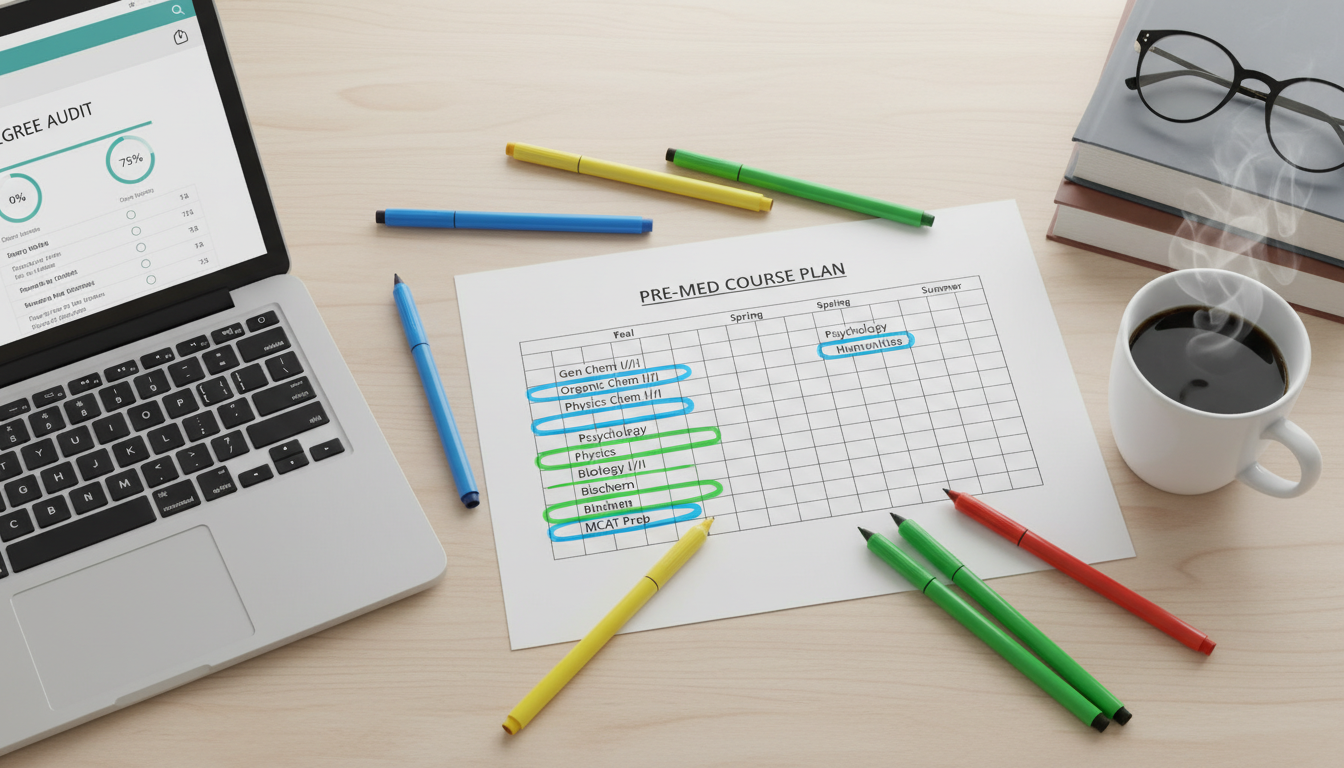
You are not changing the foundation (your major). You are adding a carefully engineered science spine on top of it.
The goal: Finish your degree on time or within +1 year max, with all major med school prerequisites and a strong science GPA.
Step 1: Decide Your Primary Path
Most non‑STEM pre‑meds fall into one of three situations:
- Early pivot (freshman / early sophomore)
- Likely can finish:
- Full pre‑med set
- Original major
- In 4 years with smart planning
- Likely can finish:
- Mid college pivot (late sophomore / junior)
- May need:
- 1 extra semester to 1 extra year
- Or heavy summers / post‑bacc style add‑on
- May need:
- Late pivot (senior / recent graduate)
- Usually:
- Complete degree as is
- Then formal or informal post‑bacc for the sciences
- Usually:
You do not need to guess your category. Look at credit hours you have left and how many science courses you can realistically carry per term.
Reality check guideline:
Most students can safely handle:
- 1 heavy lab science + 2–3 non‑lab courses per term
- 2 lab sciences in the same term only when:
- Your time management is strong
- Other courses that term are lighter reading/writing based
- You are not simultaneously doing major commitments (e.g., Division I athletics during season)
Step 2: Slot the Science Sequence Into Semesters
The main constraints are chemistry and physics sequences. They build on themselves.
A robust sequence starting soon might look like:
Year 1–2 (or first 3–4 semesters after pivot):
- Semester A:
- General Chemistry I + lab
- Biology I + lab
- Semester B:
- General Chemistry II + lab
- Biology II + lab
- Semester C:
- Organic Chemistry I + lab
- Physics I + lab
- Semester D:
- Organic Chemistry II + lab
- Physics II + lab
- Semester E:
- Biochemistry
- Statistics (if not yet completed)
- Psych or Soc
You can shuffle physics earlier or later depending on your math background and when your school offers courses.
Step 3: Integrate With Your Major and GE Requirements
Here is how not to start over:
Double count whenever allowed:
- Many schools let:
- Statistics or calculus count for both math and major/GE
- Psychology fulfill both social science GE and pre‑med needs
- Writing‑intensive major seminars fulfill “English composition” type requirements
- Many schools let:
Avoid unnecessary second majors or degrees:
- You do not need a second bachelor’s in Biology
- You do not need a full formal post‑bacc if you can slot courses during your existing or extended timeline
Practical approach:
- Print your degree audit.
- Mark:
- Required major courses
- Electives / free electives
- Use elective slots for:
- Physics
- Extra upper‑level bio (Physiology, Genetics, Microbiology) if time permits
Step 4: Plan for Summers Strategically
Summer is how you avoid starting over.
Good summer use cases:
- Take one heavy science + lab:
- Example: Physics I in Summer 1, Physics II in Summer 2
- Or knock out:
- Statistics
- Psychology or Sociology
- Public Health, Ethics, or other medicine‑adjacent electives
Bad summer use:
- Two lab sciences in a condensed 5–6 week term with a job and volunteering. That is where grades suffer.
3. Protect Your GPA While You “Learn to Be a Science Student”

The fastest way to blow up your pivot is to jump into Organic Chemistry and Physics while you are still figuring out how to study for science.
You must treat “learning how to learn STEM” as part of your pre‑med plan.
Step 1: Start With Foundational Sciences, Not Status Sciences
If your background is weak in math or science, do this:
- Begin with:
- General Chemistry I
- Biology I
- Or even a chemistry preparatory course if your placement exam suggests it
- Delay:
- Organic Chemistry
- Biochemistry
- Upper‑level biology
You are building skill, not checking boxes.
Step 2: Use the Correct Study Methods for Science
Non‑STEM majors are often excellent at:
- Reading heavy material
- Synthesizing ideas
- Writing papers
Science will demand:
- Problem‑based practice
- Spaced repetition
- Active recall
Concrete techniques:
For Chemistry / Physics:
- Work practice problem sets daily, not just before exams
- After lecture, rewrite 3–5 example problems from memory, then check
- Use resources like:
- Khan Academy
- Chad’s Prep
- Organic Chemistry Tutor (YouTube)
For Biology / Biochemistry:
- Convert notes into:
- Concept maps
- Flashcards (Anki or Quizlet)
- Use question banks:
- OpenStax end‑of‑chapter questions
- Kaplan / UWorld style questions when MCAT is closer
- Convert notes into:
Step 3: Keep Science Course Load Manageable
General rules to protect both GPA and sanity:
- Do not take:
- Organic Chemistry + Physics + heavy humanities seminar in the same term if you can avoid it
- Reasonable “pivot” science load:
- Year 1: 1–2 lab sciences per term depending on your other commitments
- Year 2: Possibly 2 lab sciences once you know you can handle the style
Watch early warning signs:
- First quiz/exam average below 80%
- Problem sets taking 2× longer than planned
- Office hours always crowded and you never get your questions addressed
Respond fast:
- Adjust study schedule within 1 week
- Increase tutoring / office hours
- Consider pass/fail / withdrawal early if a course is derailing your overall GPA and you can retake it properly later
4. Decide: Pivot In‑Place vs. Formal Post‑Bacc
Not every non‑STEM student should cram all sciences into undergrad. Sometimes the “don’t start over” move is to finish your current degree and then deliberately add a separate science layer.
When an In‑Place Pivot (During Your Current Degree) Makes Sense
Good choice if:
- You are early enough (≤ 60 credits completed)
- You can finish:
- All pre‑med sciences
- Your major
- Within 4–5 calendar years total
- Your trend is upward or stable and you can keep cGPA ≥ 3.5 and aim for sGPA ≥ 3.4–3.6
Advantages:
- Less costly than formal post‑bacc
- You stay in your current institutional ecosystem
- You can integrate research/ECs more gradually
When a Post‑Bacc Is the Smarter Move
Strong option if:
- You are late junior/senior with:
- Minimal science completed
- Scheduling constraints you cannot fix
- Your GPA is:
- OK but science‑light
- Or significantly split (for example, 3.6 cGPA but 2.9 sGPA from some early attempts)
Types of post‑bacc programs:
Career changer post‑baccs
- For students with little to no science background
- Structured, cohort‑based, typically 1–2 years
- Examples:
- Bryn Mawr, Goucher, Scripps, Columbia, Johns Hopkins programs
Academic enhancer post‑baccs
- For students who have science courses but need grade repair or stronger foundation
- Often at state universities or extension programs
DIY post‑bacc
- You enroll as a non‑degree or second‑degree student
- Take only the sciences you need
- Flexible but requires more self‑planning
You are not “starting over” with a post‑bacc. You are adding a specialized science credential on top of your already valuable non‑STEM degree.
5. Build the Rest of the Pre‑Med Profile Around Your New Timeline
Pivots often fail not due to courses, but because everything else is ignored until the last second.
You need a parallel track: academics + experiences.
Clinical Exposure (Start Within the Next 3–6 Months)
While you are building your science sequence:
- Aim for:
- 4–8 hours per week consistently
- Options:
- Hospital volunteer (patient transport, unit helper)
- Hospice visitor
- Free clinic volunteer
- Medical scribe (once schedule allows; strong exposure but time‑intensive)
If you are starting late, intensify after your first year of science when your study habits are stable.
Shadowing
Target:
- 40–80 hours total across:
- 2–4 different specialties
- MD and DO if you might apply to both
Tactically:
- Use:
- Family physician
- Community clinics
- Alumni networks
- Cold emails with:
- Short introduction
- Your major and interest in medicine
- Specific request for a limited shadowing experience
Shadowing can be done in bursts during:
- Winter break
- Summer
- Light academic terms
Research
As a non‑STEM major, research can be:
- Traditional bench or clinical research
- Or:
- Health policy
- Bioethics
- Medical humanities
Action steps:
- Ask professors in your department:
- “Do you collaborate with anyone in the medical school or public health school?”
- Look up:
- Undergraduate research office
- Volunteer research assistant postings
You do not need 3 publications. You do need evidence you can engage rigorously with inquiry and data.
MCAT Timing
You schedule MCAT after:
- General Chemistry
- Organic Chemistry
- Biochemistry
- Physics
- Intro Biology
- Intro Psych and Soc (or equivalent self‑study if necessary)
Most non‑STEM pivots do best by:
- Taking MCAT:
- End of junior year or after post‑bacc year
- Only when:
- Full‑length practice tests place you near or above your target range
6. Institutional Maneuvers That Save You Time and Money
Use the system intelligently. Many non‑STEM students never realize these options exist.
Talk to Three Key People in the Next Month
Pre‑health advisor
- Bring:
- Your GPA summary
- Your prerequisite table
- Rough courses you think you need
- Ask:
- “What is the fastest realistic path from where I am to complete standard med school prerequisites with a competitive GPA?”
- Bring:
Major advisor
- Ask:
- “How can I satisfy remaining major and GE requirements while leaving room for 8–10 science courses?”
- Ask:
Financial aid counselor
- Ask:
- “If I add 1–2 extra semesters, how does that change my aid eligibility?”
- Ask:
You are designing your pivot like a project: scope, time, cost.
Consider Officially Declaring a Minor in a Science (Sometimes)
This is optional, not mandatory.
Pros:
- Forces you to take a coherent set of courses
- Shows sustained science engagement
Cons:
- May lock you into courses that are not truly necessary for med school
- Can create scheduling conflicts
Better approach:
- First design pre‑med sequence
- Then check if those courses happen to satisfy a minor
- If yes with little or no extra work, declare it
Handle Past Academic Baggage Strategically
If you have prior low grades:
- You cannot erase them, but you can dilute and counteract them
Steps:
- Retake key prerequisites if allowed and if original grade is C or below
- Prioritize consistent A/A‑ performance from this point forward in science
- Highlight upward trend in your eventual application:
- “Early in college, I had not yet learned how to succeed in science courses. After deciding to pursue medicine, I restructured my approach and my performance in rigorous coursework reflects that.”
7. Concrete Sample Timelines for Different Starting Points
To make this real, here are simplified models. You will adjust them to your schedule.
Case A: Sophomore English Major, Pivoting Now
Current status:
- 30 credits completed
- cGPA: 3.7
- Science taken: none
- Four semesters left + summers
Plan:
- Sophomore Spring:
- Gen Chem I + lab
- Bio I + lab
- 2 English / GE courses
- Summer:
- Psych
- Statistics
- Junior Fall:
- Gen Chem II + lab
- Bio II + lab
- English seminar
- Junior Spring:
- Organic Chem I + lab
- Physics I + lab
- English elective
- Summer:
- Organic Chem II + lab
- Senior Fall:
- Physics II + lab
- Biochemistry
- English capstone
- Senior Spring:
- Research or upper‑level bio (if desired)
- Remaining electives
- MCAT:
- Summer after Junior year or Fall of Senior year depending on prep
No extra year. No new degree.
Case B: Junior Business Major, Little Science, 3.4 GPA
Current status:
- 75 credits completed
- One semester of non‑majors bio (B‑)
- Working 10–15 hours per week
- Two semesters left
In‑place pivot might force:
- Overloaded semesters
- Risk of more B‑/C+ science grades
Smarter plan:
- Finish Business degree in 4 years with strong grades
- Senior year:
- Light science start:
- Gen Chem I and II
- Light science start:
- After graduation:
- 1–2 year DIY post‑bacc or structured career changer:
- Bio I & II
- Organic I & II
- Physics I & II
- Biochemistry
- Statistics (if not already)
- 1–2 year DIY post‑bacc or structured career changer:
- Use post‑bacc:
- To reset academic narrative with strong A‑range science
- MCAT at end of post‑bacc
Still not “starting over”. You leveraged your original degree and built a clean science overlay.