
This article is for educational purposes only. It is not financial advice, not legal advice, and not tax advice. Figures vary by individual circumstances, so consult a qualified professional before acting.
Why a 'Dream Region' Stops Calling: The Mid-Season Reality Check
Mid-October arrives, and your inbox feels like a high-volume traffic center. You lock down four or five interviews in your target geographic area within the first two weeks of ERAS release. Then, as November approaches, the notifications vanish. The calendar stops updating. You refresh Thalamus, check your email spam folder, scan online applicant forums, and watch as other candidates report receiving invitations from the exact programs you targeted in your home state or preferred coastal corridor.
Here is what is actually happening behind the curtain: you have entered the mid-season consolidation phase.
Medical education selection committees do not evaluate applications in a steady, continuous trickle from October through January. Selection is a front-loaded, algorithmic, and highly risk-averse process. When an applicant speaks of a "dream region", whether that is the Pacific Northwest, New England, Southern California, or the Chicago metropolitan area, they are usually targeting a zone where applicant demand vastly exceeds available training slots.
When your interview invitations stop in a specific region mid-season, it is rarely because a selection committee suddenly read your application and rejected you. It is almost always an issue of inventory management, calendar saturation, yield protection, and shifting ranking strategy by selection committees.
Programs front-load their initial interview slots to candidates who hit clear, automated metrics: home-school students, sub-internship rotators, top-decile board scorers, and applicants who dropped explicit high-tier signals on their program. Once that initial cohort occupies 70% to 80% of the calendar, program directors pause. They wait to see how many of those top-tier applicants drop interviews before issuing their next wave.
Fewer interview invites mid-season does not automatically mean a rejection is incoming. However, it does indicate that your probability of securing an interview through standard algorithmic screening has expired. Moving forward, every invitation issued in that region will be the result of active schedule churn, cancellation management, or targeted intervention.
How Residency Interview Supply Really Changes During the Season
To understand why your dream region went silent, you must examine how residency programs manage their interview inventory across the five-month selection cycle.
The interview season functions in four distinct operational phases:
1. The Automated Release Wave (Late September to Mid-October)
Programs run initial filters based on board scores, geographic preferences, signaling tokens, and institutional ties. Invites are issued automatically to the top 20% to 30% of the applicant pool. Calendars fill rapidly within 48 hours of release.
2. The Yield Management & Hold Phase (Late October to Mid-November)
Program directors monitor their interview acceptance rates. If a program invites 100 candidates for 10 spots and 95 immediately accept, the calendar is locked. The committee stops reviewing new applications until they determine how many scheduled applicants drop their spots after securing interviews at higher-ranked institutions.
3. The Cancellation and Waitlist Wave (Late November to December)
As competitive applicants accumulate 15 to 20 interview offers, they begin cancelling interviews at mid-tier programs or secondary geographic choices. This releases spots back into the system. However, programs do not send these late spots to random applicants in the pile; they send them to waitlisted candidates or those who demonstrated targeted interest.
4. The Clean-Up Phase (January)
Programs fill remaining vacancies created by late cancellations. Interview volume is low, but conversion rates from waitlists during this period are high.
The math explains the silence you experience mid-season. A mid-sized internal medicine or general surgery program might review 1,500 applications for 12 categorical positions. They may cap total interviews at 120 candidates to preserve faculty sanity and maintain historical match rates. If 100 of those slots are booked in Wave 1, the program only has 20 slots left to distribute over the remaining eight weeks of the interview season. The supply has effectively collapsed while applicant demand remains constant.
The Most Common Reasons Your Dream Region Goes Quiet
When a specific geographic market stops calling, institutional incentives are driving the behavior. Let us break down the exact variables causing this bottleneck.
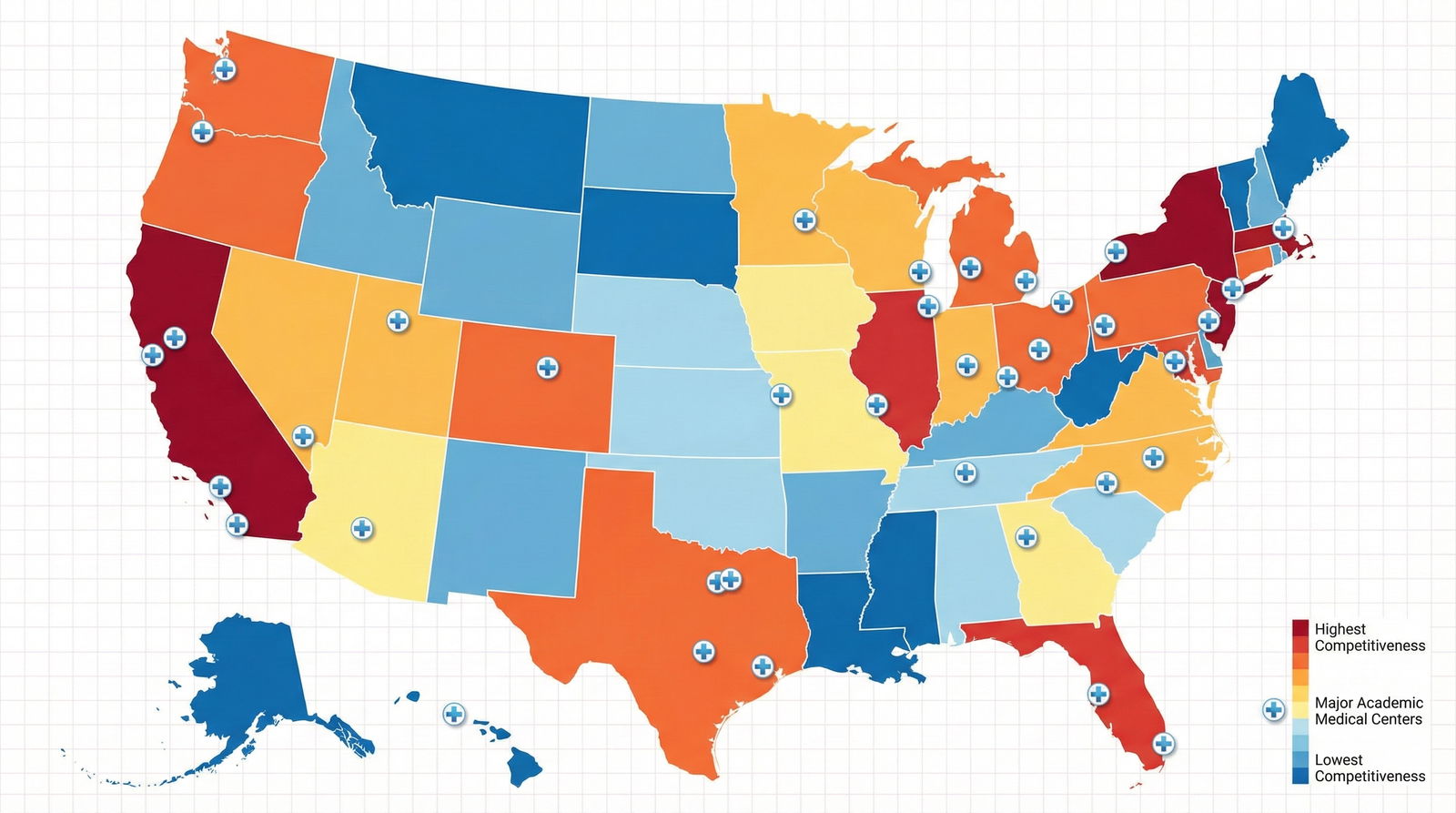
Geographic Bias and Yield Protection
Residency programs are terrified of wasting interview slots on applicants who will not rank them. Yield protection is the mechanism by which a program bypasses an objectively stellar applicant because they suspect that applicant is using them as a safety option.
If you grew up, attended undergraduate school, and completed medical school in the Midwest, but applied heavily to coastal programs without placing a Gold or Silver signal on those programs, selection committees notice. A program in San Diego or Boston assumes an applicant from Ohio with no regional ties will ultimately rank Midwest programs higher to stay near family. Unless you explicitly prove otherwise in your application, high-demand regional programs will pass on you to protect their yield.
Mismanaged Application Signaling
The introduction of program signaling via ERAS altered the selection landscape. In high-demand regions, programs receive hundreds of applications from candidates who allocated Gold or Silver signals directly to them.
If a program has 100 interview slots and receives 150 applications bearing program signals, they have zero incentive to review un-signaled applications during the mid-season phase. If you did not signal a program in your dream region, your application sits in an unreviewed secondary tier regardless of your Step scores.
Generic Personal Statement Narrative
Programs in highly desirable regions read thousands of personal statements containing identical variations of the sentence: "I am drawn to the diverse patient population and vibrant cultural atmosphere of [City Name]."
This language signals a tourist mindset, not a structural commitment to the region. Program directors look for specific operational connections: prior residency in the state, immediate family residing in the metropolitan area, explicit sub-internship experience, or research collaborations with local health systems. Without concrete evidence of local anchoring, your file is easily deferred.
Faculty Bandwidth and Review Bottlenecks
Do not discount administrative friction. Mid-season coincides with clinical service rotations, grant deadlines, and academic conferences for faculty reviewers. A program may intend to review your file, but their selection committee meets bi-weekly and caps review files at 50 per session. If your file sits at position 400 in the review queue, silence is simply the time lag of administrative processing.
What the Silence Means by Specialty and Applicant Profile
Silence does not affect all candidates equally. A lull in invitations carries completely different strategic implications depending on your specialty choice, academic metrics, and institutional ties.
High-Score Applicants Without Regional Ties
If you possess a Step 2 CK score above 255 but lack local ties, mid-season silence in a competitive region is almost certainly a yield protection filter. Programs assume you are accumulating interviews at top-tier academic hubs and will not waste an interview slot on a candidate who will place them fifth or sixth on their rank list. You are not underqualified; you are deemed un-convertible.
Candidates Applying Out-of-Region Without Signals
For this profile, mid-season silence is an absolute indicator that your application has been placed in an un-reviewed pool. Data across competitive specialties (e.g., Orthopedic Surgery, Dermatology, Urology, Radiology) indicates that programs receive sufficient signaled applicants to fill 90% or more of their interview calendar. Unsignaled, out-of-region applications are only reviewed if cancellation rates spike unexpectedly in December.
Specialty-Specific Dynamics
Specialty competitiveness completely changes the velocity of interview distribution:
- Broad-Access Specialties (Internal Medicine, Family Medicine, Pediatrics): These programs interview large candidate cohorts and experience high cancellation volumes mid-season. Silence in November frequently turns into late invites in December as applicants drop duplicate offers.
- Highly Competitive Specialties (Surgical Subspecialties, Ophthalmology, ENT): Programs interview small, tightly controlled groups (often 30 to 50 candidates total). Calendars fill almost instantly during the initial release wave. Mid-season silence here is far more ominous; waitlist movement is minimal because applicants rarely drop surgical interview slots.
What to Do When the Invitations Slow Down
When your interview volume freezes mid-season, passive waiting is a failing strategy. You must execute a structured operational audit of your application portfolio and take targeted action.
Here are the specific tactical steps to take immediately:
Step 1: Audit Your Regional Narrative
Re-read your ERAS geographic preference text box and personal statements for the silence-struck region. Did you articulate clear, objective reasons for needing to practice in that state? Or did you supply generic fluff?
If your written materials lacked strong regional anchor points, acknowledge that your initial file presumes low interest from selection committees. You will need to rectify this through direct communication.
Step 2: Systematize Waitlist and Cancellation Tracking
The vast majority of mid-to-late season interviews are secured through calendar cancellations.
- Ensure your phone notifications for Thalamus, Interview Broker, or ERAS are configured to bypass "Do Not Disturb" settings.
- When a waitlist spot opens, response times must be measured in seconds, not hours. High-demand spots fill within 90 seconds of release.
- Keep your schedule completely clear of personal conflicts during target interview weeks so you can claim last-minute openings without hesitation.
Step 3: Deploy Targeted Communications
Do not send blanket interest emails to every program in your dream region. Selection committees talk to one another, and program coordinators despise generic spam. Select three to five high-priority programs in the region where your academic metrics match their historical profile, and send a structured, professional communication.
Step 4: Expand Your Geographic Target Radius
If your target market is Southern California, expand your focus to include Arizona, Nevada, and Utah. If your target is the Boston metropolitan area, expand outward to central Massachusetts, Connecticut, and Rhode Island. Programs in adjacent, secondary markets often seek candidates who desire the broader region but were squeezed out of primary metropolitan centers.
Step 5: Protect Your Mental Bandwidth
Obsessive forum scrolling creates cognitive fatigue that harms your performance on the interviews you do have. Recognize that interview distribution is an asynchronous process. A quiet week does not mean your file has been destroyed; it means administrative processing is ongoing.
How to Rebuild Momentum Without Looking Desperate
There is a narrow line between professional self-advocacy and unprofessional desperation. Program coordinators log every interaction you have with their office. Sounding anxious, entitled, or demanding will instantly disqualify an otherwise acceptable candidate.

When reaching out to programs mid-season, adhere strictly to these operational parameters:
1. Confirm the Program's Communication Policy First
Before sending an email, check the program's website and ERAS portal page. If a program explicitly states: "We do not accept updates or letters of interest outside of ERAS," do not send one. Violating explicit administrative instructions proves you cannot follow basic protocol.
2. Time Your Outreach Correctly
Do not send interest letters in October; programs are overwhelmed with initial screening. The optimal window for mid-season outreach is between mid-November and early December. This coincides with the period when candidates begin dropping interview slots and programs are actively looking to fill calendar gaps.
3. Structure Your Communication with Concrete Data
A professional Letter of Interest must be brief (under 250 words) and structured into three tight paragraphs:
Paragraph 1: The Direct Statement of Interest
Explicitly state who you are, your AAMC ID, your medical school, and your clear connection to the program. State directly that you are writing to express your strong interest in interviewing at their program.

Paragraph 2: The Specific Fit Metrics
Provide two specific, objective reasons why their program aligns with your training goals (e.g., a specific clinical track, community outreach initiative, or research lab). Avoid generic statements about "excellent clinical care."

Paragraph 3: Tangible File Updates (If Applicable)
Detail any new meaningful developments since submission: Step 2 CK score releases, new first-author publication acceptances, or recently completed honors in sub-internships. Conclude by politely stating your schedule flexibility for unexpected interview openings.
4. Maintain Absolute Professional Decorum
Never ask why you have not received an interview invite. Never reference other candidates who received invites. State your case, provide your updates, thank the coordinator for their time, and close the email.
When to Escalate Strategy: Backup Plans, Second Look, and Late-Cycle Applications
You cannot run a match strategy entirely on hope for a single geographic region. A single-region bias is one of the most common statistical drivers of unmatched candidates.

Establishing Hard Strategy Deadlines
You must set rigid temporal thresholds for pivoting your strategy:
- By December 1st: If you hold fewer than 10 total interview invitations across all regions, you must immediately abandon regional exclusivity.
- By December 15th: If your dream region accounts for less than 30% of your total interview portfolio, your rank list will mathematically favor other geographic areas. You must mentally shift your focus to preparing for interviews in your non-primary regions.
Applying to Additional Programs Late-Cycle
If your total interview count across all regions is critically low (under six to eight invites depending on specialty), applying to additional programs in mid-to-late November is necessary. However, do not add more programs in your hyper-competitive dream region, those calendars are locked. Add programs in less competitive geographic regions, broad-community hospital systems, or newer residency programs with smaller applicant pools.
Leveraging Network Ties
If you have mentors, department chairs, or faculty members at your home institution who have personal professional relationships with program directors in your dream region, this is the time to use them. A brief, peer-to-peer phone call or email from a trusted faculty member to a program director carries 50 times more weight than an email sent directly by an applicant. Ask your mentor directly: "I have targeted the Pacific Northwest, but my invite volume there has stalled. Do you have personal connections to leadership at any of these target programs who might be willing to take a second look at my file?"
Summary: The Silence Is Usually Process, Not Personal
When your dream region stops calling mid-season, step back from the emotional narrative. Selection committees do not sit in rooms making personal judgments about your character; they are managing tight inventory schedules under severe administrative time constraints.
Mid-season lulls are driven by yield protection algorithms, program signaling thresholds, administrative backlogs, and calendar caps. The applicants who successfully navigate this lull do not spend their time spiraling on internet message boards. They audit their application materials for regional narrative alignment, monitor waitlist notifications with high responsiveness, deploy professional and targeted updates, and systematically broaden their geographic targets to ensure a successful match outcome.
Control the variables you can manipulate. Adapt your strategy to the real-time dynamics of the season. A successful match is the objective; where you spend your residency training is simply the location where you execute it.