
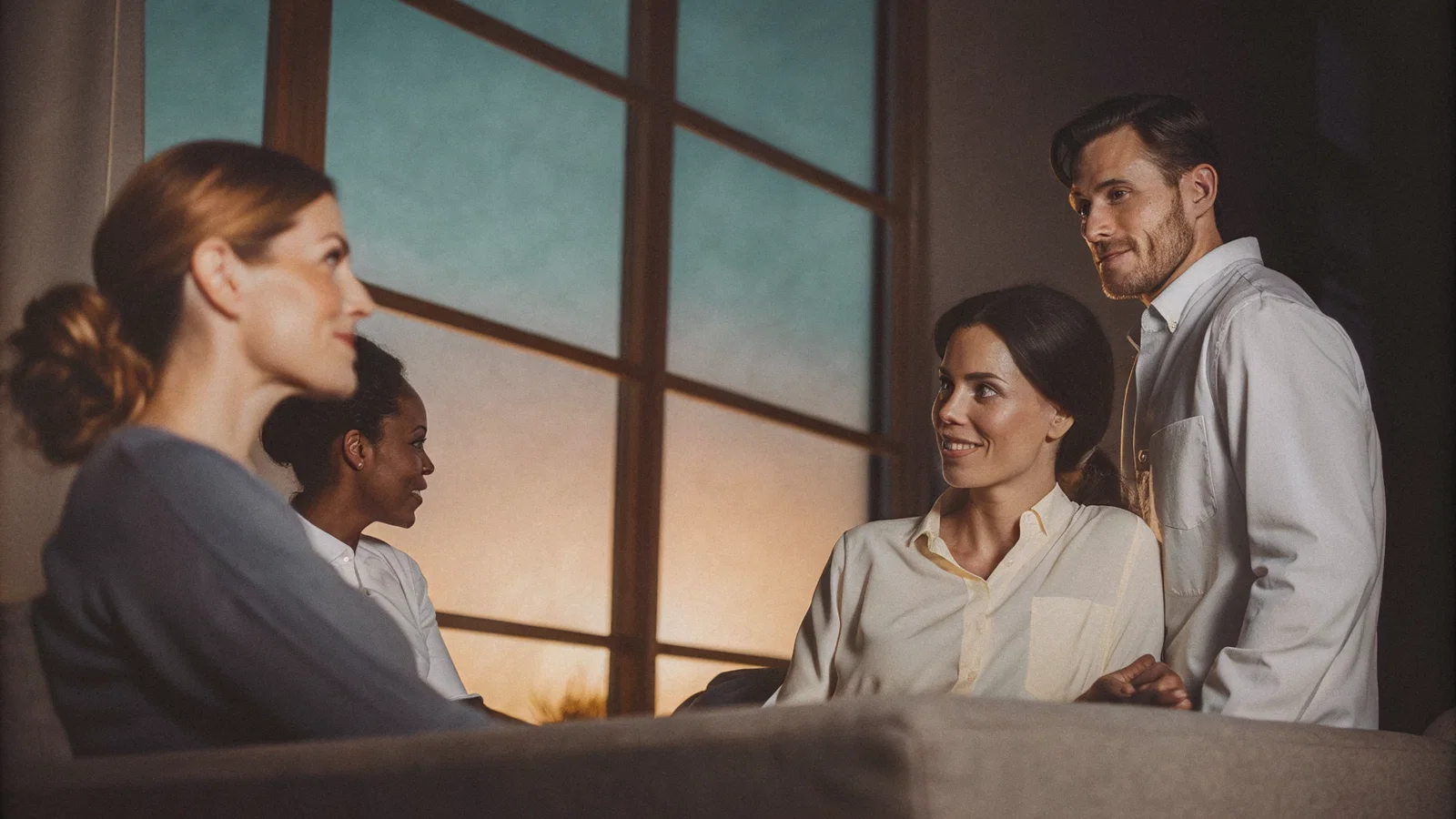
Let me tell you what really happens after you leave that residency social early. Nothing. Absolutely nothing.
I've sat in the selection meetings. I've watched the deliberations. And I can tell you with complete certainty that the resident who slipped out at 8:47 PM to catch the last train home is never, ever the topic of conversation the next morning. The conversation is about the resident who aspirated during a central line placement and tried to hide it. Or the resident who published three papers in six months. Or the resident whose letter from Dr. Harrison called them "the best intern I've trained in a decade."
Nobody is talking about your trivia team performance. Nobody noticed you weren't at bowling night. And the idea that there's a secret attendance ledger tracking your social engagement score is pure, distilled anxiety talking.
But I understand why you don't believe me. The pressure is real. The whispers in the hallway, "Did you hear So-and-so never shows up to anything?", feel like professional death sentences. So let's break this down piece by piece, because the gap between what you fear and what actually matters is enormous.
This article is for educational purposes only. It is not financial advice, not legal advice, and not tax advice. Figures vary by individual circumstances, so consult a qualified professional before acting.
The Social Illusion: Why Program Directors Don't Actually Care About Your Trivia Skills
Here's the uncomfortable truth that nobody tells you during orientation: those social hours? They're not for evaluating you. They're for selling themselves.
When a residency program hosts a mixer, a happy hour, a "casual get-together with the chiefs," the entire machinery behind that event is recruitment and retention marketing. The program director isn't standing in the corner with a clipboard marking off who made eye contact and who laughed at the attending's bad joke. The program director is exhausted. They've been up since five, they've rounded on forty patients, they've signed eighty notes, and now they're standing in a loud bar pretending to enjoy a watery IPA while three nervous residents orbit them like anxious satellites.
I've been that program director. I remember one evening at a rooftop mixer where a resident asked me if I'd noticed they'd missed the last three socials. I hadn't. I genuinely hadn't. Not because I didn't care about them as a person, but because I was trying to remember whether I'd forwarded a critical email about a grant deadline and whether my kid's recital was tomorrow or Thursday.
The "hidden observer effect" residents imagine, the feeling that every social is a covert evaluation session, is a phantom. It exists in your head, planted there by medical school interview trauma and reinforced by gunner culture. Programs don't track social attendance in some black-book database. There's no spreadsheet with a column labeled "Team Player Score (based on happy hour appearances)." If a coordinator is tracking RSVPs, it's for catering numbers, not character assessments.
Now, does this mean socials are meaningless? No. They serve a real purpose, but that purpose is yours, not theirs. Socials are your chance to evaluate the culture. Are the attendings relaxed or performative? Do the senior residents look genuinely comfortable or are they performing enthusiasm? Is there an undercurrent of toxicity masked as "we're like a family here"? These are things you can only pick up in unstructured settings. But that evaluation runs one way. They're not grading you. You're grading them.
(See also: What If My Co-Residents Judge Me for Struggling With Burnout? for context on social anxiety in residency.)
The reality of PD time is this: most program directors are clinically active, administratively buried, and personally stretched thin. The idea that they have the bandwidth to catalog your social movements is flattering to you and insulting to their intelligence. They're not watching your every move at the bar. They're watching the clock, wondering when it's socially acceptable to leave.
The Data Disconnect: What Actually Moves the Needle for Fellowship Selection
Let's get into the real selection criteria, because this is where residents tie themselves in knots over the wrong variables.
I've participated in fellowship selection at three different institutions. The process is more quantitative than you think, and far less personality-driven than you fear. Here's how decisions actually get made.
(See also: The Real Reason Some Burned-Out Residents Still Get Promoted to better understand how programs truly assess resident value.)
Clinical competency sits at the top, and it's not close. When I say clinical competency, I don't mean "passed all rotations." I mean: Does this resident manage sick patients independently? Do they escalate care appropriately? Do the attendings trust them with complex cases? This information comes from rotation evaluations, internal assessments, and, the gold standard, direct attending letters that say things like "I would trust this resident to manage my own family member." That sentence, written sincerely, is worth more than a hundred happy hours.
Research and publications are next. Fellowship programs, especially academic ones, want evidence that you can produce. They don't need you to be a Nobel candidate. But a few meaningful contributions, a case report, a retrospective chart review, a chapter contribution, demonstrate that you understand the research process and can deliver. This is quantifiable. This goes on a spreadsheet. Your karaoke performance does not.
Letters of recommendation are the third pillar. And here's where the social anxiety really misses the point. Strong letters don't come from attending mixers. They come from clinical work. They come from an attending who watched you manage a crashing patient at 3 AM, who saw you communicate clearly with a terrified family, who noticed you stayed late to make sure a handoff was clean. That attending doesn't care whether you attended the department's summer picnic. They care whether you're clinically excellent and professionally reliable.
The "personality fit" piece, the thing residents agonize over when they skip socials, accounts for maybe 10% of the decision. And even that 10% is assessed through the formal interview, not through informal social events during residency. The interview is structured, evaluated, and scored. The social is not.
Let me be blunt about something: "performative extroversion" is not a fellowship selection criterion. No program is thinking, "Well, their research is thin and their letters are mediocre, but man, they really brought the energy to that Halloween party." That doesn't happen. The hierarchy is clear. Clinical excellence beats the karaoke star every single time.
There's a deeper issue here about what programs actually value. They value reliability. They value judgment. They value the resident who knows when to ask for help and when to act independently. These qualities are demonstrated in clinical settings, not social ones. The resident who skips a social to finish a manuscript or to recover from a brutal call week is demonstrating prioritization and self-awareness, two qualities fellowship directors actively want.
I've seen residents agonize over a missed dinner while sitting on a first-author publication that hasn't been submitted because they were too busy attending events to write it. That's a catastrophic misallocation of energy. The publication moves your application. The dinner does not.
The Strategic Exit: When Skipping is Not Just Okay, It's Professionalism
Now let's talk about the actual mechanics of skipping, because there's a right way and a wrong way, and the difference matters.
The wrong way is the ghost. The resident who RSVPs yes, never shows, and never acknowledges it. Or worse, the resident who perpetually hovers at the edges of the group, clearly wanting to leave but paralyzed by the fear of being seen leaving. I've watched residents do the "fake phone call exit" so many times it's practically a residency ritual. It's painful to watch, and it's unnecessary.
The right way is the strategic exit, and it starts with a clear RSVP.
Here's what a polite decline looks like in practice: "Thank you for the invitation. I'm not able to attend this event due to a prior commitment, but I appreciate the effort to organize it." That's it. No elaborate excuse. No medical apology ("I'm so sorry, I have this really important note to finish"). No guilt-laden explanation. A prior commitment is a prior commitment, and "resting after a brutal call week" is a legitimate prior commitment whether anyone says it out loud or not.
The distinction between "burnout-induced disappearance" and "strategic prioritization" is important. Burnout disappearance looks like this: you stop responding to emails, you don't acknowledge invitations at all, you withdraw from the community entirely, and you become invisible. That's a problem, not because it hurts your fellowship application, but because it signals that something is clinically wrong. If you're that burned out, you need to be talking to someone, not worrying about social attendance.
Strategic prioritization looks different. You're engaged clinically. You're responsive to communication. You attend the events that matter, the ones with genuine networking value, the ones where fellowship faculty will be present and accessible, the ones that align with your goals. You skip the ones that are purely performative socializing with no professional return. And you do it transparently and politely.
There's a critical skill here that residency doesn't explicitly teach: the art of being present when it counts and absent when you need to be. The residents who master this are the ones who thrive. They're the ones who show up to grand rounds prepared, who contribute meaningfully to morning report, who stay late when a patient is sick, and who leave the holiday party at a reasonable hour because they have a manuscript to revise and a life to protect.
Let me tell you about the "red flag" environments, because not all socials are created equal. Some social events are genuinely toxic, and attending them is not just optional, it's potentially harmful. Here's how to identify them:
Forced fun with mandatory attendance implications. If a chief resident says "everyone needs to be there" with a tone that implies consequences, that's not a social. That's a compliance exercise. Real socials are optional. If the option is theoretical, the culture is broken.
Alcohol-centered events with no alternatives. If the only social activity is drinking, and there's no genuine non-drinking culture, that's a red flag for the program's broader inclusivity. Programs that respect their residents offer varied social formats.
Events that consistently run past reasonable hours. A social that starts at 7 PM and is expected to run past 11 PM on a weekday before a clinical day is a program that doesn't respect boundaries. Your attendance at that event is not professionalism. Your refusal is.
Events where hierarchy is enforced. If attendings sit at one table and residents at another, and there's no natural mingling, the social isn't building community. It's reinforcing divisions. Skip it.
True "fit" means finding a program that respects your downtime instead of demanding it. The best fellowship programs, the ones worth applying to, are run by people who understand that a well-rested, focused resident is more valuable than a socially omnipresent, chronically exhausted one. If a program's culture penalizes you for protecting your time during residency, that same culture will penalize you for protecting your time during fellowship. Pay attention to that signal.
Reframing the Burnout Cycle: Protecting Your Capacity
Let me tell you what I've learned from watching hundreds of residents move through training into fellowship and beyond. The residents who burn out fastest are not the ones who skip socials. They're the ones who attend everything, perform enthusiasm constantly, and never allow themselves a moment of genuine rest. They're the "always-on" residents, and they are the ones who crash hardest, usually in PGY-3 or PGY-4, at the exact moment they need to be at their strongest for fellowship applications.
Protecting your mental health is not weakness. It is the marker of a mature clinician. The fellowship directors I've worked with, the good ones, the ones you actually want to train under, recognize this. They've been through it themselves. They know the difference between a resident who is strategically managing their energy and a resident who is disengaged. Those are not the same thing, and pretending they are is either naive or manipulative.
The myth of the "always-on" resident needs to die. That resident is not sustainable. They're not a team player. They're a future burnout statistic who will either leave medicine, switch specialties, or become the cynical, disengaged attending that everyone dreads working with. The long game of a medical career is forty years. Forty. You cannot sprint for forty years. You cannot attend every social, say yes to every ask, and maintain clinical excellence, research productivity, and basic human functioning for four decades.
The fellowships that matter, the ones that will launch your career rather than drain your soul, are looking for residents who understand this. They want the resident who publishes consistently, not the one who parties consistently. They want the resident who manages their time intelligently, not the one who demonstrates loyalty through social attendance.
So here's my final advice. Show you're a team player by being reliable clinically. By answering your pages. By covering for a colleague who's sick without resentment. By contributing to morning report with something useful. By being the resident others want on their team because you're competent and calm, not because you're fun at happy hour.
And when the next social invitation arrives in your inbox, read it. Consider whether it serves you, professionally, socially, or emotionally. If it does, go and enjoy it genuinely. If it doesn't, decline politely and spend that evening doing whatever actually restores you. Write your paper. Call your family. Sleep. Stare at a wall. All of those are valid uses of your time, and none of them will appear on your fellowship application as a red flag.
The long game matters more than one awkward happy hour. It always has. And the people making fellowship decisions know that better than anyone.
Key Takeaways:
- Residency socials exist for you to evaluate program culture, not for programs to covertly evaluate you. Your attendance, or absence, is not tracked or scored.
- Clinical performance, research output, and strong letters of recommendation drive fellowship selection. Social presence is a distant, distant fourth.
- True professionalism means knowing your limits and communicating boundaries clearly. Declining an invitation politely is not disengagement, it's self-management.
Frequently Asked Questions:
What if a fellowship faculty member specifically invites me to a social? That's worth attending. A direct invitation from someone who writes letters or influences decisions has networking value. Go, stay for a reasonable amount of time, and follow up with a thank-you email referencing something specific from your conversation.
How many socials should I attend per year to show engagement? There's no quota. Attend the ones with genuine value, events with fellowship faculty, program-wide events that build community, and events you personally enjoy. For most residents, that's three to five events per year. Quality over quantity.
Will missing socials hurt me if I'm at a small program where everyone notices? Small programs have less anonymity, but the selection criteria remain the same. Be clinically excellent, be responsive, be kind to colleagues, and communicate openly. If you're engaged during work hours, no one will question your evening choices.


