

Last week, a PGY‑2 told me he sometimes hides in an empty call room bathroom just to cry for five minutes between pages. Then he wipes his face, walks back out, and pretends he’s fine because he’s terrified his co-residents will think he’s weak. The scariest part for him wasn’t the crying. It was the “What if they find out?”
If you’re reading this, I’m guessing you know that feeling a little too well. The “Everyone else is handling this. Why can’t I?” loop that plays in your head at 3 a.m. while the pager won’t shut up.
The Fear Behind the Question: “What If They Judge Me?”
Let me be blunt: your biggest fear probably isn’t burnout itself. It’s exposure.
You’re not just thinking, “I’m exhausted.” You’re thinking:
- What if my co-residents think I’m lazy?
- What if attendings think I’m not cut out for this?
- What if word gets around that I’m “struggling” and it follows me forever?
You’re imagining the worst-case scenarios:
You finally open up in the workroom and say, “I’ve been really burned out lately,” and there’s that awkward silence. Someone shifts in their chair. One person says, “Yeah, it’s hard for everyone,” and changes the subject. You walk away thinking, “I knew it. I shouldn’t have said anything. I’m the weak one.”
Or you ask for a sick day for mental health and you swear you hear your co-resident sigh on the phone. You start filling in the blanks: They hate me. They think I’m dumping on them. Next time there’s a rotation ranking, they’ll all hope they’re not paired with me.
This is the anxious brain specialty: write a full horror novel from a single facial expression.
Here’s the part you probably won’t believe yet, but I’ll say it anyway: their judgment (if it even exists) isn’t nearly as dangerous to your career as your silence.
The Reality: You Are Almost Definitely Not the Only One
Residency makes everyone good at pretending.
People pre-chart at 4 a.m., show up at 5:30 smiling with coffee, present on rounds flawlessly, then go home and Google “physician burnout signs” in the dark.
If you could see the real numbers instead of everyone’s curated persona, it would look more like this:
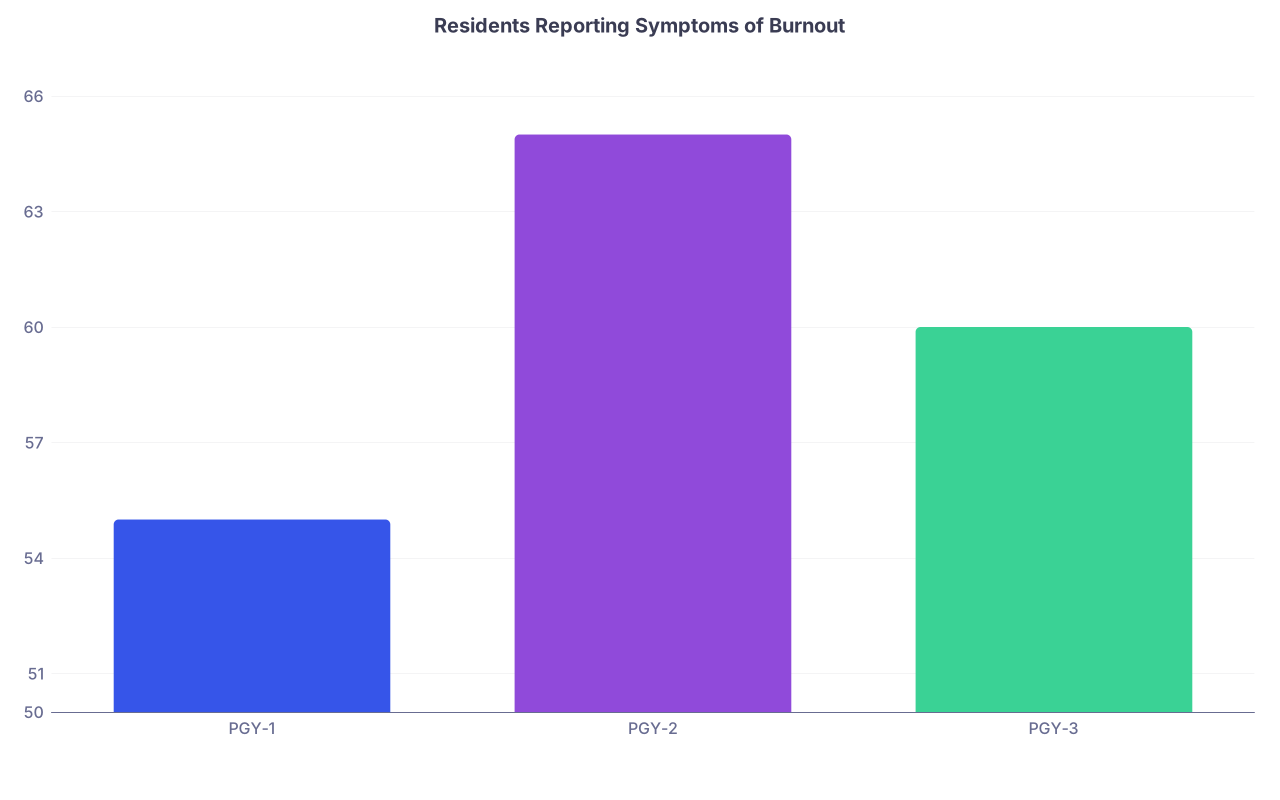
| Category | Value |
|---|---|
| PGY-1 | 55 |
| PGY-2 | 65 |
| PGY-3 | 60 |
Those aren’t made-up vibes. Surveys from multiple specialties show more than half of residents meet criteria for burnout at some point. That means in a workroom of 10 people, 5–7 of you are probably hanging on by a thread at various times.
You’re not the only one silently thinking:
- “If I see one more admit, I’m going to scream.”
- “I can’t remember the last time I felt like a real human being.”
- “Is it bad that I dread going in almost every day now?”
You’re just the only one convinced you’re the only one.
The Judgment You’re Afraid Of vs. What Usually Happens
Here’s what your brain says will happen if you admit you’re burned out:
- They’ll think you’re weak.
- They’ll talk about you behind your back.
- Attendings will label you “not resilient.”
- You’ll get fewer opportunities. Worse evals.
- This will go in some invisible permanent record.
Here’s what I’ve actually seen happen in real programs when someone admits they’re struggling:
- Three other residents say, “Same.”
- One person texts later: “Hey, I’ve been there. Want to talk?”
- An attending says, “I remember my intern year, I thought about quitting twice a week.”
- Chief quietly rearranges a schedule, gives a lighter week after a brutal call stretch.
- The resident gets connected with therapy, needs a short LOA, comes back functioning better, not worse.
Is there ever judgment? Yeah, sometimes. There are still dinosaurs in medicine who treat burnout like a character flaw. The “Back in my day we just sucked it up” crowd. The co-resident who humble-brags about “never taking a sick day.”
But those people are usually broadcasting their own unresolved stuff, not offering a fair judgment of you.
And here’s the uncomfortable truth: the ones who never struggle? They’re either lying, dissociating, or not paying attention. Residency is hard. You’re supposed to struggle.
But What If My Co-Residents Really Do Judge Me?
Let’s walk through the actual worst-case you’re picturing, because that’s the voice that’s running the show.
You tell a co-resident you’ve been having trouble sleeping, dreading work, feeling emotionally flat. They say, “Yeah, we’re all tired,” in a slightly annoyed tone and move on. Your brain concludes: “They think I’m dramatic.”
Here’s a more accurate translation:
- They don’t know what to say.
- They’re scared if they acknowledge it, they’ll have to face their own burnout.
- They’re trying to shove the conversation back into “safe” territory.
Could they be judging you? Maybe. People are flawed. But their reaction says more about their emotional capacity than your worth as a physician.
The more important question is: what then?
You’re afraid judgment will:
- Prove you’re not cut out for this.
- Make your life miserable day-to-day.
- Destroy your career.
In reality:
Judgment does none of those things. Untreated burnout, on the other hand, absolutely can wreck your performance, relationships, health, and career.
Pressed choices:
- Option A: Be silently burned out, appear “fine,” slowly implode.
- Option B: Risk some awkwardness or mild judgment, get support, maybe feel slightly better.
It’s wild that our brains still push us toward Option A.
How Much Can This Actually Hurt My Career?
Let’s separate irrational fear from realistic risk.
Real risk if you ignore burnout long enough:
- More mistakes. Medication errors, missed labs, poor documentation.
- Slipping evals. “Disengaged,” “difficulty with attention to detail,” “seems less motivated.”
- Physical breakdown: more sick days, infections, migraines, GI issues, whatever your body’s weak spot is.
- Emotional fallout: snapping at nurses, conflict with co-residents, crying in front of attendings.
Real risk if you ask for help early:
- Some people may quietly think, “Huh, I didn’t know it was that bad for them.”
- Schedule may need slight adjustment to protect you.
- You might feel temporarily exposed and vulnerable.
Here’s the kicker: programs don’t want you to crash and burn. It’s a liability nightmare and a scheduling disaster. A resident who flames out, fails boards, or quits unexpectedly is a huge problem for them.
So you getting proactive help? That’s actually aligned with their interests.
| Factor | Silent Burnout | Asking for Help Early |
|---|---|---|
| Performance | Gradual decline | Usually stabilizes/improves |
| Perception | "Off" or "checked out" | "Insightful," "proactive" |
| Risk of major event | High | Lower |
| Long-term career | More fragile | More sustainable |
The fantasy is: “If I just keep my head down, no one will notice and I’ll get through.”
Reality: they are noticing—just later, when it’s messier.
What If I Become “That Resident” Everyone Talks About?
This is the nightmare, right? Being the subject of, “Did you hear about…?”
In every program, there are stories:
- The resident who had a breakdown on rounds.
- The one who took a leave.
- The one who almost got fired.
You’re terrified of becoming that storyline.
Here’s what gets left out of those whispers:
- A lot of those residents had zero support until it was an emergency.
- Many of them were high performers who held it together too well for too long.
- A bunch of them actually came back, finished, and are practicing fine now.
No one tells that part.

Yes, people talk. Medicine is gossipy. But gossip has a short attention span. You know what actually sticks in people’s memory?
- Whether you were safe.
- Whether you owned your limits.
- Whether you showed up honestly once you got back on your feet.
I’ve seen residents who took mental health leave later become chiefs. Why? Because they knew how to set boundaries, read the room, and actually empathize with struggling co-residents. They became the person people trusted with their own burnout.
Not because they never cracked. Because they did—and handled it like a real human instead of pretending to be a machine.
What You Can Actually Do Without Exposing Your Soul to Everyone
You don’t need to stand up in noon conference and announce, “I’m burned out.” That’s not what I’m saying.
Think in layers.
Layer 1: Your “Inner Circle”
One or two people. That’s it. Someone who’s shown they can handle nuance and confidentiality.
You might say something like:
- “Hey, can I be real for a second? I’ve been feeling pretty burned out and it’s starting to scare me. Have you ever felt like that?”
- “I’m not okay lately. I’m doing the work, but mentally I feel wrecked. I’m trying to figure out what to do about it.”
If they shut it down, you learned something about them, not you. Move on. Find someone else.
Layer 2: Leadership / Chiefs
This feels terrifying, but it’s also where the most concrete help can come from.
You don’t have to bare everything. You can say:
- “I’ve been having significant burnout symptoms—sleep issues, dread before shifts, trouble focusing. I’m worried it might start affecting patient care if I don’t address it. I wanted to loop you in early and see what resources or adjustments might be possible.”
Notice how that frames it: insight, concern for patients, proactive.
That is not how a “weak” resident sounds. That’s how someone with good clinical judgment sounds—about themselves.
Layer 3: The General Workroom
You can normalize struggle without handing over your whole medical record.
Little things like:
- “This rotation is wrecking me. Anyone else feel like a zombie?”
- “I’ve started seeing a therapist and honestly, I wish I’d done it as an intern.”
- “I took my first real day off in weeks this weekend and I hadn’t realized how fried I was.”
You’re dropping signals: “It’s safe to not be okay,” without forcing anyone (including you) into full vulnerability mode.
But What If They Really Are Stronger Than Me?
You look around and you see the golden child. Perfect notes. First author on three papers. Always smiling. Runs marathons “for fun.” You think, “They’re built for this. I’m not.”
I’ll tell you something that still pisses me off years later: some of the most “together” residents I’ve seen were also the closest to breaking. But everyone around them thought they were thriving. Including leadership.
We massively over-index on what we can see:
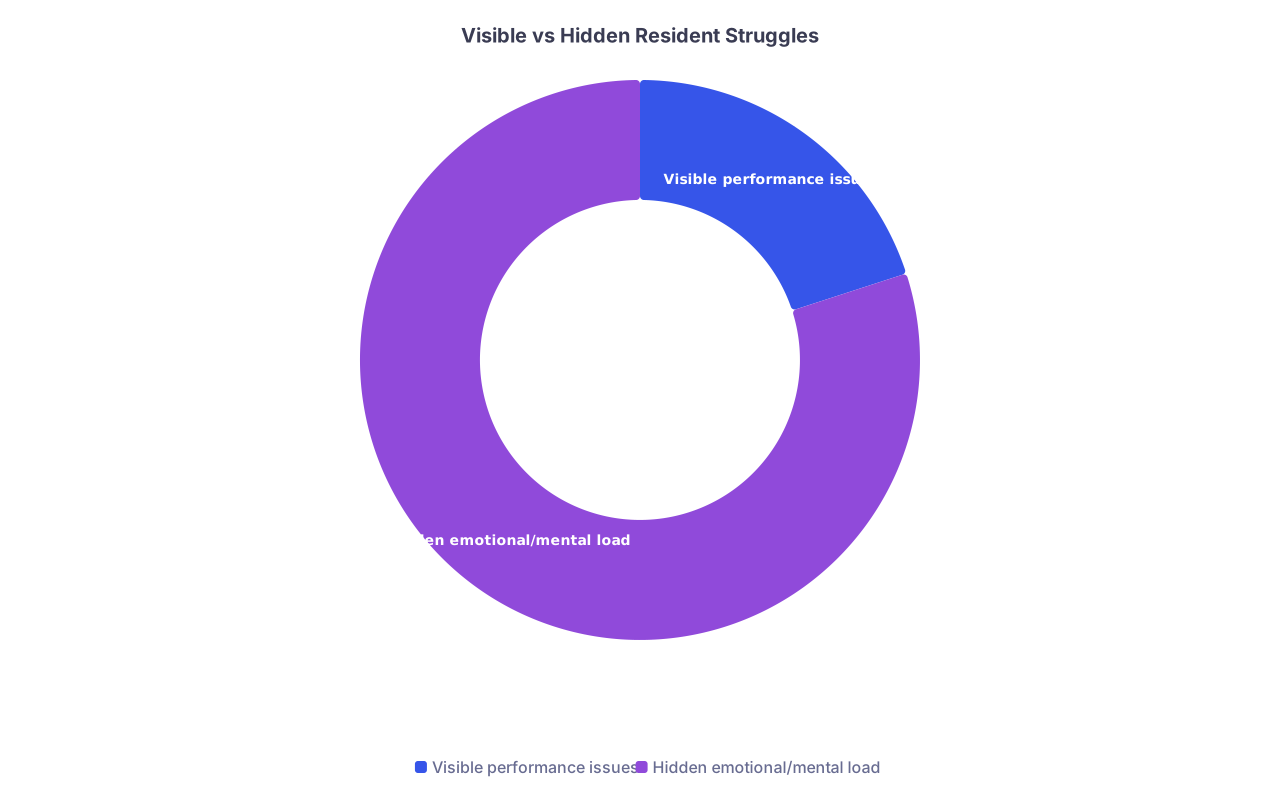
| Category | Value |
|---|---|
| Visible performance issues | 20 |
| Hidden emotional/mental load | 80 |
So you compare your internal experience to everyone else’s external presentation and draw garbage conclusions.
You don’t know who cries in their car before sign-out. Who has panic attacks in the supply closet. Who drinks too much after call. Who has intrusive “What if I just quit medicine and disappear?” thoughts.
You’re not weaker. You’re just more honest with yourself about how hard this is.
How to Think About Judgment So It Doesn’t Own You
You can’t control whether other people judge. Humans judge. Constantly.
What you can control is what judgment you’re most afraid of:
- Co-residents thinking, “They’re struggling.”
- Or future you thinking, “Why didn’t I say something sooner?”
Let me flip the nightmare on its head for a second.
Imagine this scenario:
Two years from now, a new intern tells you quietly, “I’m so burned out I’m scared I might miss something important.” What would you think of them?
Would you think, “Wow, what a weak loser”?
Or would you think, “Damn, that’s brave to say out loud. I’ve been there”?
You are not the exception. The standards you apply to yourself are so much harsher than what you’d apply to anyone else.
So when your brain says, “They’ll think I’m weak,” ask: “If they said this to me, would I think that?”
Your answer is almost always no. That’s your real belief. The rest is anxiety talking.

One Concrete Step You Can Take Today
Don’t wait until you’re fully broken.
Today—literally today—pick one of these:
- Text one co-resident you vaguely trust: “Hey, random question—how are you actually doing with everything? I’ve been more burned out than I expected.”
- Email or message your GME wellness office or counseling service and ask about an appointment. You don’t have to commit to some huge treatment plan. Just one visit.
- Draft a short message to your chief: “Could we set up a quick check-in sometime this week? I’ve been struggling a bit and wanted to talk before it affects my work.”
Not all three. Just one.
Open your phone right now and send one honest sentence to one person. That’s it. That’s your assignment.
You’re not weak for struggling in a system that constantly asks too much. You’re not fragile for having a limit. Your co-residents might judge you for a moment; your body and brain will judge you a lot longer if you keep pretending you’re fine when you’re not.
You don’t have to set yourself on fire to prove you belong in medicine.


