

The way most residents “plan” the PGY-1 to PGY-2 transition is exactly how you burn out: you do nothing, hope July is magically better, then get blindsided by new expectations and old exhaustion.
You are not just rolling over into PGY-2. You’re changing jobs while already tired.
Here’s the timeline that actually works.
Big Picture Timeline: PGY-1 to Early PGY-2
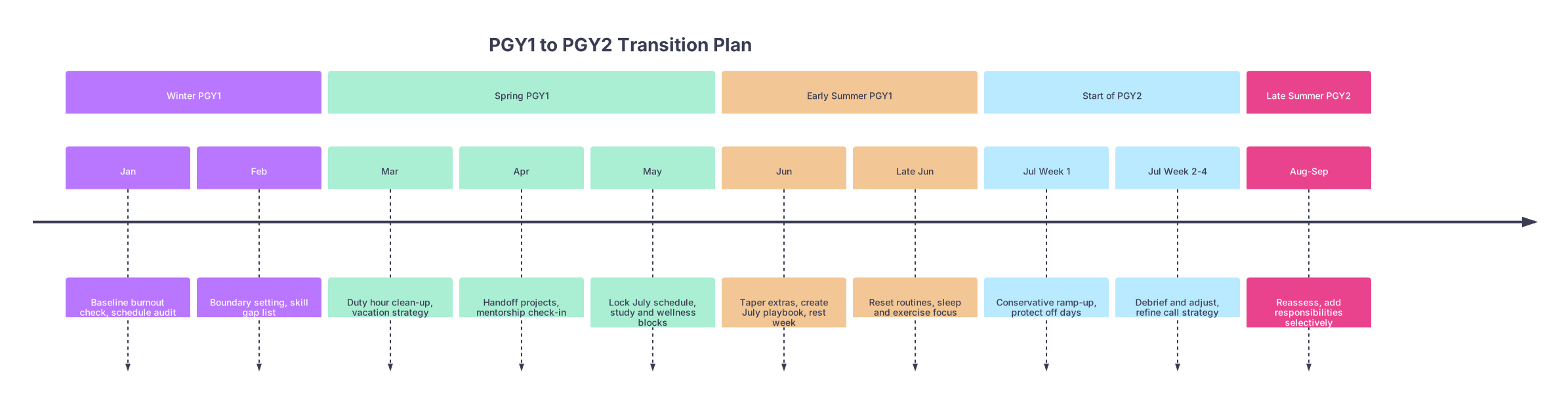
| Period | Event |
|---|---|
| Winter PGY1 - Jan | Baseline burnout check, schedule audit |
| Winter PGY1 - Feb | Boundary setting, skill gap list |
| Spring PGY1 - Mar | Duty hour clean-up, vacation strategy |
| Spring PGY1 - Apr | Handoff projects, mentorship check-in |
| Spring PGY1 - May | Lock July schedule, study and wellness blocks |
| Early Summer PGY1 - Jun | Taper extras, create July playbook, rest week |
| Early Summer PGY1 - Late Jun | Reset routines, sleep and exercise focus |
| Start of PGY2 - Jul Week 1 | Conservative ramp-up, protect off days |
| Start of PGY2 - Jul Week 2-4 | Debrief and adjust, refine call strategy |
| Late Summer PGY2 - Aug-Sep | Reassess, add responsibilities selectively |
At each stage, I’ll tell you exactly what to do. Month-by-month, then week-by-week around the transition, then what your first 30–60 days of PGY-2 should look like if you actually want to stay sane.
January–February of PGY-1: Stop the Bleeding First
At this point you should assume one thing: whatever burnout patterns you have in January will be amplified by PGY-2 responsibility if you do not change them now.
Step 1: Run a brutally honest burnout baseline (1–2 hours)
Pick one day in January or early February. Not on a 28‑hour call.
Do this:
- Open a blank document or notebook.
- Rate from 1–10 (10 = awful):
- Emotional exhaustion
- Cynicism / detachment
- “I am effective at work” (reverse scored)
- Then write quick bullet answers:
- “The parts of my week that consistently drain me are…”
- “The shifts I dread are…”
- “The people or dynamics that spike my stress are…”
- “What I’ve started to hate that I used to like about medicine is…”
You’re not journaling for therapy. You’re doing a damage inventory. This becomes your map.
Step 2: Audit your current schedule patterns (30–45 minutes)
Pull the last 2–3 months of schedules (November–January). Look for repeating burnout traps:
6 consecutive days worked more than twice per month
- Flipped nights→days with no real buffer
- ICU/ED blocks stacked back-to-back
- Clinic days after heavy call
- “Invisible work” (notes, in-basket, messaging) spilling into post-call
Make a list:
- “Keep” patterns: rotations and mixes that feel sustainable
- “Kill or limit” patterns: specific sequences you do not want repeated in PGY-2
You’ll use this language when chiefs “ask” for your preferences. No one else will protect you from schedule design that quietly destroys you.
March: Boundaries and Skill Gaps
By March, you’re no longer “just an intern.” People are already treating you like you’re almost a senior. That’s dangerous if you do not get deliberate.
Step 3: Define non-negotiable boundaries for PGY-2
Sit down on a weekend and write three lists:
Green-light behaviors you’re okay leaning into:
- Staying 30–45 minutes after sign-out for a true emergency
- Teaching interns/med students a brief topic once per week
- One committee or small QI project you actually care about
Yellow-light behaviors (case-by-case):
- Coming in early on non-call days
- Taking on extra research tasks
- Picking up additional clinic sessions
Red-light behaviors (you will default to “No”):
- Regularly staying > 1.5 hours after sign-out to “finish notes”
- Being the default person who “just does” the extra discharge summaries
- Joining extra committees “for your CV” when you’re already behind on sleep
If it’s not on paper, you’ll get guilt-tripped into everything.
Step 4: Identify skill gaps that make you slower and more exhausted
A lot of “burnout” is simply inefficiency plus shame. The stuff that takes you 40 minutes as an intern will still take 40 minutes as a senior unless you attack it.
Pick 3 domains:
- Clinical: e.g., chest pain workup, DKA management, sepsis bundles
- Workflow: e.g., note templates, order sets, task triage
- Communication: e.g., calling consults, family discussions, running the team
For each, answer:
- “If this were 30% easier, my week would feel different because…”
- “The specific situations where I freeze / stall are…”
Then choose 1–2 small targets per month (March, April, May). Not 20.
Example for March:
- Clinical: have one attending walk you through your DKA order set and note template, save them as favorites.
- Workflow: create a standard progress note template that actually works for your main inpatient rotation.
You’re trying to make PGY-2 you faster, not just “more resilient.”
April: Clean Up, Hand Off, and Build Your Support Net
At this point you should be thinking like someone who’s about to be the senior. Because you are.
Step 5: Offload or right-size your projects
If you started anything this year, decide:
- Continue into PGY-2
- Hand off before July
- Kill it on purpose
| Project Type | Keep into PGY-2 | Hand Off | End Now |
|---|---|---|---|
| Case report | X | ||
| QI committee | X | ||
| Research chart review | X | ||
| Wellness committee | X |
If you keep it, define:
- Max hours/month you’ll realistically give (e.g., 3–4 hours)
- One concrete deliverable to finish before June 30
If you hand it off:
- Pick the intern/med student
- Schedule a 30–45 minute “handoff meeting” in late May or early June
- Write a one-page summary: status, key dates, contacts
If you end it:
- Email involved faculty: “Given PGY-2 responsibilities and to avoid overcommitment, I need to step back after X date.”
Say it like that. Clear and unapologetic.
Step 6: Lock in mentorship and peer support
Burnout prevention in PGY-2 is 80% about who you talk to when it’s bad.
In April:
- Identify:
- 1 senior resident or recent grad you respect
- 1 attending you can be honest with
- 1 co-resident who isn’t competing with you
Email or meet each with an explicit ask:
- “Can I check in with you once per month from July–September as I adjust to senioring?”
- “If I hit a wall in PGY-2, can I reach out to you for a 15-minute debrief?”
You want pre-consented lifelines, not “I didn’t want to bother you” at 2 a.m.
May: Engineer Your PGY-2 Schedule and Recovery
May is when chiefs are usually finalizing next year’s schedule. This is your last real chance to steer it.
Step 7: Aggressively shape your PGY-2 rotation layout
Use your schedule audit from January and send a concise preference email:
Subject: PGY-2 Rotation Preferences Focused on Sustainability
One paragraph, max:
- “I’ve noticed I do well with [example: ICU then lighter weeks] and struggle with [example: stacked nights without buffer]. For PGY-2, I’d really like to avoid [specific pattern], and if possible, group [specific rotations] with at least one lighter block in between.”
You’re not demanding, you’re giving them a solvable problem. Chiefs actually appreciate specificity.
If your program lets you choose electives, be strategic:
- Do NOT load Q4 call, ICU, and ED all in the first 3 months of PGY-2.
- Place at least one lighter elective between high-intensity blocks.
- Consider an elective focused on skills that reduce mental load (e.g., POCUS, palliative, outpatient).
Step 8: Build a July–September resilience plan
This is where most people screw up. They treat the beginning of PGY-2 like “finally, I’ll do all the extras.” Don’t.
In May, sketch July–September at a high level:
- 1–2 “focus themes” per month, not 10:
- July: survive transition, stabilize routines, no new projects
- August: refine senior skills, small teaching goals
- September: selectively add one academic or leadership task
Then, for July specifically, block:
- 1 protected “real rest” weekend (no swaps, no extra calls, no research)
- 2–3 evenings per week with hard stop (e.g., out of the hospital by 6:30 p.m. unless true emergency)
- 1 recurring 30-minute check-in (with mentor or peer) each week
Yes, you’ll violate this sometimes. The point is to have a default pattern to return to.
June: Taper, Reset, and Script the Transition
June is dangerous. You’re exhausted, sentimental, and tempted to overextend “helping the new interns.” Be careful.
Step 9: June 1–15 – Taper extra responsibilities
At this point you should:
- Finish major project tasks or explicitly postpone them to October or later.
- Say no to new committees, studies, or “quick QI projects.”
- Stop volunteering to be the hero covering everyone’s calls in late June.
Give yourself a hard cap: no more than 1–2 extra shifts in June. You are not a machine; you are about to level up responsibility while still running on PGY-1 batteries.
Step 10: June 15–30 – Create your PGY-2 “playbook”
Take one half-day off or a lighter post-call day and do this:
Write down your senioring principles
Stuff like:- “I do not leave before my intern unless they are safe and stable.”
- “Clinical safety > speed. I’d rather call for help once too often.”
- “I will not do all the intern work myself because I feel guilty.”
Build 3–4 micro-scripts for:
- Answering overnight questions from interns
- Talking to angry families
- Calling a consult you’re intimidated by
- Saying “no” firmly but respectfully
Example:
“Let me think out loud for 30 seconds, then we’ll decide together.”
“I’m not comfortable with that plan without imaging; let’s loop in the attending now.”
- Prepare templates that save you time:
- Cross-cover note template
- Rapid signout structure (3–5 bullets per patient)
- Teaching “one-liners” on common issues (AKI, hyponatremia, chest pain)
You’re trying to reduce decision fatigue. Fewer micro-decisions = less burnout.
The Final 7–10 Days Before PGY-2: Micro-Level Reset
At this point you should be actively preparing your brain and body, not just “hoping vacation is enough.”
Sleep and body reset (3–5 days)
- Normalize your sleep schedule toward what July will look like.
If you’re about to start on days, stop pulling late nights “just because you’re off.” - Protect one day with:
- No alarm clock
- No email / EMR logins
- Minimal social obligations
This feels obvious until you’re staring at end-of-year parties and “farewell” dinners every night.
Mental reset (1 day)
Sometime in the last week of June:
- Re-read your burnout baseline from January and your notes from spring.
- Update your ratings (1–10) for:
- Exhaustion
- Cynicism
- Sense of efficacy
If any are 8–10, that’s a red flag. Email your program leadership or a mentor before July:
“Heading into PGY-2, I’m noticing pretty high levels of [symptom]. I’d like to talk about ways to keep my schedule and responsibilities sustainable the first few months.”
Yes, this is uncomfortable. The alternative is quietly falling apart in August.
First 4 Weeks of PGY-2: How to Not Get Crushed
Most burnout spikes in the first 4–8 weeks. New role, old systems.
Here’s your week-by-week operating manual.
Week 1: Conservative ramp-up
At this point you should act like you’re on a training rotation, not a final exam.
Your goals are not:
- Impress every attending
- Redesign the team
- Fix every system problem
Your goals are:
- Learn the actual expectations for seniors in this program on this service
- Build trust with your interns and nurses
- Leave the hospital no more than 60–90 minutes after sign-out on average
Concrete moves:
- Day 1: Ask your attending explicitly:
- “For seniors on this rotation, what are your top three priorities?”
- “What makes a senior here ‘great’ vs ‘overwhelmed but trying’?”
- Day 2–3: Have a 10-minute huddle with your interns:
- How they like to get feedback
- How they prefer to run sign-out
- Any personal constraints (childcare, religious obligations)
Respect their humanity and your own. That prevents resentment, which feeds burnout.
Week 2: Tighten systems, not hours
You’ll be tempted to solve stress by just staying later. Don’t.
Instead, pick 2–3 process targets:
- Standardize your signout so cross-cover is safer and faster.
- Move one recurring task earlier in the day (e.g., discharge planning rounds at 10 a.m. instead of 3 p.m.).
- Batch pages when safely possible (address multiple small issues at once after reassuring nursing).
Have a quick end-of-week check-in:
- 5 minutes alone: “What made this week better/worse than week 1?”
- 5 minutes with your attending if possible: “One thing I’m doing well, one thing I should adjust?”
Week 3: Guard rails and red flags
By now, the adrenaline is wearing off. This is when trouble shows up.
You should:
Do a 3-line daily check-in leaving work:
- “Energy now: X/10”
- “Most stressful moment today was…”
- “Tomorrow I will do less of ___ and more of ___.”
Watch for early burnout red flags:
- You’re snapping at nurses or interns.
- You’re fantasizing about quitting every single day.
- You stop caring about obvious patient issues.
If more than 3–4 days in a row look like that, escalate. Do not “wait and see.”
Week 4: Adjust commitments for August–September
End of first month, you reassess.
Ask yourself:
- “Can I add anything in August without cutting sleep, exercise, or one full off day per week?”
- “If I add something, what will I drop?”
Do not add a research project, leadership role, or extra clinic unless you can explicitly name what you’ll stop doing to make room.
August–September of PGY-2: Build Sustainable Strength, Not Heroics
By late summer, you should be moving from survival to calibration.
Refine your senior role
Pick one focus per month:
August: communication and teaching
- One 5–10 minute teaching moment per day, max.
- Scripted ways to give feedback to interns without being a jerk.
September: efficiency and delegation
- Track your “out-the-door” time for 2 weeks.
- Identify 1–2 tasks you’re doing that your interns could own (with support).
Re-run your burnout check monthly
First weekend of each month:
- Re-score exhaustion, cynicism, efficacy (1–10).
- Compare to January and July.
If scores are trending worse by September despite more competence, that’s not you “being weak.” That’s a system or workload problem that needs intervention.
Bring data when you talk to chiefs or PDs:
“Back in January, I was a 5 on exhaustion; in July I was a 6; now I’m at an 8 despite only [X] calls. I’m worried that continuing like this will push me toward burnout. Can we look at [schedule, support, coverage] adjustments?”
Specific numbers and trends get taken more seriously than vague complaints.
Your Move Today
Do one thing now, not later:
Open your calendar and block a 60-minute “PGY-2 Burnout Plan” session within the next 7 days. When that time comes, sit down and complete the January steps: burnout baseline and schedule audit. That single hour is the foundation for everything else.


