

The way most residents “track” burnout is useless. Vague wellness talks. Random checkboxes on yearly surveys. None of that helps you at 02:30 on hour 26 of call when you are one consult away from snapping at everyone.
You need something brutally simple, fast, and repeatable. Ten minutes. Every day. Especially during call weeks.
Below is a concrete, time-based system: what to do before a busy call week, what to do each day of call, and what to do after the week ends. By the end, you will have a clear daily script, with specific questions, numbers to track, and what to do when those numbers start slipping.
1. One–Two Days Before Call: Build Your 10-Minute Check-In Template
At this point you are not “winging it.” You are setting up a system.
Spend 15–20 minutes building a quick, reusable template that you can complete in 10 minutes per day during call. The less thinking you have to do on call, the better.
Step 1: Choose your tracking format (5 minutes)
Pick something you will actually open at 23:47 on a chaotic night:
- Notes app on phone (pinned note)
- Small pocket notebook
- Simple Google Form feeding into a sheet
- Paper card printed multiple times and stuck in your white coat
Do not overcomplicate this. Fancy apps die on night 2.
| Method | Pros | Cons |
|---|---|---|
| Phone notes | Always with you | Easy to get distracted |
| Paper card | Tactile, fast to use | Can lose / get damaged |
| Google Form | Easy data review over time | Needs connectivity |
| Small notebook | All in one place | Harder to see trends fast |
Choose one and commit for at least two call weeks before changing.
Step 2: Define your core metrics (10 minutes)
You will rate the same few items every day. No more than 6–7 metrics. Otherwise you will stop doing it.
Use a 0–10 scale for each, where 0 is worst and 10 is best. Here is a strong starting set:
- Physical energy (0 = exhausted, 10 = fully energized)
- Emotional reserve (0 = emotionally numb / volatile, 10 = stable and resilient)
- Cognitive focus (0 = scattered, 10 = clear and sharp)
- Connection to patients (0 = detached / cynical, 10 = engaged and empathic)
- Connection to colleagues (0 = isolated / irritated, 10 = supported and collaborative)
- Sense of meaning (0 = “this is pointless,” 10 = “this matters to me”)
- Acute distress flag (Yes/No: any thoughts of self-harm, quitting medicine today, or overwhelming dread?)
Then pre-decide thresholds that trigger action. For example:
- Any score ≤ 3 on 2 consecutive days → change something during the next 24 hours
- Any score ≤ 2 for emotional reserve, connection, or meaning even once → escalate: talk to someone trusted
- “Yes” on acute distress flag → step out, call someone now (peer, chief, mental health, hotline depending on your situation)
Write these thresholds in your template. No guessing later.
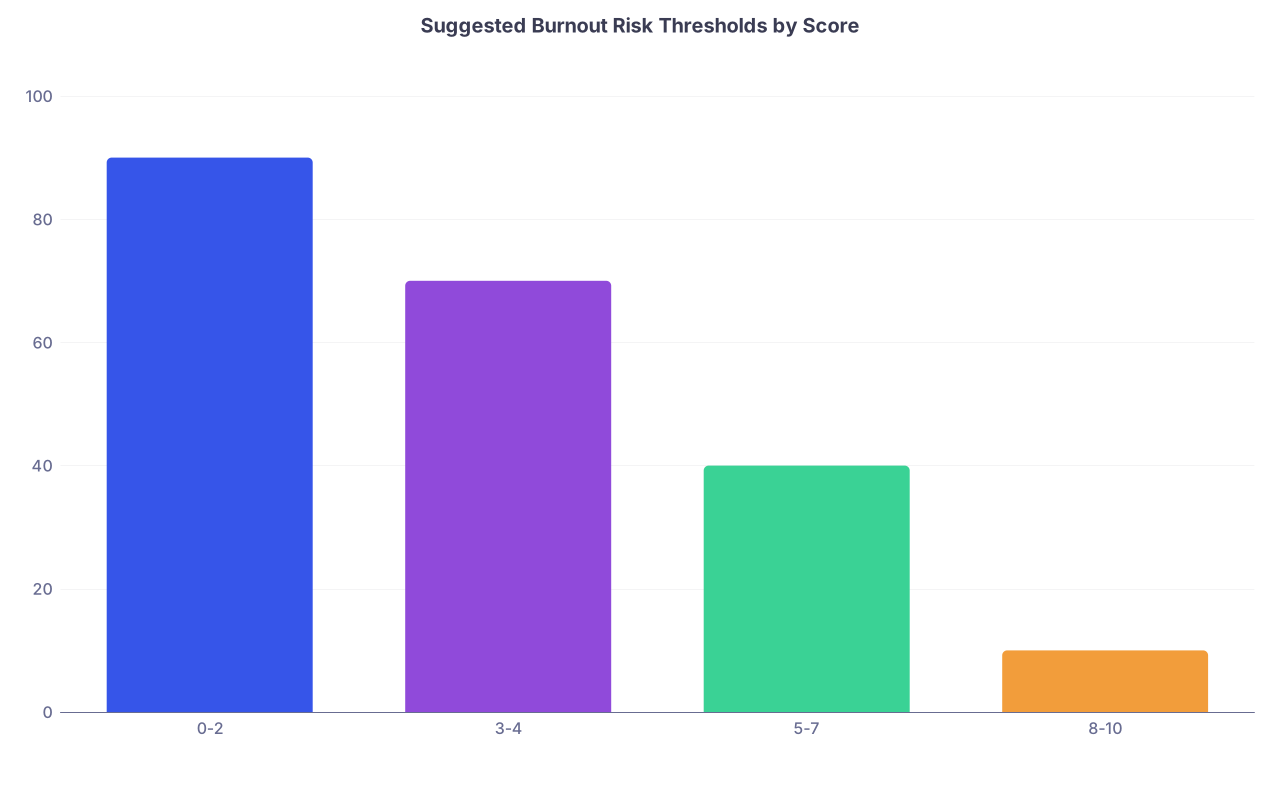
| Category | Value |
|---|---|
| 0-2 | 90 |
| 3-4 | 70 |
| 5-7 | 40 |
| 8-10 | 10 |
(Think of those values as approximate burnout risk levels. Low scores are not a personality flaw. They are data.)
Step 3: Pre-write your reflection prompts (5 minutes)
Under your metrics, add 3–4 fixed short questions you will answer in a sentence or two:
- “One moment that drained me today was…”
- “One moment that sustained me today was…”
- “One thing I did to protect myself today was…”
- “One thing I will change tomorrow is…”
Have them written out so you just fill in the blanks.
2. Morning of Day 1 of Call: Set Your Baseline and Failsafe
At this point your template exists. Now you anchor it.
Step 1: Baseline check before the chaos (5–7 minutes)
Before you start the first shift of your call week:
- Sit somewhere alone for a few minutes (call room, car, empty workroom).
- Complete your full metric set.
- Answer your 3–4 reflection prompts honestly.
This gives you a pre-call baseline. You will compare every other day this week against this.
Step 2: Decide your check-in time for the week (3 minutes)
You will not “fit it in when you can.” That guarantees it will not happen.
Pick one time window you will aim for every day of call:
- Pre-call days: after brushing your teeth, before leaving home.
- Long call days: right before lying down to sleep, even if that is 03:00.
- Night float: right after sign-out when you hand off or before you nap in the call room.
Block this in your calendar or set a repeating alarm: “10-min check-in.”
Step 3: Create a failsafe rule
Call is messy. So create a simple backup plan:
- If I miss the check-in at my chosen time,
- I will do it at the very next natural break (bathroom, sitting down to eat, or getting into the car to go home),
- Even if I only score the metrics and skip the reflections.
Perfectionism kills these systems. Consistency beats completeness.
3. Daily During Call: The 10-Minute Check-In Script
Now the core of the system. What you actually do in those 10 minutes.
At this point each day, you are not analyzing your whole life. You are just capturing a snapshot and making one small adjustment.
Minute 0–2: Pause and physiological reset
Wherever you are:
- Sit or stand with your back supported.
- Put your phone on Do Not Disturb for 5–10 minutes if safe to do so.
- Close your eyes for 3 slow breaths:
- In for 4 seconds, hold for 2, out for 6.
- Drop your shoulders deliberately.
- Unclench your jaw.
You are not meditating. You are resetting enough to access a tiny bit of clarity.
Minute 2–6: Score your metrics
Quickly move through your 0–10 scales:
- Circle or type the number. Do not overthink it.
- Use your gut first impression. If you are hesitating, pick the lower number.
- If you are too tired for story, at least get these numbers down.
Example from a resident on Q4 24-hour call:
- Physical energy: 3
- Emotional reserve: 4
- Cognitive focus: 5
- Connection to patients: 6
- Connection to colleagues: 4
- Sense of meaning: 6
- Acute distress: No
That is it. Data logged.
Minute 6–8: Short reflection
Answer your fixed prompts with short phrases, not essays.
- “One moment that drained me today was…”
- “One moment that sustained me today was…”
- “One thing I did to protect myself today was…”
- “One thing I will change tomorrow is…”
Real examples I have seen in notes:
- Drained: “Family yelling at me about wait times when I had 18 patients ahead of them.”
- Sustained: “Intern thanked me for helping them with that brutal consent.”
- Protected: “Ate real food instead of crackers at 01:00.”
- Change: “Will step outside for 3 breaths after each code instead of sprinting straight to notes.”
Keep it honest, not pretty.
Minute 8–10: Micro-adjustment plan for the next 24 hours
Now use your thresholds.
- Look for any score ≤ 3.
- Look for any sharp drop (3+ points) from baseline or previous day.
- Check if you answered “Yes” on acute distress.
Then follow a simple decision tree.

| Step | Description |
|---|---|
| Step 1 | Complete daily scores |
| Step 2 | Choose 1 small action for tomorrow |
| Step 3 | Talk to trusted person within 24h |
| Step 4 | Adjust sleep, food, or workload next shift |
| Step 5 | Seek urgent support now |
| Step 6 | Write down 1 change for next 24h |
| Step 7 | Any score 3 or less? |
| Step 8 | Emotional, connection, or meaning 2 or less? |
| Step 9 | Acute distress Yes? |
Your micro-adjustment must be:
- Actionable within 24 hours
- Under your partial control
- Small enough you will actually do it
Examples:
- “Ask co-resident to swap 30 minutes so I can eat one real meal.”
- “Tell attending I am hitting a wall and ask to step out of one non-urgent case for 10 minutes.”
- “Leave the hospital within 20 minutes of sign-out, no lingering charting unless emergent.”
Write that micro-adjustment down. That closes the loop.
4. Mid-Week Call: 5-Minute Trend Review and Course Correction
Around Day 3–4 of a heavy call stretch, you are usually not fine, no matter what you tell yourself.
At this point you add a once-per-week 5-minute review on top of your daily 10 minutes.
Quick visual trend check (3 minutes)
Look back at your numbers from Day 1 to now. You want to see the direction, not perfection.
If you are in a notes app or spreadsheet, this is where a quick mental plot matters. If you like visuals, you can graph a few scores after the week, but during call keep it simple: arrows and circles.
Typical patterns:
- Physical energy: usually trending down by Day 3–4.
- Emotional reserve: often stable until something cracks, then sudden drop.
- Connection to colleagues: often a proxy for isolation and team dynamics.
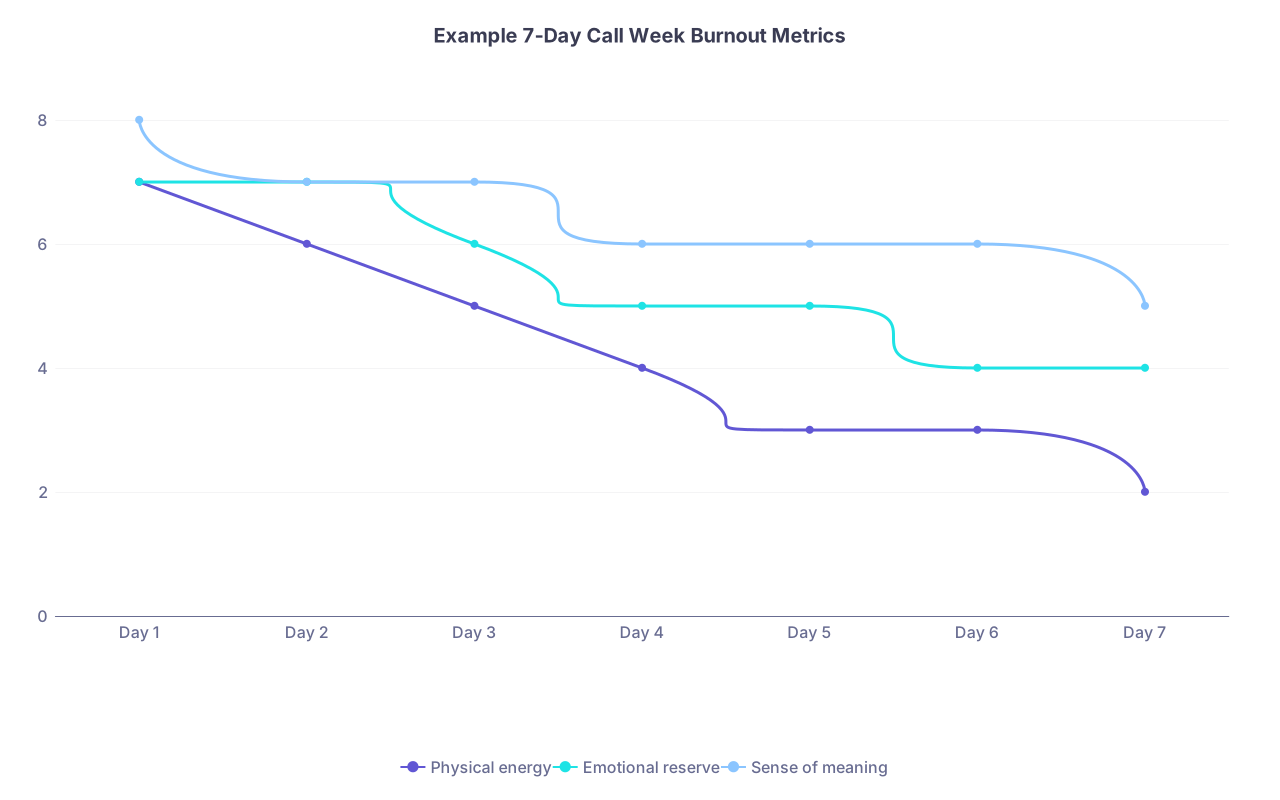
| Category | Physical energy | Emotional reserve | Sense of meaning |
|---|---|---|---|
| Day 1 | 7 | 7 | 8 |
| Day 2 | 6 | 7 | 7 |
| Day 3 | 5 | 6 | 7 |
| Day 4 | 4 | 5 | 6 |
| Day 5 | 3 | 5 | 6 |
| Day 6 | 3 | 4 | 6 |
| Day 7 | 2 | 4 | 5 |
Ask yourself:
- Which score has dropped the most from baseline?
- Where am I consistently ≤ 4?
- Have I actually done the micro-adjustments I wrote down?
Mid-week course correction (2 minutes)
Based on that quick review, pick one bigger lever to pull for the rest of the week:
- Sleep lever: Lock in a 90-minute sleep block at a predictable point (even if late).
- Food lever: Arrange one “real food” delivery / cafeteria run with a colleague each day.
- Boundary lever: Stop saying yes to non-essential tasks after a certain time.
- Connection lever: Intentionally sit with a co-resident or nurse for 5 minutes each shift to decompress.
Write this as: “For the rest of this call week, I will protect: _______.”
That becomes your anchor for Days 4–7.
5. End of Call Week: 15-Minute Debrief and Pattern Mapping
At this point the week is done or close to done. You are tired, but this is when the data you just collected turns into something useful.
Do this within 24–48 hours after your last call shift, ideally after some sleep but before you forget.
Step 1: Quick pattern summary (5–7 minutes)
Scan your daily scores and reflections. On a new page/note, write:
- Lowest scores reached for:
- Physical energy: __
- Emotional reserve: __
- Cognitive focus: __
- Connection to patients: __
- Connection to colleagues: __
- Sense of meaning: __
- Day they hit their lowest.
- Any “Yes” on acute distress?
Then list 3–5 trigger patterns you see. For example:
- “Every night after 23:00, my emotional reserve dropped below 4.”
- “On days I skipped lunch, my cognitive focus dropped 2–3 points.”
- “After conflict with an attending, connection to colleagues and meaning both fell.”
You are not writing a novel. You are labeling cause-effect pairs roughly.
Step 2: Identify your early-warning signs (5 minutes)
Look back to what happened 24–48 hours before your worst day.
Those are your early-warning signs next time. Examples I see over and over:
- You start snapping internally at minor pages.
- You stop caring about teaching interns or students.
- You eat exclusively vending machine food “because it is faster.”
- You fantasize about non-medical jobs during sign-out.
Write: “My early warning signs during call are: _______.”
This matters because on the next call block, you will respond to these earlier, not wait until full burnout mode.
Step 3: Decide 2 changes for your next call week (3–5 minutes)
Now translate your debrief into concrete tweaks:
- One structural change (schedule/habits/logistics)
- One relational change (how you use colleagues/mentors)
Examples:
- Structural: “On my next call week, I will pre-pack two real meals per shift and set an alarm to eat one before 21:00.”
- Relational: “I will text my co-resident group before call starts and agree to check in on each other once per shift.”
Write those down at the top of your template for next time. You are iterating your system.
6. Using the Data Beyond One Week: Protecting Yourself Over a Rotation
Daily 10-minute check-ins shine during call, but the real power shows when you repeat them over multiple rotations.
At this point you can step back and ask bigger questions.
Compare across different rotations
Over a couple months, look at average scores by rotation:
- ICU nights vs. wards call vs. ED.
- Surgical services vs. clinic-heavy blocks.
| Rotation | Physical | Emotional | Meaning |
|---|---|---|---|
| Wards call | 4 | 5 | 7 |
| ICU nights | 3 | 4 | 6 |
| Outpatient | 7 | 7 | 8 |
This is the kind of thing that helps you decide:
- What kind of practice is sustainable for you.
- Where you need more support or structural fixes.
- What you should say to your program leadership with actual data, not vague “I am tired.”
Track when micro-adjustments actually worked
Look back at your “One thing I will change tomorrow is…” lines.
Circle the ones where you noticed a real improvement in the next day’s scores. You are building your own “personal manual” for what actually shifts your burnout level.
Patterns I see:
- A 10-minute protected solo break > scrolling for 40 minutes in the workroom.
- Eating one proper meal > random snacking.
- One honest vent to a trusted co-resident > 3 hours of internal bitterness.
Keep those winners. Discard what did nothing.
7. Practical Tips to Make This Survive Real Call Chaos
If you ignore everything else, use these at the start of your next call week:
- Pre-write your template once. Do not reinvent it.
- Commit to 10 messy minutes a day. Not perfect, just done.
- Use thresholds. Numbers force you to take your own distress seriously.
- Decide in advance: “If _____ score is ≤ 3 for 2 days, I will talk to ______.”
And one more harsh truth: burnout is not solved by individuals filling out forms while systems stay broken. But daily check-ins keep you from ignoring your own internal alarms until it is too late.
You cannot fix hospital culture alone. You can, however, stop flying blind.


Key Takeaways
- Daily 10-minute check-ins during call work because they are structured, fast, and repeatable, not because they are “inspiring.”
- Use concrete metrics, clear thresholds, and one micro-adjustment per day to turn vague burnout into specific, actionable data.
- After each call week, debrief your patterns and tweak your plan, so every future call block is slightly less destructive than the last.


