

The way most residents “recover” after a brutal month is broken. Collapsing for 48 hours, doom-scrolling, then stumbling into the next rotation is not recovery. It is slow-motion burnout.
You need a structured, time-bound reset. Seven days. Not a vague intention to “rest more,” but a concrete, hour-by-hour framework that pulls you back from the edge and sets you up for the next block.
This is that framework.
Before Day 1: The 12-Hour Decompression Window
This starts the minute your brutal rotation ends—often post-call, half-delirious, smelling faintly of chlorhexidine and fear.
At this point you should not try to “be productive.” Your brain is fried. Your job now is to land the plane without crashing.
First 1–2 hours after sign-out:
- Get home safely. If you’re dangerously sleepy, call a ride or ask a co-resident. I’ve seen too many near-misses on the highway.
- Drop your stuff by the door. Do not start cleaning. Do not open your laptop.
- Eat something simple: eggs and toast, frozen meal, leftover curry. Protein + carbs. Not just chips.
- Hydrate: 16–24 oz water or electrolyte drink.
Next 4–6 hours:
- Shower. Full, hot, as-long-as-you-want shower. This is a psychological line between “that month” and “this reset.”
- Sleep. Blackout curtains. Phone on Do Not Disturb. White noise if you need it.
- No alarms unless you absolutely have to be somewhere later. Let your body take a first pass at debt recovery.
Evening (whenever you wake up):
- Light movement: 10–20 min walk outside. No running. You are not “getting back into shape” today.
- One easy, non-medical pleasure: mindless show, light video game, talking to a trusted friend.
- Go back to bed when you’re sleepy. If you’re wide awake at 2 a.m., that’s fine. We’re resetting over a week, not one night.
You officially start Day 1 when you first wake up after at least one decent block of sleep (5–7 hours) post-rotation, even if your circadian rhythm is a mess.
Overview: Your 7-Day Reset Framework
You’re going to move through three phases:
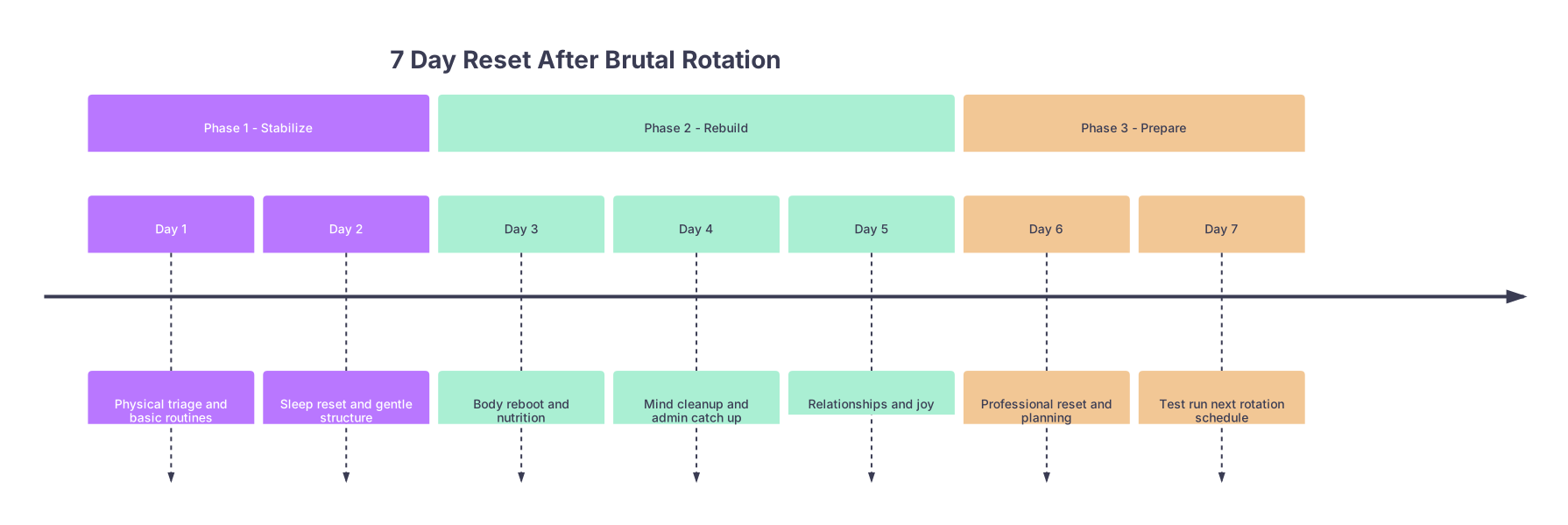
| Period | Event |
|---|---|
| Phase 1 - Stabilize - Day 1 | Physical triage and basic routines |
| Phase 1 - Stabilize - Day 2 | Sleep reset and gentle structure |
| Phase 2 - Rebuild - Day 3 | Body reboot and nutrition |
| Phase 2 - Rebuild - Day 4 | Mind cleanup and admin catch up |
| Phase 2 - Rebuild - Day 5 | Relationships and joy |
| Phase 3 - Prepare - Day 6 | Professional reset and planning |
| Phase 3 - Prepare - Day 7 | Test run next rotation schedule |
The point is not perfection. The point is to leave Day 7 with:
- A partially repaid sleep debt
- A calmer nervous system
- Basic life tasks under control
- A realistic plan for the next block
Now let’s go day-by-day.
Day 1: Physical Triage and Baseline
You’re not “off.” You’re in recovery mode. Different job.
Morning (or whenever you naturally wake up)
At this point you should start by scanning your body, not your email.
- Check: headache, neck/shoulder tightness, eye strain, stomach weirdness, back pain, any lingering viral crud from the hospital.
- Take care of the obvious: ibuprofen or Tylenol if needed, gentle stretching, refill chronic meds you’ve been ignoring.
- 10–15 minutes of sunlight exposure. Balcony, sidewalk, parking lot. No sunglasses if you can tolerate it. This starts nudging your circadian rhythm back.
Do NOT:
- Open your work email “just to clear a few things.”
- Start a deep clean of your apartment. That comes later.
Midday
Your goal block here: fuel and gentle movement.
- Eat a real meal: protein + fiber + something you actually like. Example: omelet with veggies + toast; rice + beans + chicken; large salad with added protein.
- 20–30 min easy walk outside. If you’re wiped, break it into 2 x 10 minutes.
- Chug water whenever you think of it. Aim for ~2 liters by bedtime.
Late Afternoon
You’re allowed one tiny bit of structure:
- Quick “life triage” list (10–15 min max):
- Bills due
- Licensure/GME emails that cannot wait a week
- Absolute deadlines (e.g., Step 3 registration, fellowship letter requests)
Write them down. Do not start tackling all of them today.
Evening
Your job now is to protect your first semi-normal night of sleep.
- Light dinner, ideally 3–4 hours before bed.
- Screen cutoff: 60 minutes before you want to be asleep.
- Do something low-stimulation: paper book, stretching, easy conversation.
- Set a target sleep window: pick when you want to be asleep tomorrow night (e.g., 11 p.m.–7 a.m.). You’ll move toward that over a couple of days.
Day 2: Sleep Reset and Gentle Structure
Day 2 is about reclaiming a predictable 24-hour cycle. You will not fix months of night float in one day, but you can take a strong step.
Morning
At this point you should set a wake time and stick to it. Even if sleep was choppy.
- Choose a wake time that fits your upcoming rotation (e.g., 6 a.m. for surgery, 7 a.m. for medicine).
- Get out of bed within 15 minutes of that time. No 90-minute doom-scroll.
- Hydrate + light breakfast within an hour of waking.
- 10–20 minutes of outdoor light again. Make this non-negotiable.
Late Morning / Early Afternoon
Build a simple skeleton schedule for the day:
- 1 block of movement (30–45 min):
- If you lift: very light, just moving through ranges of motion.
- If you’re deconditioned: a long walk, some stairs, or basic bodyweight work.
- 1 block of “life admin” (45–60 min):
- Pay urgent bills
- Respond to essential emails
- Confirm schedules for the upcoming rotation
- Any time-off requests that are about to expire
Set a timer. When it’s done, you’re done for today.
Evening
- Keep caffeine cutoff at least 8 hours before your target bedtime.
- Give yourself a wind-down hour:
- Dim lights
- No work screens
- Gentle stretching or a hot shower
- Try to be in bed at your target sleep time, even if you don’t fall asleep right away. Your body needs the cue.
Expect your sleep to still be weird. That’s fine. You’re laying track.
Day 3: Body Reboot and Nutrition Reset
Now that you’re not half-dead, you can address the actual chassis you’re driving.
Morning
At this point you should lean into routine:
- Same wake time as Day 2.
- Hydration on waking. Big glass.
- Protein-forward breakfast. Not just coffee and vibes.
Late Morning: Movement
Goal today: a more deliberate workout, but still submaximal.
Options:
- 30–40 min brisk walk with hills or intervals
- 20–30 min light strength circuit:
- Squats or lunges
- Push-ups (incline is fine)
- Rows (bands or weights)
- Planks
- Gentle yoga or mobility session if you’re wrecked
This is about reminding your body it exists for more than chair-spinning in the ICU.
Midday: Nutrition Audit

You’re not going to become a nutrition saint this week. But you can fix the worst damage.
Spend 20–30 minutes on:
- Quick pantry/fridge check
- Short grocery list with 3–4 easy meals you can repeat:
- Stir-fry kit + frozen shrimp or tofu
- Rotisserie chicken + salad mix + microwavable grains
- Eggs + pre-cut veggies + whole grain toast
- One snack category you’re upgrading (e.g., replacing vending machine candy with nuts + fruit).
If you can, shop today. If not, order delivery.
Evening
Cook or assemble one simple meal. Make enough for leftovers. Put tomorrow’s lunch in a container now.
Then, protect the sleep routine again. At this point, lights-out should feel at least somewhat intentional, not random collapse.
Day 4: Mind Cleanup and Admin Catch-Up
Here’s where you deal with the mental clutter that’s been buzzing in the background.
Morning
Same wake / light / hydration rhythm. Boring consistency is your friend.
Late Morning: Mental Debrief
At this point you should process the month you just survived, not just slam the door on it.
Take 30–45 minutes with a notebook or notes app:
- List 3–5 cases or moments that are still sticking with you:
- The code that went sideways
- The attending who humiliated you
- The patient who died alone
- For each, jot:
- What actually happened (2–3 sentences, factual)
- What you felt during and after
- One thing you learned or would do differently next time
- One thing that was completely outside your control
If something feels particularly heavy, flag it as “needs follow-up” with:
- A trusted co-resident
- A mentor or chief
- Therapy or counseling (yes, including your GME resources)
You are not weak for needing this. You’re realistic.
Midday: Admin Power Hour
Set a 60–90 minute block. Phone on Do Not Disturb. This is your cleanup sprint.
Tasks:
- Sign any lingering notes or orders in the EMR (if required post-rotation)
- Update duty hour logs
- Respond to:
- PD / chief emails
- Required training modules reminders
- Evaluation requests that are time-sensitive
- Check licensing / Step / board deadlines
- Glance at your schedule 1–2 months out: any conferences, vacations, interviews, exams?
You’re not planning your whole life. Just preventing landmines.
Evening: Cognitive Off-Ramp
You just did a lot of mental work. Now, give your brain a clear off-switch:
- Something engaging but non-medical:
- A movie you love
- Board game night
- Deep dive into a hobby YouTube channel (not medicine)
Be actively off. Not half-watching TV while thinking through that bad code.
Day 5: Relationships and Joy (Yes, Actual Joy)
By now, your basic physiology and admin are less chaotic. Time to reconnect with the parts of your life that are not on your ERAS CV.
Morning
Same routine. You should start waking a little more easily by Day 5. If not, it will come.
Late Morning: Social Triage
At this point you should repair the small fractures residency causes.
Spend 20–30 minutes deciding:
- Who do you actually miss?
- Who gives you energy instead of draining it?
- Who needs a quick “hey, I survived that month” text?
Then:
- Send 3–5 short, honest messages:
- “I just finished a brutal block. I’ve been MIA but would love to catch up this week or next.”
- “I finally have a day off. Want to walk/grab coffee later?”
- If you have a partner or family nearby, plan something clearly defined and simple:
- 60–90 min walk and coffee
- Dinner at home with a no-phones rule
- Watching a show together from start to finish
Afternoon: Something Just for You

You’re allowed to enjoy yourself. Permission granted.
Pick one thing that feels like you pre-residency:
- Play music
- Draw or paint
- Read sci-fi or fantasy
- Go for a scenic drive
- Visit a park or museum
Set a boundary: no med podcasts, no uptodate, no “I’ll just check my work email for a sec.”
Evening
Short reflection (5–10 min):
- What activities today gave you the most energy?
- Who made you feel most like yourself?
- What’s one small version of this you can realistically keep during the next rotation? (e.g., 10 minutes of guitar at night; weekly Saturday coffee with a friend)
Write that down. You’ll plug it into your ongoing schedule on Day 6–7.
Day 6: Professional Reset and Next-Rotation Planning
The last two days are about re-entry. You’re shifting from recovery to preparation.
Morning
Same wake time. You should feel at least somewhat more human by now.
Late Morning: Skills and Knowledge Check (Optional but Useful)
At this point you should remind yourself you’re competent, especially if the last rotation beat you up.
Spend 45–60 minutes on focused, non-panicked learning:
- 20–30 UWorld or TrueLearn questions in your specialty
- Review 2–3 high-yield topics you struggled with last month
- Skim your evaluations (if available) from the last few rotations:
- Look for patterns: “shows initiative,” “needs to work on efficiency,” “great with families”
- Note 1–2 specific, actionable goals for the next block
Midday: Next-Rotation Logistics
Pull out your schedule and run a logistics drill:
- Start dates, end dates
- Call schedule / night shifts
- Commute time
- Parking / badge access if at a new site
Then answer:
- What will my typical day look like? (time leaving home, time home)
- Where does sleep fit? (target in-bed / out-of-bed times)
- Where can I realistically fit:
- 3 short movement sessions per week
- 1 grocery or food prep window
- 1 social/hobby anchor (the one from Day 5)
Write this into a simple weekly template. Not fantasy. Realistic.
Day 7: Test Run and Lock-In
This is your dress rehearsal. You’re still off, but you’re practicing living like you’re back on.
Morning
At this point you should wake up as if it’s a workday:
- Set your alarm for the exact time you’ll need tomorrow.
- Go through your morning sequence at work-pace:
- Out of bed
- Bathroom / shower
- Dress
- Coffee / breakfast
- Out the door (or at least ready) by the time you’d need to leave
You’ll see where the bottlenecks are: too slow in the shower, no clean scrubs, coffee takes too long. Fix what you can today.
Late Morning: Environment Reset

60–90 minutes of targeted environment cleanup:
Focus on:
- Bed and bedroom (sleep sanctuary first)
- One surface in the kitchen (counter or table)
- One “command center” space:
- Where your bag, keys, ID, and badge will live
- Where you toss mail and keep your planner or whiteboard
You’re not deep-cleaning the world. You’re removing future friction.
Afternoon: Gear and Food Prep
- Lay out:
- Work bag with essentials (stethoscope, pens, small notebook, chargers)
- ID badge, parking pass
- One backup snack stash in your bag or white coat
- Prep:
- At least 1–2 meals for the first 2–3 days:
- Could be as simple as pre-made salads and rotisserie chicken
- Easy grab-and-go breakfast items:
- Greek yogurt, bananas, overnight oats, boiled eggs
- At least 1–2 meals for the first 2–3 days:
Think like a tired future-you: “What will I be grateful is already done?”
Evening: Mental Framing and Boundaries
Last step.
Take 15–20 minutes and write down:
- Three things you’re proud of from this past brutal month (yes, you have them)
- Two concrete goals for this coming rotation:
- One clinical (e.g., “present more concisely on rounds”)
- One personal (e.g., “move my body 3x/week, even if just 10 minutes”)
- Two hard boundaries:
- Example: “No checking email after 9:30 p.m. unless on call.”
- Example: “I leave the hospital by 6:30 p.m. if my work is done, even if others are hanging around to impress.”
Then close the book. Watch something light. Go to bed at your work-night target time.
You’re ready.
What This 7-Day Reset Actually Fixes
You’re not magically healed. But if you follow this timeline with reasonable effort, by the end of Day 7:
- Your sleep schedule is at least partially realigned
- Your body has moved, stretched, and been fed real food
- Your mind has offloaded the ugliest parts of the last rotation
- Your admin and deadlines are not silently sabotaging you
- Your next rotation has a basic logistical and emotional plan
- You have one or two non-negotiable “you” activities preserved
Burnout doesn’t come from one bad month. It comes from stacking bad months with no reset in between.
So here’s your first action step:
Right now, block off the next 7 days in your calendar and label them “RESET – DO NOT SCHEDULE.” Then open Day 1 of this plan and schedule the exact time you’ll take that first 10–15 minute walk outside.


