

The fantasy that “you can just take vacation whenever it’s lighter” is one of the fastest ways to burn out during residency.
You cannot wing vacation planning as a resident. The system is not built for spontaneity. The residents who stay sane treat vacation like a clinical procedure: planned, timed, documented, and protected.
This is your yearly blueprint to do exactly that—month by month, then rotation by rotation, then week by week as vacations get close.
Big Picture: Your Vacation Reality in Residency
Before we go month-by-month, you need the frame.
Most programs give:
- 3–4 weeks of paid vacation per academic year (some split as 15–20 days)
- Often plus a few “educational” or “conference” days
- Very strict rules on blackout periods (ICU months, July, certain holidays)
The mistake I see constantly: residents “save up” vacation for later, then hit February exhausted, stuck in ICU, with zero usable blocks left.
At this point, you must accept three truths:
- You cannot rely on future you to be less tired.
- The rotation calendar, not your feelings, determines when you can rest.
- If vacations are not blocked early, they will be stolen by chaos—switches, sick calls, staffing gaps.
So we build the year backwards from where you are most likely to burn out.
Step 1: The Yearly Blueprint – Before July 1
Assume you are about to start (or are early in) an academic year. Here is how to approach it.
3–4 Months Before New Year Start (March–April)
At this point you should:
- Get your draft rotation schedule as soon as it appears (even if “tentative”).
- Identify:
- ICU and night float months
- Heaviest ward blocks
- Lighter electives / outpatient / research blocks
- Known key dates (weddings, exams, partner’s schedule, childcare)
Print your schedule. Literally print it. Grab a pen.
Circle your non‑negotiables:
- Sibling’s wedding in October
- Partner’s graduation in May
- Religious holidays you must be off
- Important exams (Step 3, in‑training if you want a buffer)
Mark your high‑risk burnout months:
- Back‑to‑back wards
- ICU/CCU months
- High winter viral season if you are in peds or IM
- Heavy consult rotations with constant pages
Tentatively assign vacation clusters, not random days:
- Aim for 5–7 day stretches at least twice a year
- Use remaining days for:
- Strategic long weekends
- Buffer around critical life events
At this point you should have:
- A rough plan: “One week after my first ICU month, one week mid‑winter, remaining days grouped around big events.”
Do not ask for exact days yet. Wait until the program shares vacation rules for the year.
Step 2: Program Rules – Set Your Constraints Early
Most programs quietly sabotage residents by “assuming” you already know the rules. You probably do not.
By late April–early May, at this point you should:
- Ask chief residents or coordinator for:
- Vacation policy (days vs weeks, minimum block size)
- Blackout rotations / months
- Max residents off per block
- Rules for:
- Interview days (for fellowship)
- Conference time
- Carrying over or losing days
Put this into a simple reference table for yourself.
| Item | Typical Rule Example |
|---|---|
| Total vacation | 4 weeks per year |
| Minimum block size | 1 week (no single days) |
| Blackout months | July, December ICU |
| Max off per rotation | 1 resident per team |
| Conference days | 5 days, separate from PTO |
Once you know the rules, adjust your earlier plan:
- Move any vacation that accidentally landed on blackout rotations.
- Combine conference + vacation if allowed (example: 3 days conference + 2 days vacation = one full week away).
At this point your year should have:
- 2–3 clear “anchor” vacation blocks
- 1–2 flexible blocks you can shift depending on life events
Now we talk timing through the academic year.
July–September: Surviving the Start of the Year
Most programs front‑load pain: wards, ICU, night float. Burnout risk here is quiet but real.
July
You are adapting. You do not yet know what tired means in this program.
At this point you should:
- Not schedule vacation this month unless required for a life event.
- Watch:
- Where seniors and PGY3s put their vacations.
- Which rotations actually run you into the ground vs just look scary on paper.
Use this month for reconnaissance:
- Note which attendings are reasonable about coverage.
- Learn who the “schedule wizards” are among your peers.
August
The adrenaline of starting is gone. You are just… working.
At this point you should:
- Lock in your first real vacation block if not already submitted.
- Ideal timing: end of your first or second brutal rotation.
- Example:
- July: wards
- August 1–14: ICU
- August 15–21: Vacation week
- Decide: is this a staycation or travel?
- Early in residency, staycations are underrated. Sleep, laundry, reset.
Also:
- If you have an October/November life event, get those vacation forms submitted now.
- Chiefs are much more flexible in August than in November.
September
This is your first danger zone. You have been running for 2–3 months.
At this point you should:
- Check your remaining vacation balance:
- If you have 4 weeks total and used 1 in August, you have 3 left.
- Decide what winter will look like:
- One full week in December or January?
- Two strategic long weekends instead?
If you have not taken any time off yet, do not tell yourself “I feel okay, I can wait.” That is how you hit November on empty. Book something for before the New Year ends.
October–December: The Creep Toward Exhaustion
This is when a lot of residents quietly fall apart.
October
At this point you should:
- Take a 3–7 day break if you have not done so yet.
- Even a Wednesday–Sunday break helps: 3 PTO days + weekend.
- Protect at least one non‑negotiable weekend this month with no extra shifts.
If October is stacked with weddings, interviews, family events:
- Use vacation days to bundle around them instead of scattering.
- Thursday–Monday blocks around a Saturday wedding.
- Travel Friday, recover Sunday, return Monday evening.
November
Grind month. Weather worsening, daylight shrinking, no real holidays off for many of you.
At this point you should:
- Look ahead 6–8 weeks:
- Where will you be for Thanksgiving, December holidays, New Year’s?
- If your program assigns holiday coverage by lottery or seniority:
- Decide which holiday you care less about and plan vacation away from it.
- Work Thanksgiving, vacation over New Year’s.
- Or opposite.
- Decide which holiday you care less about and plan vacation away from it.
If you are stuck working the holiday you hate:
- Use the week after as your rest period.
- Burnout prevention is about offsetting, not pretending you can avoid all bad schedules.
December
ICU. Flu season. Family expectations. Emotional landmines everywhere.
At this point you should:
- Be extremely realistic:
- If you are on wards/ICU over holidays, do not burn vacation on microbreaks mid‑month.
- Instead aim for a proper week immediately after your hard rotation.
Also:
- Decide how much social obligation you can tolerate on vacation.
- If you are on the edge, it may be better to spend vacation quietly instead of flying across the country to argue with relatives about your work hours.
Here’s what an effective first‑half‑year might look like:
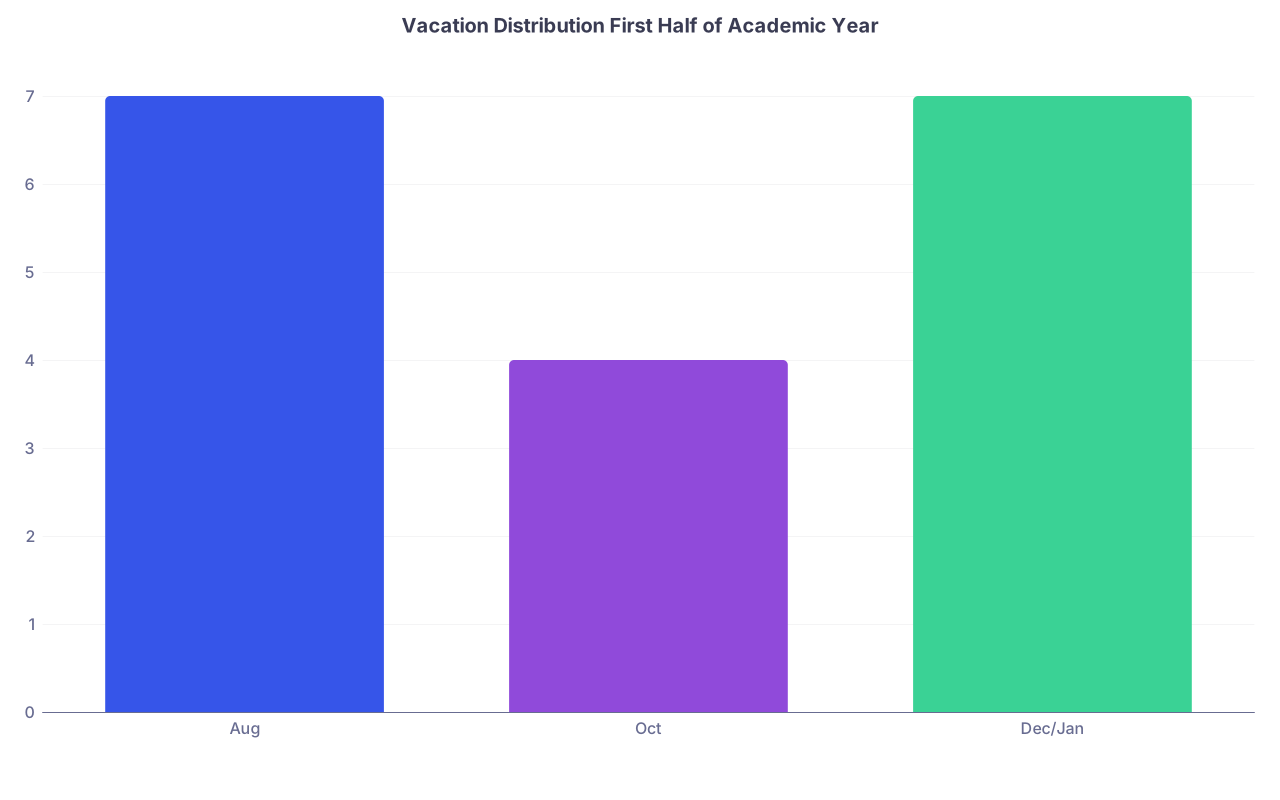
| Category | Value |
|---|---|
| Aug | 7 |
| Oct | 4 |
| Dec/Jan | 7 |
That is two full weeks + one mini‑break. Much better than “maybe I will take something after winter if it calms down.”
January–March: The Mid‑Year Cliff
This is when even the strongest residents start saying, “I am so tired I cannot think straight.”
January
Cold, dark, post‑holiday letdown. Perfect time for intentional rest.
At this point you should:
- Take your second major vacation block if possible.
- If you did not get time in December, January is your reset.
- Use this block for:
- Actual travel if your body is holding up.
- Or a deep recovery week: sleep, exercise, no alarms, no pages.
Be ruthless:
- No “catching up on research” during your first 3–4 days.
- If you absolutely must do academic work, confine it to the last 1–2 days.
February
This is prime burnout month. Friends in non‑medical fields are living normal lives, and you are drowning in RSV.
At this point you should:
- Audit yourself:
- Sleep: Are you averaging under 6 hours?
- Mood: Snapping at nurses, co‑residents, family?
- Errors: Making more small mistakes?
If the answer is yes to all three:
- Pull a mini‑vacation or 1–2 days off ASAP during a lighter rotation.
- Even a Friday off on an ambulatory block can reset you significantly.
If your schedule allows:
- Align a 3‑day break with something that gives you joy:
- A concert
- A visit from a friend
- A short road trip instead of another flight disaster
March
(See also: A 7-Day Reset Plan for Residents After a Brutal Rotation Month for more.)
Second half of the academic year starts to feel endless here.
At this point you should:
- Look at your remaining vacation days:
- Ideally you still have ~1 week (or at least 4–5 days) left.
- Map them against:
- Any upcoming board exams (Step 3, specialty boards)
- Heavy blocks in April–June
Strategic move:
- Use part of this remaining time as protected study + recovery before exams.
- Example:
- 3 days purely off
- 2 days light study for Step 3
- Example:
- Do not schedule the exam immediately after a 14‑day stretch of nights. That is how people fail and burn out simultaneously.
April–June: Landing the Plane Without Crashing
The year is almost over, but that does not mean you sprint through the wall.
April
At this point you should:
- Finalize:
- End‑of‑year vacation
- Any rollover rules (some programs wipe unused days on June 30)
- If you are a senior applying for fellowship:
- Start thinking how next year’s interviews will intersect with vacation.
If you have unused time:
- Do not hoard everything for June.
- Take a few scattered days in April/May when patient volumes may be lower (depends on specialty and region).
May
You can see the new academic year on the horizon. Fatigue plus anticipation is a weird mix.
At this point you should:
- Use your last significant block of vacation if:
- You have boards coming up.
- You are transitioning between PGY years with new responsibility (PGY2, PGY3).
- Or, if you are relatively stable:
- Place your last block right between your two hardest rotations.
Example structure:
- April: wards
- First half May: elective
- Late May: 1 week vacation
- June: ICU
You want the buffer before the final heavy month, not some theoretical big trip after June that you might not even have the energy to enjoy.
June
This month lies to you. It says, “Just push. You are almost done.”
Residents crash here:
- They run out of vacation.
- They are covering for people finishing, moonlighting, moving.
At this point you should:
- Guard any remaining off days aggressively:
- Say no to extra shifts unless you truly need the money.
- Avoid major life commitments back‑to‑back with work (moving, back‑to‑back weddings, etc).
If you managed this well, June should feel like:
- Tired but functional.
- Not hollowed out.
Zoom In: Rotation‑Level Planning
Year plan done. Now we step closer.
For each 4‑week block, at this point you should:
Week 0 (before block starts):
- Scan the calendar:
- Any holidays?
- Any continuity clinic requirements that make vacation tricky?
- Decide:
- “Is this a good block for a day or two off?”
- Or “This is a grind month, I will just survive and rest before/after.”
Week 1–2:
- If you have a vacation / days off scheduled for Week 3–4:
- Remind your attending and team early: “I will be off starting the 21st.”
- Make sure coverage / sign‑out expectations are clear.
- If you are not scheduled for vacation:
- See how you feel by the end of Week 2.
- If you are crashing and the block is flexible (clinic, elective), ask about adding a day off week 3.
Week 3–4 (approaching vacation):
- Front‑load any mandatory tasks:
- Notes
- Evaluations
- Required modules
- Protect the 24 hours before vacation:
- Do not agree to stay late “just this once” unless safety demands it.
- Say no to nonessential extras:
- Teaching sessions you are not required to run
- Optional meetings
The Microview: Week‑Before and Week‑Of Vacation
This is where burnout prevention either works or fails.
7 Days Before Vacation
At this point you should:
- Freeze new commitments:
- No last‑minute research meetings that fall during your vacation.
- No “sure, I will help cover that weekend just before I leave.”
- Tell the key people:
- Co‑residents
- Nurses you work closely with
- Fellow or attending who plans the service
Phrase it simply:
- “I am off next week. I want to make sure I close the loop on everything before I go.”
2–3 Days Before
At this point you should:
- Clean all loose ends:
- Close charts.
- Sign notes.
- Finish any consult follow‑ups.
- Identify:
- Any patients or projects you deeply care about—hand them off cleanly.
This matters. Walking into vacation with 12 unfinished notes in the back of your mind is not rest.
During Vacation
The burnout‑preventing move is not complicated. It is just rare.
At this point you should:
- Disconnect as much as the program allows:
- Turn off pager. Block hospital numbers if they keep calling “just with a quick question.”
- No checking the EMR “to see how that patient is doing.”
- Set one very light structure:
- 1–2 anchors per day: a walk, a meal out, a call with someone you like.
- The rest of the time: guilt‑free nothing.
And no, you do not “owe” your program email responsiveness while on vacation.
1–2 Days After Vacation Starts
You will be tempted to start thinking about your return. Fight it off until at least halfway through your time off.
Tools That Actually Help (Not Just Pretty Planners)
You do not need a $50 planner. You need a system you will actually touch once a week.
Minimal effective setup:
- One digital calendar:
- Rotations as all‑day events (color A)
- Vacation as multi‑day events (color B)
- Exams / travel as events (color C)
- One shared doc or note:
- “Vacation and Time Off – 2024–2025”
- Sections:
- Confirmed dates
- Requested but not approved
- Ideas for future blocks
Use a quick timeline view to keep your brain clear:
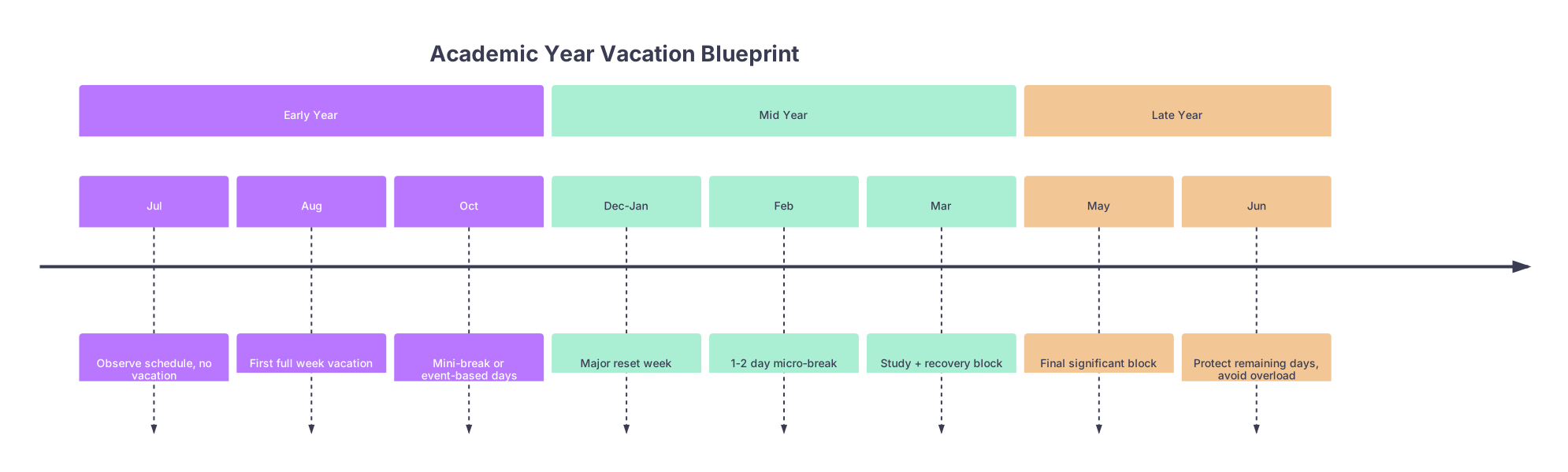
| Period | Event |
|---|---|
| Early Year - Jul | Observe schedule, no vacation |
| Early Year - Aug | First full week vacation |
| Early Year - Oct | Mini-break or event-based days |
| Mid Year - Dec-Jan | Major reset week |
| Mid Year - Feb | 1-2 day micro-break |
| Mid Year - Mar | Study + recovery block |
| Late Year - May | Final significant block |
| Late Year - Jun | Protect remaining days, avoid overload |
Looking at this regularly prevents the “I had no idea I had not taken any time since August” phenomenon.
Closing: What You Actually Need To Remember
Keep it simple:
- Front‑load the planning, not the suffering. Map your rotation year, lock anchor vacations early, and move them only if absolutely necessary.
- Use vacation strategically around heavy blocks and emotional landmines, not randomly when you are already broken.
- Protect the boundaries: no work creep into vacation, no chronic over‑commitment just before or after time off.
Do that, and you stop seeing vacation as a rare emergency intervention—and start using it as the yearly rhythm that keeps you from burning out at all.


