

The first year of residency does not randomly burn people out. It does it on a schedule.
You’re not falling apart because you’re weak. You’re falling into a pattern thousands of interns before you have followed almost month by month. Once you see the pattern, you can interrupt it.
This is the month‑by‑month burnout timeline for PGY‑1—and what you should watch for, expect, and actively do at each point.
Big Picture: Burnout Risk Across PGY‑1
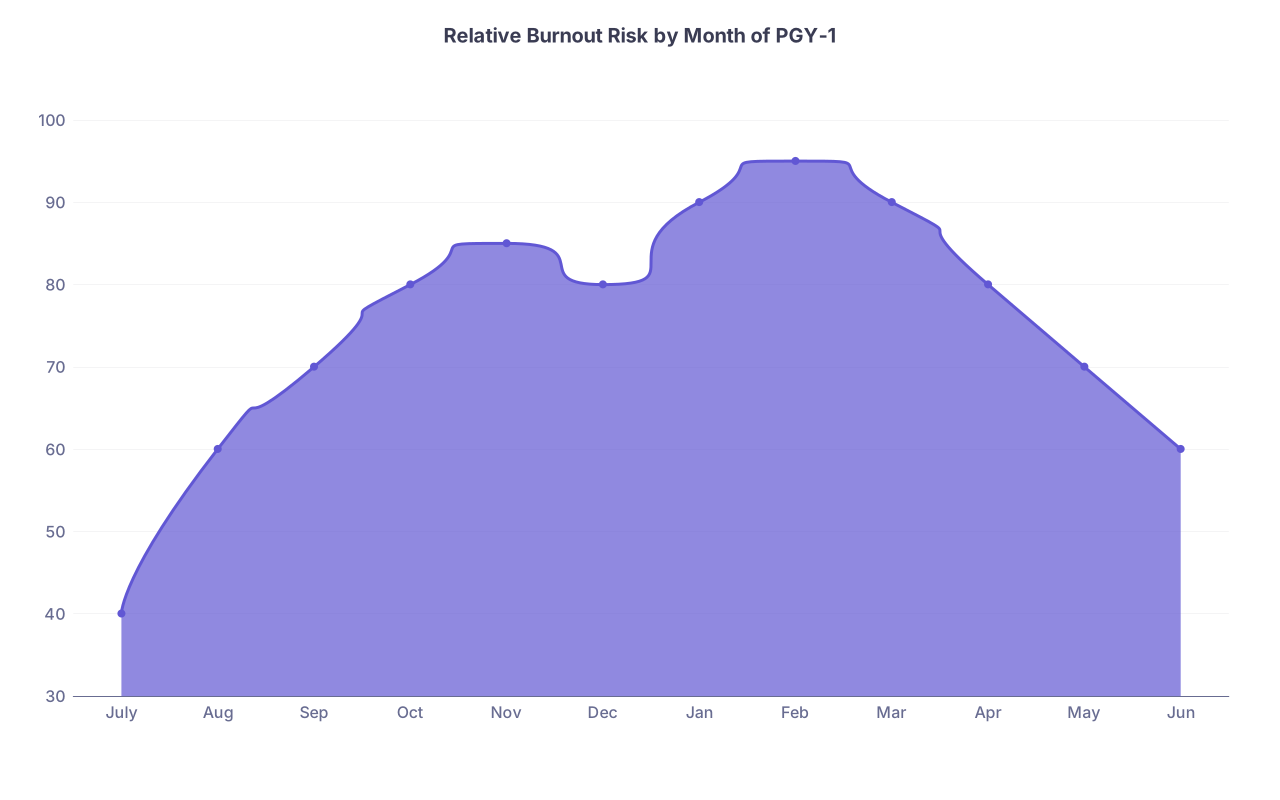
| Category | Value |
|---|---|
| July | 40 |
| Aug | 60 |
| Sep | 70 |
| Oct | 80 |
| Nov | 85 |
| Dec | 80 |
| Jan | 90 |
| Feb | 95 |
| Mar | 90 |
| Apr | 80 |
| May | 70 |
| Jun | 60 |
Read that as relative intensity, not destiny. Your job is to flatten that curve.
July – Shock, Adrenaline, and Silent Panic
At this point you should expect: chaos, overcompensation, and a weird mix of excitement and terror.
Typical schedule/feel:
- New intern orientation → a few “soft” days
- First real call/nights → massive adrenaline
- Constant “I have no idea what I’m doing” energy
Early warning signs in July:
- You can’t fall asleep even when you’re exhausted (mind running through patient lists).
- You rehearse orders and pages in your head for hours after leaving.
- You apologize constantly—“sorry, I’m just the intern”—to nurses, seniors, literally everyone.
- You skip meals because you “don’t want to look slow” or “can’t leave the floor.”
- You obsessively check Epic/Cerner at home to make sure you didn’t miss a result.
That’s not full burnout yet. That’s acute stress. But if you hardwire these patterns now, they’ll wreck you later.
What you should do in July:
Week 1–2: Build survival routines, not perfection.
- 1 non‑negotiable meal per shift where you sit down for 10 minutes. Even if it’s vending‑machine crackers.
- 1 check‑in text or call per day to someone outside medicine. Short is fine.
- Decide your “no-go” limit: e.g., “I will always call my senior if I am unsure about X, Y, Z.” Then actually follow it.
Week 3–4: Set boundaries early.
- Practice one sentence: “I will finish this note, then I need 10 minutes to eat, I’ll be right back.”
- Stop opening your EHR app after you get home unless you’re on home call. You’re not the night float.
At this point you should be tired but still curious. If you’re already dreading every shift by the end of July, that’s a yellow flag.
August – Competence Anxiety and Comparison Trap
At this point you should expect: comparison, imposter syndrome, and the first cracks in enthusiasm.
You’ve survived your “firsts”:
- First code
- First angry family
- First time your senior looked annoyed
Now the adrenaline fades and the self‑judgment ramps up.
Warning signs in August:
- Constant comparison: “She’s so much faster than I am,” “He already knows all the guidelines.”
- You start silently resenting consults, nurses, or other services instead of asking for help.
- Charting time explodes because you’re re‑reading everything out of fear.
- You’re still thinking about work while brushing your teeth, driving, showering—no mental off‑switch.
At this point you should:
Week 5–6: Normalize being slow.
- Ask your senior: “Realistically, how long should X take me?” Get an actual number instead of guessing.
- Time yourself on a few tasks (admission H&P, discharge summary, prerounding) so you can see progress.
Week 7–8: Set a floor for sleep.
- Choose a hard minimum (4–5 hours on bad days, 6–7 on good ones). Below that more than 2–3 nights in a row is a red flag.
- If you’re routinely below that because of work, speak with chief or program leadership early. I’ve watched people wait until they’re completely broken. Do not be that person.
Your goal by end of August: you feel incompetent often, but not hopeless.
September – The “New” Is Gone, the Workload Isn’t
At this point you should expect: the first real wave of emotional exhaustion.
The novelty has worn off. The pager tone now triggers a tiny spike of dread. You’ve had at least one shift where everything went wrong.
Common September patterns:
- Cynicism creeps in: “They’ll be back in a week; this doesn’t matter.”
- You start defaulting to minimal conversation with patients and families to save time.
- You feel annoyed by learners (students, off‑service rotators) because they “slow you down.”
Early burnout signs:
- You stop doing anything on post‑call days except lying on the couch staring at your phone.
- You say “I don’t care” a lot—about rotations, learning, even evaluations.
- Your friends outside medicine start to feel like “too much effort.”
What you should do in September:
Week 9–10: Protect one thing that makes you feel human.
- 1 recurring, scheduled, non‑work thing each week: gym class, call with sibling, soccer league, Sunday breakfast. Treat it like a clinic appointment. You don’t casually skip clinic.
- Tell co‑interns about it so they understand when you guard that time.
Week 11–12: Watch for isolation.
- If you realize you haven’t talked honestly with anyone about how hard it is in >2 weeks, that’s a problem.
- Aim for one real conversation per week with a co‑resident: “What’s actually been rough this week?”
At this point you should be seeing the job more clearly. If your main feeling is, “I made a mistake going into this field,” take that seriously and bring it to a mentor or therapist, not just group venting.
October – Efficiency vs. Humanity Trade‑off
At this point you should expect: you’re faster…but colder.
You know your EMR shortcuts, your attendings’ quirks, the radiology people on a first‑name basis. You’re getting efficient. The risk now: you trade away the parts of the job that used to make it meaningful.
Warning signs in October:
- You skip introductions and just say, “Hi, I’m your doctor,” without eye contact.
- You stop asking about social history because “it doesn’t change management.”
- Your internal monologue about certain patients becomes contemptuous—“frequent flyer,” “non‑compliant,” “train wreck”—and you barely notice.
Burnout is moving from exhaustion → depersonalization here.
What you should do in October:
Weeks 13–14: Choose one small, human practice.
- Example: Sit down for 30 seconds with each new admission and ask one non‑medical question.
- Or end every encounter with, “What’s the one thing worrying you most right now?”
Weeks 15–16: Audit your off‑service time.
- Look at your non‑call weeks. If they’re instantly eaten by board prep, errands, and mindless scrolling, you’re not actually recovering.
- Build a tiny ritual of “leaving the hospital behind”: music on the drive home, changing clothes as soon as you walk in, 5 deep breaths before you open your phone.
If you catch yourself saying “I hate everyone” more days than not, that’s not just a personality quirk. That’s burnout talking.
November – Accumulated Grief and Quiet Numbness

At this point you should expect: at least a few cases that stick with you. A bad outcome, an unexpected death, maybe an error or near‑miss.
The danger isn’t the grief. It’s the shutdown.
Warning signs in November:
- You replay a specific case over and over but never talk about it.
- Or the opposite: you feel nothing at all when you sign the death note.
- You start thinking, “If I don’t feel anything, I can’t get hurt.”
Also, holidays are coming. You may be on nights for Thanksgiving or Christmas. That hits harder than people admit.
What you should do in November:
Week 17–18: Name the hard cases.
- Pick one person who can hear it: co‑resident, therapist, partner. Tell the story out loud once.
- If your program has debriefs, go, even if you just sit quietly.
Week 19–20: Plan your holiday boundaries.
- If you’re working a major holiday, schedule a “fake” one: brunch, Zoom call, or dinner on a nearby day.
- Decide in advance: What’s the minimum “holiday” you want? Then communicate that to family instead of just ghosting them or resenting them.
At this point you should feel tired, maybe sad, but still able to care. If you feel hollow or numb most of the time, that’s burnout’s middle stage.
December – Performance vs. Collapse
At this point you should expect: to be running on fumes while the world expects “festive.”
Performance is usually peaking: you’re functional, efficient, praised for being “solid.” Interns often get their first glowing comments right as they start feeling dead inside.
Warning signs in December:
- You’re doing fine on evaluations but you fantasize about quitting medicine weekly.
- You start using phrases like “I just need to survive until vacation,” and vacation is the only thing keeping you going.
- You drink or scroll or game to shut off your brain, not because you actually enjoy it.
What you should do in December:
Week 21–22: Pre‑empt holiday crash.
- If you have a block of time off, do not schedule it wall‑to‑wall with family or obligations. You need at least one true do‑nothing day.
- Expect a “crash day” at the start of vacation where you feel sick/tired/emotional. That’s normal.
Week 23–24: Mid‑year self‑audit.
- Quick check in three domains:
- Sleep: average hours on call vs non‑call.
- Mood: how many days last month did you feel “mostly okay” vs “mostly awful”?
- Connection: how many genuine conversations did you have that weren’t about work?
- Quick check in three domains:
If “mostly awful” days outnumber “mostly okay” for a full month, that’s not a phase. That’s burnout.
January – The Wall
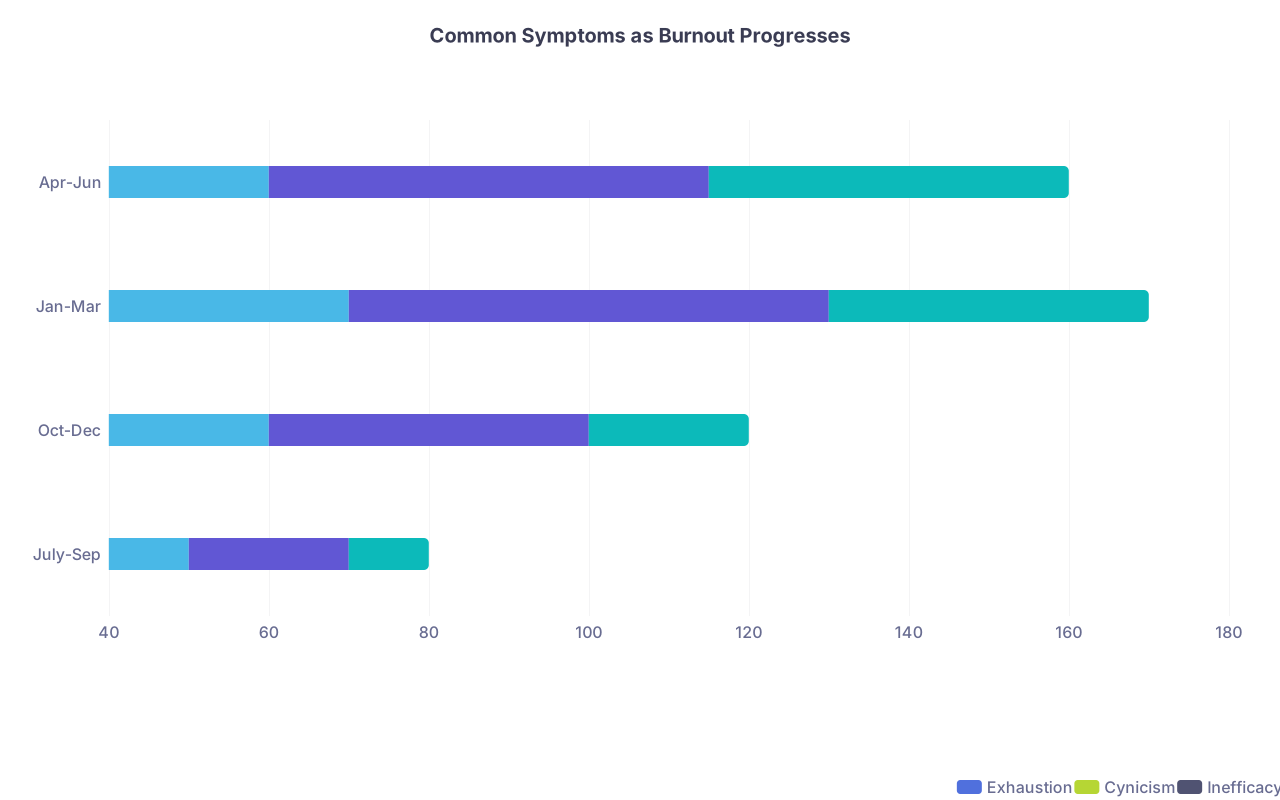
| Category | Exhaustion | Cynicism | Inefficacy |
|---|---|---|---|
| July-Sep | 50 | 20 | 10 |
| Oct-Dec | 60 | 40 | 20 |
| Jan-Mar | 70 | 60 | 40 |
| Apr-Jun | 60 | 55 | 45 |
At this point you should expect: a serious dip. Short days, bad weather (in a lot of places), no more “new intern” sympathy. You are expected to be competent now.
This is where many interns break.
January red‑alert signs:
- You wake up with a sense of dread almost every work day.
- You cry in the bathroom or stairwell more than once a week.
- You start making small but worrying mistakes—missed labs, near drug dosing errors—because your brain is just done.
- You seriously Google non‑clinical jobs on a random Tuesday at 2 a.m.
What you should do in January:
Week 25–26: Escalate, not white‑knuckle.
- Talk to your program director, APD, or chief if:
- You’ve had thoughts like “They’d be better off without me” or “I don’t care if something happens to me.”
- You’re having panic attacks before shifts.
- This isn’t drama. I’ve seen these conversations literally keep people in medicine.
- Talk to your program director, APD, or chief if:
Week 27–28: Get professional help if needed.
- If your program offers confidential counseling—use it.
- If they don’t, use your insurance and book someone. Even once a month is better than nothing.
At this point you should not be trying to “tough it out” alone. That’s how people end up in catastrophic burnout or worse.
February – Numb, Angry, or Both
At this point you should expect: your dominant coping style to show. Some residents get quiet and detached. Some get sarcastic and angry. Some oscillate.
Warning signs in February:
- You snap at nurses, students, or your co‑interns over tiny things.
- You feel zero satisfaction when things go well—discharges, good feedback, thank‑you notes.
- You start cutting corners you would have cared about earlier (skipping key parts of exams, not reviewing imaging yourself).
What you should do in February:
Week 29–30: Watch your safety margin.
- If you notice thoughts like “No one will notice if…” or “Close enough,” pause. That’s burnout shrinking your sense of responsibility.
- Make a small, strict checklist for high‑risk tasks (transfusions, ICU transfers, discharge meds) and follow it even when you’re tired.
Week 31–32: Rebuild one relationship at work.
- Pick one nurse, RT, pharmacist, or co‑resident you like. Ask them one non‑work question on each shared shift.
- The point isn’t friendship. It’s to remind your brain that this isn’t just a machine; it’s humans.
If your only vision of the future is “maybe fellowship will be better,” you’re not actually imagining a life, just another tunnel.
March – Identity Crisis Month

At this point you should expect: the “Who am I outside of this?” question to hit, hard.
You’ve been “the intern” for months. Your old hobbies are gone. Your non‑medical friends are living lives that look nothing like yours.
Warning signs in March:
- You feel like you have no identity besides being a resident.
- You can’t answer “What do you like to do for fun?” without joking or saying “sleep.”
- You avoid non‑medical social events because you’re too tired or feel you have nothing to say.
What you should do in March:
Week 33–34: Reclaim one pre‑med school habit.
- Music, reading, pickup sports, cooking, running, whatever. But make it small and realistic: 15 minutes with a guitar, not “start a band.”
- Schedule it for an easy day, not post‑call.
Week 35–36: Future‑you check.
- On a non‑call day, take 20 minutes and write down:
- 3 things about your current life you want to keep.
- 3 things you absolutely do not want to repeat next year.
- Use that in upcoming schedule talks (electives, clinic distribution, etc.).
- On a non‑call day, take 20 minutes and write down:
At this point you should be re‑connecting to some version of yourself that existed before residency. If you can’t even remember that person, that’s a loud alarm.
April – Subtle Recovery or Quiet Resignation
At this point you should expect one of two trajectories:
- You’ve made some changes and feel slightly more stable.
- You’ve given up on feeling better and are just counting days.
Warning signs in April:
- You stop seeking feedback entirely—“whatever, they’ll say what they say.”
- You’re indifferent to rotation assignments, learning opportunities, or conferences.
- You feel a constant low‑grade despair but tell yourself, “It’s too late in the year to fix anything.”
What you should do in April:
Week 37–38: Re‑negotiate what’s left of the year.
- Look at your upcoming blocks. Any brutal combination (e.g., ICU → wards → nights with no break)? Talk to chiefs about tweaks or swaps.
- Ask directly: “Given how the year has gone, where can I build in a slightly lighter block or an elective I’d find restorative?”
Week 39–40: Small mastery wins.
- Choose one thing to actually get better at this month: vent settings, diabetes management, family meetings, whatever.
- Track your learning on a notes app. This counters the “I’m not growing, I’m just surviving” story.
If your mental script is “I just need to make it to June,” fine—but stack the deck so those last months aren’t pure misery.
May – Emotional Hangover and Pre‑PGY‑2 Anxiety
At this point you should expect: an odd mix of pride (“I made it”) and dread (“Now I’ll be the senior soon”).
Warning signs in May:
- You minimize everything you’ve survived: “It wasn’t that bad; I’m just weak.”
- Or you overcorrect: “I’m fine, I’m a machine, next year will be easy.”
- You shut down any reflection because remembering the hard parts is painful.
What you should do in May:
Week 41–42: Honest debrief with yourself.
- 10–15 minutes, three questions:
- What almost broke me?
- What actually helped?
- Who knows the truth about how this year felt for me?
- If the answer to #3 is “no one,” fix that before June.
- 10–15 minutes, three questions:
Week 43–44: Prepare for PGY‑2 without catastrophizing.
- Talk to a current PGY‑2: ask what was actually harder vs easier than intern year.
- Identify one PGY‑2 skill you want to build: leading rounds, triaging admissions, teaching students.
You don’t want to carry unprocessed burnout straight into a supervisory role. That’s how toxicity perpetuates.
June – Transition, Not Reset
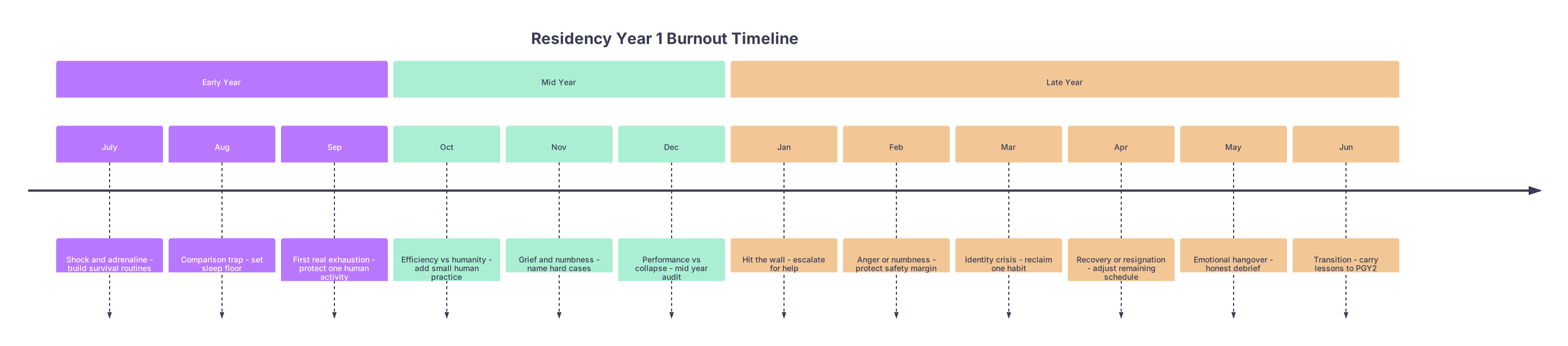
| Period | Event |
|---|---|
| Early Year - July | Shock and adrenaline - build survival routines |
| Early Year - Aug | Comparison trap - set sleep floor |
| Early Year - Sep | First real exhaustion - protect one human activity |
| Mid Year - Oct | Efficiency vs humanity - add small human practice |
| Mid Year - Nov | Grief and numbness - name hard cases |
| Mid Year - Dec | Performance vs collapse - mid year audit |
| Late Year - Jan | Hit the wall - escalate for help |
| Late Year - Feb | Anger or numbness - protect safety margin |
| Late Year - Mar | Identity crisis - reclaim one habit |
| Late Year - Apr | Recovery or resignation - adjust remaining schedule |
| Late Year - May | Emotional hangover - honest debrief |
| Late Year - Jun | Transition - carry lessons to PGY2 |
At this point you should expect: mixed feelings and a lot of “How did that go by so fast and so slowly at the same time?”
Warning signs in June:
- You tell the incoming interns to “run” or “never go into this specialty.” That’s not just dark humor; it’s leakage.
- You feel completely detached from the incoming class, like you’re 20 years older.
- You avoid end‑of‑year evaluations or feedback because you don’t want to re‑visit any of it.
What you should do in June:
Week 45–46: Capture lessons while they’re fresh.
- One short document:
- “Things I wish I’d known as an intern”
- “Ways I’ll treat my interns differently”
- Save it somewhere you’ll actually see in July.
- One short document:
Week 47–48: Decide 2 changes for PGY‑2.
- One structural: e.g., “I won’t check the EHR from home unless I’m on call,” or “I’ll schedule therapy every 2 weeks.”
- One relational: e.g., “I’ll learn my interns’ names, goals, and one non‑work fact in week 1.”
You’re not going to magically reset on July 1. You’re going to carry whatever you’ve built—or neglected—into next year.
Quick Reference: Month‑by‑Month Watchpoints
| Month | Main Risk | Key Warning Sign | One Action Focus |
|---|---|---|---|
| July | Acute stress | Can’t shut brain off | Build basic sleep/meal routine |
| August | Comparison, imposter | Constant self-criticism | Set realistic speed expectations |
| September | Emerging exhaustion | Social withdrawal | Protect one weekly non-work thing |
| October | Depersonalization | Cold, rushed patient care | Add one small humanizing habit |
| November | Unprocessed grief | Numbness about bad outcomes | Tell one hard case to someone |
| December | “Just survive” mode | Hopelessness without vacation | Mid-year sleep/mood audit |
| January | The wall | Frequent dread/tears | Escalate & seek professional help |
| February | Anger/numbness | Snapping or cutting corners | Use safety checklists for key tasks |
| March | Identity loss | “I have no life outside” | Reclaim one pre-residency habit |
| April | Quiet resignation | Indifference to learning | Adjust remaining schedule if possible |
| May | Suppressed reflection | Minimizing the struggle | Honest personal debrief |
| June | Unprocessed transition | “Run while you can” jokes | Capture lessons for PGY-2 |
The Three Things to Remember
- Burnout in PGY‑1 follows a pattern. You’re not uniquely weak or broken—you’re on a predictable curve you can actually plan around.
- The earliest signs are subtle: sleep erosion, isolation, growing cynicism. Catching and addressing those in July–October is far easier than digging out of the January wall.
- You do not have to fix everything. One small, deliberate adjustment each month is enough to bend the curve away from full burnout and toward a survivable, even meaningful, intern year.


