

The real reason some burned-out residents still get promoted is blunt: promotions in residency are about risk management, not wellness. Programs will advance a visibly exhausted, miserable PGY-1 to PGY-2 if they believe one thing—“this person will not blow up the service or embarrass us.”
That’s it. Not because the program “cares about your resilience.” Not because they “believe in your potential.” Because from the program’s side of the table, the calculation is brutally simple: Does keeping you and promoting you create fewer problems than firing you or holding you back?
Let me walk you through what actually happens behind closed doors when faculty decide which residents move on and which ones get stopped.
What Promotion Really Means To Your Program
You think “promotion” means: I did a good job, I’m progressing, I’m becoming a better doctor.
Program directors and CCCs (Clinical Competency Committees) think: Can we safely let this person have more autonomy without putting patients, the program’s reputation, or accreditation at risk?
Promotion is not a medal. It’s a risk statement.
Here’s the unflattering reality I’ve heard in actual CCC meetings:
- “He looks terrible, but he gets the notes done and doesn’t scream at nurses.”
- “She’s clearly burned out, but families like her, and she owns her mistakes.”
- “He’s not thriving, but I don’t lose sleep when he’s on nights.”
That’s who gets promoted. The burned-out resident who is:
- Safe enough.
- Predictable enough.
- Not creating extra administrative headaches.
The resident who doesn’t get promoted? That’s the one who is seen as:
- Dangerous.
- Volatile.
- Or such a bottomless pit of remediation that the program decides to cut their losses.
Burnout, by itself, almost never stops promotion. Burnout plus risk does.
The Meeting Where Your Fate Is Decided
Let me show you how this actually works, because nobody ever explains this to residents honestly.
Every cycle, the CCC sits down with a stack of data: evaluations, milestones, exam scores, incident reports, patient complaints, maybe some 360 feedback. They talk through each resident. It’s not a vibe check; it’s a risk meeting.
You’re not in the room. Here’s the style of conversation that happens about burned-out residents who still move on:
“Yeah, she looks wiped. I saw her crying on days last month.”
“Same. But she’s always prepared on rounds. I’d trust her as a senior with some guardrails.”
“Any patient safety events?”
“No. Documentation’s late sometimes, but she responds when we push. Families like her.”
“Alright. Promotion with recommendations for wellness follow-up.”
Compare that to the burned-out resident who doesn’t make it:
“He’s struggling. Pages go unanswered at night. Nurses don’t trust him.”
“We’ve had three near-misses in the last two months.”
“And he gets defensive when given feedback.”
“If we promote him, he’ll be supervising interns.”
“I’m not signing my name to that.”
Now you see the game. Everyone at that table is asking two questions:
- Will this person hurt a patient?
- Will this person hurt us?
Burnout matters mainly to the extent it affects those two answers.
Why Programs Tolerate Burned-Out Residents
The dirty secret: many programs quietly accept a baseline level of resident burnout as “normal collateral damage.”
I’ve literally heard these phrases:
- “That’s just internship.”
- “We all went through it.”
- “This year’s class is soft; they call everything burnout.”
Do I agree with that attitude? No. But this is the insider reality.
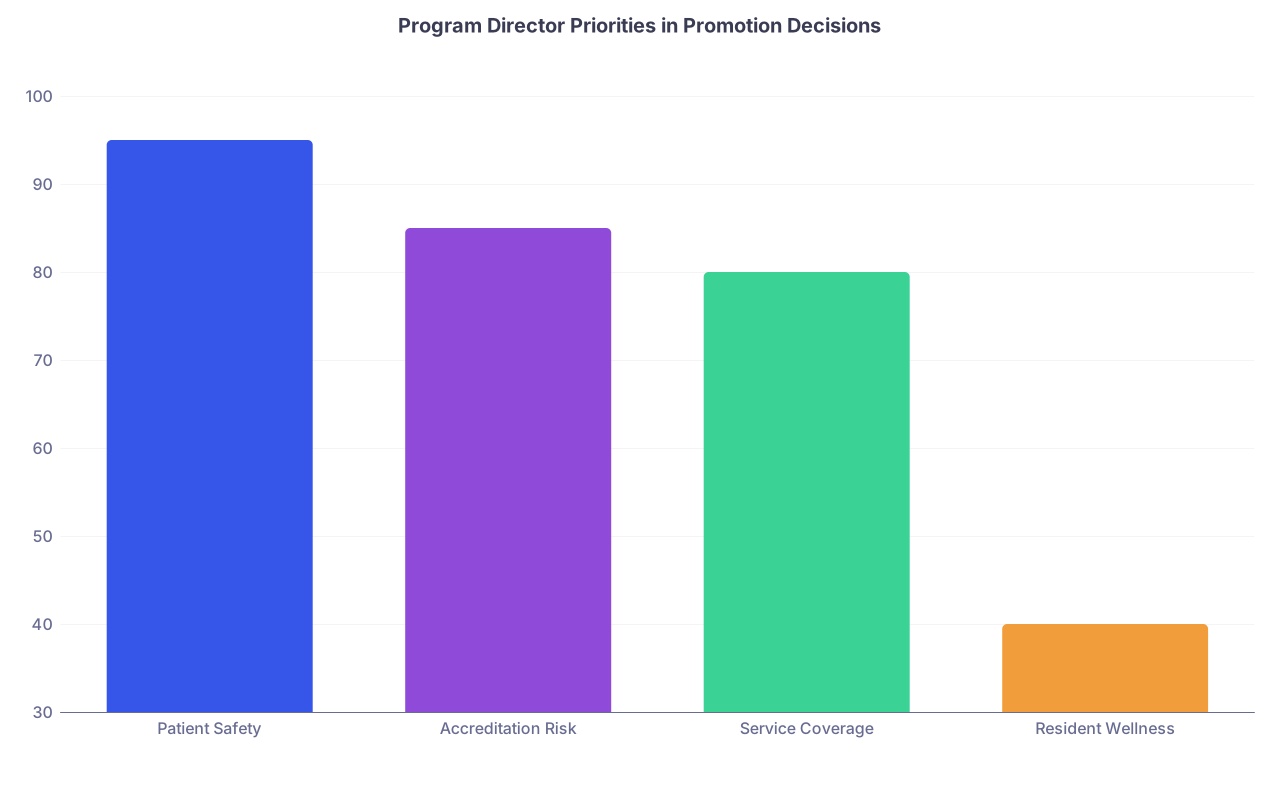
From the program’s perspective, here are the forces at play:
| Category | Value |
|---|---|
| Patient Safety | 95 |
| Accreditation Risk | 85 |
| Service Coverage | 80 |
| Resident Wellness | 40 |
Wellness is not at zero. But it’s not at the top either.
Programs tolerate burned-out residents getting promoted because:
- Terminating a resident is a paperwork and legal nightmare.
- Replacing you mid-residency is almost impossible.
- ACGME and hospital leadership hate deficiencies in coverage.
- Most burned-out residents are still technically safe and functional.
So if you’re dragging yourself through each block, half-zombie, but:
- You show up.
- You answer pages.
- You don’t lie, falsify, or blame others.
- You respond, even grudgingly, to feedback.
You will probably still get promoted.
That should scare you a little. Because it means no one is going to hit the brakes for you.
The Traits That Get Burned-Out Residents Promoted Anyway
Here’s the part you actually care about: what do programs actually reward, even if you’re clearly burned out?
I’ve seen this pattern so many times it’s practically a script.
The burned-out PGY-1 who still gets promoted almost always has:
Baseline clinical safety.
You follow the algorithm. You ask for help. You don’t pretend to know things you don’t. You’re exhausted, but you’re not reckless.Predictability and dependability.
You show up. You answer pages. You eventually do what you say you’ll do. Maybe late. Maybe grumpy. But done.Non-toxic behavior.
You aren’t poisoning the team. You may be quiet or withdrawn, maybe a bit blunt, but you’re not screaming, belittling, or creating HR-level drama.A minimum level of teachability.
When someone gives feedback, you don’t explode or stonewall. You may not love it, but you don’t fight every point. They see at least some adaptation.No pattern of major safety events.
Occasional errors happen. Patterns are different. If you’re not accumulating a trail of “we had to file an incident” stories, you’re still in the game.
Put simply: programs promote the burned-out resident who is safe, boring, and fixable.
The ones who don’t get promoted? They’re seen as unsafe, high-drama, or simply not trustworthy when things get messy.
Why This Matters For Burnout Prevention
You’re reading this under a burnout prevention category, so let me connect the dots.
Here’s the dangerous misunderstanding residents fall into:
“I’m still getting promoted, so I must be okay.”
No. Promotion only means: “We think you’re safe enough to advance.” It says nothing about your mental health, your long-term sustainability, or whether you’re quietly disintegrating inside.
Promotion is a lagging indicator. Burnout is often a leading indicator. Programs mostly act on the former, not the latter.
What this means for you:
- Do not use promotion as proof that your current level of suffering is sustainable.
- Do not assume “if it were really bad, they’d stop me.” They almost never will.
- Do not wait for the system to validate your need for a change. It won’t.
I’ve seen residents promoted every year who later took leave, crashed in fellowship, or quit medicine entirely. On paper, they were “successful.” In reality, they were a slow-moving train wreck no one wanted to stop.
The Quiet Signals Programs Actually Watch
There’s another layer to this. Programs don’t only look at evals and test scores. They watch the “soft” indicators. The things that don’t make it into Milestones PowerPoints but come up in hallway conversations.
Typical backchannel signals about a burned-out resident:
- “Nurses say he disappears for long stretches at night.”
- “Social work says she’s short with families when under pressure.”
- “He’s starting to cut corners—templates everywhere, same note for everyone.”
- “She’s doing the bare minimum. Not dangerous yet, but definitely disengaged.”
None of that, by itself, will necessarily stop promotion. But each one moves you closer to the wrong side of the risk line.
Programs are especially sensitive when burnout starts showing up as:
- Unreliability: not answering pages, late for rounds, missing key tasks.
- Defensiveness: arguing with feedback, blaming others for everything.
- Disrespect: patterns of conflict with nursing, consultants, or staff.
- Dishonesty: documenting exams you didn’t do, backfilling notes dishonestly.
That last one is a career-killer. I’ve watched PDs who tolerated incredible levels of burnout draw a hard, immediate line at dishonesty. They’ll promote an exhausted, depressed resident who’s trying. They will not promote a liar.
How Residents Quietly Protect Themselves (The Real Playbook)
Now the practical part. What do the residents who survive burnout and still grow into functional attendings actually do differently?
They do not just “tough it out.” They manage the optics and the substance.
1. They stay brutally honest with at least one faculty member
Not performative wellness. Actual honesty.
“I’m not okay. I’m still safe to work, but I’m at the edge. Here’s what I’m doing to manage it.”
That kind of conversation, done with the right attending or APD, changes how you’re discussed in meetings. You stop being the “mysteriously angry resident” and become the “struggling but insight-ful and proactive resident.”
That distinction saves careers.
2. They protect the three non-negotiables
The residents who make it through rough years treat these as sacred:
- Sleep windows when off duty. Not optimal sleep. Protected minimums.
- One or two real humans they can be unfiltered with.
- A hard line around safety—if they feel unsafe to work, they escalate.
They don’t wait until they’re in the ICU as a patient themselves.
3. They separate “being liked” from “being safe”
You don’t need to be the favorite resident to be promoted. You do need to be:
- Safe.
- Not destructive.
- Not a constant source of drama.
Stop chasing universal approval. Start making sure your work is clean, your communication is clear, and your attitude isn’t contaminating the room.
4. They make their struggles show up as effort not avoidance
Here’s what I mean.
Two burned-out residents. Same misery level.
Resident A:
Avoids feedback, cuts corners, shows up just on time, disappears post-call, never speaks up about being overwhelmed until something blows up.
Resident B:
Admits they’re struggling, asks for strategies, occasionally says, “I need help prioritizing,” still shows they’re trying to do the right thing even when exhausted.
Resident B gets promoted with comments like, “We should keep an eye on them and support them more next year.” Resident A gets the, “I’m not sure they can handle senior responsibilities.”
Same burnout. Different optics and behaviors.
What Program Directors Won’t Say Out Loud
I’ve had PDs tell me things privately that they’ll never put in an email.
Stuff like:
- “We’re not in the business of rescuing people who don’t want to be helped.”
- “Burnout matters, but safety and professionalism matter more.”
- “If a resident is burned out but still safe, it’s often kinder to move them forward than to trap them in PGY-1 purgatory.”
That last one is key. Sometimes advancement is an act of mercy. Because being held back can crush a resident who might have recovered with a change in role, more experience, and time.
But do not confuse that mercy with wellness approval. It’s still a risk-based bet.
How To Interpret Your Own Promotion
So when you get that “promoted to PGY-2” or “advanced to senior resident” message, here is what it truly means and does not mean.
It does mean:
- Your program believes you are safe enough for more responsibility.
- Your performance, on balance, meets the minimum expected bar.
- They think you’ll represent the program adequately.
It does not mean:
- Your burnout is mild or imaginary.
- Your current lifestyle is sustainable.
- You don’t need to change anything.
If you’re already burned out and still getting promoted, that’s actually a warning light. Your program just told you, “We are comfortable giving you more responsibility.” They did not say, “We are confident you’re okay.”
That distinction can make or break your long-term career.
Using This Knowledge To Actually Prevent Burnout
Let’s connect this back to prevention, not just survival.
If you know the system will keep promoting you as long as you’re “safe enough,” then the burden of protecting your long-term health falls on one person: you.
Very concretely:
- Don’t wait for the program to pull you aside and say, “You look burned out; take a step back.” By the time they’re saying that, you’re already deep in the red.
- Take early signs seriously: cynicism that doesn’t lift post-rotation, dreading every shift, constant emotional numbness, fantasizing about disasters just to get a day off. These are not “everyone feels that” signs. These are danger signs.
- Treat mental health like you treat sepsis. Early is always easier than late. “But I’m still functioning” is the residency equivalent of “but their blood pressure is holding for now.”
And here’s the hardest part: sometimes the healthiest move is not pushing for every possible promotion, opportunity, or elective. It’s using your small pockets of choice to make your life just 10–15% more humane: a less brutal elective, setting real boundaries on off-day obligations, saying no to that extra committee.
No PD is going to email you: “Please sacrifice fewer pieces of your soul this year.” You have to do that math yourself.

A Quick Reality Check: You’re Not Imagining This
One more thing. I want to validate something you’ve probably noticed but couldn’t put words to.
You’ve seen:
- The resident who cried in the call room but still became chief.
- The guy who looked half-dead for two years and then landed a solid fellowship.
- The co-resident everyone knew was burned out who still got strong letters.
You weren’t misreading it. The system is not selecting for wellness. It’s selecting for perceived safety, minimal hassle, and basic professionalism.
| Resident Type | Promotion Likely? | Main Reason |
|---|---|---|
| Burned-out but safe, reliable | Yes | Low perceived risk |
| Burned-out and defensive | Questionable | Hard to remediate |
| Burned-out with safety issues | At risk | High program risk |
| Well but unprofessional | At risk | Toxic to team |
So no, you’re not crazy for feeling like the bar is twisted. It is.
Recognizing that twist lets you finally stop asking, “Why am I still being pushed forward if I feel this bad?” and start asking the better question:
“What do I need to change so I’m not just technically promotable, but actually okay?”
| Category | Value |
|---|---|
| Stabilize with support | 35 |
| Stay functional but miserable | 30 |
| Take leave or change path | 20 |
| Burn out and quit medicine | 15 |
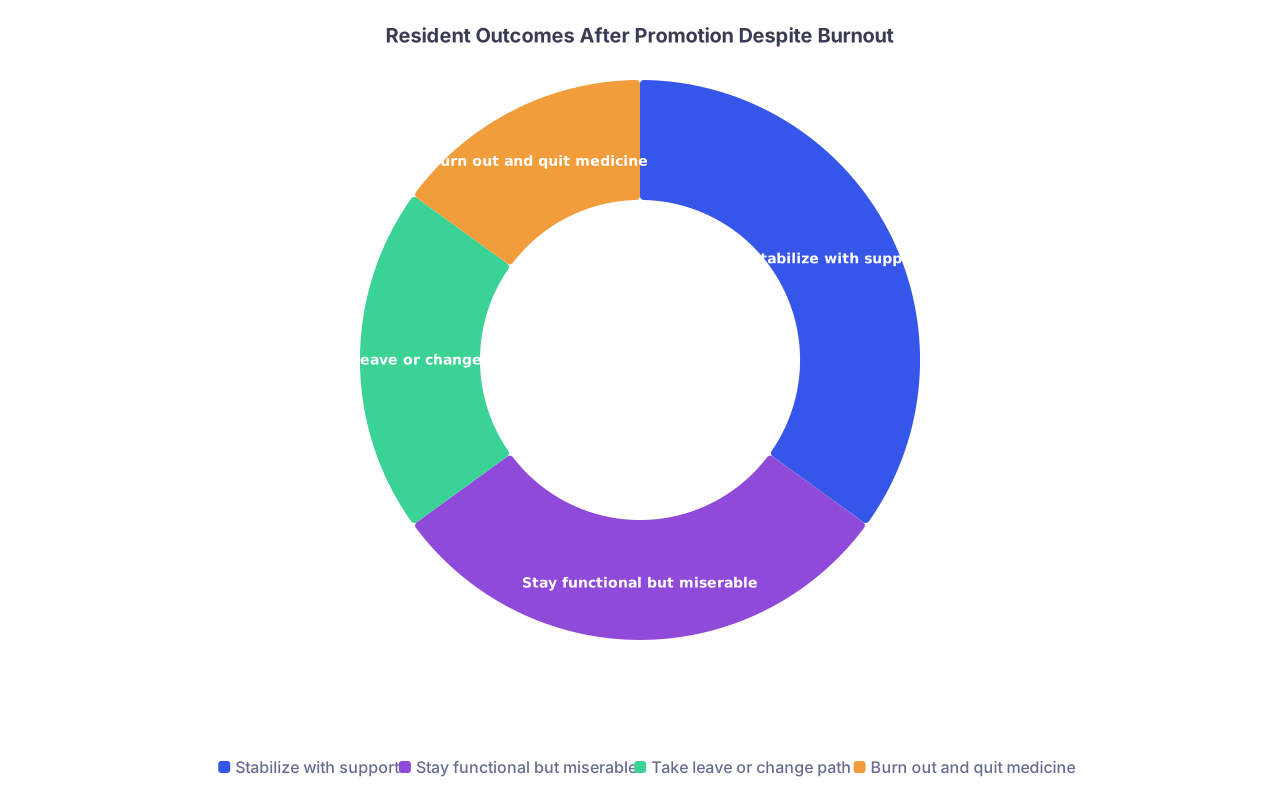
Notice something in that chart: a decent chunk stabilize once they get the right support. Another chunk grind through for years, technically successful but deeply unhappy. You have more influence than you think over which group you end up in—but only if you stop using “I got promoted” as proof that you’re fine.

| Step | Description |
|---|---|
| Step 1 | Burned-out Resident |
| Step 2 | Remediation or non-promotion |
| Step 3 | At risk of non-promotion |
| Step 4 | Promoted despite burnout |
| Step 5 | Stabilizes and grows |
| Step 6 | Chronically burned-out attending |
| Step 7 | Clinically safe? |
| Step 8 | Professional behavior? |
| Step 9 | Gets real support? |
The goal is obvious. You don’t just want F → H. You want to avoid ending up at I, the chronically burned-out attending who “made it” but hates every clinic day.
That starts now, not “after I get through this year.”

Final Thought
Years from now, you won’t remember your exact PGY level when you started to crack. You’ll remember whether you listened to yourself or to the system that kept telling you, “You’re good enough to move on.”
Promotion is the program’s verdict on its own risk, not on your well-being. Your verdict about your own life has to come from you.
Make it a brave one.


