
Duty-hour mistakes usually don’t start with laziness. They start with a bad assumption.
Here’s the one that gets residents and programs in trouble: people assume EMS ride-alongs and simulation sessions either always count or never count. Both assumptions are wrong. And that’s exactly how inaccurate duty-hour logs happen—quietly, repeatedly, and just convincingly enough that nobody notices until there’s a review, a compliance question, or a resident who’s more exhausted than the record suggests.
I’ve seen this play out in the most ordinary ways. A resident does a required ride-along and logs only the ambulance call time, not the full assigned period. Another stays late for mandatory simulation and doesn’t count it because “it wasn’t on the ward.” Someone else logs optional open sim lab practice exactly the same way as a required mock code. Now your records are inconsistent, your fatigue picture is distorted, and your program looks sloppy.
That’s the real danger. Undercounting can hide overwork. Overcounting can create fake violations and needless panic. Either way, the log stops reflecting reality.
This article is here to stop that mistake before it becomes a pattern. I’ll show you where EMS and simulation time are commonly miscounted, what usually belongs in duty hours, and the simplest way to keep your logs accurate without guessing.
What actually counts as duty hours—and where people get it wrong
Duty hours are broader than many residents think. They’re not just your inpatient shift, clinic session, or call night. In practical terms, duty hours generally include the clinical and educational activities you perform as part of residency. If the program assigns it, requires it, supervises it, or builds it into your training, your first instinct should be: this may count.
That’s where people go wrong. They treat “duty hours” like a synonym for “time physically spent on the unit.” Bad shortcut. Wrong answer.
An off-site activity can absolutely count. A required educational session can count. A supervised experience that isn’t traditional bedside care can count. Location is not the deciding factor. Purpose is.
A safer way to think about it:
- If the activity is part of your residency job or training, it may count
- If the program expects attendance, it may count
- If you’re assigned, scheduled, or supervised, it may count
- If it’s directly tied to required educational or clinical work, don’t casually exclude it
That’s why EMS ride-alongs are a trap. People hear “ride-along” and think shadowing, volunteer work, or informal exposure. Sometimes it is. Often it isn’t. If the ride-along is a required educational experience, part of an emergency medicine rotation, a supervised field exposure, or assigned by the program, you should not assume it’s exempt from duty hours.
Simulation creates the same mess. Residents often treat sim as “just education,” as if education somehow happens outside duty-hour reality. That’s nonsense. Required, scheduled simulation that is part of your residency curriculum usually counts. If you’re expected to be there, and it’s part of the training structure, pretending it doesn’t count is exactly how underreporting starts.

The biggest misunderstanding is this: off-site does not mean off-the-clock. If you leave the hospital to do program-assigned educational or clinical work, you didn’t magically leave duty hours behind.
Don’t make another common mistake, either: assuming every educational minute automatically counts in the same way. Some programs distinguish between required and optional activities. Some have specific rules about independent study, open lab sim access, or voluntary observation. That’s why guessing is dangerous. You need local policy and consistent interpretation, not hallway folklore.
If you remember one rule from this section, make it this: duty hours follow the training obligation, not the building.
EMS ride-alongs: the most common counting traps
EMS ride-alongs generate more confusion than they should. Mostly because people use one phrase to describe very different activities.
Sometimes a ride-along is clearly duty hours. Sometimes it clearly isn’t. The trouble comes from residents and programs acting like those two situations are interchangeable.
When an EMS ride-along may count
You should strongly suspect the time counts if the ride-along is:
- Required by the residency program
- Part of a formal rotation
- Assigned by faculty or the program
- Supervised clinical or educational activity
- Built into curriculum goals or competency requirements
Example: you’re on emergency medicine, and the program schedules a field EMS experience from 0700 to 1300 with a pre-brief and debrief. That is not “just observing around town.” That is assigned residency activity. Don’t shave it down to only the 92 minutes when actual patient care happened in the rig. That’s the kind of undercounting that corrupts the whole record.
When it may not count
A ride-along may be treated differently if it is:
- Purely voluntary
- Outside the residency curriculum
- Independent personal enrichment
- Unofficial shadowing with no program requirement
- Optional observation not tied to training expectations
Example: you arrange your own extra Saturday ride-along out of personal interest, with no program requirement and no curricular role. That may not be logged the same way. But don’t freelance that judgment. Check policy first. “I thought it probably didn’t count” is a terrible defense.
The trap nobody respects enough: the full assigned period
Residents often log only active patient contact. That’s a mistake.
If you are assigned to an EMS experience, the countable period may include more than the lights-and-sirens moments. Depending on program rules and the structure of the assignment, relevant time may include:
- Pre-trip briefing
- Equipment orientation
- Waiting time while assigned and available
- Travel as part of the assignment
- Handoff activity
- Return-to-base responsibilities
- Debriefing
I’ve seen residents drop all the “in-between” time because it felt less official. That instinct gets people in trouble. Duty-hour logging is not supposed to be a highlight reel of your most dramatic moments. It’s supposed to reflect the actual assigned work period.
Documentation mistakes that keep repeating
Here’s what residents forget to record all the time:
- Start time of the assigned experience
- Structured pre-brief
- Downtime while still assigned to EMS
- Return and debrief
- Whether the experience was required or optional
That last point matters more than people think. If the log doesn’t clarify the status of the ride-along, reviewers are left guessing. And once reviewers are guessing, they start distrusting the whole system.
Programs need written rules. Period.
This should not depend on resident interpretation. If one resident logs the whole assigned block, another logs only patient contact, and a third doesn’t log it at all, the problem is not the residents. The program failed to define the rule.
A good policy should answer these questions plainly:
- Are required EMS ride-alongs duty hours?
- What start and stop times should be used?
- Does downtime during the assignment count?
- How are pre-brief and debrief handled?
- How are voluntary ride-alongs treated?
If those answers aren’t in writing, your duty-hour process is built on vibes. That’s not a system. That’s a future problem.
Simulation time: don’t ignore it, but don’t count it blindly
Simulation is where programs accidentally create invisible work.
Residents stay after shift for mock codes, airway labs, trauma scenarios, procedural stations, or team training. Everyone agrees it’s educational. Then someone decides it’s “extra” and doesn’t belong in duty hours. Wrong. If the session is mandatory, scheduled, and part of the residency curriculum, it usually belongs in the count.
That includes a lot of things residents try to shrug off:
- Required sim sessions
- Scheduled mock codes
- Curriculum-based procedure labs
- Formal debriefing tied to the session
- Program-directed team training
The opposite mistake is counting every sim-related minute without thinking. That’s sloppy too.
Optional open lab time, self-directed practice, or voluntary extra sim may be treated differently depending on local rules. A resident practicing central line technique alone in the sim center at 9 p.m. is not automatically in the same category as a required airway curriculum block from 5 to 7 p.m.
The hidden error is vagueness. Residents enter one fuzzy chunk—“sim 3 hours”—without separating what happened:
- Was it required or optional?
- Was there prep time?
- Was the prep assigned or self-directed?
- Was there a formal debrief?
- Was it protected educational time or after-hours add-on?
That matters because sim can quietly push residents toward fatigue when it’s piled onto already long days and then dismissed as “not real work.” It is real work when the program requires it. Ignoring it doesn’t make residents less tired. It just makes the data less honest.
And yes, programs vary. Some handle protected educational time differently from after-hours sessions. Some specify whether conference-style simulation and call-adjacent simulation are logged the same way. That variation is exactly why blind assumptions are dangerous.
Use this decision path before you log—or fail to log—a sim session:
Simple rule: required and scheduled usually deserves a hard look as duty hours; optional and self-directed needs policy confirmation.
How to build a safer counting system
If your system depends on memory and improvisation, it will fail. Not maybe. Will.
You need a boring, repeatable method. That’s what protects residents and programs.
Use this practical rule first
If an activity is:
- Assigned
- Required
- Supervised
- Educationally mandated
…stop and verify whether it belongs in duty hours. Don’t rely on instinct. Instinct is how bad records happen.
Build a standardized log template
Every duty-hour tool should let residents document more than just start and stop times. At minimum, include fields for:
- Activity type
- Setting: hospital, EMS, sim center, clinic, off-site
- Purpose
- Required vs optional
- Supervisor or sponsoring service
- Pre-brief/debrief included or not
- Program approval or policy category
This is not overkill. This is what prevents the same exact event from being logged three different ways by three different residents.
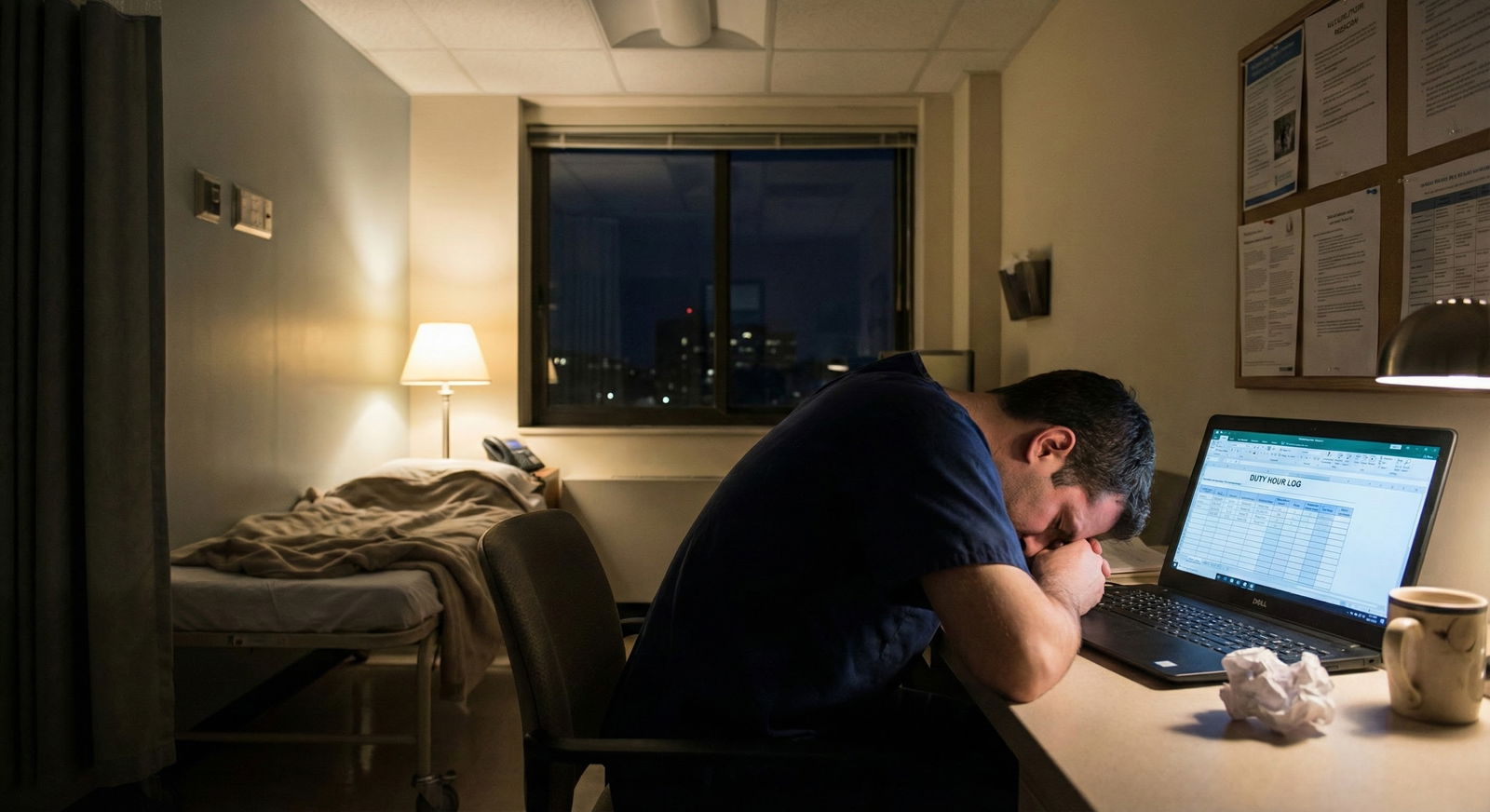
Ask before you log it wrong
Residents waste a lot of energy trying to reverse-engineer policy after the fact. Don’t do that.
If you’re unsure whether a ride-along, sim block, mock code, debrief, or prep session counts, ask before the entry becomes part of a messy pattern. It’s much easier to prevent an error than to clean up six months of inconsistent reporting.
Program leaders: train with examples, not slogans
“Log duty hours accurately” is useless advice by itself. Show people actual scenarios:
- Required EMS ride-along with pre-brief and debrief
- Voluntary EMS observation outside curriculum
- Mandatory sim lab after clinic
- Open practice in the sim center
- Mock code during protected conference time
- Procedure prep done independently at home
That’s how you create consistency.
Red flags for programs
If you’re overseeing duty hours, recheck your process when you see:
- Inconsistent logging for the same activity
- Repeated underreporting of educational events
- Residents saying “I wasn’t sure”
- Policy language that is vague, outdated, or silent on EMS/simulation
- Fatigue concerns that don’t match the logged hours
Those are warning lights. Don’t ignore them.
Common red flags that mean you should recheck the log
Some patterns practically scream that the log is wrong.
Recheck duty hours if:
- A resident says they “just guessed” whether an EMS or sim activity counted
- The program has no written examples for off-site or simulation activities
- Different residents log the exact same ride-along in completely different ways
- Required simulation keeps happening after hours, but nobody’s hours increase
- EMS ride-alongs are being reduced to patient-contact minutes only
- Debriefs and assigned downtime keep disappearing from entries
Small errors don’t stay small. If EMS and simulation are routinely excluded without policy support, the result is systematic underreporting.
And this isn’t just a compliance headache. It’s a wellness problem. Miscounted duty hours can hide overwork, mask fatigue trends, and make a resident look “fine on paper” when they’re actually stretched too far. Bad data protects no one.
Conclusion: Don’t let one bad assumption skew your duty hours
Don’t make this mistake. EMS ride-alongs and simulation time are two of the easiest places to miscount residency duty hours, and the damage is bigger than people think.
Check your local policy. Log carefully. Train residents, chief residents, coordinators, and faculty using the same examples and the same rules. No guessing. No informal myths. No “it probably doesn’t count.”
Fix the process before it becomes a compliance problem—or worse, before it hides fatigue that should’ve been obvious. Accurate duty-hour logging isn’t paperwork theater. It’s protection. Use it that way.