Maya is a PGY-2 on ICU nights. On Friday afternoon, she opens the duty hour portal and logs what the system wants to see: 80 hours for the week. Clean. Compliant. No flags. No awkward meeting.
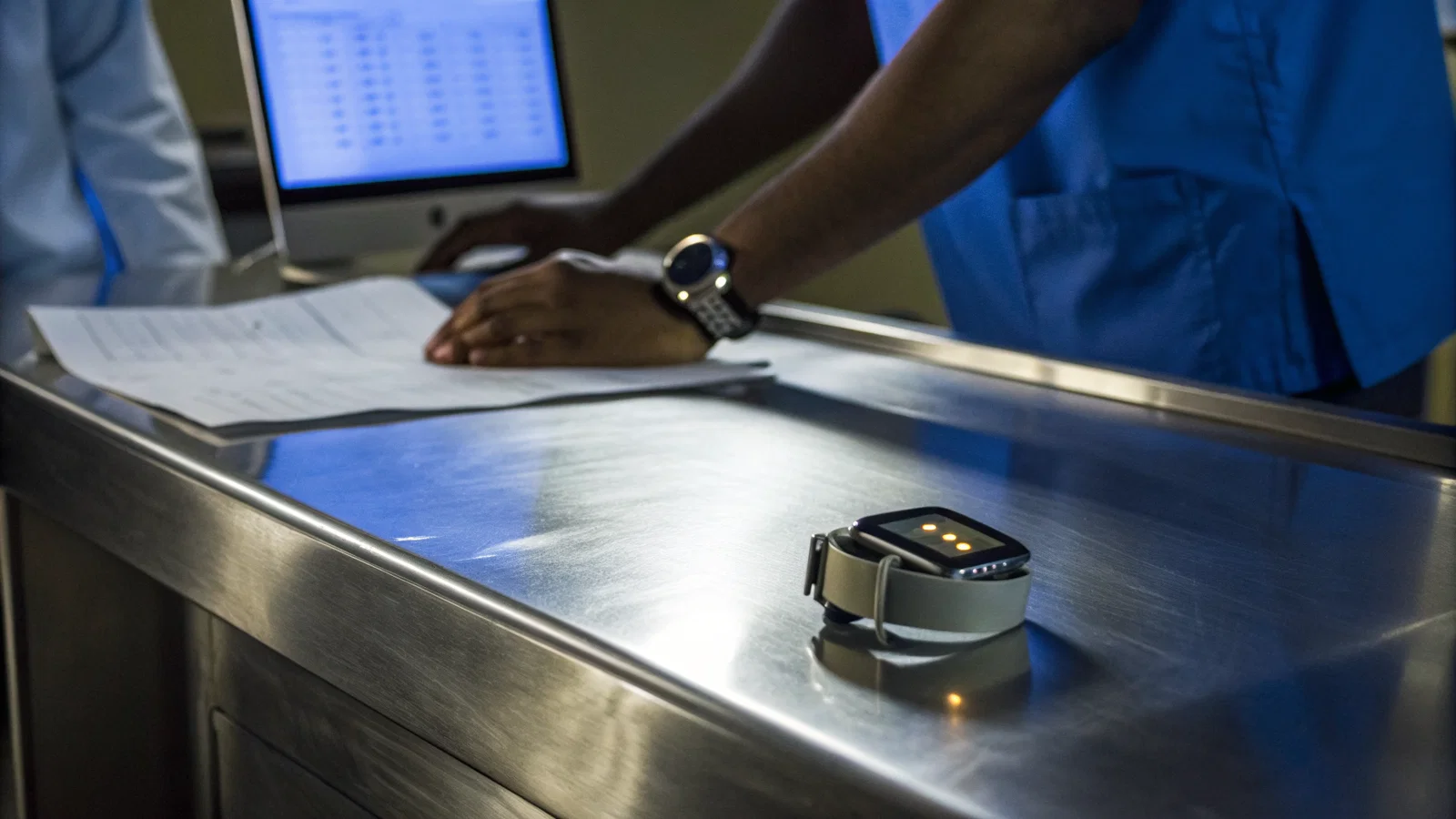
But her watch tells a different story.
Understanding how programs prepare for ACGME duty hour audits can shed light on why your local logs often feel like a disconnect from reality.
Between continuous movement, overnight heart-rate elevation, interrupted sleep, and timestamps that show she was active in the hospital long after sign-out, her wearable paints a blunt picture: 96 hours of hospital-linked activity and recovery disruption. Not "maybe overworked." Overworked. Full stop.
That discrepancy has a name, and programs need to start acting like it exists. I call it the Duty Hour Gap: the difference between what the institutional log records and what your body, your device, and your digital trail say actually happened.
This gap isn't academic. It's where risk lives.
For residents, the risk is obvious: fatigue, impaired judgment, burnout, microsleeps on the drive home, worse learning, worse patient care. For programs, the risk is more cynical but just as real: self-reported logs create plausible compliance while burying operational dysfunction. That works right up until it doesn't. A resident makes an error, a grievance surfaces, an accreditation review gets ugly, and suddenly everyone wants to know why the official record looks so tidy when reality looked nothing like it.
Here's the core conflict: administrative compliance versus physiological reality.
Administrative compliance asks, "Did the portal show fewer than 80 hours?" Physiological reality asks, "Were you actually awake, working, recovering poorly, and unsafe?"
Those are not the same question. Too many institutions pretend they are.
And let's be honest about why. Self-reported duty hours are convenient. They're cheap. They preserve deniability. They let a program say, "We monitor hours," while quietly depending on residents to sand down the edges of the truth.
I've seen this happen. Residents round down. They leave out the charting done from home. They ignore the 40 minutes spent wrapping up after sign-out because "it's not worth the hassle." They underreport because they don't want to be the problem resident. The system trains them to do it.
To better navigate these discussions, it is worth reviewing how PDs use duty hour violations in promotion and remediation talks to protect your professional standing.
So which truth matters in a duty hour audit: the institutional log or the wearable?
If you're asking what the institution will usually use, it's the log. If you're asking what should matter for your safety, it's the data that reflects your actual life.
The fix is not to throw your watch at the GME office and demand justice. That usually goes nowhere. The fix is smarter: understand what each data source can and can't do, then build a defensible, personal protocol that protects your health and your training record.
This article is for educational purposes only. It is not financial advice, not legal advice, and not tax advice. Figures vary, and you should consult a qualified professional.
The Tale of Two Clocks: A Scenario of Discrepancy
Let's make the scenario concrete.
Maya's week looked like this:
- Mon: 5:30 a.m. pre-rounding to 7:15 p.m. wrap-up
- Tue: 5:40 a.m. to 8:05 p.m.
- Wed: 6:00 a.m. to 6:30 p.m., then 90 minutes of charting at home
- Thu: 5:20 a.m. to 9:00 p.m. after a crashing patient and delayed transfer
- Fri: 6:00 a.m. to 7:40 p.m.
- Sat: "Day off," except three hours answering messages, checking results, and finishing notes remotely
- Sun: Back in at 6:00 a.m.
In the portal, she enters something cleaner:
- 13 hours
- 13 hours
- 12 hours
- 14 hours
- 12 hours
- 0 hours
- 16 hours
That lands near 80. Nobody asks questions.
But her watch catches patterns the portal never will:
- Prolonged waking periods
- High overnight heart rate after late shifts
- Reduced REM sleep
- Repeated step-count spikes in the hospital overnight
- Activity clusters during "time off"
Her EHR access log adds another layer:
- Login at 5:31 a.m.
- Orders signed at 7:48 p.m.
- Remote chart access on the "day off"
- In-basket replies after 10 p.m.
That's the Duty Hour Gap in the wild. Not one dramatic lie. Just death by a hundred tiny omissions.
Programs often treat those omissions as harmless. They're not. The gap does three dangerous things:
It hides fatigue
- A resident can be technically "compliant" on paper and physiologically wrecked in real life.
It shifts responsibility onto the resident
- If the portal says 80, the institution can act surprised later.
It normalizes false documentation
- Once residents learn that honesty creates friction, underreporting becomes culture.
That last point matters most. Culture beats policy every time. A program can have a perfect duty hour policy sitting in a binder and still run on silent coercion. "Just log it the way everyone does" is still coercion. Softer voice. Same effect.
So when you see a mismatch between your logged hours and your wearable data, don't dismiss it as noise. Treat it as a signal. Maybe not a legal one. But a clinical one. A safety one. A "something is off and I need to address it" one.
Because your body doesn't care what the portal says.
The Anatomy of Institutional Logs: Why They Fail
Institutional logs fail for predictable reasons. Not mysterious reasons. Not technological reasons. Human reasons.
The main failure points are these:
1. Recall bias
After a 14-hour shift, nobody remembers with precision when they truly started, when they actually stopped, or how much work bled into home time.
Residents forget:
- Pre-charting before formal start time
- Post-call loose ends
- Notes finished at home
- Weekend "quick checks" that become two-hour tasks
- The 25-minute sign-out delay that happens four times a week
Memory gets worse as fatigue gets worse. That's the sick joke in the system: the more overworked you are, the less accurate your self-report becomes.
2. Fear of reprisal
This is the big one.
Before you initiate a conversation, it is helpful to understand how to track post-shift home chart work without breaking duty hour rules (https://residencyadvisor.com/resources/residency-duty-hours/how-to-track-post-shift-home-chart-work-without-breaking-duty-hour-rules).
Residents know what happens when logs trigger attention:
- Emails from coordinators
- "Educational conversations"
- Schedule reshuffling that punishes the team
- Subtle branding as inefficient or difficult
- Pressure to "be more accurate" next time, which often means lower
Nobody has to threaten you directly. The message is usually ambient. You absorb it fast.
3. Rounding down behavior
Residents shave off time because it feels minor.
Examples:
- "I was only there 30 minutes late."
- "That charting from home probably doesn't count."
- "I don't want the chiefs to get blamed."
- "It was a weird week."
Do that three or four times, and a 92-hour week becomes an 80-hour week.
4. The compliance-first design
Administrators use these logs because they fit accreditation workflows. The logs are standardized, reportable, and familiar. That doesn't make them accurate. It makes them administratively useful.
That distinction matters.
Programs aren't evil because they use portal logs. They're using the tool the system expects. But many programs become sloppy because they start confusing required documentation with truthful measurement.
Here's the usual data flow:
Look at the weak link. It's obvious. The whole system depends on one fatigued person translating a chaotic week into neat boxes.
Why current systems discourage transparency
Here's the step-by-step failure cascade I've seen over and over:
- Resident works beyond scheduled hours
- Resident knows logging true hours will trigger follow-up
- Follow-up is perceived as annoying, punitive, or useless
- Resident trims entries to avoid fallout
- Program sees acceptable numbers
- Underlying staffing problem remains untouched
- Residents learn accuracy is costly
- Underreporting becomes normalized
That's not a bug. That's the operating logic.
To fix it, you have to stop pretending the institutional log is a neutral measuring tool. It's not. It's a compliance instrument. Useful for accreditation. Weak for safety surveillance.
So yes, keep logging. You have to. But don't confuse "submitted" with "settled."
The Wearable Revolution: Pros, Cons, and Legal Ambiguity
Wearables changed the conversation because they measure what residents have always felt but struggled to prove.
A decent wearable can track:
- Continuous movement
- Heart rate trends
- Heart rate variability (HRV)
- Sleep duration
- Sleep fragmentation
- REM and deep sleep estimates
- Recovery strain over multiple days
Is that perfect? No. Is it far more objective than guessing how many hours you worked on Thursday? Absolutely.
If your watch shows five nights of shortened sleep, elevated resting heart rate, poor recovery, and high activity load linked to hospital time, that's not random trivia. That's a fatigue map.
Here's the practical comparison:
What wearables do well
1. They catch patterns, not excuses. Your memory may rationalize a brutal week. Your HRV trend won't.
2. They show recovery debt. Duty hour rules focus on worked time. Your body cares about cumulative strain. Big difference.
3. They create a personal safety baseline. Over time, you'll learn what your own danger signs look like:
- Resting heart rate 8-10 beats above baseline
- HRV sharply suppressed for 3 days
- REM sleep cut in half
- Step/activity spikes combined with shortened sleep
That's useful. Really useful.
What wearables do poorly
Let's not get cute. Wearables also have limits.
- They can't always distinguish work walking from non-work walking
- Sleep stage estimates are approximations
- They don't know whether you were admitting a crashing patient or pacing in your apartment
- They may miss periods when you take the device off
- They are consumer devices, not formal forensic instruments
So no, your watch is not the final legal truth. It's a strong personal dataset. Different thing.
Why wearable data is usually inadmissible in standard grievance processes
This frustrates residents, but the reason is straightforward:
- Duty hour systems are built around institutional reporting structures
- Consumer wearable data lacks standardized chain-of-custody procedures
- Programs can challenge device accuracy, context, and ownership of data
- Policies rarely define wearables as official timekeeping tools
- Arbitration and grievance channels tend to prefer institutionally recognized records
That doesn't mean the data is worthless. It means you should use it strategically, not theatrically.
Bad move:
- "My watch says 96 hours, therefore your audit is fraudulent."
Better move:
- "I've noticed repeated discrepancies between my logged hours, EHR timestamps, and recovery data. I'm concerned this reflects a sustained workload and safety issue. I'd like to review the pattern."
That framing gets traction. Accusation usually doesn't.
Your wearable protocol: use it as a safety baseline
Here's the fix.
Step 1: Establish your baseline for 2-3 normal weeks
Track:
- Average sleep
- Resting heart rate
- HRV
- Subjective fatigue score from 1-10
- Typical shift length
You need your normal before you can identify your dangerous.
Step 2: Flag strain markers
Create personal alert thresholds such as:
- Sleep under 5.5 hours for 2 nights in a row
- HRV down more than 20% from baseline
- Resting heart rate up more than 7 bpm for 3 days
- Total active waking period over 18 hours
Don't obsess over single-day blips. Look for clusters.
Step 3: Match wearable strain to calendar reality
At the end of each week, compare:
- Scheduled shifts
- Actual log submission
- Watch activity/sleep trends
- Home charting or after-hours messages
Now you're not reacting emotionally. You're auditing yourself.
Step 4: Use the data to trigger protective decisions
If your strain markers are red for several days:
- Don't volunteer for extras
- Use backup transportation if you're too fatigued to drive
- Escalate if patient safety or your own safety feels compromised
- Document the pattern privately
Step 5: Keep the tone clinical, not combative
You're not building a courtroom exhibit. You're building a safety record.
That mindset matters. A lot.
Bridging the Gap: Your Practical Action Plan
Now the part that actually helps. If your log, your watch, and your real life don't match, use a Triangulation Protocol.
Three data sources. One defensible picture.

The Triangulation Protocol
Source 1: Your institutional duty log
This is the official record. Keep it current. Late logging gets sloppier and less defensible.
Weekly task:
- Enter hours within 24 hours of each shift when possible
- Include home charting if your program's rules count it
- Avoid "averaging" the week
Source 2: EHR access timestamps
This is your strongest corroborating source in most settings.
Look for:
- First login
- First note started
- Order entry times
- Last chart access
- Remote logins on days off
- In-basket messages handled after hours
Important caveat: EHR time is not identical to duty time. But it's a powerful anchor.
Source 3: Wearable data
Use it to detect physiologic load and timing patterns.
Look for:
- Sleep truncation after late shifts
- Activity periods overlapping hospital time
- Elevated overnight heart rate
- Recovery deterioration across consecutive shifts
How to reconcile the three
Use this quick weekly checklist:
Compare scheduled shift vs actual EHR window
- Was your workday consistently longer than planned?
Compare EHR window vs submitted duty log
- Are you repeatedly shaving off 30-90 minutes?
Compare wearable recovery vs reported workload
- Does your body show a far heavier week than your log suggests?
Note hidden work
- Home charting
- Remote messages
- Pre-rounding before clocked start
- Delayed sign-out
Calculate the discrepancy
- If your log says 78-80 but triangulated data supports 88-96, that's not noise. That's a pattern.
When a discrepancy exceeds the 80-hour threshold
Don't panic. Don't send a furious midnight email either. Use a script.
Script for chief or scheduler
"Hi, I reviewed my last two weeks using my submitted duty log and EHR timestamps, and I'm seeing that my actual work time may be running higher than what I entered. I want to correct that and also talk through whether the current workflow is sustainable."
Short. Factual. Not apologetic.
Script for Program Director
"I'm concerned there's a recurring mismatch between my duty hour log and the actual time reflected by workflow demands and EHR access. I'm bringing this up because I want my reporting to be accurate and because I'm noticing cumulative fatigue."
That phrase works because it hits both priorities:
- documentation accuracy
- safety concern
Script for GME office if local response is weak
"I've attempted to address a recurring duty hour discrepancy at the program level. My concern is not just the reporting itself, but the sustained workload pattern and fatigue risk. I'd appreciate guidance on how to document this appropriately."
Again: factual, calm, documented.
When to escalate
Escalate beyond routine correction if any of these are true:
- You're consistently exceeding 80 hours
- You're pressured to alter entries
- You're experiencing unsafe fatigue
- Your commute home feels dangerous
- Patient care errors or near-misses are rising
- You've raised concerns locally and nothing changes
And let me be blunt: protecting your license and your health is not disloyalty. Programs that act offended by accurate reporting are telling you exactly who they are.
Your documentation rules
If you need an audit-proof approach, do this:
- Keep a private weekly record
- Screenshot relevant EHR access summaries when allowed by policy
- Export wearable weekly summaries for personal reference
- Document conversations with dates and neutral language
- Store personal records securely, off shared institutional devices
Do not:
- Record protected health information in personal files
- Take screenshots containing patient identifiers
- Blast accusations in group chats
- Rely on memory after the fact
The mindset shift that fixes the problem
Here it is.
Stop acting like duty hour logging is just a bureaucratic chore. It's part of your safety practice. Same category as checking a medication dose. Same category as not driving home half-asleep because you're trying to prove toughness.
Passive compliance is how residents get trapped. Active self-advocacy is how they stay safe and credible.
You do not need to become combative. You do need to become precise.
Key Takeaways
- Institutional logs are built for compliance, not physiological accuracy. That gap is real, and ignoring it is how residents get hurt.
- Wearable data is best used as a personal advocacy and safety tool, not as a blunt weapon in a formal dispute.
- Your best defensible method is triangulation:
- institutional log
- EHR timestamps
- wearable recovery/activity data
- If the discrepancy is recurrent, speak up early with calm, specific language.
- Accurate reporting protects more than accreditation. It protects your judgment, your patients, and your ability to keep going.
If you've been rounding down, stop. Start this week. Pull your last seven days, compare your log to your EHR access and your wearable trends, and see what's actually there. Don't wait for a bad outcome to prove that the portal wasn't telling the whole story.
That's the move. Not passive compliance. Not denial. A clear record. A clear ask. And the nerve to defend your own reality.