Why “Malignant” Programs Matter Even More for Non‑US Citizen IMGs
Radiation oncology is a small, close-knit specialty with high expectations, rapidly evolving technology, and intense competition for jobs. As a non-US citizen IMG (international medical graduate), the stakes are even higher: your residency is not only education and career development, but also your immigration pathway and your primary chance to build a US professional network.
A “malignant residency program” is one where the training environment is chronically toxic—characterized by disrespect, bullying, lack of educational support, and disregard for resident well-being. In radiation oncology, this can be especially harmful because:
- The specialty is small; your reputation spreads quickly.
- Fellowship and job opportunities often hinge on strong letters and mentor advocacy.
- Visa status creates dependence on your program and limits your ability to leave easily.
- Research and networking are critical, and malignant cultures often block these opportunities.
For a foreign national medical graduate, the consequences of matching into a toxic program can include not just burnout, but serious visa and career complications. This article will walk you through what “malignant” really looks like in rad onc, how to identify residency red flags early, and how to protect yourself as a non-US citizen IMG during the rad onc match process.
Understanding Malignancy in Radiation Oncology Programs
“Malignant” is a strong word, and not all difficult or demanding programs are malignant. Radiation oncology is inherently stressful: critically ill patients, complex planning, rapidly changing evidence, and the pressure of board exams. A rigorous program can be excellent if it is fair, supportive, and transparent.
A malignant residency program, by contrast, consistently shows:
- Chronic disrespect: Residents routinely belittled or humiliated.
- Abuse of power: Threats related to promotion, visas, or evaluations used to control residents.
- Lack of psychological safety: Residents afraid to ask questions, admit errors, or seek help.
- Persistent dishonesty: Misrepresentation of case volume, research, or graduate outcomes.
- Retaliation culture: Residents punished for raising legitimate concerns.
In radiation oncology, malignancy may also show up in specialty-specific ways:
- Unsupervised complex cases: Being expected to contour, plan, or sign off without proper attending guidance.
- Research exploitation: Being used primarily as cheap research labor with minimal authorship or mentorship.
- Board pass pressure without support: Blaming residents for exam failures while providing poor teaching and chaotic call schedules.
- Job/fellowship obstruction: Weak or obstructive letters, not advocating for trainees, or playing favorites.
For non-US citizen IMGs, add two more layers:
- Visa leverage: “If you complain, we might not renew your visa” — often unspoken but very real.
- Isolation: Being the only IMG or foreign national without genuine inclusion or mentorship.
Recognizing these dynamics early can save you years of distress and protect your immigration status.
Pre‑Interview Research: Detecting Red Flags Before You Apply
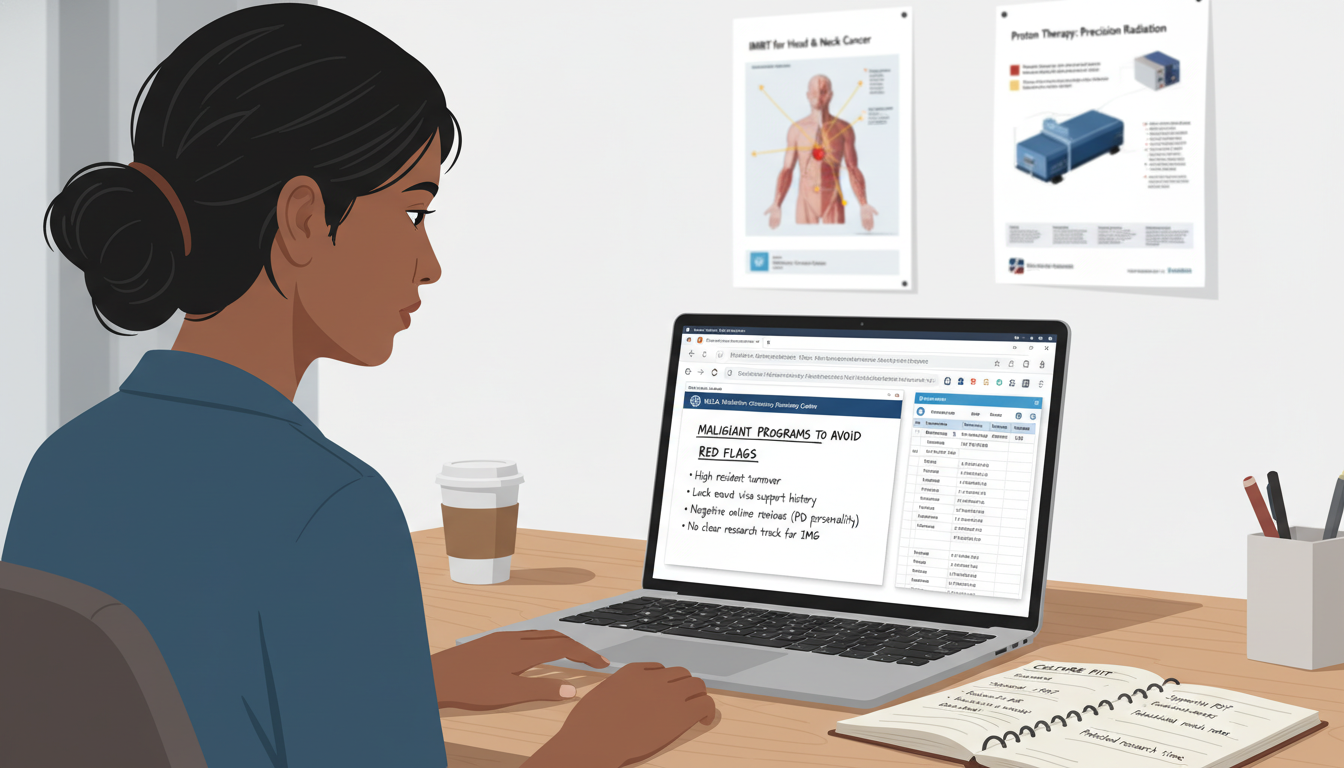
Your best protection against malignant residency programs is front‑loaded research. Many non-US citizen IMGs focus almost exclusively on getting any interview offer in radiation oncology residency; but part of a smart rad onc match strategy is screening for residency red flags before you commit.
1. Scrutinize Program Websites and Public Data
Program websites are marketing tools, but they still reveal useful patterns.
Look for:
Resident class stability
- Are there unexplained gaps (e.g., a 4-year program but only 2 residents listed in a PGY class)?
- Do you see multiple residents who “transferred” or “resigned” with vague explanations?
Graduate outcomes
- Do they list where graduates go—fellowships, academics, community practice?
- Are there several “private practice – unspecified” or “location not listed” outcomes? That can suggest poor support or mismatches.
Visa information
- Do they clearly state support for J‑1 and/or H‑1B visas?
- Lack of clear information is a mild red flag; dishonesty or inconsistency about visas is a major one.
Research environment
- Is there a description of active clinical trials and faculty interests?
- Are resident publications highlighted?
- If research is heavily advertised but residents have few visible outputs, that mismatch itself is a warning.
Check external sources as well:
- FREIDA / ACGME / program PDFs
- Look at case volumes: extremely low volume can compromise training; extremely high volume without clear resident support can suggest overwork.
- Verify accreditation status; any recent warning or probation deserves extra caution.
Example: A program website mentions strong research, but on PubMed you find very few recent radiation oncology publications from that institution, and almost no resident co-authors. That discrepancy is an early sign of potential misrepresentation.
2. Analyze Resident and Faculty Turnover
High turnover is one of the clearest toxic program signs.
Check:
Resident LinkedIn profiles
- Do you notice residents leaving after PGY-2 or PGY-3?
- Are there unexplained gaps or switches to non-clinical careers?
Faculty page history (via Web Archive / Google)
- Have several attendings left within 1–3 years?
- Are there frequent changes in program director or chair?
Some turnover is normal; clusters of departures across trainees and faculty suggest deeper issues.
3. Look for Reputation Signals in Small Rad Onc Circles
Radiation oncology is small, especially in academic circles. Use that to your advantage.
Ask research mentors
- Many rad onc faculty know which programs are supportive and which are malignant.
- Ask open-ended questions: “Are there any programs you’d strongly recommend I avoid as a non-US citizen IMG?”
Conferences & virtual events
- Attend ASTRO or regional rad onc meetings virtually if possible.
- Listen for comments about programs’ culture, mentorship, and supportiveness.
You likely won’t get explicit “do not go there” statements, but tone and hesitation can be revealing.
4. Program Culture on Social Media
Some departments are active on Twitter/X, LinkedIn, or Instagram.
- Are residents visible and engaged, or does the account only show attendings?
- Is there evidence of diversity and inclusion, or only a very narrow demographic?
- Do posts celebrate resident achievements (presentations, publications) or only service and clinical throughput?
Social media is curated, but a complete lack of resident presence or an oddly polished but impersonal feed may indicate low resident agency.
Red Flags During Interview Season: What Malignancy Looks Like Up Close
Once you have interview invitations, your goal is not just to impress programs, but to evaluate them. Non-US citizen IMGs often feel they cannot be “choosy,” but matching into a malignant radiation oncology residency can be worse than not matching in that cycle.
Below are practical, specialty-specific red flags to watch for on interview day.
1. Resident Behavior and Body Language
Residents are your most valuable source of truth.
Warning signs:
Residents seem fearful or overly guarded
- They give short, rehearsed answers.
- They avoid making eye contact with faculty in group sessions.
- When you ask about challenges, they give vague non-answers or glance at each other nervously.
No private time with residents
- If the program does not provide any resident‑only Q&A (without faculty present), that often means they are worried about what residents might say.
Residents discourage follow-up
- If they say, “Please direct further questions to the coordinator or PD,” and seem uncomfortable sharing email contact, that suggests a culture of control.
For IMGs specifically, notice:
- Are there any non-US citizen IMGs currently in the program?
- Do they appear genuinely integrated, or isolated and cautious?
- Are they willing to discuss how the program handles visa or relocation challenges?
2. Program Director and Faculty Attitudes
Faculty attitudes on interview day are powerful indicators of culture.
Dismissiveness or Disrespect
- Making jokes about “weak residents,” “not all residents are cut out for oncology,” or “complainers.”
- Interrupting or talking over residents in front of applicants.
- Minimizing wellness: “We don’t believe in all this work-life balance talk. We’re here to train cancer doctors.”
Hostility Toward IMGs or Non-US Citizens
This might be subtle:
- Comments like, “We usually prefer US graduates, but we’re open-minded.”
- Emphasizing the “extra work” of visas in a resentful tone.
- Asking borderline-inappropriate questions about your country of origin, accent, or “plans to go back home” in a way that feels suspicious or negative.
Any hint that they view non-US citizen IMGs as administrative burdens rather than valued colleagues is a serious warning—these are the people controlling your visa and evaluations.
Lack of Transparency
Vague answers to direct questions about:
- Work hours, call burden, coverage when someone is sick.
- Board pass rates and how they support residents who struggle.
- Case volume and complexity.
- Resident attrition or transfers.
Changing answers or contradicting each other (e.g., PD says, “We rarely exceed 60 hours/week,” while a resident later admits, “70–80 is common when people are out”).
3. Structural Signs of a Malignant or Toxic Program
These “system-level” issues often reveal more than personalities.
Chronic Overwork Without Support
- Residents covering multiple attendings simultaneously with no protected time for teaching.
- Heavy weekend or night call with no post-call relief.
- Common expectation to stay late to finish notes or research, framed as “commitment.”
In radiation oncology, ask specifically:
- “How is time for contouring/plan review protected?”
- “Do residents routinely contour at home in the evenings?”
- “How many active patients is a resident typically following at once?”
If the answers consistently describe high volume, little supervision, and no adjustment for complexity, this may be a malignant workload pattern.
Poor Educational Structure
- No consistent didactic schedule, or frequent cancellations “due to clinical demands.”
- Board review is resident-led only, with minimal faculty involvement.
- No plan for remediation or support if a resident fails an exam or struggles.
Rad onc is heavily technical; a program that expects you to “just pick it up” from clinic without structured teaching is not serious about your success.
Research Exploitation
- Research is required for graduation but:
- No protected research time.
- No clear mentorship system.
- Residents are asked to do extensive data collection for faculty with limited authorship or recognition.
Ask: “How many first-author publications do typical graduates have?” Then compare this with what residents actually say later.
4. Visa and Immigration-Specific Red Flags
For a foreign national medical graduate, visa and sponsorship practices are central to program safety.
Be attentive to:
Inconsistent visa answers
- PD says they “support H‑1B,” but GME office or coordinator later says “only J‑1.”
- Past residents’ profiles show H‑1B, but now they say they “no longer do that” without explanation.
Blaming residents for visa issues
- Stories where they describe previous non-US citizen IMG residents as “difficult” because of visa questions.
- Statements like, “We expect you to handle your own visa issues; we just sign what is necessary.”
No dedicated support
- No mention of institutional legal support or an immigration office.
- Lack of clarity about what happens if there are delays or changes in policy.
Because your ability to stay in the US depends heavily on the program, any sign that they are careless with visas is an enormous residency red flag.

After the Interview: Verifying Your Impressions and Ranking Safely
Once interviews are done, you’ll build your rank list. This is where your risk as a non-US citizen IMG is highest: you may feel pressure to rank every program that interviewed you. Instead, combine your impressions with some methodical follow‑up to avoid malignant programs.
1. Debrief Immediately After Each Interview
Within 24 hours, write down:
- How did residents seem? Stressed? Supported? Free to speak?
- Did anyone make you feel small, dismissed, or as if you were “lucky just to be here” as a non-US citizen IMG?
- Were your direct questions about workload, research, or visas answered clearly?
Include a simple rating:
- Educational strength
- Culture/support
- Visa reliability
- Overall safety for you as a foreign national medical graduate
Patterns will emerge over multiple interviews.
2. Reach Out to Current or Recent Residents (Carefully)
Where possible:
- Email or message one or two residents—ideally those who share your IMG or non-US background.
- Ask targeted, neutral questions:
- “How would you describe the culture of feedback?”
- “Have residents ever left the program, and how was that handled?”
- “Do you feel supported as an IMG/non-US citizen?”
Red flags in their responses:
- Hesitation to put anything in writing: “I’d rather not answer by email.”
- Very vague, generic positivity with no concrete examples.
- Overly glowing answers that sound scripted and don’t match what you heard earlier.
Remember: current residents might fear retaliation. If multiple residents are overly careful, that is itself information.
3. Interpreting Concerning Information
No program is perfect. You must distinguish between:
- Normal imperfection (occasional disorganization, one difficult attending, recent leadership transition)
- Systemic malignancy (pattern of disrespect, chronic overwork, high attrition, fear of speaking up, visa carelessness)
Indicators of systemic malignancy:
- More than one resident leaves within a short period without clear reasons.
- Repeated faculty turnover and unstable leadership.
- Consistent stories of retaliation against residents who raised concerns.
- Mixed or negative reputation among independent faculty you trust.
When you are weighing whether to rank such a program, remember: as a non-US citizen IMG, your ability to transfer out is constrained by visa and match rules. Err on the side of avoiding clearly toxic environments.
4. Rank List Strategy for Non‑US Citizen IMGs
Some practical tips:
Never rank a program you would be truly unwilling to train at. Matching there locks you in for years and can complicate your immigration plan.
Consider a slightly shorter rank list of safe programs over a long list that includes clearly malignant options.
If you have a combination of:
- A smaller, less “prestigious” but supportive program, and
- A big-name program with serious culture red flags,
As a foreign national medical graduate, prioritize safety, mentorship, and visa reliability over prestige.
In radiation oncology, your letters, reputation, and well-being will open more doors than a brand-name program where you are miserable or harmed.
Protecting Yourself if You Land in a Difficult Environment
Despite careful screening, some residents still find themselves in programs that are more toxic than they expected. As a non-US citizen IMG, you must be strategic.
1. Document and Seek Early Mentorship
- Keep careful records of concerning interactions (dates, specifics).
- Seek multiple mentors, including outside your department (e.g., internal medicine or surgery faculty who are fair and well-respected).
- Establish relationships with faculty known to be supportive of trainees and IMGs.
2. Understand Institutional and External Protections
Learn your institution’s policies on:
- Harassment and discrimination.
- Duty hours and wellness.
- Academic due process.
Identify:
- The GME office and designated ombudsperson.
- National organizations (e.g., ACGME Resident Services) that can give confidential guidance.
As a foreign national medical graduate, weigh any formal complaint against potential visa consequences, but do not assume you have no rights—ACGME-accredited programs must meet specific standards.
3. Consider Strategic Long-Term Planning
If the environment is harmful and unlikely to change:
- Explore early transfers if feasible (rare in rad onc, but not impossible).
- Keep your professional reputation spotless: be on time, be prepared, and avoid public conflict.
- Focus on:
- Passing boards on the first attempt.
- Building a research portfolio with supportive faculty.
- Networking outside your department for future job leads.
In some cases, the pragmatic move is to finish as safely as possible, then move to a healthier environment post-residency or post-fellowship.
Frequently Asked Questions (FAQ)
1. Should a non‑US citizen IMG ever rank a program with known “malignant” reputation?
Generally, no. If multiple independent sources describe a radiation oncology residency as malignant—chronic bullying, high attrition, or unsafe workloads—ranking that program is risky, especially when your visa is tied to continued training. Even if you fear not matching, consider expanding your application to preliminary years, research positions, or re-applying later rather than committing to a known toxic environment that could harm your health, career, and immigration status.
2. How can I specifically evaluate how a program treats non‑US citizen IMGs?
During interviews, ask:
- “Have you had non‑US citizen residents recently, and how did you support them?”
- “Do you currently sponsor J‑1 and/or H‑1B visas?”
- “Can you describe any institutional resources for international graduates (immigration, cultural, or relocation support)?”
Watch for:
- Clear, consistent answers from PD and coordinator.
- Residents who are foreign national medical graduates speaking openly and positively about their experiences.
- Examples of flexibility and advocacy when residents faced visa or family challenges.
Ambiguity, dismissiveness, or visible discomfort answering these questions are important red flags.
3. Is it okay if a program has no current IMGs or foreign national graduates?
Lack of current IMGs is not automatically a sign of a malignant residency program, but it raises questions:
- Is the program open and experienced in handling visas?
- Are they genuinely committed to diversity and inclusion?
- Why have they not matched IMGs recently, especially in a competitive specialty like radiation oncology?
If they demonstrate clear policies, strong support structures, and positive attitudes toward your background, they may still be a good fit. If they seem unfamiliar with or resistant to the needs of non-US citizen IMGs, proceed cautiously.
4. How much weight should I give to online reviews or anonymous forums about toxic programs?
Anonymous forums can provide early clues but should never be your only source. Use them as a starting point:
- If multiple independent posts report the same issues (bullying, retaliation, extreme overwork), take that seriously.
- Cross-check with:
- Conversations with trusted faculty and mentors.
- Program data (attrition, faculty turnover).
- Your own impressions from interviews.
If online reports of malignancy line up with your interview observations and what you hear from mentors, it’s wise to treat the program as high-risk and adjust your rank list accordingly.
A thoughtful, research‑driven approach to identifying malignant programs will help you not only survive training, but truly develop as a competent, confident radiation oncologist. As a non-US citizen IMG, you deserve a residency that values your contribution, protects your well‑being, and supports your long‑term career and immigration journey—use the tools in this article to find exactly that.