Understanding “Malignant” Programs in EM-IM as a US Citizen IMG
In residency culture, “malignant” is an unofficial but widely used term. It refers to programs where the training environment is consistently harmful to residents’ well‑being, learning, or careers. For US citizen IMGs—Americans studying abroad who return to the United States for graduate medical education—spotting these environments early is especially important, particularly in a demanding combined Emergency Medicine–Internal Medicine (EM-IM) pathway.
As a US citizen IMG, you may already feel more vulnerable in the match process. You might worry about visa issues (even if you don’t need one), perceptions of your school, or limited access to home programs. That combination can make it tempting to accept any position that shows interest. However, a malignant residency program can damage your physical health, mental health, and long‑term career prospects.
This article breaks down how to identify malignant or toxic program signs specifically in Emergency Medicine–Internal Medicine combined residencies, from the pre‑application phase through interviews and rank list decisions.
What Makes a Program “Malignant” in EM-IM?
While every program has tough rotations and stressful seasons, malignant programs are different in quality, not just intensity. They systematically disregard resident well‑being, fair treatment, and professional development.
Core Features of Malignant Residency Programs
Most malignant programs share some or all of these traits:
- Chronic violation of duty hours or work-hour “gaming”
- Culture of fear, punishment, or humiliation
- Poor supervision with high responsibility but low support
- Retaliation against residents who speak up
- Lack of transparency about outcomes (board pass rates, attrition, fellowships, job placement)
- High and unexplained resident turnover
- Bullying, discrimination, or harassment that is normalized or ignored
In EM-IM combined programs, this can be amplified because:
- You must meet the requirements of two full specialties.
- You rotate between two cultures (EM and IM), which may not be equally supportive.
- You have unique scheduling pressures, often with heavier night and off‑service demands.
- You may be treated as an “odd one out” in both EM and IM groups if the program is poorly integrated.
A program that is simply rigorous will still show respect, strong teaching, clear expectations, and support mechanisms. A toxic program demands more and more while giving little in return—no safety net, no advocacy, no honest mentorship.
Pre‑Application Research: Early Red Flags You Can Spot From Afar
Before you even apply, you can identify potential residency red flags using publicly available information. For a US citizen IMG, this step is crucial because it helps you target safer programs and avoid wasting applications or interview money.
1. Website and Public Information Quality
A residency website will never call itself malignant—but it can still tell you a lot.
Concern if:
Minimal or outdated information
- No recent resident roster or photos
- Schedule examples older than 2–3 years
- No detailed curriculum for both Emergency Medicine and Internal Medicine sides
Very little transparency on outcomes
- No data on board pass rates for EM and IM
- No information on fellowship placement, job outcomes, or alumni paths
- No mention of EM IM combined graduates specifically
Lack of clarity about the EM-IM structure
- No block schedule overview explaining how EM-IM residents divide time
- No clear description of how EM-IM residents are integrated with categorical EM and IM residents
An EM-IM combined program that can’t clearly explain how your five years will look may have poor organization or weak leadership, both of which can be toxic when things become stressful.
2. Resident Roster and Attrition
Look carefully at current and past residents:
- Programs that post PGY-1 but not PGY-2+ residents may be “forgetful,” or they might be hiding high attrition.
- Frequent notes like “transferred to another program,” “left for personal reasons,” or missing photos can signal trouble if it happens repeatedly.
- In EM-IM, note how many residents complete the full 5 years versus transferring to categorical EM or IM or leaving altogether.
Key questions for your research list:
- How many total EM-IM residents are there?
- How many have graduated in the last 3–5 years?
- Does the EM-IM section look “thin” compared with what you’d expect?
A single resident leaving is not proof of a toxic program, but a pattern of departure should make you cautious.
3. Reputation Among Peers and Online Communities
As a US citizen IMG, you might not have the same home‑institution network as US MDs, but you can still gather intel:
- Ask senior IMGs from your school who matched in EM, IM, or EM-IM what they’ve heard.
- Look at online forums and reviews (e.g., Reddit, SDN, specialty-specific forums). Treat anecdotes cautiously, but consistent themes matter.
- Seek out EM-IM specific communities (social media groups, alumni groups, or specialty interest groups through EMRA or ACP).
Red flags mentioned repeatedly:
- “No one ever gets feedback.”
- “They punish you for calling in sick.”
- “The EM side is great, but the IM side is awful” (or vice versa).
- “Multiple residents left in the same year.”
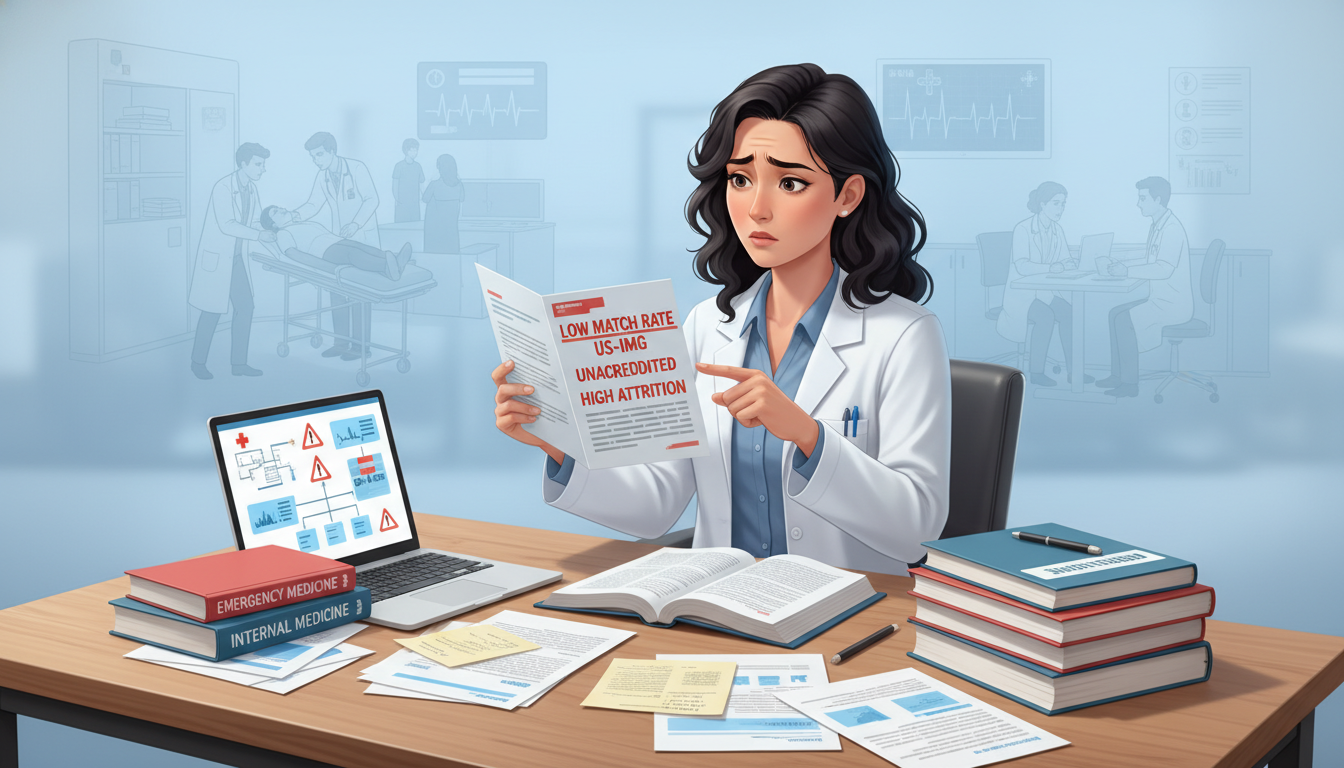
Toxic Program Signs During Interviews and Second Looks
Once you reach the interview stage, you’ll have richer, more nuanced data. This is your best opportunity to separate tough-but-supportive programs from truly malignant ones, especially in a demanding EM-IM combined track.
1. How They Talk About EM-IM Versus Categorical Residents
You are not just joining a residency; you’re joining two:
- Emergency Medicine program
- Internal Medicine program
Listen carefully:
- Do they describe EM-IM residents as an integrated, valued group?
- Or as “the 5-year people,” “floaters,” or “weird hybrids” without a strong identity?
Red flags in language:
- “You’ll basically do all the hardest rotations from both sides.”
- “We expect our EM-IM residents to be extra tough—no hand-holding.”
- “You’re like our backup coverage when either side is short.”
These suggest that EM-IM residents may be used as workhorses rather than learners, which is a classic malignant pattern.
2. Resident Behavior: What You See vs. What You’re Told
On interview day, notice:
- Eye contact and openness: Do residents seem anxious when answering culture questions in front of faculty?
- Consistency of answers: If one resident says “we always leave about on time” and another later says “we routinely stay 2–3 hours late,” that inconsistency is telling.
- Availability: If you never get to talk to residents alone, that’s a red flag. Malignant programs often control access to residents to limit honest conversation.
Questions to ask residents (preferably in private):
- “What changes would you make if you were program director?”
- “How does the program respond when someone is struggling or burned out?”
- “If a co-resident had a serious personal crisis, what would happen with their schedule and support?”
- “How often are you working beyond your scheduled hours, especially on EM-IM rotations that combine responsibilities?”
Look for hesitation, nervous laughter, or evasive answers—these may be more informative than their actual words.
3. Duty Hours, Workload, and Coverage Patterns
For EM-IM combined residents, schedules are inherently dense, but they should still respect ACGME duty hour rules and basic human limits.
Red flags:
Residents casually mention:
- “We almost never log our real hours.”
- “We just ‘fix’ the numbers so ACGME doesn’t get upset.”
- “We’re told not to report violations because it looks bad.”
On call or night float patterns that sound unsafe:
- Extremely long sequences of nights with minimal rest
- Frequent “flip” of day–night cycles with no transition time
- Being pulled from IM wards to EM shifts suddenly (or vice versa) without schedule protection
EM-IM residents appear to cover:
- Extra shifts when EM is short-staffed
- Extra ward coverage when IM is short
- More holidays/weekends than categorical peers
These arrangements may indicate a malignant culture of overwork, especially if justified with phrases like “this is how you become strong” or “real doctors don’t complain.”
4. Attitude Toward Wellness and Mistakes
All residents make errors; how the program responds is a major litmus test.
Concerning signs:
Proud statements like:
- “We’re not a touchy‑feely program.”
- “We don’t believe in hand‑holding.”
- “We don’t really talk about burnout here; we just get the job done.”
When asked about wellness resources, leaders give vague or dismissive answers:
- “We have something through the hospital, I think.”
- “You probably won’t have time to use those.”
Residents describe:
- Being publicly shamed for errors.
- Attending physicians raising their voice, insulting intelligence, or ridiculing in front of patients or staff.
- Fear of asking questions because it may be interpreted as incompetence.
An environment where fear and shame are the primary educational tools is a classic toxic program sign.
EM-IM Specific Red Flags: Unique to Combined Training
Emergency Medicine–Internal Medicine combined training has special structural and cultural challenges. Some programs manage these beautifully; others allow them to become malignant. As a US citizen IMG, you need to be particularly attuned to how the program handles the “combined” part.
1. Fragmented Identity and Poor Advocacy
Healthy EM-IM programs:
- Have a dedicated EM-IM program director or associate PD.
- Conduct EM-IM-only meetings to address unique concerns.
- Ensure EM-IM residents have a voice in both departments.
Red flags:
- No clearly identified EM-IM leadership.
- You are told, “You’ll just report to whichever PD is over the rotation you’re on at that moment.”
- EM-IM residents say:
- “Sometimes I’m not sure who is actually responsible for me.”
- “When there’s a conflict between EM and IM, we’re stuck in the middle and no one advocates for us.”
Without clear advocacy, EM-IM residents can easily become exploited for service needs or fall through the cracks when problems arise.
2. Imbalanced or Lopsided Training
A strong EM-IM program balances both disciplines. Malignant-style programs often:
- Overload one side (usually IM wards or ICU time) while skimping on EM or vice versa.
- Use EM-IM residents to plug service holes in unpleasant or under‑resourced rotations, with little educational value.
Questions to ask:
- “Can I see a sample 5‑year block schedule specifically for EM-IM?”
- “Do EM-IM residents feel confident taking boards in both specialties?”
- “How often do EM-IM residents rotate with categorical peers versus being alone?”
Red flags in answers:
- “We haven’t fully built out the EM-IM schedule yet, but it works out.”
- “Our EM-IM residents tend to just figure it out across both sides.”
- “We don’t track EM-IM board pass rates separately.”
For an American studying abroad, your initial board performance is especially important for leveling the playing field in fellowship and job applications. A program that does not take your dual board readiness seriously is risky.
3. Poor Support for Career Development and Fellowships
EM-IM graduates have diverse options: critical care, ultrasound, administration, academic EM, hospital medicine, cardiology, pulmonary/critical care, and more. Good programs celebrate and support this.
Malignant or weak programs often:
- Have no EM-IM alumni network or can’t tell you where people ended up.
- Provide little or no tailored mentorship for EM-IM career paths.
- Rely on you to “cobble together” letters and experiences from two disconnected departments.
Ask:
- “Can you share examples of recent EM-IM graduates and their current positions?”
- “How do you support EM-IM residents who want competitive fellowships?”
- “Are there EM-IM faculty who share this training background?”
If the answer is silence or vague generalities, the combined track may be under‑developed and potentially neglectful.

Special Considerations for US Citizen IMGs: Vulnerability and Protection
Being a US citizen IMG brings both advantages and vulnerabilities. You don’t need visa sponsorship, which can make you attractive to some programs—but in malignant environments, that can translate into being easier to exploit.
1. Know Your Value and Rights
Some toxic programs subtly imply that IMGs should be grateful for any spot, using that to justify mistreatment or ignoring concerns.
Protect yourself by remembering:
- As an EM-IM resident, you will be doing critical frontline work in both ED and inpatient settings.
- You are entitled to:
- ACGME duty hour protections
- A safe learning environment
- Freedom from discrimination based on where you went to medical school
If leaders say things like:
- “We expect more from IMGs because we took a chance on you.”
- “Complaints about hours or culture might make us reconsider taking IMGs in the future.”
That is deeply concerning and a strong sign of a malignant mindset.
2. Ask Directly About Support for IMGs
Even as a US citizen IMG, your training background may differ from US MDs or DOs.
Questions to consider:
- “How does the program support residents who may need extra time adjusting to the US health system?”
- “Have previous US citizen IMGs been successful here? Can I talk with one of them?”
Supportive programs will:
- Proudly share success stories of IMGs.
- Offer structured onboarding, feedback, and remediation pathways that are supportive, not punitive.
Toxic programs might:
- Blame IMGs disproportionately for systemic issues.
- Stereotype IMGs as weaker or more problematic.
- Use IMG status as an excuse for more intense scrutiny or harsh evaluation.
3. Beware of Overpromising and Under‑Delivering
Some malignant programs compensate for poor culture by over‑selling themselves to applicants, especially US citizen IMGs who may feel they have fewer options.
Be cautious if:
- They excessively emphasize prestige, case volume, or fellowships, but become vague when asked for concrete numbers.
- Faculty dismiss every concern with, “You’ll be fine; we’re like a family,” without specifics.
- Residents say, “We were told it would be different, but once we started, nothing changed.”
Ask for specifics:
- “Can you share your last three years of EM and IM board pass rates?”
- “How many EM-IM graduates have entered fellowship, and in what fields?”
- “What concrete changes has the program made based on resident feedback in the last 2 years?”
If they cannot answer directly, their promises may not be reliable.
Turning Observations Into a Safe Rank List
By the time you’re ranking programs, you’ll have accumulated dozens of impressions. The key is to differentiate between normal imperfection and true malignant risk.
1. Weighing Red Flags vs. Yellow Flags
Yellow flags might include:
- A newer EM-IM program still refining its schedule
- Lower but improving board pass rates
- Limited research, but supportive faculty
Red flags (much more serious):
- Patterns of resident mistreatment and fear
- Systematic under‑reporting or ignoring work‑hour violations
- High attrition among EM-IM residents with evasive explanations
- No clear EM-IM leadership or advocacy
- Consistent negative reputation from multiple, unconnected sources
A program with a few yellow flags but strong, honest leadership may still be a great fit. A program with multiple true red flags should be moved low on your rank list—or left off entirely, even if it seems like your “only shot.”
2. Gut Feeling Matters—But Confirm It
Your instincts are valuable. If you finish an interview day feeling uneasy, ask yourself:
- “What specifically bothered me?”
- “Did I see or hear anything that suggested residents weren’t safe, supported, or respected?”
- “Did EM-IM residents seem satisfied and proud, or tired and trapped?”
Then, try to confirm with data:
- Recontact residents with follow‑up questions.
- Revisit online discussions or reach out to alumni.
- Talk with trusted mentors who can help you interpret what you found.
3. Remember That No Match Is Better Than a Malignant Match
This is the hardest perspective shift, especially as a US citizen IMG who may fear not matching at all. But matching into a truly toxic program can lead to:
- Burnout and serious mental health consequences
- Difficulty completing training or passing boards
- Damage to future career opportunities
In extreme cases, some residents leave medicine entirely after malignant residency experiences. It is far better to reapply strategically than to sacrifice your career and well‑being in a destructive environment.
FAQs: Identifying Malignant EM-IM Programs as a US Citizen IMG
1. How can I tell if negative online reviews reflect a truly malignant program or just a few unhappy residents?
Look for patterns across multiple sources and years. One or two angry posts may not mean much, but consistent themes (e.g., retaliation, poor supervision, chronic duty hour abuse) from different cohorts and platforms are more credible. Use interviews to directly ask about those issues and observe how transparently the program responds.
2. Are EM-IM combined programs more likely to be malignant than categorical EM or IM programs?
Not inherently. Many EM-IM programs are excellent. However, EM-IM residents are more vulnerable when:
- The EM-IM track is poorly organized
- There’s no dedicated EM-IM leadership
- They are used to plug service gaps in both departments
This makes it even more important to evaluate how well integrated and supported the EM-IM pathway is at each institution.
3. As a US citizen IMG, should I avoid any program that has never taken an IMG before?
Not necessarily. Some newer or smaller programs may simply not have had many IMG applicants. Focus instead on:
- Their attitude toward IMGs
- Their support structures (onboarding, mentorship, feedback)
- Their overall culture
A non‑malignant, IMG‑naïve program that is transparent, eager to support you, and strong in EM-IM structure may be safer than a long‑standing but toxic program that regularly matches IMGs.
4. What should I do if I realize after matching that my program is malignant?
First, document specific issues (duty hour violations, mistreatment, unsafe supervision). Seek:
- Support from chief residents and trusted faculty
- Guidance from your GME office and DIO (Designated Institutional Official)
If your safety, health, or education is at serious risk, transferring is possible but complex. Involve trusted mentors outside your program for advice. Your well‑being comes first; even in a malignant residency program, you are not powerless, and there are formal channels to address serious concerns.
By approaching your EM-IM residency search with a critical eye—especially around malignant residency program behaviors—you can protect your health, education, and long‑term career. As a US citizen IMG, you bring valuable diversity of experience to any training environment. You deserve a program that recognizes that value, supports your dual training in emergency medicine internal medicine, and helps you thrive rather than merely survive.