
Understanding Resident Turnover as an IMG in Preliminary Medicine
Resident turnover is one of the most important—and most underestimated—red flags for any residency applicant. For an international medical graduate (IMG) pursuing a preliminary medicine year (prelim IM), it can be especially critical. You have only one year to build U.S. clinical experience, obtain strong letters, and prepare for your advanced specialty. A toxic or unstable program can derail these goals quickly.
This IMG residency guide focuses on “resident turnover warning signs” specifically in Preliminary Medicine programs. You will learn how to recognize when residents leaving a program signal normal transitions versus serious program problems you should avoid.
1. Why Resident Turnover Matters So Much in a Prelim IM Year
Normal vs Problematic Turnover
Residency programs always have some natural “turnover”:
- Graduating residents moving on to fellowships or practice
- Residents transferring for geographic or personal reasons
- A rare mismatch where one resident changes specialties
This is expected. However, high or unexplained turnover—especially among interns and juniors—can be a major resident turnover red flag.
In a preliminary medicine year, turnover has unique consequences:
Compressed timeline
You have only 12 months to:- Adapt to the U.S. system
- Earn strong letters for your advanced program
- Pass Step 3 (often recommended or required)
- Demonstrate reliability and professionalism
A chaotic program with frequent resident departures can make it much harder to reach these goals.
Redistributed workload
When residents leave, their shifts and responsibilities don’t disappear. They’re redistributed:- More night float and call for remaining residents
- Extra cross-coverage
- Less time for study, research, or observerships in your intended advanced field
Educational degradation
Programs under stress often:- Convert educational conferences into service coverage
- Cancel teaching rounds regularly
- Reduce supervision due to staffing crises
As an IMG, you particularly depend on structured teaching and feedback to adapt quickly to U.S. practice.
Risk to wellness and visa stability
- Overwork + poor support = burnout, anxiety, or depression
- If multiple residents leave, the program may come under ACGME or institutional scrutiny
- In extreme scenarios (program closure, probation), there can be implications for visa-holding IMGs who rely on stable GME employment
Bottom line: In a prelim IM year, high resident turnover doesn’t just mean “busy.” It can directly affect your training quality, well-being, and future opportunities.
2. Key Resident Turnover Warning Signs Before You Rank a Program
As an IMG, you often have limited in-person exposure to programs before Match Day. That makes it vital to detect resident turnover red flags from all available signals—websites, interviews, social media, and word-of-mouth.
A. Patterns on the Program Website and Public Information
Missing or incomplete resident lists
Warning patterns:- Many PGY-1 or PGY-2 slots listed as “TBD” with no explanation
- Bios that vanish midyear without replacement
- A large discrepancy between the number of positions advertised and the number of residents shown
Programs may not publicly label “residents leaving program,” but frequent updates removing names can be telling.
Frequent changes in program leadership
Watch for:- New program director every 1–3 years
- Rapid turnover of associate program directors or chief residents
- “Interim program director” mentioned for extended periods
Leadership instability often correlates with program problems that drive residents away as well.
ACGME citations or warnings (if visible)
While details are not always public, you might see:- Sudden reduction in number of positions
- Public statements about “restructuring” or “right-sizing” without clear rationale
- Rumors on forums about ACGME concerns, especially related to duty hours or supervision
B. Signals During Interviews
Use the interview day to gather specific data about turnover.
1. Direct questions to ask
Frame questions in a neutral, professional way:
- “In the past 3–5 years, how many residents have transferred or left the program early?”
- “Have there been any residents who did not complete the preliminary medicine year as planned? What were the main reasons?”
- “How does the program manage coverage when a resident leaves?”
- “Has the program made any recent changes in response to resident feedback or ACGME surveys?”
Reasonable responses might include:
- One or two residents over several years due to personal or geographic reasons
- Clear, factual explanations (e.g., spouse relocation, family illness, change in specialty)
- Specific improvements made based on feedback (schedule adjustments, additional support staff)
Concerning responses:
- “We don’t track that.”
- Vague or evasive language: “People leave sometimes; it’s like any job.”
- Smiling but non-specific: “We’re working on some things; it’s complicated.”
- Conflicting answers between faculty and residents
2. Emotional tone and body language
Pay attention to how people react when you mention turnover:
- Residents look at each other before answering
- Nervous laughter or change of subject
- Faculty give very polished, rehearsed answers that sound inconsistent with what residents say
These can be subtle but important resident turnover warning signs.
C. Clues From Current and Former Residents
As an international medical graduate, you may not have a large U.S. network—but you can still gather insights.
Contact current prelims or recent alumni
Especially seek out:- IMGs who completed a preliminary medicine year there
- Residents who matched into your intended advanced specialty
Ask:
- “In your year, did anyone leave the program early or transfer?”
- “How often do prelim IM residents complete the year successfully?”
- “If you had to do it again, would you rank this program in the same position?”
Online forums & social media
Treat anonymous reports cautiously, but recurrent themes are meaningful:- Multiple comments about residents leaving program midyear
- Posts referencing “toxic culture,” “unsafe workload,” or “no support for IMGs”
- Threads describing “silent” but consistent resident turnover every year
Look for consistency of stories
- One angry post could be a single bad experience
- Many similar stories across years often indicate persistent program problems
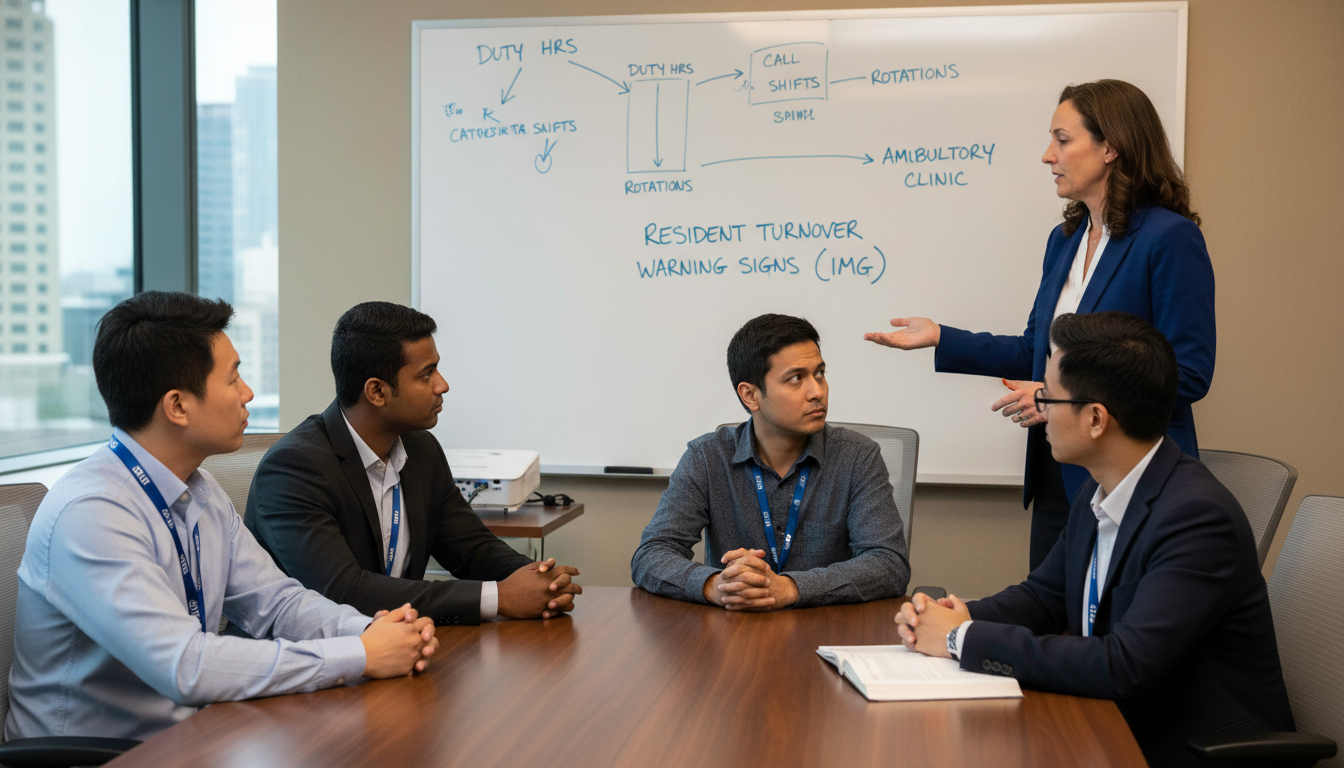
3. On-the-Ground Red Flags: What You’ll Notice on Interview Day or Rotations
If you get to visit the program in person—for an interview, observership, or audition rotation—you will have even more opportunities to assess resident turnover warning signs.
A. How Residents Talk About Their Experience
- Global negativity or resignation
Listen for phrases like:
- “It’s survivable.”
- “You just have to get through the year.”
- “We’re short-staffed a lot, but it is what it is.”
One resident speaking this way might just be burnt out. But if many residents describe the program this way, it suggests a culture of dissatisfaction that can drive turnover.
- Reluctance to speak without faculty
Notice whether residents:
- Seem guarded when faculty are nearby
- Ask to answer your questions later by email or off-site
- Give brief, generic answers and quickly change the subject
These behaviors can indicate fear of retaliation, which strongly correlates with toxicity and higher resident turnover.
- Specific mentions of “people leaving”
Pay attention to wording:
- “We had a couple of people leave last year, but it was mostly for family reasons or specialty change.” (could be normal)
- “We’ve had a few people leave every year for a while now.” (concerning pattern)
- “We’ve been very short on interns since last fall.” (major resident turnover red flag)
B. Visible Signs in Schedules and Workflow
- Heavy reliance on moonlighters or float residents
Red flags:
- Many shifts labeled “TBD” or filled by outside moonlighters
- Residents mentioning frequent emails asking for volunteers to cover last-minute holes
- Repeated comments like “We’re constantly scrambling to fill the schedule”
- Excessive cross-coverage for prelims
In some medicine programs, prelims:
- Do more nights than categoricals
- Cover multiple services simultaneously
- Have limited elective time
This by itself is not always a red flag for a prelim year. However, combined with residents leaving program and constant schedule instability, it becomes worrisome.
- “Stretching” ACGME duty hours
Common warning signs:
- Residents regularly working beyond 80 hours/week
- Logging hours inaccurately to “stay compliant” on paper
- Statements like, “We’re told not to log extra hours,” or “If you log everything honestly, it causes trouble.”
ACGME duty hour violations are a classic marker of program problems that often precede resident departures, citations, or probation.
C. Treatment of IMGs Specifically
As an international medical graduate, also look at how the program handles:
- Visa sponsorship: Are there delays, confusion, or last-minute changes?
- Orientation and onboarding: Is there special support for IMGs adjusting to U.S. documentation, EMR, communication norms?
- Feedback style: Do faculty show patience with accents and different communication styles?
If IMGs seem isolated, unsupported, or disproportionately stressed, that may in itself contribute to residents leaving the program, particularly among international graduates.
4. When High Turnover Might Be Understandable (But Still Requires Caution)
Not all turnover is purely negative. Context matters. Your job is to differentiate between acceptable and dangerous patterns.
A. Programs Undergoing Genuine Reform
Some programs are actively improving, and turnover reflects growing pains rather than long-term toxicity.
Positive signs:
- New leadership with clear, transparent plans
- Visible changes in schedules, support staff, or educational structure
- Residents acknowledging: “Things were rough 2–3 years ago, but it’s getting better, and people are staying now.”
- ACGME or institutional support for reform
As a prelim IM applicant, you must consider timing:
- Will reforms realistically benefit you during your one-year stay?
- Or are you likely to face instability while they “figure things out”?
B. Geographic or Lifestyle Factors
Some programs have consistent challenges:
- Very high cost of living with relatively low salary
- Remote location with limited spousal job opportunities
- Intense urban setting with long commutes and safety concerns
Turnover due primarily to geography is less alarming than turnover due to program problems. Still, for an IMG without strong local support systems, these factors can compound stress.
C. Specialty Mismatch or Career Reorientation
If a program honestly states:
- “We had a few residents leave to pursue anesthesiology or radiology.”
- “One preliminary medicine resident left to match into a surgery prelim spot elsewhere.”
This may be less about program toxicity and more about personal goals. However, repeated losses across many different reasons often still indicate underlying dissatisfaction.

5. Practical Strategy: Applying and Ranking Smartly as an IMG in Prelim Medicine
A. Balancing Risk and Opportunity
As an IMG, you may feel pressure to rank every program that offers you an interview. This is understandable but potentially dangerous, especially when solid resident turnover warning signs are present.
Ask yourself:
Is matching into a high-turnover program better than not matching at all this year?
For some candidates with expiring attempts or visa timing, the answer might be yes—but go in with clear expectations.Do I have safer alternatives, even outside Prelim IM?
- Transitional year programs
- Preliminary surgery or other prelim specialties
- Research or observer roles for a year while reapplying
How much risk can I tolerate for one intense year?
- Very high turnover + frequent duty hour violations + poor support for IMGs = high risk
- Moderate turnover + visible improvements + strong faculty mentorship = more nuanced
B. Questions to Ask Specifically as an IMG
When you’re an international medical graduate, prioritize questions like:
- “How many IMGs have you had in the preliminary medicine program in the past 3–5 years?”
- “What percentage of them successfully completed the year?”
- “How many went on to secure advanced positions in their intended specialty?”
- “Do IMGs here ever leave before finishing the year? If so, why?”
Also ask about:
- Visa processing history and reliability
- Support for USMLE Step 3 study (time, schedule flexibility)
- Opportunities to obtain letters from subspecialists in your target field
C. Recognizing “Last-Minute” Red Flags Before Rank List Submission
In the weeks before ROL certification, revisit your impression of each program. Watch out for:
- Sudden email announcements about leadership changes
- New rumors or statements from residents about multiple departures
- Silence or reluctance from residents who previously communicated openly
If you learn that several residents have recently left the program—especially prelims or interns—reconsider how high you rank that program. Even a small shift in ranking order can protect you from a very problematic match.
6. If You Match Into a High-Turnover Program: Damage Control and Success Strategies
Sometimes, despite all efforts, you may match into a program that turns out to have significant resident turnover and program problems. As an IMG in a preliminary medicine year, your goal becomes: survive, protect yourself, and still maximize your future prospects.
A. Protecting Your Well-Being and Safety
Know your rights and standards
- Understand ACGME duty hour rules
- Be familiar with your institution’s GME policies on supervision, fatigue, and patient safety
- Identify ombudspersons, wellness resources, and confidential reporting channels
Set boundaries where possible
- Log your hours honestly
- Request help for unsafe patient loads
- Use formal mechanisms rather than only informal complaints
Build a support network
- Connect with other IMGs in the hospital
- Maintain ties with mentors from medical school or observerships
- Seek mental health resources early, not only in crisis
B. Maximizing Educational Value Despite Turnover
Seek out good mentors individually
Even in problematic programs, there are often excellent individual attendings:- Identify those who teach well and care about residents
- Ask them explicitly for feedback and letters of recommendation
- Clarify your career goals in your intended advanced specialty
Be strategic with elective time
If possible:- Reserve electives with faculty in your target specialty
- Avoid electives known to be chaotic and under-supervised
- Use elective blocks to prepare for Step 3 and your future applications
Document your accomplishments
- Track procedures, presentations, QI projects
- Save emails of positive feedback
- Maintain a portfolio for your next application cycle
C. Considering Transfer or Early Exit (Rare but Important)
Transferring out of a prelim IM year is complex, especially for IMGs on visas, but not impossible:
- Speak confidentially with trusted faculty or GME leadership if the environment is unsafe
- Explore:
- Transfer to another prelim program
- Transition into research or non-clinical roles while maintaining immigration status
- Carefully weigh the risk of leaving early against potential long-term damage to your career or visa position
Even if you cannot leave, having a clear one-year survival plan helps you stay focused and less overwhelmed.
FAQs: Resident Turnover Warning Signs for IMGs in Preliminary Medicine
1. How much resident turnover is “too much” in a preliminary medicine program?
There is no absolute number, but patterns matter. One or two residents leaving over several years for personal or specialty-change reasons is normal. Consistently losing residents every year—especially interns or multiple prelims—is a strong resident turnover red flag, particularly if explanations are vague or inconsistent.
2. As an IMG, should I avoid any program with recent resident departures?
Not automatically. Look at:
- The reason for departures
- Whether the program is making transparent, concrete improvements
- How current residents describe their experience now
However, if you have options and a program has repeated residents leaving program, chronic duty hour issues, and unstable leadership, you should think hard before ranking it highly.
3. How can I ask about resident turnover without sounding negative or accusatory?
Use neutral, data-focused language during interviews, such as:
- “Can you share how often residents transfer or leave your program before graduation?”
- “What changes have been made in the last few years based on resident feedback or ACGME surveys?”
- “How does the program support residents when someone leaves unexpectedly?”
This shows maturity and insight, not negativity.
4. Is a high-workload prelim IM program always a bad sign?
Not necessarily. Many prelim IM spots are demanding by nature, with heavier service and less elective time than categorical positions. High workload becomes a major red flag when combined with:
- High resident turnover
- Lack of supervision or support
- Dishonest duty hour reporting
- Poor track record of IMGs successfully completing the year and advancing in their careers
A busy but honest, supportive program can still be an excellent stepping stone for an international medical graduate—while a chaotic, unstable one can be damaging even if it looks prestigious on paper.
By learning to recognize and interpret resident turnover warning signs, you significantly improve your chances of choosing a preliminary medicine year that supports, rather than sabotages, your long-term goals as an IMG. Use every piece of information—websites, interviews, resident conversations, and forums—to build a realistic picture before you rank. Your one year of prelim IM is too important to leave to chance.