
Why Malignant Programs Matter in Clinical Informatics
For an MD graduate pursuing clinical informatics, the allure of a cutting‑edge, tech-driven career can sometimes obscure a harsh reality: not all programs are healthy, supportive learning environments. Some are dysfunctional, hostile, or exploitative—what many residents and fellows call a malignant residency program.
Malignancy is not just about long hours or high expectations. In the context of a clinical informatics fellowship or any health IT training pathway, it usually means a persistent pattern of:
- Psychological unsafety
- Systematic disregard for trainee wellbeing
- Dishonesty in recruitment or evaluation
- Exploitative use of trainees as cheap labor or “IT coverage”
Because clinical informatics is a relatively new specialty with rapidly expanding opportunities, there is a wide spectrum of program quality. MD graduates, especially those coming from an allopathic medical school match experience in a more traditional specialty, may not yet recognize subtle residency red flags specific to informatics and digital health.
This article focuses on helping you, as an MD graduate, identify toxic program signs and avoid wasting critical years of your early career in a malignant environment.
We will cover:
- How malignancy looks different in clinical informatics vs. categorical residencies
- Core red flags in culture, leadership, and workload
- Informatics‑specific warning signs around project work, IT governance, and career development
- How to research programs and ask difficult but professional questions
- What to do if you discover toxicity after you start
How “Malignancy” Looks Different in Clinical Informatics
Many MD graduates think of malignant programs in terms of classic residency horror stories—brutal call schedules, screaming attendings, and chronic 100‑hour work weeks. Clinical informatics training has its own version of malignancy, which is often more subtle.
Unique Vulnerabilities in Clinical Informatics Training
Clinical informatics fellowships and related health IT training paths often include:
- Smaller programs (sometimes 1–2 fellows per year)
- Newer accreditation structures
- Mixed reporting lines (to GME, IT, quality, data analytics, or the CMO/CMIO)
- Project‑based work with non‑physician teams (IT, data science, operations)
- Ambiguous deliverables and “soft” milestones
These factors create unique risks:
Isolation and lack of peer support
A single fellow or very small cohort can magnify the impact of any toxic supervisor or dysfunctional team.Role confusion and scope creep
You may be seen as:- The “physician IT support desk”
- A full‑time EHR builder
- A data analyst
…instead of a trainee receiving structured education.
Vague expectations around deliverables
Without clear learning objectives, you might be judged on poorly defined “impact” or “visibility” of projects—easy to weaponize against trainees.Blurry boundaries between service and education
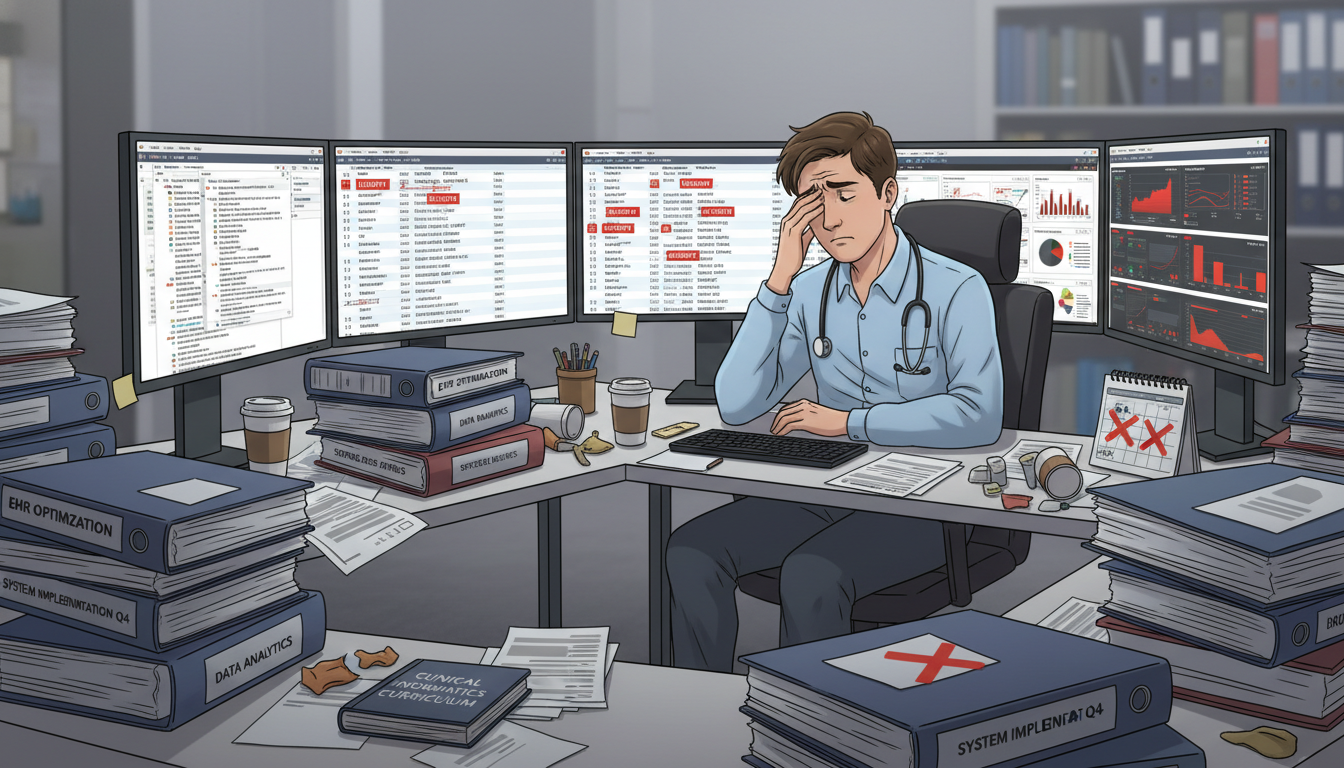
Programs can quickly slip into exploiting fellows to cover gaps in IT or analytics staffing, especially during major EHR go‑lives or upgrades.
How This Differs from Core Residency
If you come from an allopathic medical school match and a traditional residency:
- You’re used to ACGME-defined duty hours and explicit supervision standards.
- You might expect robust institutional oversight and resident unions/committees.
- Clinical workload and educational time are often tracked and regulated.
In informatics, while ACGME standards exist for accredited fellowships, the culture can vary even more widely than in core residencies. Some programs are outstanding; others barely understand what a clinical informatician is supposed to be.
Key takeaway: Malignant informatics programs often don’t look overtly abusive at first glance. Instead, they quietly devalue education, blur your role, and drain your energy on low‑yield work while offering little mentorship or career growth.
Core Red Flags: Culture, Leadership, and Wellbeing
Certain residency red flags are universal across specialties. For MD graduates evaluating clinical informatics fellowships or combined training pathways, pay close attention to these foundational issues.
1. Persistent Disrespect and Psychological Unsafety
Toxic program signs:
- Attendings or IT leaders mock or belittle trainees in meetings or emails.
- Honest questions are met with sarcasm or “You should know that already.”
- People are publicly blamed for system failures (e.g., “Our downtime happened because Dr. X didn’t test properly.”).
- Trainees report they are afraid to speak up about safety issues or workload.
Questions to ask current fellows or recent grads:
- “Do you feel safe admitting you don’t know something?”
- “What happens when something goes wrong on a project—how is it handled?”
- “Have you seen anyone punished for raising a concern?”
Red flag: Hesitation, vague answers, or “We don’t really talk about that here.”
2. Dishonesty Between Recruitment and Reality
Misalignment between what a program sells and what it delivers is a hallmark of a malignant residency program or fellowship.
Watch for:
- Promised “protected research time” that disappears once you arrive.
- Glossy talk of innovation and AI, but your daily work is password resets and click‑through order sets.
- Assurances of flexible clinical time, then sudden demands to take on heavy moonlighting to cover service gaps.
Ask specifically:
- “Can you walk me through a typical week, month by month, over the first year?”
- “What percentage of your time is actual educational/academic vs. operational service?”
- “What changed in the last year that surprised new fellows?”
Compare answers from leadership vs. current fellows; large discrepancies are telling.
3. Nonstop “Firefighting” With No Educational Structure
Even excellent programs can have intense periods (e.g., EHR go‑live). But in malignant settings, chaos is constant and unplanned.
Red flags:
- No written curriculum or rotation schedule; learning is “whatever is on fire.”
- Fellows are the default escalation point for every high‑urgency ticket.
- Meetings dominate your calendar, but few have clear objectives or outcomes.
- There are no defined milestones for informatics competencies.
Ask:
- “Can I see your written curriculum and rotation plan?”
- “How do you ensure fellows get exposure to governance, analytics, and clinical decision support, not just build tasks?”
- “How are fellows protected from being pulled into every IT crisis?”
4. Systematic Burnout and Turnover
Burnout is unfortunately common in medicine, but patterns matter.
Concerning patterns:
- Multiple fellows left early or transferred in the last 3–5 years.
- Alumni warn you privately to “be careful” or “get everything in writing.”
- The CMIO or key informatics leaders have high turnover—three leaders in five years.
- Exit interviews are informal or nonexistent; no one seems interested in why people leave.
When you can, contact alumni directly:
- “What made you choose this program originally?”
- “Would you choose it again?”
- “If not, why?”
Hesitant answers or requests to talk “off the record” can signal deeper cultural issues.
5. Lack of Support for Mental Health and Wellbeing
Even if workload seems reasonable, a program can be malignant if it trivializes stress, mental health, or work–life boundaries.
Warning signs:
- No awareness of GME wellness resources or reluctance to let fellows use them.
- Comments like, “We don’t really get burned out here; it’s informatics, not surgery.”
- Dismissive attitudes toward personal needs, caregiving responsibilities, or protected time.
- Culture of always being available for after‑hours IT calls without compensation or scheduling.
Ask:
- “How do fellows access mental health or counseling services?”
- “Are there any policies about after‑hours call or expectations during vacations?”
- “What happens if a fellow is overwhelmed—who advocates for them?”
Informatics-Specific Red Flags: When Training Becomes Cheap Labor
Beyond general toxicity, clinical informatics has several specialty-specific residency red flags that MD graduates should recognize early.
1. You’re Treated as an IT Fixer, Not a Trainee
A common malignant pattern is seeing fellows as free technical staff.
Warning signs:
- You spend most of your time:
- Closing helpdesk tickets
- Troubleshooting printers and logins
- Responding to “How do I order this?” emails
- You have limited exposure to:
- Governance committees
- Strategic planning
- Clinical decision support design
- Data science or analytics projects
Programs should offer structured rotations through:
- EHR build and optimization
- Data analytics and reporting
- Clinical decision support
- Quality improvement and patient safety
- Governance and leadership (change management, steering committees)
- Research and innovation (where available)
If what you hear is “We’ll just plug you in wherever we need extra hands,” be cautious.
2. No Clear Mentorship or Career Development Plan
Clinical informatics is deeply network‑driven. Your mentor relationships and project portfolio often matter more than case logs or board scores.
Red flags:
- No assigned primary mentor or mentorship committee.
- Mentors change frequently due to institutional instability.
- Faculty have little time for you; meetings are repeatedly canceled.
- No structured guidance on:
- Choosing projects
- Building a CV suited for CMIO, data science, or academic tracks
- Preparing for the clinical informatics board exam
Ask:
- “Who will be my primary mentor, and how often will we meet?”
- “Can I see recent fellows’ capstone projects and where they are now?”
- “Do fellows typically publish, present at AMIA, or attend major conferences?”
If a program can’t name recent fellow accomplishments, it may be failing to provide true academic or career development.
3. Misaligned Clinical vs. Informatics Responsibilities
For MD graduates, clinical work remains critical—but in an informatics-focused path, it must be properly balanced.
Concerns:
- Excessive clinical duties “to help the department” that crowd out informatics time.
- Pressure to pick up additional shifts with vague hints about “being a team player.”
- No explicit cap on clinical hours or clear division between clinical and informatics FTE.
- Your “informatics’ time” is repeatedly repurposed by operational clinical leaders.
Ask:
- “What’s the exact breakdown of clinical vs. informatics FTE?”
- “Is that protected in writing, or can it shift mid‑year?”
- “How do you handle conflicts if clinical needs threaten to overwhelm fellows’ informatics time?”
Programs that answer vaguely—“We’re flexible, we work it out as we go”—may be at risk of exploiting fellows for service.
4. Poor Interprofessional Relationships
Clinical informatics thrives on collaboration with non‑physician colleagues: nurses, pharmacists, analysts, and IT staff. A malignant environment often has fractured or hierarchical relationships.
Red flags:
- Analysts describe prior fellows as “difficult” or “just doctors who don’t understand IT.”
- Physicians and IT talk about each other with open hostility.
- Fellows are caught in the middle, expected to “fix” deep organizational conflicts without authority.
- No opportunities for cross‑training or team‑based learning (e.g., shared workshops, co‑leading projects).
Ask:
- “How do fellows typically work with analysts, builders, and project managers?”
- “Can you describe a project where clinical and IT teams collaborated successfully?”
- “What happens when there’s disagreement between clinicians and IT?”
5. Narrow, Vendor-Locked Exposure
Healthy programs expose you to principles you can apply across systems. Toxic programs may lock you into one narrow niche to serve local needs.
Concerns:
- Your work is entirely limited to one EHR vendor with no conceptual framing.
- No exposure to interoperability, standards (FHIR, HL7), data governance, or broader health IT strategy.
- Little recognition of non‑EHR domains: patient engagement tools, clinical registries, telehealth platforms, or population health analytics.
Ask:
- “What are the core competencies your graduates achieve beyond your local EHR?”
- “Do fellows get exposure to interoperability, data standards, or external partners?”
- “How many conferences or external courses do fellows typically attend?”
Programs that answer with “We’re really just an Epic shop” and stop there may not provide full-spectrum health IT training.

How to Research and Detect Red Flags Before You Commit
Avoiding a malignant program starts long before rank lists or acceptance letters. MD graduates can systematically evaluate clinical informatics fellowships and related tracks using several strategies.
1. Read Beyond the Brochure
Start with official materials, but don’t stop there.
Review:
- Program website: look for specifics—curriculum, rotation descriptions, leadership structure, alumni outcomes.
- Faculty bios: Are there active informatics researchers, leaders in AMIA, or recognized CMIOs?
- Institutional context: Is the health system known for innovation or for chronic financial and leadership turmoil?
Red flags in web presence:
- Outdated pages (no updates in several years).
- No mention of current fellows or alumni.
- Vague language about “excellence” with little detail.
2. Talk to Current and Recent Fellows—Alone
The most important source of truth is often current or recent trainees. Insist on at least some unstructured, leadership‑free time with them.
Questions to ask:
- “What surprised you most after joining the program—good and bad?”
- “What would you change if you were in charge?”
- “How does the program respond to feedback or complaints?”
- “Has anyone left early or switched programs? Why?”
- “Do you feel you are primarily here to learn, or to provide service?”
Pay attention not just to words, but to:
- Body language—do they look guarded or uneasy?
- What they don’t say—long pauses, frequent “It’s…fine.”
- Whether multiple fellows give similar examples of issues.
3. Ask Direct but Professional Questions in Interviews
You have limited time; ask questions that surface real issues.
Examples:
- “Can you describe a time when a fellow raised a concern and how the program addressed it?”
- “What are the biggest challenges your current fellows face?”
- “How do you prevent informatics responsibilities from being overshadowed by clinical or IT service needs?”
- “How does your program differentiate between education and operational work?”
If answers are defensive, vague, or dismissive, treat that as data.
4. Investigate Program Stability and Governance
Ask about:
- How long the program director has been in role.
- Whether the program has undergone recent ACGME reviews or probation.
- How often major leadership changes have occurred in GME, IT, and CMIO roles.
You can also:
- Search for public reports or news about the health system.
- Look at accreditation status where applicable.
- Ask directly: “Have there been any significant changes to the program in the last 3 years?”
Frequent leadership turnover or recent crises (financial, IT debacles, public scandals) can create an unstable environment that tends to breed malignancy.
5. Cross-Check Alumni Outcomes
Healthy programs have graduates who:
- Hold meaningful informatics roles (CMIO, associate CMIO, medical director of quality, data science lead, academic faculty).
- Publish, present, or at least demonstrate a relevant project portfolio.
- Speak positively about mentorship and career preparation.
If you cannot locate alumni or the program hesitates to connect you with them, be cautious.
Questions for alumni:
- “How prepared did you feel for your current role?”
- “Did the fellowship match what was described to you?”
- “Would you recommend it to someone with my background and goals?”
If You Discover You’re in a Malignant Program
Despite your best efforts, you may still end up in a toxic environment. This is painful, but not career‑ending—especially in a field as flexible as clinical informatics.
1. Document and Clarify
Start by:
- Keeping objective records of major incidents (dates, people involved, what happened).
- Saving emails or messages that show unrealistic expectations, disrespect, or boundary violations.
- Clarifying expectations in writing (e.g., email recaps after meetings: “To confirm, my FTE breakdown is 0.5 clinical, 0.5 informatics, with these responsibilities…”).
Written clarity serves both to improve your situation and to protect you if you need to escalate.
2. Use Internal Support Channels
Options may include:
- Program director or associate program director (if not part of the problem).
- GME office or designated ombudsperson.
- CMIO or departmental leadership outside the immediate program.
- Institutional wellness or physician support programs.
When approaching them:
- Be concrete: describe patterns, not just single events.
- Frame concerns in terms of education quality and patient safety, not just personal discomfort.
- Ask for specific changes: clearer schedules, limits on non‑educational work, formal mentorship.
3. Protect Your Health and Professionalism
Malignant programs can push you toward burnout and cynicism. Counter this by:
- Setting personal boundaries where possible (e.g., non‑emergent email response times).
- Maintaining connections with external mentors (AMIA networks, previous residency faculty).
- Prioritizing sleep, exercise, and mental health support—even if you need to use formal leave.
Remember: You are not obligated to sacrifice your well‑being for an institution that does not hold up its side of the training contract.
4. Consider Strategic Exit or Reorientation
If things do not improve:
- Explore transfer options to other clinical informatics fellowships or related roles (e.g., quality, data science) if available.
- Consider finishing core residency and then pursuing informatics positions without a fellowship—many MD graduates build informatics careers via operational roles and on‑the‑job training.
- Reframe your current experience as a learning period: Identify transferable skills (project management, stakeholder communication, EHR build) you can leverage elsewhere.
Malignant training does not define your long‑term career—many successful CMIOs and informaticians started in less‑than‑ideal environments and moved on.
FAQs: Identifying Malignant Clinical Informatics Programs
1. How can I tell if a program is truly “malignant” vs. just demanding or high‑volume?
Demanding programs still demonstrate:
- Respect for trainees
- Honest communication about workload
- Structured learning objectives
- Support when you struggle
A malignant residency program or fellowship shows patterns of disrespect, exploitation, dishonesty, and psychological unsafety, often combined with dismissive attitudes when concerns are raised. If the culture consistently prioritizes institutional or IT needs over your education and wellbeing, that’s malignancy, not just rigor.
2. Are malignant programs more common in newer fields like clinical informatics?
Not necessarily, but the risks are higher because:
- Many programs are young and still defining their structure.
- Leadership may lack prior GME experience.
- Institutions may be unsure how to balance service vs. education in health IT training.
This makes due diligence essential. Ask to see written curricula, defined competencies, and examples of past fellows’ projects. Programs that cannot articulate what an informatics physician graduate should know and be able to do are more likely to become toxic by default.
3. I’m an MD graduate from an allopathic medical school match in another specialty. Should I worry about losing clinical skills during an informatics fellowship?
Healthy programs usually preserve a reasonable level of clinical activity to maintain your skills and credibility. A red flag is either extreme:
- Too much clinical work that crowds out informatics education, or
- Almost no clinical practice with no plan to keep you active post‑training.
Ask for precise FTE breakdowns and where fellows typically practice. If a program seems indifferent to your clinical identity, it may undervalue physician expertise in informatics more broadly.
4. Can a single red flag be a deal‑breaker, or should I look at the overall pattern?
Context matters. One concern (e.g., recent leadership change) may be manageable in an otherwise supportive culture. Worrisome patterns include combinations of:
- Vague or shifting expectations
- High turnover among fellows or faculty
- Consistent reports of disrespect, overwork, or feeling like IT “cheap labor”
- Lack of mentorship and unclear graduate outcomes
When multiple residency red flags cluster together—especially around culture, honesty, and educational structure—it’s reasonable to downgrade or avoid that program, even if it looks strong on paper.
By approaching clinical informatics fellowships and related health IT training programs with a structured, skeptical, and well‑informed lens, you can avoid malignant environments and position yourself for a fulfilling, impactful informatics career. As an MD graduate, your time, skills, and wellbeing are valuable—choose a program that treats them that way.