
Why Program Malignancy Matters Even More for Non‑US Citizen IMGs in Medical Genetics
For a non-US citizen IMG or foreign national medical graduate pursuing medical genetics residency in the United States, choosing the right program is about more than prestige or location—it is about survival, visa security, and career viability. A “malignant residency program” is one where the culture, workload, leadership, or hidden policies consistently harm trainees rather than support them.
Medical genetics is a small, close-knit specialty. Your residency reputation and your program director’s opinion will follow you for years. In a field this small, landing in a toxic environment can:
- Derail your career trajectory
- Threaten your visa status
- Limit fellowship and job opportunities
- Cause burnout or push you out of training entirely
Because there are fewer medical genetics residency programs compared to large specialties like internal medicine or pediatrics, some foreign national medical graduates feel pressured to accept any offer they receive. That pressure can make you more vulnerable to malignant programs.
This article will help you systematically identify residency red flags and toxic program signs specifically in the context of medical genetics and non-US citizen IMGs, and give you practical steps to protect yourself before, during, and after the match.
Understanding Malignant vs. Healthy Medical Genetics Programs
Before you can spot a malignant residency program, you need to know what a healthy program looks like—especially in a relatively small and specialized field like medical genetics.
Characteristics of a Healthy Medical Genetics Residency
A strong, non-toxic medical genetics residency typically has:
Clear educational structure
- Well-defined curriculum in dysmorphology, biochemical genetics, cancer genetics, prenatal genetics, and molecular diagnostics
- Regular teaching conferences (case conferences, journal clubs, tumor boards, multidisciplinary clinics)
- Protected academic time that is respected, not routinely overridden by clinical demands
Supportive leadership
- Program director and core faculty who know residents personally and advocate for them
- Approachability—residents can raise concerns without fear of retaliation
- Transparency about evaluations, remediation, and expectations
Reasonable workload
- Balanced clinic and call schedules for a small-specialty program
- Outpatient-heavy work that reflects typical genetics practice, with manageable inpatient consult volume
- Systems to prevent chronic overwork of any single resident (especially the IMG or J‑1/H‑1B holder)
Respectful interdisciplinary relationships
- Good collaboration with pediatrics, internal medicine, oncology, OB/MFM, neurology, and NICU/PICU teams
- Genetic counselors integrated as partners, not as overburdened substitutes for residents
Fair treatment of non-US citizen IMGs
- Clear, written policy on visa sponsorship (J‑1 and/or H‑1B)
- History of successfully training and graduating non-US citizen IMGs
- Equivalent expectations and opportunities for IMGs and US graduates
What Makes a Program “Malignant”?
A malignant residency program is characterized not by one bad day or one difficult attending, but by a pattern of:
- Chronic disrespect or humiliation of residents
- Unrealistic workloads with poor supervision
- Retaliation against those who raise concerns
- Lack of transparency in evaluations or promotion decisions
- Systematic exploitation of vulnerable groups—especially IMGs and visa-holders
In medical genetics, malignancy may not always look like 100-hour weeks (the clinical volume is often smaller than in surgical fields), but it can be psychologically and professionally damaging in subtler ways:
- Residents treated as clerks or “paperwork machines” for insurance, prior auths, and test requisitions
- Little to no formal education in dysmorphology/biochemical genetics despite being a core competency
- Being used as “consulting labor” for other departments without credit, support, or learning
- A culture where genetics is undervalued or tolerated rather than respected
For a non-US citizen IMG, a malignant program can also mean:
- Visa insecurity being used as leverage
- Closed doors to fellowships or jobs due to poor letters or lack of advocacy
- Increased risk of non-renewal or dismissal when there are systemic problems not of your making
Core Residency Red Flags: General Toxic Program Signs to Watch For
The same broad signs of a toxic program apply across specialties, including medical genetics. Pay attention to these during interview season, program research, and informal networking.
1. High Resident Turnover or Many “Gaps” in the Program
Red flag patterns:
- Multiple residents leaving or transferring in the past 3–5 years
- Several “unfilled” positions, year after year
- Vague explanations like “they decided genetics wasn’t for them” repeated many times
In a small specialty like medical genetics, losing even one resident from a small cohort (e.g., a 1–2 resident per year program) is significant. One departure might be circumstantial; multiple departures suggest structural problems.
Actionable step:
During interviews or Q&A sessions, ask concretely:
- “How many residents have left or transferred in the past 5 years, and what were the reasons?”
- “Have you ever had to place a resident on remediation or non-renewal, and how did the program support them?”
Watch for discomfort, defensiveness, or vague answers.
2. Residents Look Exhausted, Guarded, or Afraid to Speak Freely
Nonverbal cues often reveal more than words. Warning signs during virtual or in-person interview days:
- Residents dodging direct questions about workload or culture
- Nervous laughter or frequent “We’ll talk about that offline” remarks
- PD or faculty hovering during resident-only Q&A
- Only “hand-picked” residents available, all very enthusiastic and similar in personality, no dissenting perspectives
For medical genetics specifically, ask:
- “How many clinics and consults do you cover per week on average?”
- “What does a typical call night or weekend look like?”
- “How often do you have to stay significantly past scheduled hours?”
If residents cannot give a straightforward answer, or if their responses contradict each other, consider it a red flag.
3. Ambiguous or Shifting Information About Workload and Expectations
Malignant programs often provide inconsistent or deliberately vague information. Warning signs:
- Different people (PD, coordinator, residents) give different answers about:
- Clinic load
- Nights/weekends
- Inpatient consult responsibilities
- Research requirements
- “We’re working on formalizing that” for basic policies like evaluation criteria, duty hours, or supervision
You should be able to understand, by the end of the interview cycle, what your life would look like as a PGY‑1/PGY‑2 in that specific program.
4. Blame-Oriented Culture
In a blame culture, errors are treated as individual moral failings rather than system issues. Signs:
- PD or faculty boast about “weeding out the weak” or having “a zero-tolerance culture” for mistakes
- Stories about residents being “written up” for minor issues without mention of support or remediation
- Heavy emphasis on punishment, little mention of teaching or coaching
In medical genetics, where complex testing and counseling are involved, a blame culture discourages appropriate escalation and learning from near-misses, which can be dangerous for both trainees and patients.

IMG-Specific Malignant Behaviors: When You’re a Non‑US Citizen or Foreign National Graduate
For a non-US citizen IMG, some of the most dangerous toxic program signs relate to visa, immigration status, and differential treatment. These may not be obvious to US grads or citizens.
1. Unclear or Shifting Visa Sponsorship Policies
This is one of the most serious residency red flags for a foreign national medical graduate.
Be extremely cautious if:
- The program cannot state clearly whether they sponsor J‑1, H‑1B, or both
- Different people give different answers about visa sponsorship
- They say things like:
- “We’ll figure it out once you match”
- “We don’t usually sponsor H‑1Bs, but maybe we can make an exception”
- “You could start on a J‑1 and then switch to H‑1B later” (this is often unrealistic or risky)
You need written, program-level clarity on:
- What visa types they have sponsored in the last 3–5 years
- How many current residents or fellows are on those visas
- Whether they have institutional legal/immigration support
A malignant program may use visa ambiguity to trap you later—once you have limited options.
2. Longer Hours and Less Protection for IMGs
Another toxic pattern: IMGs, especially non-US citizen residents, are quietly assigned the most difficult rotations, heaviest call, or extra work because they are perceived as “less likely to complain” or “more desperate to keep their visa.”
Warning signs during interview conversations or informal chats:
- Senior residents say things like:
- “They know we IMGs are hard workers, so they rely on us a lot more.”
- “You just have to put your head down; as an IMG you can’t make trouble.”
- IMGs report:
- More frequent weekend coverage
- Being pulled into additional clinics
- Doing more administrative tasks than US grads
In a truly healthy program, workload distribution should be transparent and equitable across all residents.
3. Threat or Fear Around Contract Renewal
In malignant programs, residents—especially IMGs—may feel constantly under threat:
- Fear that one mistake will lead to non-renewal of contract
- Residents mentioning “walking on eggshells,” particularly those on visas
- Stories of residents not being renewed without clear prior feedback or documentation
For non-US citizen IMGs, non-renewal can mean:
- Loss of visa status
- Forced departure from the US within a short time frame
- Severe disruption of career and personal life
Ask residents directly in private or anonymous channels:
- “Have you ever seen a resident surprised by non-renewal?”
- “How does the program handle performance issues—are there clear steps before drastic actions?”
4. Lack of Career Support for IMGs in Genetics
Medical genetics is a small field; fellowship and job opportunities often depend heavily on mentorship and advocacy.
Red flags that a program does not truly support IMG careers:
- Few or no IMG graduates in competitive fellowships (e.g., cancer genetics, biochemical genetics, prenatal genetics) despite their stated interest
- Graduates struggling to find positions that allow employer-sponsored visas
- PD or faculty making comments like:
- “Academic positions are hard for IMGs; you should aim for private practice.”
- “Visa issues make it complicated; we can’t help much with that.”
You want a program where prior non-US citizen IMG graduates:
- Completed training successfully
- Matched into solid fellowships or jobs
- Had support navigating visa transitions for employment (e.g., J‑1 waiver jobs, H‑1B positions)
Medical Genetics–Specific Red Flags: When the Specialty Signals Trouble
Medical genetics residencies are structurally different from large, inpatient-heavy programs. Because of that, their malignant features can be more subtle and tied to specialty-specific factors.
1. Weak or Disorganized Genetics Education
A core function of a medical genetics residency is to train you as an expert consultant, not just a service provider. Warning signs:
Minimal formal teaching in:
- Dysmorphology and physical examination of congenital anomalies
- Biochemical genetics and metabolic emergency management
- Cancer genetics, hereditary cancer syndromes, familial risk counseling
- Molecular testing technologies, interpretation, and limitations
Conferences or teaching sessions being frequently cancelled without rescheduling
Residents saying they have to “self-teach everything” or are “learning on the fly” from UpToDate and Google
Little exposure to:
- Prenatal genetics clinics
- Adult genetics
- Specialty multidisciplinary clinics (e.g., neurogenetics, cardiogenetics)
You can ask:
- “How is the didactic curriculum structured across the two years?”
- “How often do you have dedicated dysmorphology teaching?”
- “Who teaches biochemical genetics, and how often do you see metabolic patients?”
2. Overreliance on Residents for Administrative Work
Because genetics involves complex testing and insurance processes, malignant programs may offload large volumes of non-educational paperwork onto residents:
- Residents spending large portions of their day:
- Filling prior authorization forms
- Completing paperwork for genetic tests
- Calling labs and insurance companies
- Limited assistance from genetic counselors, nurse coordinators, or administrative staff
- Residents complain they “barely have time for patients” due to paperwork
Some admin work is inevitable, but it should not dominate your training. A healthy program invests in staff and workflows so residents focus on learning and complex clinical reasoning, not purely clerical tasks.
3. Disorganized or Overburdened Genetic Counselor Collaboration
Genetic counselors are essential partners in medical genetics. Signs that the system is unhealthy:
- High counselor turnover
- Strained relationships between physicians and counselors
- Residents pulled into tasks that should be handled by genetic counselors or vice versa
- Fragmented communication that leads to delays or miscommunication with families
If the counselors appear burned out or marginalized, that may reflect a wider culture problem in the genetics division and hospital.
4. Poor Interdisciplinary Respect for Genetics
Genetics programs exist within larger institutions. Toxic dynamics with other departments can hurt your education:
- Pediatrics, OB, oncology, or neurology never invite genetics to rounds or tumor boards
- Genetics input is routinely ignored, or consults are requested only at the last minute “for documentation”
- Residents describe frequently “begging” services to involve genetics early in patient management
This matters because your success as a future geneticist depends on being seen as a valuable consultant and collaborator, not an afterthought.
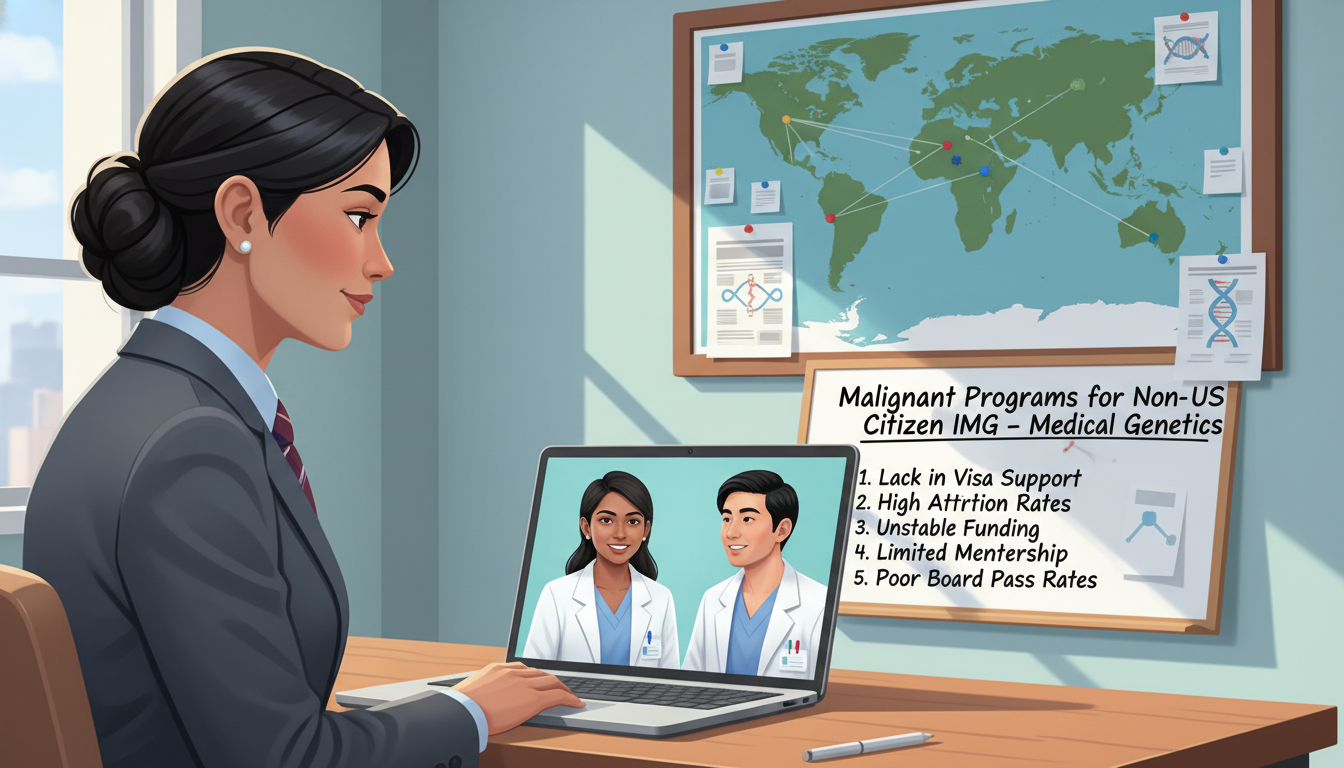
Practical Strategy: How Non‑US Citizen IMGs Can Investigate Programs Before Ranking
You cannot change a malignant program, but you can avoid matching there. Use a multi-step, evidence-based approach to evaluate programs before you submit your rank list.
Step 1: Deep Pre‑Interview Research
Go beyond the program’s official website. For each medical genetics residency you consider, check:
NRMP and program fill history
- Has the program frequently gone unfilled in the genetics match?
- Do they routinely fill primarily with their own internal medicine or pediatrics residents (which may limit IMG opportunities)?
Graduate outcomes
- Do they list where graduates went for fellowship or practice?
- How many are non-US citizen IMGs?
Online reputation (with caution)
- Look for patterns, not single anonymous complaints.
- Pay attention if multiple people mention:
- Toxic leadership
- Visa issues
- Poor educational structure
Step 2: Ask Targeted Questions During Interviews
Prepare a short list of questions that specifically reveal toxic program signs and residency red flags. Examples tailored to your situation:
On visa and IMG support:
- “Which visas do you currently sponsor for residents, and how many current residents are on each type?”
- “Have you ever had a foreign national medical graduate fail to complete training due to visa or contract issues?”
- “What support is available for J‑1 waiver or H‑1B transition after graduation?”
On culture and resident wellbeing:
- “Can you describe a time when a resident struggled, and how the program supported them?”
- “How are residents involved in program decision-making or curriculum changes?”
On workload and expectations:
- “What is a typical weekly schedule for a first-year genetics resident?”
- “How often do residents violate duty hours, and how is this tracked and addressed?”
On medical genetics education:
- “How do you ensure balanced exposure to pediatric, adult, prenatal, biochemical, and cancer genetics?”
- “How is feedback collected from residents about the educational value of each rotation?”
Pay close attention not only to the content of answers, but to the tone: openness, defensiveness, or dismissiveness.
Step 3: Network with Current and Former Residents Privately
Some of the most reliable information about malignant residency programs comes from private conversations.
- Reach out through:
- Alumni from your medical school
- IMG networks and WhatsApp/Telegram groups
- Social media (LinkedIn, X/Twitter, specialty forums)
- Ask to speak briefly, off the record. Respect their time and privacy.
Possible questions:
- “If you could choose again, would you still match at this program?”
- “Have you ever seen a resident unfairly targeted or treated differently because of being an IMG or on a visa?”
- “How does the PD respond when residents raise concerns?”
If multiple people independently describe:
- Retaliation
- Intimidation
- Excessive workload
- Broken visa promises
consider that program high risk.
Step 4: Compare Programs Objectively Before Ranking
As a non-US citizen IMG, it is tempting to rank any program that interviews you. Instead, create a scoring system that weighs:
- Visa security and IMG track record
- Culture and resident welfare
- Educational quality
- Career outcomes
- Location and personal considerations
If a program shows major red flags in culture, visa support, and educational structure, consider ranking it low—or not at all—despite your fear of going unmatched. Being trapped in a malignant program can be worse than re-applying with a better strategy next year.
If You Land in a Malignant Program: Damage Control for Non‑US Citizen IMGs
Despite careful research, you may still end up in a toxic or malignant residency program. As a foreign national medical graduate, you must be particularly strategic.
1. Document Everything
Maintain a factual, contemporaneous record:
Dates and descriptions of:
- Threats
- Discriminatory remarks
- Unfair workload distributions
- Broken promises regarding visa or contract
Save relevant emails and messages
Avoid emotional language in documentation; focus on objective facts
This is essential if you ever need to:
- Transfer programs
- Seek help from GME, ECFMG, or legal counsel
- Demonstrate that you were treated unfairly
2. Identify Allies and Safe Channels
Within the institution:
- Program coordinator (often knows the system well)
- Trusted faculty member or mentor (inside or outside genetics)
- GME office, ombudsperson, or resident wellness office
Outside the institution:
- ECFMG/ERAS advisors for non-US citizen IMGs
- National IMG support groups or specialty societies (e.g., American College of Medical Genetics and Genomics can sometimes offer informal mentorship)
Discuss your situation hypothetically at first if you are unsure whom to trust.
3. Protect Your Visa and Career Trajectory
As you navigate a malignant program:
- Understand your visa regulations:
- J‑1 vs H‑1B implications for leaving a program early
- Grace periods and transfer rules
- Keep communication with ECFMG (for J‑1) or your employer’s legal/HR department open and professional
- If considering transfer:
- Start exploring other programs through discreet networking
- Gather strong letters from faculty who know your work and are not part of the conflict
Do not make sudden decisions that jeopardize your legal status without consulting immigration experts.
4. Prioritize Your Mental Health
Toxic environments can cause severe stress, anxiety, and depression. Seek confidential support:
- Counseling services through your institution or independent providers
- Peer support groups, especially IMG-centered ones
- Trusted family or friends who understand your constraints
Your well-being is not negotiable, even when visa pressure and cultural expectations push you to “tolerate anything.”
Frequently Asked Questions (FAQ)
1. Should I rank a potentially malignant program lower even if it’s my only medical genetics interview?
You must balance the risk of going unmatched against the risk of harm in a clearly toxic environment. If a program shows multiple, severe red flags—visa insecurity, documented resident mistreatment, high turnover, and weak education—it may be safer to:
- Rank it very low or not at all
- Consider re-applying with a wider specialty strategy (e.g., preliminary IM/pediatrics with future genetics fellowship)
If concerns are moderate and you have no other interviews, you might still rank it, but go in prepared to:
- Document issues
- Seek mentorship early
- Evaluate possibilities for transfer if the situation proves malignant
2. Is it better to accept a J‑1 than insist on H‑1B sponsorship for medical genetics?
For many non-US citizen IMGs, J‑1 is the standard pathway for residency and fellowship, including medical genetics. The key is:
- Confirm that the program has recent, successful experience with J‑1 residents
- Understand the J‑1 home-country requirement and waiver options for your future career
- Avoid programs that are vague or inexperienced with either visa type
An H‑1B can offer more flexibility for staying in the US afterward, but a malignant program with poor H‑1B experience is far riskier than a stable, J‑1-friendly program.
3. How can I confirm if a program has a history of mistreating IMGs?
No single source is perfect; use triangulation:
- Ask current and former residents privately, including IMGs and US grads
- Review public match and graduation lists to see:
- How many IMGs enter vs. successfully graduate
- Look for patterns on forums or social media (but be cautious; verify with real people when possible)
- During interviews, directly ask:
- “Can I speak with a current or former IMG resident?”
If a program cannot or will not connect you with any non-US citizen IMG alumni, that is a meaningful signal.
4. Are small or newer medical genetics programs more likely to be malignant?
Not necessarily. Some small or newer programs are innovative, supportive, and excellent. However, you should scrutinize:
- Leadership stability (frequent PD turnover is a red flag)
- Clarity of curriculum and rotations (especially early in a program’s development)
- How they respond to questions about past challenges
A newer program that is transparent about its growth, open to feedback, and clearly structured can be very positive. A program that dismisses concerns with “we’re still figuring things out” and offers no concrete plans may be risky—especially if you are a non-US citizen IMG relying on visa stability.
By approaching the genetics match with clear criteria, asking targeted questions, and leveraging IMG networks, you can significantly reduce your chances of ending up in a malignant residency program. As a non-US citizen IMG or foreign national medical graduate, your goal is not just to match—it is to match into a safe, supportive, and educationally rich medical genetics residency where you can build a sustainable, fulfilling career.