
As a Caribbean IMG pursuing emergency medicine, you already know the EM match is competitive and demanding. What often gets less attention—but can have a huge impact on your training and career—is resident turnover. When multiple residents leave a program, or when every year seems to have one or two unexpected vacancies, it’s more than just gossip. Resident turnover can be a critical red flag for program problems that could derail your education, wellness, and even board eligibility.
This article will help you understand resident turnover warning signs, especially as they apply to Caribbean medical school residency applicants targeting emergency medicine residency programs. Whether you’re coming from SGU, Ross, AUC, Saba, or another Caribbean school, you need to be able to spot subtle (and not-so-subtle) indicators that residents are leaving, and what that might mean for you.
Why Resident Turnover Matters So Much in Emergency Medicine
Emergency medicine has unique stressors: high-volume shifts, unpredictable acuity, overnight work, and intense decision-making. These realities can sometimes be used to excuse or normalize problems that are actually preventable and structural.
For a Caribbean IMG, the stakes are even higher:
- You may have fewer “backup options” if a program becomes unsafe or toxic.
- Transferring programs as an IMG is logistically and politically harder.
- Visa issues can make leaving a program especially risky.
- You may have fewer local mentors to help you interpret rumors or patterns.
Resident turnover—residents quitting, transferring out, going on prolonged leave, or being non-renewed—isn’t always a sign of a bad program. Life happens: illness, family issues, partner relocation, or a mismatch of specialty interest can all lead a resident to leave a well-functioning program.
However, repeated or unexplained resident turnover is often a major red flag. When multiple residents leave over a short period, or when every class loses people, it’s worth asking tough questions before you rank that program on your ERAS list.
Understanding Types of Resident Turnover (and What They Mean)
Not all turnover is equal. Understanding the pattern matters more than any single story.
1. Normal vs Concerning Turnover
Normal / low concern examples:
- One PGY-1 leaves EM after a few months to pursue anesthesia because they realized EM isn’t the right fit.
- A resident transfers to a program closer to family because of a spouse’s job.
- A single resident goes on prolonged medical leave (with clear support from the program).
Concerning patterns:
- Multiple residents leaving the same year or in consecutive years.
- Residents leaving mid-year without a clear, transparent reason.
- Residents leaving and their co-residents are tight-lipped, vague, or visibly uncomfortable discussing it.
- Frequent references to “we’ve had some turnover, but it’s all fine now” without specifics.
If you’re an SGU or other Caribbean IMG looking into a Caribbean medical school residency track in EM, it’s crucial to distinguish between a rare, understandable departure and a pattern of residents leaving the program that suggests deeper issues.
2. Types of Turnover and Possible Causes
Voluntary Transfer or Resignation
- Could reflect personal choice or program dysfunction.
- Red flags when several residents tell similar stories about burnout, poor support, or feeling unsafe.
Non-Renewal of Contract / Dismissal
- May indicate a resident had serious performance or professionalism issues.
- However, repeated dismissals may signal:
- Poor recruitment (admitting residents they can’t support).
- Lack of remediation structure.
- A punitive culture with little educational support.
Prolonged Leave (Medical, Personal, or “Undisclosed”)
- One or two residents taking leave is not necessarily concerning.
- A concerning pattern:
- Several residents out for “stress,” “personal reasons,” or “scheduling issues.”
- Residents repeatedly going on leave and never returning.
- Little transparency or a culture of secrecy around why people disappear.
Concrete Warning Signs of Problematic Resident Turnover
Here are specific “resident turnover red flags” that Caribbean IMGs should watch for when evaluating an emergency medicine residency—whether during away rotations, interviews, or virtual meet-and-greets.
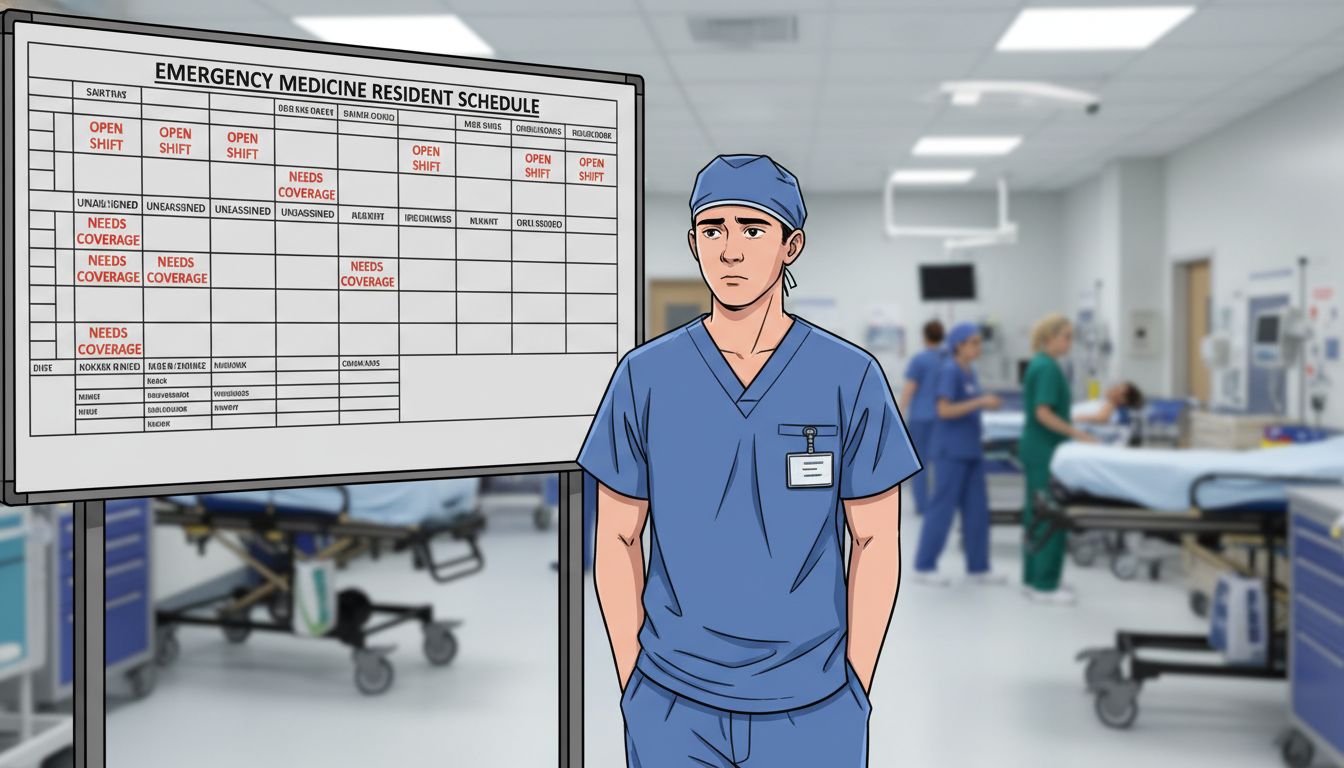
1. Multiple Unfilled or “Unexpected” Open Positions
What you might see or hear:
- The program mentions they have a PGY-2 or PGY-3 opening outside of the NRMP match.
- There’s a mid-year or off-cycle EM match posting for an unexpected vacancy.
- Faculty or residents say, “We usually run one short,” or “We’re hoping to fill a spot next year.”
Why it matters:
In EM, training is heavily dependent on team-based clinical volume. If the department is understaffed:
- Your workload may be significantly higher.
- You may have less supervision and teaching.
- Burnout risk increases, which continues the cycle of residents leaving.
Questions to ask:
- “I noticed there’s an open PGY-2 position. Could you share what led to that?”
- “Has the program had other mid-year vacancies in the past few years?”
- “How often are you fully staffed at your planned resident complement?”
Pay attention not only to the content of their answers, but also to their comfort level and transparency.
2. Consistent Stories of “Personality Mismatches” or “Not a Good Fit”
When you ask what happened to former residents and the answers repeatedly sound like:
- “They weren’t a good fit.”
- “We had some professionalism concerns.”
- “They just didn’t mesh with our culture.”
…this can be a resident turnover red flag. One such story can be legitimate. But multiple similar vague explanations over time hint at:
- Poor mentoring or feedback.
- A rigid culture that doesn’t support diverse backgrounds or learning styles.
- Difficulty supporting IMGs or non-traditional residents.
For a Caribbean IMG, this pattern may mean the program doesn’t know how to support your unique needs, such as:
- Bridging gaps in clinical exposure from medical school.
- Adjusting to a new healthcare system.
- Managing visa and relocation stressors.
Actionable advice:
During interviews or pre-interview dinners (virtual or in-person), you can ask:
- “Have Caribbean IMGs trained here before? How have they done?”
- “Can you describe how you support residents who initially struggle with adjustment or with a specific area like procedures or documentation?”
You’re not just asking if support exists—you’re evaluating whether it’s structured, consistent, and compassionate.
3. Overworked, Exhausted Residents (Especially Seniors)
If residents seem universally exhausted, cynical, or disengaged, this may be more than just EM being demanding.
Warning signs:
- Residents frequently mention “coverage issues” because someone left.
- Seniors regularly stay several hours past the end of shift due to understaffing.
- Complaints (even jokingly) about “pulling extra shifts all year” or “always being short.”
- Residents saying, “Our PGY-3s are spread too thin since we lost two people.”
Why this matters for the EM match:
Overworked seniors have less time and energy to:
- Teach you critical EM skills at bedside.
- Provide feedback on your clinical reasoning.
- Supervise procedures safely.
Programs with a history of residents leaving the program often compensate by stretching remaining residents, which can degrade both education and wellness.
What you can ask:
- “How often do residents have to pick up extra shifts due to vacancies?”
- “How is the workload adjusted if you’re one or two residents short?”
- “Have duty hour violations been an issue in the last few years?”
Listen for consistency between what faculty say and how residents actually look and sound.
4. Residents Are Hesitant or Afraid to Talk About Former Colleagues
Healthy programs generally can acknowledge past challenges frankly and respectfully. Troubled programs often show discomfort, fear, or evasiveness when you ask about prior turnover.
Concerning patterns:
- Residents exchange glances, go quiet, or change the subject when you ask about prior classes.
- You hear generalities: “We had some issues, but that’s all been addressed” without detail.
- They emphasize “we can’t really talk about that” in a way that feels more cultural than privacy-related.
Of course, they must protect privacy and professionalism. But a complete communication blackout about multiple departures often signals a toxic or punitive environment where people are afraid of the consequences of speaking honestly.
As a Caribbean IMG, you want a program where psychological safety is strong—where residents can raise concerns without fearing retaliation.
How to probe respectfully:
- “Has the program gone through any big changes in the last 3–5 years? How has that affected residents?”
- “Have there been any major lessons learned from past resident turnover that improved the program?”
You’re not digging for gossip—you’re assessing whether the leadership learns from problems or just buries them.
5. Frequent Leadership Changes, Especially in the ED
Some turnover at the leadership level is normal. But rapid or repeated changes can signal instability:
- Multiple program directors in 3–5 years.
- Frequent turnover in the chair or residency leadership team.
- A long period where “interim” leadership runs the show.
Unstable leadership can correlate with:
- Conflicting expectations about workload and performance.
- Inconsistent policies on remediation and evaluation.
- Poor advocacy for residents with hospital administration.
Combine this with residents leaving, and you may be seeing a structural issue rather than an isolated mismatch.
Questions to ask:
- “How long has the current program director been in place?”
- “What changes has the current PD implemented, and how have residents responded?”
- “How would you describe the relationship between the residency leadership and hospital administration?”
Programs that acknowledge past turbulence and can point to specific, implemented improvements are safer bets than those that dismiss or minimize recent leadership churn.
How to Research Resident Turnover Before You Apply or Rank
You can begin assessing programs long before interview season. This matters especially if you’re a Caribbean IMG trying to time away rotations, plan USMLE step timelines, and balance applications across multiple specialties or regions.

1. Use Public Data and Online Clues
a. ACGME and Program Websites
- Look at the current resident roster:
- Are there class size inconsistencies? (e.g., 10 PGY-1, 7 PGY-2, 6 PGY-3)
- Are there unexplained gaps or “PGY-2 (off cycle)” spots?
- Check for news or announcements about leadership transitions.
b. Program-Specific Forums and Social Media
- Reddit (e.g., r/medicalschool, r/residency), Student Doctor Network, specialty forums.
- Look for:
- Multiple posts over several years describing similar concerns.
- Repeated comments about “residents keep leaving” or “we’re always short.”
- Remember: online reports can be biased or outdated, so look for patterns, not a single post.
c. NRMP / EMRA / SAEM Resources
- Some organizations provide basic match data on programs, including expansion or contraction in class size.
- If a program is shrinking its class size without clear explanation (e.g., hospital restructuring), that may reflect ongoing program problems.
2. Ask Smart Questions During Interview Season
You can ask about turnover without sounding confrontational. Focus on curiosity and learning, not accusation.
During resident-only sessions:
- “Have there been any residents who left the program in recent years? How has that affected day-to-day life?”
- “How does leadership respond when residents struggle, either clinically or personally?”
- “Do you feel residents are supported if they need time off or remediation?”
During faculty/PD interviews:
- “How has the program evolved over the past 3–5 years?”
- “Have there been any challenges with retention or burnout, and what changes have you implemented in response?”
- “If a resident is struggling, what does the standard remediation process look like?”
Compare resident answers to leadership answers. Large discrepancies can themselves be a red flag.
3. Use Away Rotations and Observerships Wisely
If you’re an SGU or other Caribbean graduate doing an EM rotation at a U.S. site—especially at a program where you might want to match—treat it as both an audition and an investigation.
Observe:
- How many residents are actually on the schedule vs what you were told is the “expected” number.
- Whether residents seem to be covering extra shifts regularly.
- How often residents openly mention colleagues who left.
- The general tone: do people feel hopeful about their training, or are they just “surviving”?
After a couple of weeks, it’s completely reasonable to ask a senior resident or chief:
- “How has resident retention been in the last few years?”
- “What’s one thing you wish you had known about this program before you started?”
You’ll often learn more from body language and tone than from the exact words.
Interpreting Turnover as a Caribbean IMG: When Is It a Dealbreaker?
Not every program with some turnover deserves to be blacklisted. The key questions are: Is there a pattern? and Has the program improved?
Situations Where Turnover Might Be Acceptable
- Single prior departure with a clear, logical explanation, and residents seem otherwise content.
- A program that openly discusses a rough period (e.g., leadership change, COVID-related strain) and can describe:
- Concrete steps taken (schedule reform, wellness initiatives, expansion of faculty).
- Clear evidence that things have improved (better retention in the last 2–3 years).
In such cases, you might reasonably rank the program—especially if:
- You have personal reasons to be in that region.
- The program has a track record of successful Caribbean IMG graduates.
- You’ve met alumni who are thriving in fellowships or community EM jobs.
Situations That Should Strongly Lower a Program on Your Rank List
Consider moving a program down or off your rank list if:
- Multiple residents have left in each of the last several years.
- There’s obvious understaffing with frequent schedule gaps.
- Residents consistently look burned out, cynical, and unsupported.
- There is a culture of fear or secrecy about discussing past problems.
- Leadership is defensive, minimizing, or vague when turnover is mentioned.
As a Caribbean IMG, your margin for error is narrower. Transferring or leaving a program can threaten your visa, income, and board eligibility. Prioritize stability, transparency, and a supportive culture over prestige or geography when in doubt.
Balancing SGU Residency Match Goals with Red Flags
You may feel pressure—especially from peers or family—to secure any EM position in the U.S. But your SGU residency match (or Ross/AUC/etc.) is only a success if the program will:
- Train you safely and competently.
- Support you through, not contribute to, burnout.
- Graduate you in good standing, ready for independent EM practice.
A “name” program with high resident turnover may be riskier than a less famous but stable, resident-centered community program that routinely graduates Caribbean IMGs into strong EM careers.
Practical Steps if You Suspect a Program Has Turnover Problems
If your research and interactions suggest concerning patterns of residents leaving the program, here’s how to proceed:
Gather More Data, Calmly
- Talk to an alum from your Caribbean school who trained or interviewed there.
- Reach out (politely and respectfully) to a recent graduate on LinkedIn.
- Revisit forums to cross-check, but don’t base decisions on a single anonymous comment.
Re-examine Your Priorities
- Rank safety, training quality, and culture above geography and prestige.
- Consider whether you’re willing to accept a more competitive program with red flags vs a slightly less competitive but stable one.
Diversify Your Application Strategy
- Apply broadly across EM programs that are known to be IMG-friendly and stable.
- Consider backup specialties or combined EM/IM or EM/FM programs if your application strength is borderline.
Use Your Mentors
- Ask EM faculty who know you (from away rotations or electives) to give their honest opinion on programs you’re uncertain about.
- Ask Caribbean-school advisors which EM programs have historically been strong for their graduates.
FAQs: Resident Turnover and Emergency Medicine for Caribbean IMGs
1. Is any resident turnover automatically a bad sign?
No. One or two residents leaving over several years can be completely normal and may reflect personal or family circumstances. The concern arises when there is a pattern—multiple residents leaving over a short period, unclear explanations, or obvious understaffing that persists year after year.
2. As a Caribbean IMG, should I avoid any EM program that’s ever had a resident leave?
Not necessarily. Focus on how the program responded. Did leadership:
- Acknowledge problems?
- Implement concrete changes?
- Show improved retention afterward?
If the program is transparent, residents seem supported, and recent classes are stable, it may still be a solid choice—even if there was a rough patch in the past.
3. How can I safely ask about resident turnover during interviews without sounding negative?
Frame questions around learning and improvement, such as:
- “What have been the biggest challenges for the program in the last few years, and how have you addressed them?”
- “How do you support residents who struggle or need time off?”
- “What changes have been made recently to improve resident wellness and retention?”
This shows maturity and insight rather than suspicion.
4. What should I do if I match into a program and later discover a history of high turnover?
First, observe carefully and document any concerning patterns. Use:
- Your chief residents.
- The program director.
- Institutional supports (GME office, ombudsperson, wellness services).
If serious problems emerge (unsafe supervision, harassment, or chronic duty hour violations), seek confidential advice from trusted mentors outside the program and, if necessary, the ACGME or appropriate oversight bodies. Transferring is possible but complex—especially for IMGs—so proactive, early communication and documentation are critical.
Resident turnover is one of the most valuable, yet under-discussed, indicators of a residency program’s true culture and stability. As a Caribbean IMG targeting emergency medicine residency, investing time now to understand these warning signs can protect your training, your wellness, and your long-term EM career.