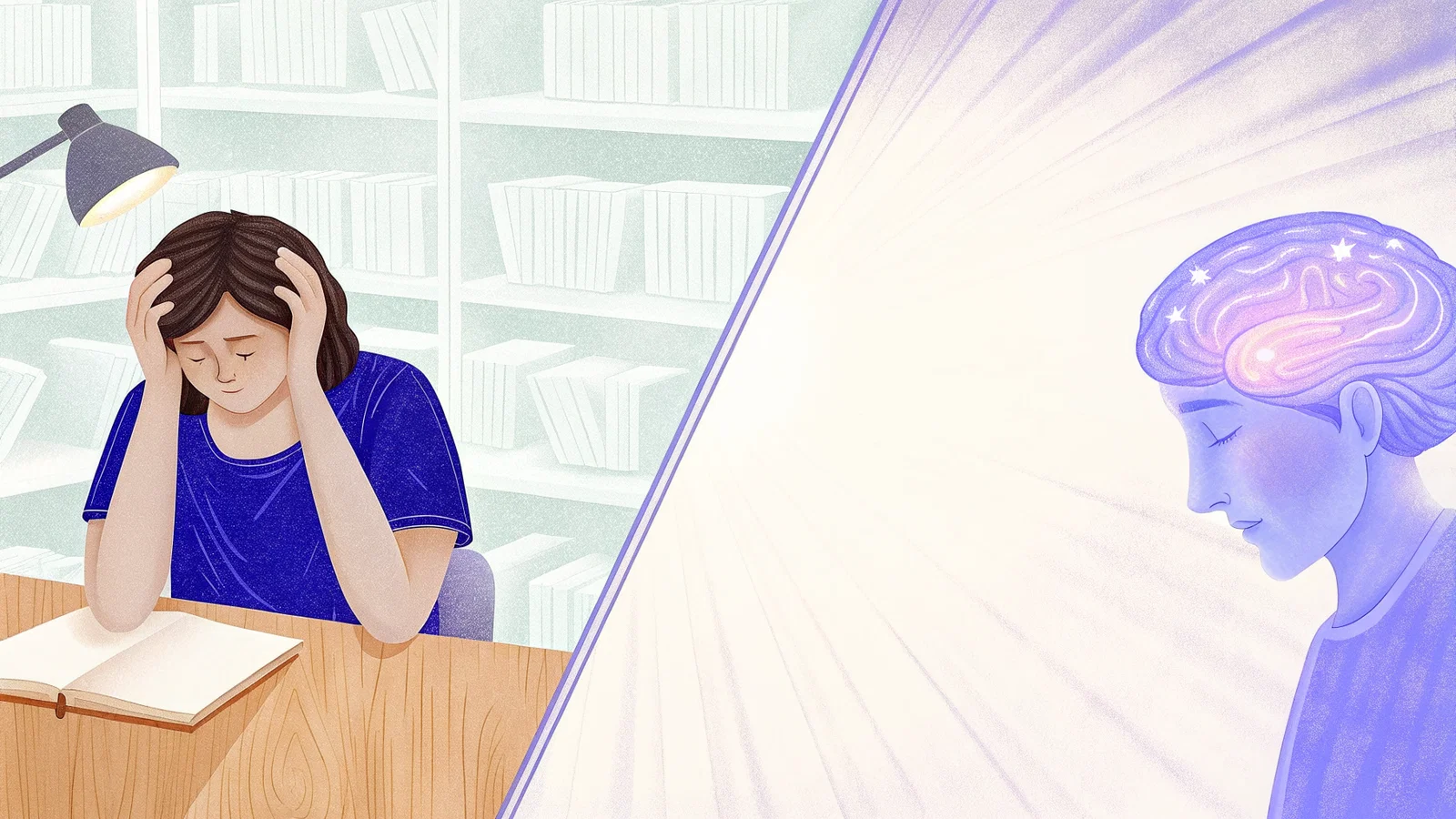
Step 1 anxiety is rarely a personal failing. It is almost always a symptom of a flawed study strategy. When medical students sit in my office expressing paralyzing dread about the USMLE, they usually attribute their fear to the sheer volume of material or the high stakes of the exam. I push back on this narrative immediately. The volume of material is a constant; the stakes are a constant. The variable that dictates your psychological state is your daily study methodology.
Passive review is the primary culprit behind pre-exam panic. Rereading notes, highlighting textbooks, and rewatching lecture videos at 1.5x speed create a profound, dangerous false sense of mastery. When you read a paragraph about the pathophysiology of DiGeorge syndrome for the fourth time, the text looks incredibly familiar. Your brain registers this familiarity as knowledge. You feel safe. You feel prepared. But this safety is an illusion. Under the sterile, high-pressure environment of the Prometric testing center, when a question stem presents a vague clinical vignette rather than a direct definition, that passive familiarity evaporates. The resulting blank stare is what triggers the anxiety spiral.
Active recall operates on an entirely different psychological and neurological frequency. Self-testing, using flashcards, and grinding through practice questions feel objectively harder. They are supposed to feel harder. This method forces you to confront what you actually know versus what you merely recognize. While passive review masks your ignorance, active recall exposes it.
This exposure is precisely why active recall lowers test anxiety in the long run. Step 1 anxiety is largely driven by uncertainty. You are terrified of the unknown gaps in your knowledge. Active recall systematically hunts down those gaps and replaces vague uncertainty with calibrated confidence. When you know exactly what you do not know, and you have a protocol to fix it, the existential dread of the exam dissipates. You stop hoping you will remember the material and start trusting that you will retrieve it.
To understand why your study method dictates your anxiety levels, we must examine the cognitive science of memory consolidation. The "testing effect" is one of the most robust findings in educational psychology. It proves definitively that the act of retrieving a memory from your brain strengthens the neural pathway far more than re-exposing yourself to the original information.
When you engage in passive review, you are simply tracing an existing, shallow neural pathway. When you engage in active recall, you are forcing your brain to reconstruct the pathway from scratch. This reconstruction requires significant metabolic and cognitive effort. It feels like a struggle. In the literature, this is termed a "desirable difficulty." The short-term friction you experience when trying to recall the exact enzyme deficient in Von Gierke disease is not a sign that you are bad at studying. It is the exact mechanism of effective learning. Avoiding that struggle by looking at the answer immediately is a critical error.
Passive review exploits the illusion of fluency. Fluency is the ease with which you process information. When you reread your First Aid annotations, the processing is smooth. Your brain misinterprets this smooth processing as deep understanding. But Step 1 does not test processing fluency; it tests retrieval under duress. Familiarity feels like knowledge in your dorm room, but it does not withstand exam pressure.
The data from USMLE preparation cohorts is unequivocal. Students who structure their dedicated study periods around active recall consistently demonstrate 15-20% higher retention rates at the 7-day and 30-day marks compared to peers who rely on passive review. More importantly, they report significantly lower subjective anxiety scores in the final two weeks before their exam. They have subjected their memory to rigorous stress testing, so the actual exam feels like just another practice block.
Look at the decay curves in the chart above. Passive review yields a steep, catastrophic drop in retention within the first week. If your study plan relies on passive review, you are forced to constantly relearn the same material, which breeds exhaustion and panic. Active recall flattens the forgetting curve. You retain the information longer, which means you spend less time relearning and more time integrating complex concepts.
Anxiety is a feedback loop. The way you study either feeds the loop or breaks it.
Passive review reduces anxiety in the immediate moment. Highlighting a page feels productive. Watching a Boards and Beyond video feels like progress. But this temporary emotional relief leaves gap-sized holes in your long-term schema. When you eventually take a practice exam, those holes are exposed. Your score stalls or drops. The anxiety returns, magnified by the realization that you have wasted weeks of dedicated time. You respond to this spike in anxiety by returning to the comfort of passive review, seeking that temporary emotional relief once again. It is a toxic, self-defeating cycle.
Active recall, conversely, functions as a form of interoceptive exposure. In clinical psychology, interoceptive exposure involves deliberately triggering the physical sensations of anxiety to desensitize the patient to them. When you stare at a blank Anki card and your heart rate elevates because you cannot remember the answer, you are experiencing micro-doses of exam anxiety. By sitting with that discomfort and forcing the retrieval, you teach your autonomic nervous system that the feeling of uncertainty will not kill you. You build emotional tolerance to the exact sensations you will feel on test day.
This creates a powerful confidence loop. You attempt to recall information without notes. You struggle. You identify a specific knowledge gap. You target that gap with focused study. You successfully recall it the next day. This sequence builds profound self-efficacy. Self-efficacy is the ultimate antidote to test anxiety.
I have watched countless high-anxiety M2 students avoid active recall because it "feels like failing." They get a card wrong and experience a spike of shame, so they close the laptop and open a textbook to feel better. This is a fundamental misunderstanding of the learning process. That feeling of failure is the exact mechanism of improvement. If you are not getting cards wrong during your daily reviews, your parameters are set too low, and you are not pushing the boundaries of your knowledge. Embrace the friction.
Theory is useless without execution. You need a rigid, uncompromising protocol to shift your study habits from passive consumption to active retrieval. The golden rule for Step 1 dedicated is the 70/30 split. Spend 70% of your study time in active recall and 30% in passive preview.
Here is how you structure your day to systematically dismantle test anxiety.
Morning: Predictive Retrieval Do not open your notes or your video lectures first thing in the morning. Start each day with 20 recall prompts. Pick a high-yield topic, such as the nephrotic syndromes, and write down everything you can remember about the pathophysiology, histology, and pharmacology before looking at any resources. This primes your brain for the day and immediately highlights your blind spots.
Daily: Spaced Repetition Anki is non-negotiable for Step 1. Use a curated, high-yield deck (like AnKing) and customize it to your weak areas. During dedicated, schedule 50 new cards per day and commit to clearing 150 to 200 reviews. The algorithm handles the spacing; your only job is to engage in the retrieval. Do not just flip the card when you struggle. Force your brain to work for the answer.
Weekly: Simulated Recall You must build test-like endurance to lower situational anxiety. Every week, complete timed, random 40-question blocks using UWorld or AMBOSS. Do not pause the timer. Do not look up facts. Simulate the physical and mental constraints of the actual exam. Reviewing the explanations afterward is where the deep learning occurs, but the initial 40 questions must be a pure, uninterrupted retrieval exercise.
Response to Panic: Micro-Recall When you feel the familiar chest tightness of panic setting in because a topic feels overwhelmingly large, use the micro-recall technique. Set a timer for two minutes. Write down every single fact you know about the specific topic causing the panic. When the timer stops, compare your brain dump to your reference material. This immediately converts a vague, overwhelming sense of "I do not know this" into a concrete, manageable list of "I know these five things, and I need to review these three things." Action cures anxiety.

Active recall is not merely a learning tool. It is a continuous, real-time self-assessment mechanism. It provides you with hard data regarding your readiness for Step 1. Passive review provides no data; it only provides comfort.
This is not to say passive review is entirely worthless. It has a specific, limited role. Use passive review for the initial exposure to a completely novel concept, or for the final review of high-yield summary tables in the last 48 hours before your exam. But it must never be the primary mode of your study plan. If you find yourself spending hours reading textbooks or watching videos without immediately testing yourself on the material, you are wasting your time and actively feeding your anxiety.
Adopt this research-backed rule as your personal threshold: If you would not be willing to be tested on it right now, you do not know it. Use that standard to dictate when you are done studying a topic.
Your Step 1 anxiety is not a sign of intellectual weakness. It is a highly accurate signal that your current study method is misaligned with the retrieval demands of the exam. The USMLE does not care how many hours you spent highlighting First Aid. It cares whether you can retrieve a third-order biochemical pathway under extreme time pressure. Shift your methodology. Embrace the struggle of retrieval. The anxiety will follow the strategy.
- Active recall lowers test anxiety by replacing vague worry with specific, actionable knowledge gaps.
- Passive review creates a temporary sense of safety but amplifies uncertainty and panic on exam day.
- Adopt a strict 70/30 rule: 70% active recall (Qbanks, flashcards, brain dumps) and 30% passive review (videos, initial reading) for consolidation.
- If you feel too comfortable while studying, you are likely not learning at the depth Step 1 requires; embrace the desirable difficulty.