
More CCS practice does not automatically make you better at CCS. That's the myth. And it's a stubborn one.
I've watched students grind through case after case, brag about doing "50 more this week," then make the exact same mistakes they were making a month ago: delayed antibiotics, no reassessment after fluids, terrible disposition, random shotgun orders tossed in because panic feels productive. Busy? Sure. Improved? Not necessarily.
Here's what the data actually shows. Real CCS progress isn't measured by time spent, number of cases completed, or whether you felt less nervous on Sunday night. It shows up in objective performance changes: fewer critical errors, faster recognition of the scenario, cleaner prioritization, better reassessment, and more reliable case completion. That's it. If those metrics aren't moving, your practice may be repetitive, but it isn't high quality.
So let's kill the fantasy that volume alone wins. It doesn't. Deliberate correction wins. Pattern recognition wins. Better decisions under time pressure win. The rest is just academic cardio.
1) Your error rate is dropping, not just your anxiety
Confidence is a terrible scoreboard. I've seen people walk out of a practice block saying, "I felt way smoother," then review the case and realize they still forgot pregnancy testing, still delayed airway support, still never advanced the clock properly, still discharged someone who obviously needed admission. Feeling better is not the same as doing better.
What matters is whether your preventable errors are actually declining. Count them. Missed orders. Delayed interventions. Wrong sequence. Failure to follow up labs or vitals. Omitted counseling or disposition steps. Those are the mistakes that cost points and expose weak habits.
Track repeat errors by category, not by vague mood. If the same two or three high-cost mistakes keep showing up, that's your real curriculum. Fix those first. Good practice shrinks recurring error patterns. If your anxiety is dropping but your errors aren't, congratulations, you're just getting comfortable being wrong.
2) You're acting faster without becoming reckless
Speed, by itself, is overrated. Plenty of students move quickly and still manage to do dumb things. Fast nonsense is still nonsense.
The real marker is this: you recognize the pattern earlier and launch the right first moves sooner. In a good CCS run, you don't spend two minutes mentally sightseeing. You identify the unstable patient, order the key diagnostics, start treatment, and set monitoring in motion before indecision gums up the case.
Efficiency has fingerprints. Shorter time to first relevant order. Less hunting through menus. Fewer long pauses where you stare at the screen hoping inspiration descends from heaven. You know what happens next because you've built a sequence.
But speed has to stay tethered to safety. If getting faster means you're skipping pregnancy tests, cultures, DVT prophylaxis, or follow-up reassessment, that isn't improvement. That's sloppier panic wearing a stopwatch.
3) You're prioritizing the right actions earlier
Here's another bad habit: the "do everything" mindset. Students think exhaustive ordering looks thorough. Usually it looks unfocused.
Strong CCS performance is not about remembering 40 details at once. It's about identifying the first 3 to 5 actions that actually change outcomes. Sick chest pain patient? Stabilize, monitor, ECG, IV access, aspirin, troponins, targeted escalation. Septic patient? Fluids, cultures, antibiotics, lactate, monitoring, source control thinking. The winners move the case with high-yield actions before drowning in low-value extras.
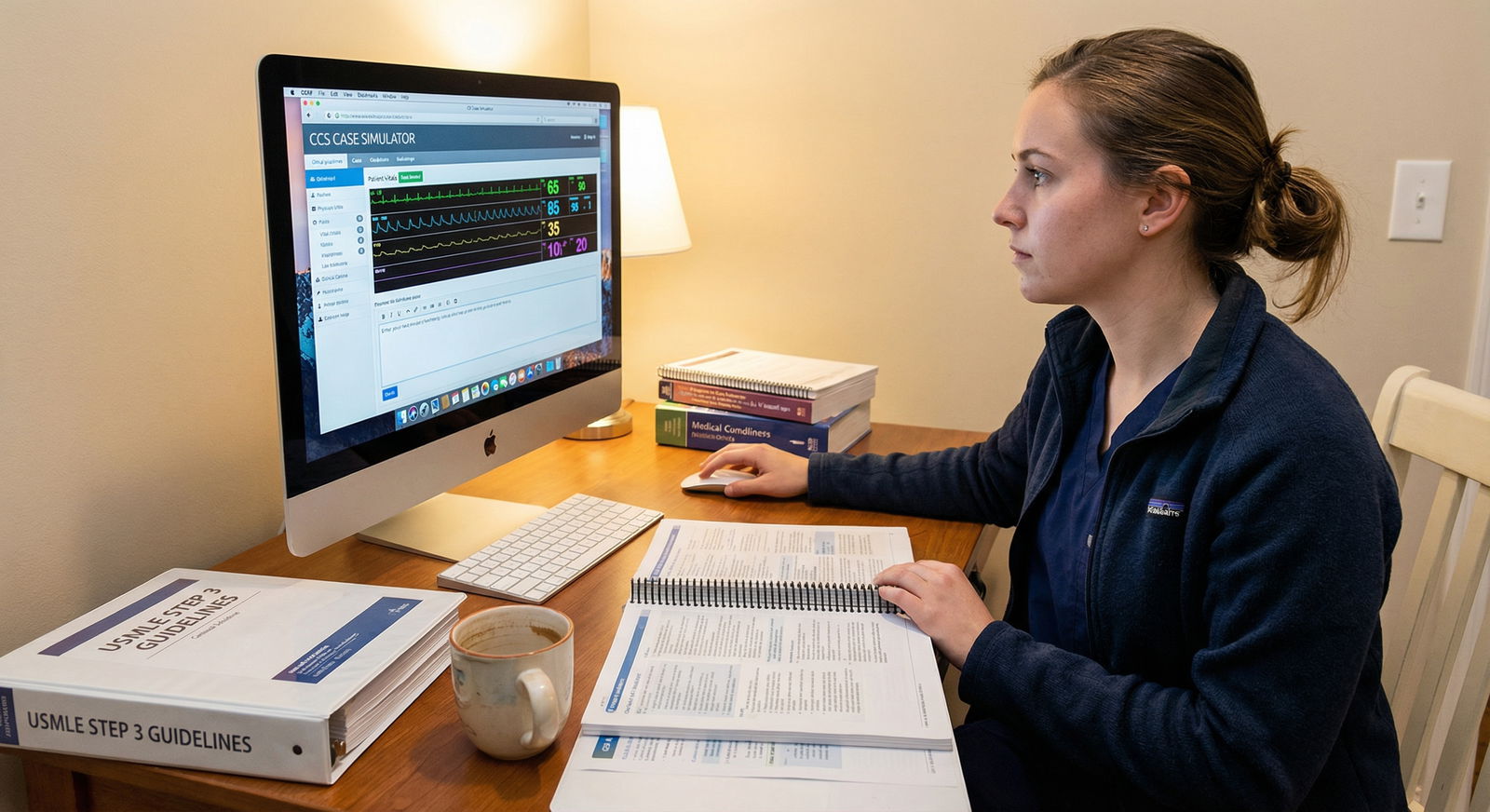
Improvement shows up when you stop behaving like every case deserves the same giant shopping cart of orders. It doesn't. Indiscriminate testing often signals weak prioritization, not thoroughness. I've seen students order obscure confirmatory tests before handling oxygen, telemetry, or empiric treatment. That's backward. And on CCS, backward thinking gets punished.
If you're improving, your initial sequence is getting cleaner. The urgent stuff happens early. The nice-to-have stuff waits its turn. That's how competent clinicians think, and it's how strong test-takers score.
4) You're making fewer "stuck" moments and recoveries are faster
Everybody gets stuck. That's normal. What matters is how often it happens and how expensive the recovery becomes.
Early on, students hit a weird lab value or a clinical twist and freeze. They backtrack through every order. They restart the differential from scratch. They waste simulated time because they can't tell whether the case is changing or whether they simply missed something obvious. I've seen this happen after a patient fails to improve with initial therapy. Instead of reassessing the likely miss, wrong diagnosis, wrong severity, missing complication, the student spirals.
Improvement means fewer dead ends. And when you do hit one, you recover faster. You recognize, "I'm missing the next pivot," then correct with intention. Maybe you add imaging after persistent abdominal pain. Maybe you escalate antibiotics. Maybe you stop pretending this outpatient plan still makes sense and admit the patient. That's growth.
Don't use "I got stuck" as a personality trait. Measure it. How many times did you pause, backtrack, or redirect? How long did it take to recover? Advanced practice isn't never getting stuck. It's getting unstuck before the case falls apart.
5) Your reassessment is actually changing what you do
A lot of students collect data the way squirrels collect acorns. Constant gathering. Very little use.
They order vitals, labs, imaging, response checks, and then barely act on the results. That is a massive CCS problem. Reassessment is not decorative. If the patient remains tachycardic after fluids, that should matter. If the potassium comes back dangerous, that should trigger treatment. If antibiotics aren't touching the fever curve and the pressure is tanking, your management should change immediately.
Better learners don't just gather information. They close the loop. Data comes in, interpretation happens, orders change, monitoring updates, disposition gets revised. That discipline matters just as much on the exam as in real patient care.
If your reassessments are becoming more actionable, that's real progress. If you're still treating new information like background noise, you're not improving nearly as much as you think.
6) Your case finishes are more reliable, even when the scenario is messy
A lot of mediocre CCS practice looks decent until the final stretch. Then the wheels come off.
Students stabilize the patient, make a reasonable diagnosis, even start treatment, and then forget to finish the case like an adult. No follow-up. Weak monitoring. Vague disposition. Missing counseling. Incomplete long-term plan. That's not a minor issue. Case closure is part of the skill.
Messy cases don't excuse sloppy endings. If anything, they expose whether you have systems thinking. Can you decide inpatient versus outpatient appropriately? Can you arrange the right follow-up tests? Can you specify monitoring after a medication change? Can you tie the whole case together instead of abandoning it once the drama fades?

Improvement means your finishes become dependable. Even when the diagnosis was tricky or the presentation incomplete, you still land the plane.
7) Your score trend is improving for the right reasons
Yes, scores matter. No, a single good session proves almost nothing.
People love to overinterpret lucky streaks. Maybe the cases matched what you reviewed last night. Maybe you guessed correctly on a pattern you barely understand. Maybe the platform scored generously. One bump means very little. Trend matters. Breadth matters. Durability matters.
The useful question is why your score is rising. Is it because your diagnosis, treatment, monitoring, and completion are all improving together? Or is it because you memorized a handful of canned shortcuts and happened to see familiar cases? Real improvement survives unfamiliar scenarios.
That's the signal to trust: stable gains across categories over multiple sessions, including cases you didn't see coming. Anything else may just be cosmetic progress. Looks nice. Means less.
What real CCS improvement looks like
Real CCS improvement is boring in the best way. Fewer repeat errors. Faster first moves. Better prioritization. More meaningful reassessment. Cleaner finishes. A score trend that rises because your decisions are better, not because your luck improved.
That's the standard. Not "I did more cases." Not "I felt more confident." Not "I was busier." Busier is not better. Confidence is not competence. Repetition without correction is just rehearsing your flaws.
If you want to know whether your CCS practice is working, stop counting volume and start tracking outcomes. The data has to show it. If it doesn't, your study plan needs fixing, not more mythology.