
Program directors do not care about Step 3—until they absolutely do. And when they do, it can quietly decide whether you move up… or get held back.
Let me walk you through what actually happens in those closed-door meetings where your name is on the agenda and your Step 3 score is sitting in the packet in front of every faculty member.
Most of what you’ve heard about Step 3 is superficial: “It’s just a formality,” “Just pass it,” “No one cares about your score.” That’s only partially true. The truth is messier, and it depends heavily on when and why your file is being opened.
You want the insider version? Here it is.
The First Lie: “Step 3 Doesn’t Matter”
This line usually comes from one of three people:
- The PGY-4 who barely remembers taking it and passed easily.
- The attending who hasn’t looked at a Step score in 15 years.
- The program director who doesn’t want to provoke anxiety before you’ve even started residency.
They’re not exactly lying. But they’re not telling you the part that matters to you.
Here’s the real breakdown, and this is roughly how most academic programs I’ve seen actually view Step 3:
| Situation | How Step 3 Is Really Used |
|---|---|
| Strong resident, no issues | Box-check for licensing |
| Borderline resident | Tie-breaker & “risk” signal |
| Resident in trouble | Evidence to justify promotion delay |
| IMG / visa issues | Proof of test reliability & security |
| Fellowship-bound resident | Minor data point, rarely decisive |
Notice what’s missing: “Primary factor in promotion.” It usually is not.
But here’s the part nobody tells you as a student: Step 3 is not about rewarding excellence. It’s about risk management.
If you’re obviously strong, Step 3 is a checkbox. If you’re borderline or concerning, Step 3 suddenly becomes a weapon or a shield—depending on which side of the table you’re sitting on.
Where Step 3 Actually Shows Up in Promotion Meetings
I’ve sat in these meetings. I’ve watched PDs flip straight to the Step 3 page for certain names and completely ignore it for others.
Here’s how your Step 3 gets used when decisions are made about promotion:
1. The “Green Light” Resident
This is the majority.
You’re competent clinically, decent evaluations, no professionalism issues, no major exam disasters in the past. When your name comes up for promotion, the conversation is short.
“Any concerns?”
“No.”
“Has Step 3?”
“Yes, passed.”
“Good. Next.”
Your actual score is irrelevant in this scenario. A 205 and a 245 function identically. The only thing that matters is: “Did they pass, and is it done early enough to not delay licensing?”
This is where that casual advice “Just pass it” is basically accurate—if everything else in your record is solid.
Step 3 is a nuisance here, not a threat. But only if you get it off the table early.
2. The Quiet Red Flag: Failing Step 3 Once
This is where things change tone.
When a PGY-1 or PGY-2 fails Step 3, what happens behind closed doors isn’t outrage. It’s a series of quiet, serious questions:
“Any prior exam issues?”
“What were their Step 1 / Step 2 scores?”
“Have there been clinical performance concerns?”
“Are they remediation material or progression material?”
You’re being sorted.
I watched this play out with a categorical IM resident who failed Step 3 with a history of Step 1 barely passing and Step 2 barely passing. On paper: 197 / 209 USMLE, passed on first tries.
The PD literally said in the meeting:
“I was hoping Step 3 would reassure me. It doesn’t.”
That one line told me everything about how they used the exam.
They didn’t care about the number per se. They cared that it didn’t break the pattern. A Step 3 fail confirmed a concern they already quietly had: this resident might not be safe to send into independent practice without more supervision, more time, or—brutally—without considering whether they’ll ever truly get there.
What usually happens after one fail?
- You’ll be required to pass before promotion to the next PGY level or before being supported for a full license.
- You may get a formal remediation plan, even if you ultimately pass.
- Your “file narrative” shifts from “normal resident” to “borderline but working on it.”
This matters a lot more than you think.
Because when you’re now being discussed in a room of attendings a year later, they’re no longer just saying “Any concerns?” They’re saying, “How is [your name] doing compared to last year?” That failed Step 3 comes back into the conversation as part of your risk story.
3. Multiple Fails: Where Promotion Really Gets Blocked
A single Step 3 fail can be spun as bad luck, poor timing, life stress, whatever.
Multiple fails? That’s different.
I’ve watched PDs who were extremely resident-friendly turn stone-faced when a second Step 3 failure shows up. At that point, the question becomes:
“Are we willing to sign off that this person is safe to practice independently as an attending in 12–24 months?”
A second fail is often treated as strong evidence that the answer might be no.
This is where Step 3 stops being a formality and starts being leverage.
Conversations behind closed doors sound like this:
“We can’t promote them to PGY-3 until they pass. We’ll be on the hook for their license and credentialing.”
“We need to protect the program’s board pass rate and reputation.”
“If we keep them and they never pass, we’ve wasted a position for 3 years.”
That last sentence is ugly but real. Every PD I know has said some version of that at least once.
Multiple fails can lead to:
- Delayed promotion (you repeat a PGY year or part of it).
- “Non-renewal” of contract at year’s end framed as “fit” or “progress issues.”
- Being pushed toward a non-boarded career path or alternate role.
Everyone will sugarcoat it in person. Not in the promotion meeting.
The Real Hidden Role of Step 3: Protecting the Program
You need to understand the incentives, because once you see them, everyone’s behavior makes sense.
Programs are judged on:
- Board pass rates
- Resident performance
- Clinical safety and complaint history
- Accreditation reviews
You are not just a person to them. You are a risk profile attached to a training slot.
Step 3 becomes a tool PDs use to justify decisions they already want to make based on what they’ve seen on the wards.
Resident doing well clinically, good feedback, some minor exam worries? A marginal Step 3 performance gets shrugged off.
Resident chronically struggling, disorganized, mixed evaluations, professionalism noise? A marginal or failed Step 3 is exactly the “objective evidence” PDs use to document and defend tough calls.
Here’s the part that makes people uncomfortable:
I’ve seen residents with:
- Lower Step 3 scores but strong evaluations sail through promotion.
- Higher Step 3 scores but bad evaluations get blocked or pushed out.
Step 3 is not the primary weapon. It’s just the cleanest number people can point to in an email to GME or the Dean when they need something that looks objective.
Special Cases Where Step 3 Suddenly Matters a Lot
There are a few scenarios where Step 3 carries outsized weight, even if no one says that directly to your face.
1. International Medical Graduates (IMGs)
IMGs are scrutinized more closely. Not fair, but very real.
For IMG residents, I’ve watched leadership look at Step 3 as:
- Proof of sustained performance in a U.S. testing environment
- A hedge against visa, credentialing, and state licensing complexities
- A signal to fellowship programs and credentialing committees down the line
Here’s how one APD put it, not realizing a student overheard:
“With IMGs, a low or failed Step 3 makes people nervous all the way down the chain. It’s not just about promotion; it’s visas, boards, and whoever credential them later.”
If you’re an IMG, Step 3 is not just a box. It’s part of the proof that you can hit U.S. standard benchmarks consistently. You do not need a 250, but you really do not want a fail on that record.
2. Residents With Prior Exam Problems
If you barely passed Step 1 or Step 2, or if you needed multiple attempts, your Step 3 becomes a referendum:
- A clean, solid Step 3 = “Maybe they’ve matured, they’ve figured it out.”
- A marginal or failed Step 3 = “This pattern isn’t going away.”
One PD I know keeps a simple mental rule:
“If someone’s already had one major board problem, I need Step 3 to be boring.”
Boring = on time, passed, no drama.
If Step 3 becomes yet another problem, promotion talks get much harsher. They’ll bring up your old failures, your remediation notes, your “academic probation” history. The narrative shifts from “had some early bumps” to “chronic risk.”
3. Residents On Thin Ice for Other Reasons
People love to pretend things are compartmentalized. They’re not.
If you’ve had:
- Professionalism issues
- Time management disasters
- Serious complaints from nurses or patients
- Documented remediation for clinical skills
Then your Step 3 result often ends up being used as confirmation either way.
Passed early and drama-free? It weakens the case that “you’re just not capable.”
Struggle, fail, or procrastinate until last minute? It strengthens that case, brutally.
Behind closed doors, it’s very common to hear some version of:
“They’re also behind on Step 3” or “And they still haven’t passed Step 3” slipped into the discussion as supporting evidence that you’re not keeping up.
You do not want to hand them that talking point.
How Timing of Step 3 Affects Promotion Decisions
The score isn’t the only part that matters. Timing is a big deal.
Many programs expect:
- Step 3 passed by the end of PGY-1 for prelims in competitive fields
- Step 3 passed by mid-PGY-2 for most 3-year programs (IM, Peds, FM)
- Step 3 done before PGY-3 or before they sign off on your unrestricted license
But here’s the hidden tension: PDs are constantly juggling schedules.
They need:
- Enough licensed senior residents to cover supervisory roles
- People positioned to moonlight (in some programs)
- Proof for the hospital credentialing committee that seniors are board-eligible and moving toward full licensure
So if you’re late on Step 3—even if you end up passing—your name starts getting associated with “logistical headache.”
The conversation can sound like:
“We can’t slot them into that senior rotation yet; they don’t have Step 3.”
“Credentialing is holding their application because we don’t have that score.”
“We should not promote them into a role we can’t license.”
Passing late may still allow promotion, but it narrows your options, slows your licensing, and makes PDs reluctant to rely on you for senior roles early in the year.
Step 3 and Chief Resident Selection, Fellowships, and Beyond
You’re probably wondering: do promotion decisions to chief or competitive fellowships care about Step 3?
The honest answer: far less than people think—but not zero.
For chief:
Most PDs choose chiefs based on:
- Reliability
- Professionalism
- Leadership potential
- How much they trust you to represent the program
Step 3 only enters the picture if:
- You’ve failed it, or
- You’ve significantly delayed taking it, creating headaches
No PD wants a chief who:
- Is still dealing with Step 3 issues
- Might fail boards later and reflect badly on the program
For fellowships:
Serious fellowships (cards, GI, heme/onc, etc.) mostly care about:
- Strong letters
- Research
- Clinical performance and reputation
But Step 3 plays a quiet reputational role. I’ve heard this exact line on a fellowship selection call:
“Any testing issues we should be aware of?”
They’re not looking for a 260. They’re screening for chronic board risk.
A clean, on-time pass? You’re fine.
A failure or delay? They start asking “why” and “is this a pattern?”
What You Should Actually Do About Step 3
Let me cut through all the noise and give you practical positioning advice.
Do not treat Step 3 as a crisis. Treat it as a liability to neutralize early.
Take it when you’ve seen enough bread-and-butter inpatient medicine to not be surprised by the cases, but not so late that it becomes a dangling loose end at promotion time.You don’t need a monster score. You do need a clean story.
Your narrative should sound like this in a PD’s head:
“Solid resident, took Step 3 on time, passed, no drama.”
That’s it. That’s the goal.If you’ve had past exam trouble, Step 3 is your redemption shot.
You can’t erase Step 1 or Step 2, but you can demonstrate improvement. A focused, disciplined approach to Step 3 prep actually matters for you more than for your high-scoring co-residents.If you fail, control the narrative immediately.
Do not disappear. Do not wait. Talk to your PD. Show a plan. Use faculty, question banks, and—yes—maybe a formal prep course if you’ve had multiple test issues. You want your PD to be able to say in that meeting:
“They took this seriously, they’ve remediated, and they’re ready for another attempt.”
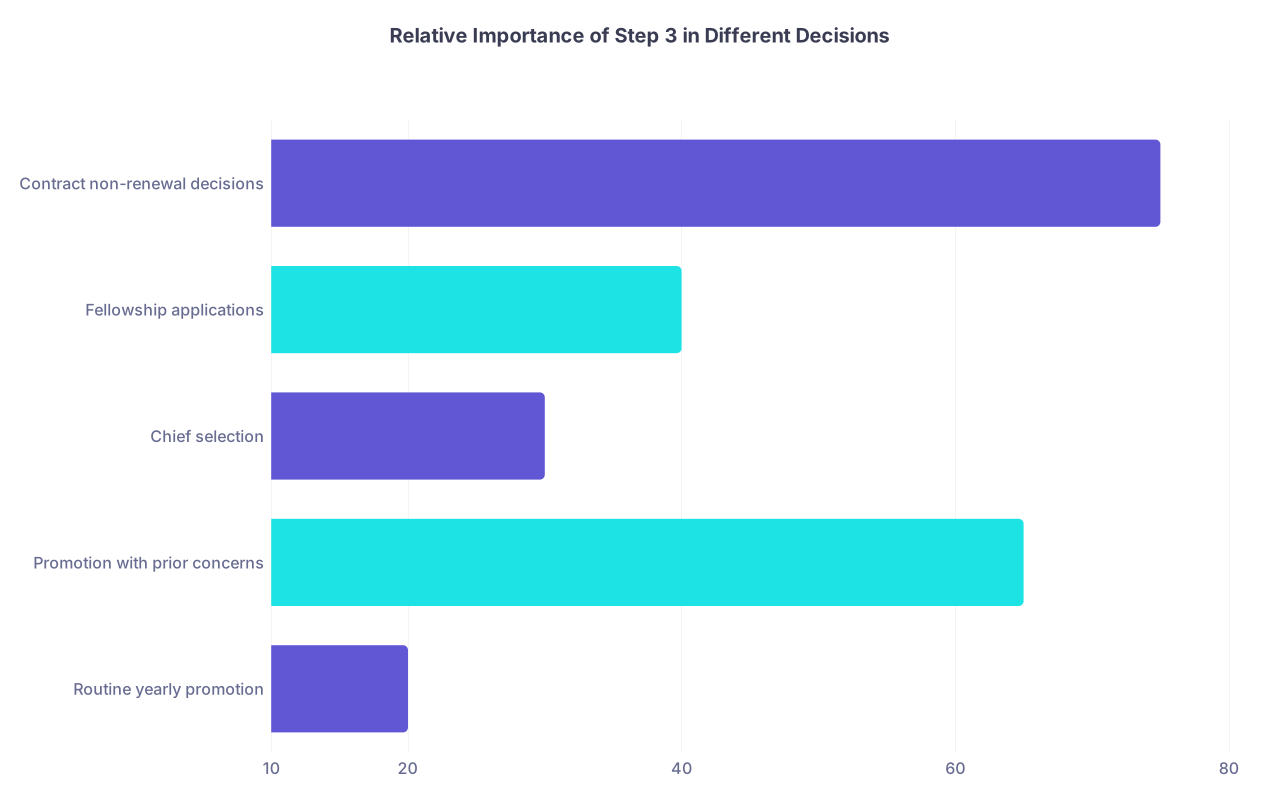
| Category | Value |
|---|---|
| Routine yearly promotion | 20 |
| Promotion with prior concerns | 65 |
| Chief selection | 30 |
| Fellowship applications | 40 |
| Contract non-renewal decisions | 75 |

| Step | Description |
|---|---|
| Step 1 | Resident Year Review |
| Step 2 | Step 3 Passed? |
| Step 3 | Promote |
| Step 4 | Require Completion Before Promotion |
| Step 5 | Review Evaluations, History |
| Step 6 | Step 3 Used as Supporting Data |
| Step 7 | Step 3 Heavily Weighted |
| Step 8 | Conditional Promotion with Monitoring |
| Step 9 | Delay Promotion / Non-Renewal Discussion |
| Step 10 | Any Concerns? |
| Step 11 | Prior Exam Issues? |
| Step 12 | Pass or Fail? |
FAQ: Step 3 and Promotion Decisions
1. If I fail Step 3 once but then pass, will it still hurt my promotion?
Usually you’ll still be promoted if you’re solid clinically and you pass on the second try before a key deadline (often before moving to senior year or applying for a full license). But the fail doesn’t vanish—it becomes part of your “risk narrative.” It may resurface if other concerns show up, or when people talk about your board-readiness. You want your behavior after the fail (organized, proactive, communicative) to be so strong that it reassures them more than the fail worries them.
2. Does my actual Step 3 score (like 205 vs 245) matter for promotion?
For 90% of residents, no. A pass is a pass. Promotion decisions are not usually splitting hairs over 20–30 points on Step 3. Where a low-but-passing score can matter is if it fits a larger pattern of marginal exams and borderline performance. Then it’s one more weak datapoint among many. But by itself, a low pass with strong clinical evaluations is rarely a barrier to promotion.
3. Can a strong Step 3 score “save” me if I’ve had mediocre evaluations?
Not really. A great Step 3 might help someone argue that you’re capable of the knowledge side, but it will not erase professionalism problems, poor teamwork, or consistent negative feedback. Programs are much more afraid of a clinically unsafe or unprofessional attending than of someone who struggles slightly on tests. Step 3 can support a positive narrative; it cannot rescue a toxic or unsafe one.
4. When is the latest I can safely take Step 3 without risking promotion issues?
This depends on your specialty and program, but in most 3-year programs, you want it done and passed by mid-PGY-2 at the latest. After that, you start bumping into licensing and senior-role scheduling timelines. If you’re in a competitive field, an IMG, or have prior exam issues, do not cut it close. The earlier you convert Step 3 from “unknown risk” to “resolved box,” the less power it has over you in any closed-door conversation.
Bottom line?
Step 3 is not the exam that makes your career. It’s the exam that quietly complicates it if you mishandle it.
Use it as a tool to keep your story boring, predictable, and safe in the eyes of the people voting on your promotion. Pass it, pass it early, and give them nothing to talk about.