It’s 2:07 a.m. You’re on night float. You sneak a look at your email between pages, and there it is: “USMLE Step 3 Score Report Available.” Your heart’s already pounding and you haven’t even opened it. You click. You scroll. And you see the word you’ve been quietly terrified of for months:
“Fail.”
Everything in your brain goes white noise. You’re thinking:
Am I going to get fired?
Will I ever be board certified now?
Do programs tell each other?
Did I just ruin my career… in PGY-1?
Let me say this as directly as possible: failing Step 3 as an intern feels catastrophic, but it is not the end of your career unless you let panic make it worse.
I’m going to walk through the actual consequences, the ugly possibilities, the realistic next steps, and how to keep this from spiraling into a residency-ending disaster. This isn’t the fake “it’ll all be fine” pep talk. I’m going to assume your brain is doing worst-case gymnastics and meet you there.
How Bad Is Failing Step 3 Intern Year… Really?
First, you need to separate three different things in your head that right now are all blended into one giant “I’m screwed” blob:
- Your feelings about failing (shame, fear, embarrassment)
- The actual rules (ACGME, state license, your hospital’s policies)
- The politics (how your PD and program culture respond)
Your feelings are valid. But they’re not a reliable measure of how doomed you are.
Let’s talk impact in real-world terms.
| Area | Typical Impact (First Failure) |
|---|---|
| Job as an intern | Usually retained, closer monitoring |
| Promotion to PGY-2 | Sometimes delayed, often still promoted |
| State licensing | Needs retake/pass, rarely career-ending |
| Future jobs/fellowships | Mild blemish, not automatic rejection |
| Board certification | Still possible after eventual pass |
The part your brain is lying to you about
Your anxiety says: “One fail = unemployable.”
Reality: A single Step 3 failure is a red flag, not a death sentence.
I’ve seen:
- IM residents who failed Step 3 twice and still matched GI fellowship after eventually passing
- A surgery intern who failed once, passed on second try, and is now a chief
- A peds resident whose promotion was delayed three months, then completely forgot about it by PGY-3
Does a fail hurt? Yes. Is it permanent branding iron on your forehead? No. It’s a datapoint. An annoying one. But still just a datapoint.
The First 48 Hours: What You Do Right Now Matters
You’re going to want to either (1) ignore it and hope no one notices or (2) send a panicked 3 a.m. novel to your PD. Don’t do either.
Here’s the actual sequence that keeps this from exploding.

| Step | Description |
|---|---|
| Step 1 | See Step 3 Fail |
| Step 2 | Take 24 hours to breathe |
| Step 3 | Download & save score report |
| Step 4 | Review program & state license policies |
| Step 5 | Email PD/program coordinator |
| Step 6 | Meet to make concrete retake plan |
Step 1: 24-hour rule
Give yourself 24 hours before you talk to leadership.
You can tell a trusted co-intern or friend. Cry. Rage. Spiral a little. But don’t make formal moves when you’re in full meltdown mode. You want to show up to your PD with some composure and some plan.
Step 2: Grab the data
Download the actual score report. You’ll need:
- The exact score
- Performance profile by content area
- Date of exam
This isn’t just emotional. It’s diagnostic. Did you bomb CCS? Was it biostats again? Did you rush through day 2? That matters later.
Step 3: Quiet policy check
Before you tell anyone, figure out what you’re dealing with.
Check:
- Your resident handbook or GME policies
- Your program’s “promotion” requirements (often on internal site)
- Your state licensing board site (some states require Step 3 by certain PGY level)
You’re not trying to lawyer your PD here. You just want to avoid going in blind.
Telling Your PD Without Sounding Like You’re Falling Apart
This part makes people physically nauseous. It feels like walking into a performance review where you already know you failed.
But here’s the ugly truth no one says out loud: PDs care less about the failure and more about how you handle it. They’ve seen failures before. What freaks them out is denial, defensiveness, or chaos.
Here’s roughly what you say in an email:
Subject: Step 3 Score & Plan
Hi Dr. [PD],
I received my Step 3 score report yesterday and unfortunately did not pass. I’ve reviewed the score breakdown and identified a few weak areas.
I’d like to meet briefly to discuss expectations from the program side and to propose a concrete plan and target timeline for a retake.
I’m very committed to correcting this and making sure it doesn’t interfere with my performance on service.
Thank you,
[Your Name]
You’re not asking permission to be devastated. You’re signaling:
- I know this is serious
- I’m not hiding it
- I’m already thinking about what to do
How PDs actually react
Most common reactions I’ve seen:
- “This isn’t the end of the world; we’ll get you through it.”
- “I’m disappointed, but let’s talk about what went wrong and how to fix it.”
- “You’re not the first. You won’t be the last.”
Worst-case realistic reaction on a bad day:
- “This could affect your promotion timeline. You’ll need to pass on the next attempt.”
Notice what’s not there: “You’re fired. Hand in your badge.” That’s vanishingly rare for a first Step 3 fail unless your performance on the job is already in serious question.
Will I Still Be Promoted to PGY-2?
Here’s the part your brain keeps rewinding: “What if they don’t renew my contract?”
So let’s call the scenarios what they are.

Scenario A: You pass on second attempt before promotion
This is the cleanest version. PD shrugs, documents it, you retake within a reasonable timeframe, pass, and it becomes an annoying footnote.
Scenario B: Promotion with contingency
Very common. PD says something like:
- “We’ll promote you to PGY-2, but you must pass by [date].”
- They might require a study plan, scheduled test date, maybe even some protected time if they’re supportive.
This is survivable. Slightly stressful, but survivable.
Scenario C: Delayed promotion
This is the one you’re most scared of, and yes, it does happen. Example I’ve seen:
- Resident’s promotion delayed 3 months
- Remained at PGY-1 pay during that time
- Once Step 3 passed, retroactively moved to PGY-2 mid-year
Is that fun? No. Is it the end of residency? Still no. It’s embarrassing and financially annoying, but long-term, nobody outside HR and your PD will care.
The truly worst-case (and rare) path
Non-renewal explicitly due to Step 3 failure as a sole issue is extremely rare. Usually if someone gets non-renewed, Step 3 is just one piece of a much bigger pattern: repeated unprofessionalism, patient safety concerns, multiple remediation issues.
If your clinical performance is solid and faculty like working with you, most programs will fight to keep you, not cut you loose over one exam.
How This Actually Affects Future Jobs and Fellowships
You’re probably already fast-forwarding to fellowship interviews where some big-name PD is glaring over your application saying, “So why did you fail Step 3?”
Let’s be blunt:
- One Step 3 failure is a yellow flag
- Multiple Step failures (Step 1/2/3) can be a pattern flag
- But strong letters, strong clinical reputation, and a clear narrative can absolutely override this
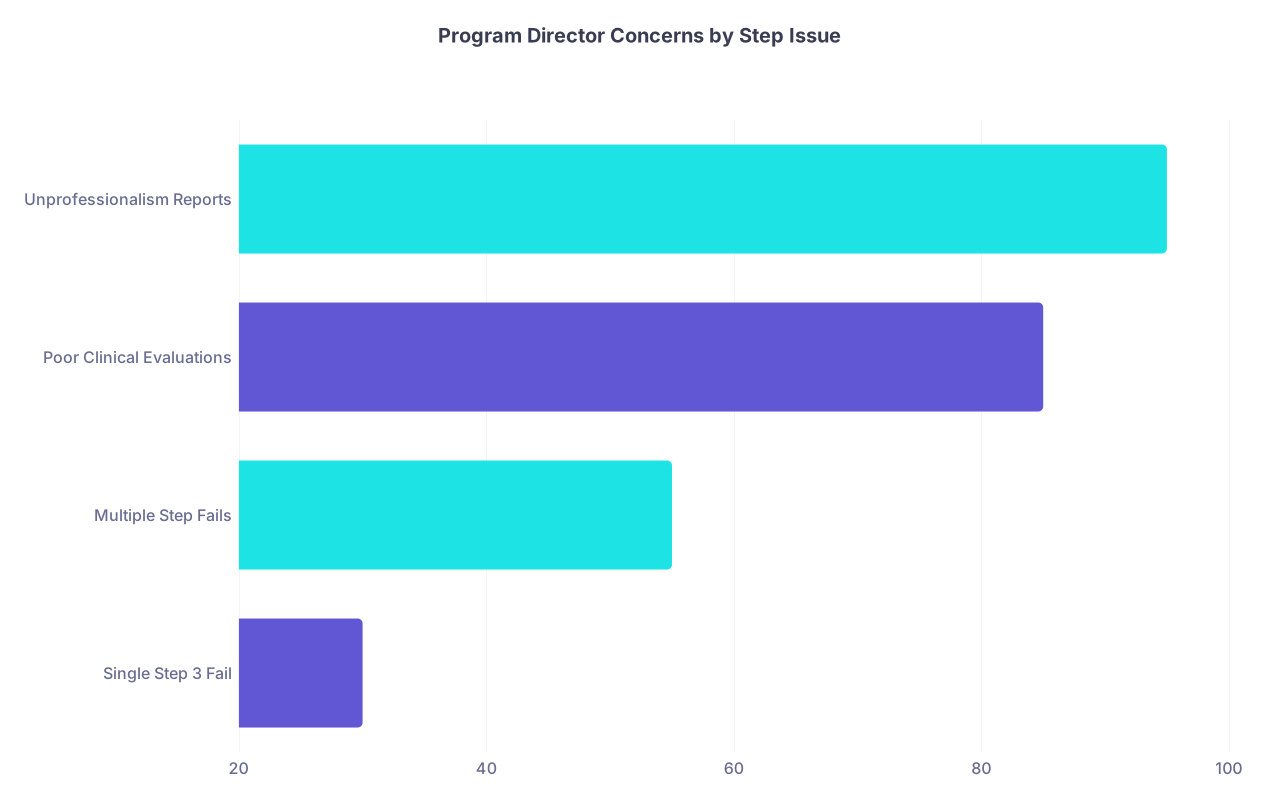
| Category | Value |
|---|---|
| Single Step 3 Fail | 30 |
| Multiple Step Fails | 55 |
| Poor Clinical Evaluations | 85 |
| Unprofessionalism Reports | 95 |
PDs are way more freaked out by “can’t function on the wards” or “unprofessional” than “needed two tries for Step 3.”
What you’ll need later (for fellowship or job interviews):
- A simple, non-dramatic explanation
- Evidence it was a temporary issue, not a chronic one
- Clear improvement and eventual pass
Something like:
“I failed Step 3 the first time during a very intense stretch of intern year when I honestly underestimated how much dedicated prep time I needed. I reflected on that, adjusted my schedule, used more targeted resources, and passed comfortably on the second attempt. Since then, I’ve consistently performed well on in-training exams and my clinical evaluations have been strong.”
You don’t overshare. You don’t cry in the interviewer’s office. You own it, briefly, and move on.
Making a Retake Plan That Doesn’t Destroy Your Life (or Patient Care)
You can’t fix a Step 3 fail by just “trying harder.” You’re going to have to be smarter and more structured, especially while working 60–80 hours a week.

Start with three questions:
- Did I actually study enough last time?
- Did I use the right resources?
- Did test-day issues kill me (timing, fatigue, panic)?
Then build a realistic plan, not the fantasy “I’ll study 3 hours every day post-call” lie.
Core pieces that usually work
- UWorld Step 3 questions, all of them, done slowly and reviewed
- CCS cases: actually practicing, not just reading about them
- One decent text or outline (Step-Up to Medicine level, or similar) only as needed for weak spots
Focus where you actually bled points per your score report. If your database section was solid but CCS was trash, don’t spend 80% of your time reading nephrology again because it feels safer than touching CCS.
Protecting your schedule (this matters more than the resource list)
You’ll need to sit with your PD or chief and say something like:
“To increase my chances of passing, I’d like to request lighter rotations during the 6–8 weeks before my exam if possible, like clinic or electives rather than ICU. I want to make sure I’m still functioning well clinically while studying.”
If they’re even halfway reasonable, they’ll try to help you not take Step 3 while you’re drowning on nights + wards + codes.
Also, set a hard test date. Open-ended “I’ll take it when I’m ready” turns into a year of low-grade dread and no progress.
What About State Licensing and Visa Issues?
Here’s the more bureaucratic anxiety that kicks in at 3 a.m.
Some states require:
- Step 3 by end of PGY-1 or early PGY-2 for a full license
- A passing Step 3 before PGY-3 promotion
If you’re in such a state, failing Step 3 doesn’t mean automatic expulsion. It means pressure to retake within a defined window. Your GME office usually knows these rules better than you.
If you’re on a visa (J-1 / H-1B), this gets trickier and you absolutely need to loop in:
- GME office
- Sometimes institutional legal/visa coordinator
Don’t guess on this. Ask explicitly, “Does this affect my visa status in any way, and what timelines do I need to be aware of for a retake?”
Most of the time, as long as your contract is renewed and you’re in good standing clinically, they’ll help you work around it. They do not want the paperwork disaster of losing you mid-year if they can avoid it.
How to Not Let This Eat You Alive on the Wards
Here’s the part nobody warns you about: the emotional hangover from a fail can quietly wreck your performance more than the fail itself.
You start doubting every order. You apologize for existing. You overthink every decision because “Hey, I’m the idiot who failed Step 3.”
You can’t do that. That’s how a test score turns into bad evals, and bad evals are much harder to explain away than a single exam.
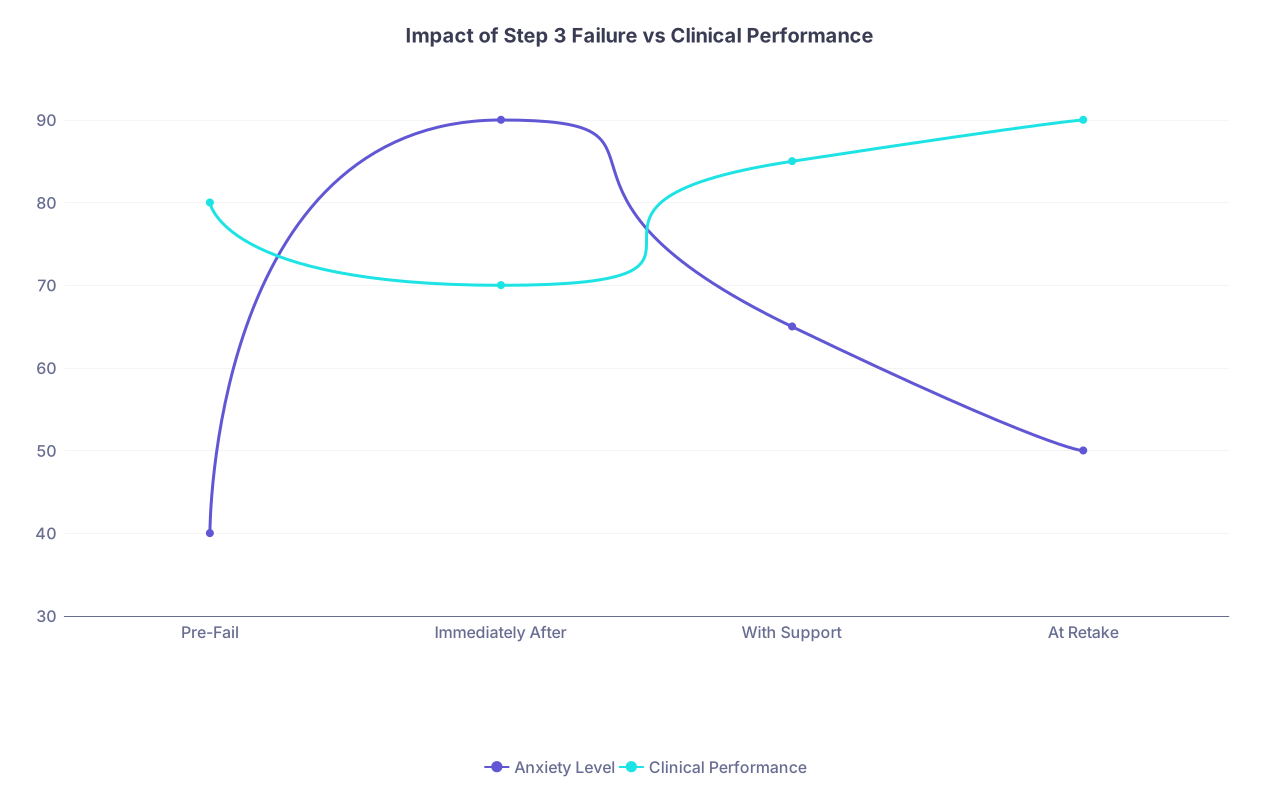
| Category | Anxiety Level | Clinical Performance |
|---|---|---|
| Pre-Fail | 40 | 80 |
| Immediately After | 90 | 70 |
| With Support | 65 | 85 |
| At Retake | 50 | 90 |
What helps, realistically:
- Tell one trusted senior or attending you’re close with. Let them know you’re shaken and trying to keep it from affecting your work.
- If your program has an EAP or easy-access therapist, use it. This is exactly the kind of situation it’s for.
- Don’t make big life decisions (switching specialties, quitting, etc.) in the same week you got your score.
You’re allowed to be upset. You’re allowed to be scared. But you still have patients tomorrow, and they don’t care what your Step 3 score was. They need you present and functioning.
Reality Check: You’re Not the Only One
This feels isolating as hell because nobody brags about failing Step 3 in the workroom. But behind closed doors? I’ve seen more Step 3 fails than people admit.
It’s the “quiet shame” of residency. And it honestly shouldn’t be.
The uncomfortable truth: Step 3 is less about how good a doctor you are and more about how well you can perform a very specific, time-pressured, clinically-styled exam while already exhausted from actual doctoring.
You failing this one standardized test doesn’t cancel out four years of med school, Step 1/2, clinical performance, and everything else you’ve done.
FAQ: Failing Step 3 as an Intern
1. Can my program fire me for failing Step 3 once?
They could, but for a first-time Step 3 failure in an otherwise solid resident, it would be extremely unusual and frankly bad optics for them. What’s far more common is closer monitoring, a documented remediation/plan, and sometimes promotion delays. If you’re already on remediation for clinical issues, then yes, this might add weight to a non-renewal decision. But in isolation? Very unlikely.
2. Should I hide my failure from co-residents and attendings?
You don’t have to announce it at sign-out, but trying to hide it from everyone often backfires. At minimum, your PD and coordinator will know. I think it helps to tell 1–2 people you trust—maybe your classmate you study with and a senior who’s been supportive. You don’t owe anyone the details, but having even a tiny support system keeps this from becoming a secret that eats you alive.
3. How soon should I retake Step 3?
Soon enough that the content is still familiar, but not so soon that you just repeat the same mistake. For most interns, 6–12 weeks of real prep time (not fake “I’ll study on q4 call” time) is about right. You should also line the retake up with a lighter block if at all possible. Talk to your PD about rotating schedules around it—they’d rather shift you once than deal with another fail.
4. Will fellowship programs automatically reject me for a Step 3 fail?
No. A Step 3 fail is a downside, not a death sentence. Programs look at the whole application: letters, research, evaluations, interviews, personal statement. If this is your only major blemish and you ultimately passed, most PDs will mentally file it as “tough timing during intern year” and move on. It’s more damaging if paired with multiple Step fails and weak clinical evaluations. The key is having a calm, brief explanation and strong performance afterward.
5. What’s one thing I should do today if I just found out I failed?
Download your score report, put it in a safe folder, and write down three things on a single page: (1) what you actually did to study last time, (2) where the score report shows you were weakest, and (3) one concrete change you’ll make for the retake (like “schedule CCS every other day” or “request a lighter rotation before exam”). Then draft that short email to your PD asking for a meeting, even if you don’t send it until tomorrow. Don’t let this sit in silent panic mode for weeks.
Open whatever Step 3 prep resource you used last time and look at your old study schedule. Right now. Ask yourself honestly: “Is this what I’d do again?” If the answer is no, grab a scrap of paper and sketch what you’d change for the retake. That’s your first step out of “I failed” and into “I’m fixing this.”