, Step 3, Other Factors](https://cdn.residencyadvisor.com/images/articles_svg/chart-relative-weight-of-exam-scores-in-residency-select-3282.svg "Relative Weight of Exam Scores in Residency Selection")
| Category | Value |
|---|---|
| Step 1 | 35 |
| [Step 2 CK](https://residencyadvisor.com/resources/usmle-step3-prep/how-over-reliance-on-step-2-ck-notes-sabotages-step-3-scores) | 30 |
| Step 3 | 10 |
| Other Factors | 25 |
“Step 3 doesn’t matter” is lazy advice that belongs in the same trash can as “you don’t need to study for shelf exams if you read the textbook.”
It is not true.
It is also not the whole story.
Step 3 is rarely the most important test you’ll ever take.
But for a non-trivial chunk of residents and applicants, it’s the difference between doors opening and doors slamming shut.
Let me walk through what actually matters, with data and real-world behavior from PDs (program directors), not Reddit folklore.
What Step 3 Is Really Used For (Not What People Say)
On paper, Step 3 is a licensing exam: “Can this person practice medicine without someone holding their hand?” The test leans on:
- Day 1: foundational science, biostats, ethics, basic clinical reasoning.
- Day 2: management, prognosis, next best step, CCS cases.
So where does it sit in the hierarchy of exams?
| Exam | Biggest Impact Stage | Typical Use by Programs |
|---|---|---|
| Step 1 | MS3–MS4 / Applying to residency | Screen for interviews (historically); now pass/fail but still seen |
| Step 2 | MS4 / Applying to residency | Primary standardized metric for competitiveness |
| Step 3 | PGY1–PGY2 / Fellowship/Boards | Risk filter, visa requirement, contract/license gate |
Here’s what actually happens:
Before residency
Most categorical programs do not care much about Step 3 for matching into residency—because you haven’t taken it yet. Transitional years, prelims, and some advanced specialties sometimes like to see it, but that’s not the norm.During residency
Step 3 becomes a compliance item. Honestly, many residents coast on that idea. But program directors track who passes on the first attempt. People who fail get labeled—informally—as “board-risk.” That label follows you to fellowship and job applications.At transition points
Step 3 is a switch:- No Step 3 = no full license in most states.
- No license = no independent moonlighting, limited job offers, visa problems.
- Multiple fails = red flag on every application that matters.
So yes, Step 3 matters. Not for everyone, not equally, but to act like it’s irrelevant is simply wrong.
What Program Directors and Employers Actually Do With Step 3
Let’s cut through theory and talk about behavior.
1. Fellowship programs use Step 3 as a risk filter
For competitive fellowships (cards, GI, heme/onc, some academic hospitalist tracks), PDs are ruthless with quick filters. There’s survey data from NRMP Program Director reports and numerous specialty-specific surveys showing the same pattern:
- Step 2 CK and in-training exam scores are primary.
- Step 3 failures or multiple attempts are a problem.
They might not care if you scored a 215 vs 230.
They definitely care if you failed it. Or took it 3 times.
I’ve heard some version of this too many times to count:
“We have plenty of applicants who passed on the first try. Why take someone who failed Step 3?”
That’s the underlying logic. Not fair. But real.
2. State medical boards and hospitals treat Step 3 as a hard gate
You can survive bad shelf scores. You can survive an unimpressive Step 1.
You cannot practice independently without Step 3 in most states.
A few key realities:
- Many states require Step 3 within a certain time limit (e.g., 7 years from Step 1) or a maximum number of attempts.
- Some employers and malpractice carriers balk at multiple exam failures—especially if they correlate with poor in-training or board performance.
Programs know this. That’s why they don’t want to graduate residents who are stuck in licensure limbo.
3. Visa-dependent residents: Step 3 can be critical
If you’re on a visa (especially J-1, sometimes H-1B), Step 3 is absolutely not optional noise:
- Some visa categories require Step 3 for sponsorship.
- Employers hiring you after residency may insist you’ve passed Step 3 to sponsor an H-1B.
I’ve seen IMGs on solid academic tracks stuck because they listened to “don’t worry, you can push Step 3 later” and ended up racing deadlines for visa paperwork and licensing.
For this group, “Step 3 doesn’t matter” is catastrophically bad advice.
When Step 3 Truly Matters Less (and When It Doesn’t)
Now the nuance. Is Step 3 the hill to die on for everyone? No.
Scenarios where Step 3 is low-stakes (but not zero)
If this is you:
- US grad
- Categorical resident in a less competitive specialty (FM, psych, peds in many places)
- No exam failures, solid ITE scores
- No plan for highly competitive fellowships
- No visa issues
Then Step 3 is mainly:
- A licensing checkbox
- A minor data point for future employers
You probably do not need a 240+.
You absolutely do need: pass on first attempt, no disasters.
For you, Step 3 “mattering” means: do well enough that nobody talks about it.
Scenarios where Step 3 can swing your trajectory
Now the part people conveniently ignore when they say “don’t worry about it”:
You had a weak Step 1 or Step 2 CK
Step 3 is one of the few chances to show improvement in standardized testing. PDs notice an upward trend. I’ve seen residents with 210-ish Step 1s and 220 Step 2s redeem themselves with a 235–240 Step 3 and solid ITEs, then match into decent fellowships.You’re switching specialties or applying outside your initial lane
Switching from prelim surgery to anesthesiology, or from FM to heme/onc? Every datapoint gets scrutinized. A strong Step 3 won’t magically erase everything, but a poor or failed one will absolutely hurt your case.You’re targeting competitive fellowships from a non-elite program
Coming from a mid-tier or community program and shooting for cards/GI? You need every metric on your side:- Strong ITE scores
- No USMLE failures
- Respectable Step 3 (or at least not weak)
You already failed another exam
If you failed Step 1 or Step 2 CK, Step 3 becomes your chance to prove the narrative wrong. Pass it cleanly on the first attempt with a decent score, and PDs can say, “They had a stumble, but they recovered and improved.” Blow Step 3, and now it looks like a pattern.
What the Data and Patterns Actually Show
Nobody has a giant, perfect dataset tying Step 3 score directly to “career success,” but here’s what is consistently observed:
Program directors care far more about:
- Step 2 CK
- In-training exam scores
- Clinical performance, letters, professionalism
Step 3 is used for:
- Confirming you’re not a licensing risk
- Filtering out applicants with failures
- Meeting visa and state licensing requirements
- Occasionally, as a minor positive if you’re trending upward
There are also relationships you can infer:
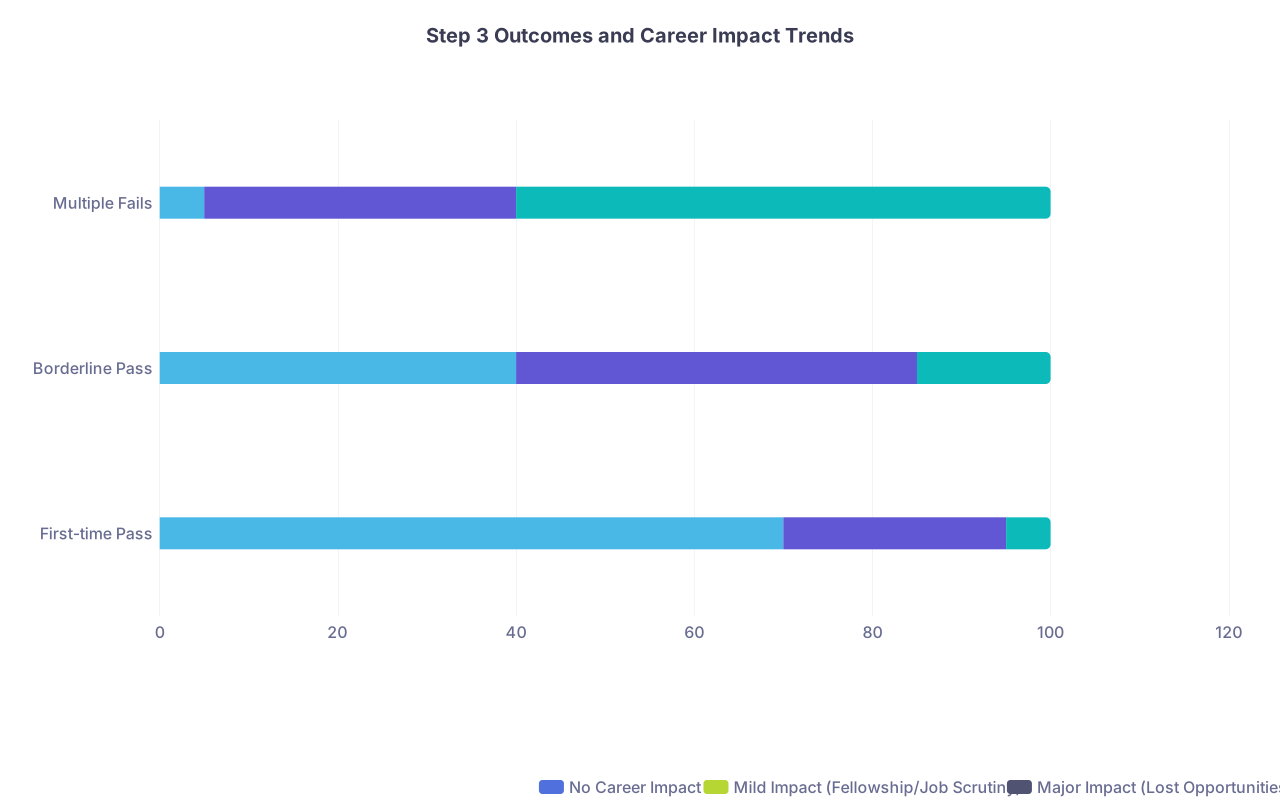
| Category | No Career Impact | Mild Impact (Fellowship/Job Scrutiny) | Major Impact (Lost Opportunities) |
|---|---|---|---|
| First-time Pass | 70 | 25 | 5 |
| Borderline Pass | 40 | 45 | 15 |
| Multiple Fails | 5 | 35 | 60 |
This is the pattern you see talking to PDs and advisors:
- First-time pass with reasonable score → Almost never discussed again.
- Weak but passing score → Occasionally raised in competitive settings; usually overshadowed by other strengths.
- Multiple failures → Becomes a central part of your narrative, and not in a good way.
The Biggest Myths About Step 3
Let’s systematically kill a few popular myths.
Myth 1: “Nobody looks at Step 3.”
False.
Many people don’t obsess over the exact number, but:
- Every PD looks at pass/fail and number of attempts.
- Many fellowship directors glance at the score, especially if your other numbers are marginal.
The score granularity may matter less. The existence and cleanliness of the result absolutely matter.
Myth 2: “You can just wing it; everyone passes.”
That’s the bravado you hear from the one guy who actually barely passed and never tells you his score.
Reality:
- Residents are tired, overworked, out of test-taking shape.
- Many do not review CCS cases at all.
- Every year, people—good residents—fail because they treated Step 3 like a formality.
The pass rate is high, but it’s not a guaranteed layup. Especially if you:
- Struggled with Step 2 CK
- Hate long exams
- Ignore biostats and CCS
Myth 3: “If your Step 1/2 are good, Step 3 is irrelevant.”
Partly true, but oversimplified.
If you’ve got a 250+ Step 2, sure—most people won’t care much if your Step 3 is 220 vs 235. But bomb Step 3 with a fail or obvious outlier score relative to your prior performance and it raises questions.
I’ve seen PDs ask:
“Was this burnout? Unprofessional prep? Personal problems? Is this going to predict trouble with boards?”
You do not want your CV to invite those questions.
Myth 4: “A high Step 3 will rescue a weak application.”
No.
It can mitigate concern. It can show a positive trajectory. But it won’t rewrite your file.
You’re not going from bottom-of-the-class, multiple failures, poor ITEs to “top fellowship lock” because of a 240 Step 3. Anyone selling that story is lying to you.
So How Much Should You Actually Care? A Practical Framework
Let me be concrete. Here’s how I’d think about Step 3 intensity based on who you are.
| Situation | Prep Intensity Target |
|---|---|
| Strong prior scores, non-competitive path | Moderate: pass comfortably, no drama |
| Average scores, aiming for fellowship | Solid: aim to be in clear pass zone |
| Weak or failed prior exams | High: treat as redemption opportunity |
| Visa-dependent or switching specialties | High: plan, schedule, and prep seriously |
Translation into behavior:
Minimum standard for everyone:
Serious prep for at least a few focused weeks, do question banks, practice CCS, know your biostats.If you have prior exam scars:
Treat Step 3 like a real exam that can hurt you if you blow it and help you a bit if you improve.If you’re coasting in a low-risk context:
You still don’t get to completely blow it off. But you don’t need to torture yourself chasing some arbitrary “prestige” score.
A Simple Strategy That Matches Reality (Not Hype)
You don’t need a 3-month Step 1-style grind. You do need an intelligent, efficient approach.
Here’s a sane outline that fits most PGY1/PGY2 lives:

| Step | Description |
|---|---|
| Step 1 | Check Deadlines & Visa/State Rules |
| Step 2 | Pick Exam Window with Light Rotations |
| Step 3 | Baseline: Review Weak Topics |
| Step 4 | Question Bank: 1-2 Blocks/Day |
| Step 5 | CCS Practice Cases |
| Step 6 | Targeted Review of Missed Concepts |
| Step 7 | Light Review Week Before Exam |
| Step 8 | Take Exam on Rested Day |
Key principles:
- Use a Qbank (UWorld is still the workhorse).
- Actually practice CCS—don’t just “read about them.”
- Protect 2–3 weeks with at least some study time, especially before Day 2.
Is this overkill if you’re a natural test-taker? Probably. But remember: the goal isn’t a hero score. It’s a clean, boring pass that never causes future trouble.
The Bottom Line: How Much Does Step 3 “Matter”?
Here’s the clean version:
- For some residents, Step 3 is low-importance but non-optional.
- For others—visa holders, those with weak prior scores, career-switchers, fellowship hopefuls—it is a critical risk-management exam.
- The number usually matters less than with Step 1/2. The pattern and pass/fail status matter a lot.
So the slogan “Step 3 doesn’t matter” is lazy, incomplete, and in some situations, dangerous.
A better rule to live by:
“Step 3 should be forgettable—because you handled it well enough that nobody ever needs to talk about it again.”
Years from now, you won’t remember exactly what you scored. But you’ll definitely remember if you had to explain a Step 3 failure on every application and interview.
Make sure your future self doesn’t have to keep telling that story.