
It is 10:45 p.m. You just admitted a septic patient, signed out your cross-cover list, and finally sat down in the call room. COMLEX Level 3 is in three weeks. Your Qbank percentages actually look decent. Co-residents tell you, “You’ll be fine, everyone passes Level 3.”
But you know you are not fine.
You are re-reading a vague NBOME blueprint, half-skimming question explanations, and telling yourself you will “really start next week” even though your test is scheduled, vacation time approved, and program director already signed your form.
This is exactly how strong DOs fail COMLEX Level 3.
Not because they are not smart enough. Because they make the same eight lazy, very fixable mistakes.
Let me walk through them one by one, so you do not end up staring at a “fail” next to your name while your co-interns quietly move on.
Error #1: Treating COMLEX Level 3 Like a Second-Class Exam
The most common and most dangerous mistake: assuming Level 3 “does not really matter” because residency has already started.
I keep hearing the same lines:
- “Programs already ranked me. This is just a formality.”
- “No one cares about Level 3 scores.”
- “It’s just like Level 2 with less pressure.”
That attitude is how you end up retaking an exam as a PGY-2 while trying to be a senior resident.
Here is the reality:
- Many state medical boards require Level 3/Step 3 for full licensure by a specific PGY year. Fail once and you can easily delay licensure.
- Your program director will care if you fail. Suddenly you become a remediation project. Extra meetings. Extra evaluations. Extra scrutiny.
- For competitive fellowships, a clean, first-attempt pass on all licensing exams is expected. A Level 3 failure makes you the candidate with “an issue to explain.”
And the worst part? The exam is absolutely passable on the first try for most residents. It is not impossible. It is just unforgiving if you disrespect it.
How to avoid this:
Schedule Level 3 for a time when you can actually study (more on that later), and mentally classify it as “the last gatekeeper to independent practice.” Not as “that annoying NBOME tax.” You do not need to obsess over every point, but you must treat a pass as non-negotiable.
Error #2: Ignoring OMM Because “They Won’t Test It Much”
I have watched multiple otherwise strong DOs fail Level 3 because they completely blew off OMM.
They remembered:
- Counterstrain basics
- HVLA contraindications
- Vague Fryette principles
What they did not remember: the nuance and pattern recognition COMLEX still loves to throw in.
And yes, they absolutely still test OMM at Level 3. Not as heavily as Level 1, but enough that if your OMM bank is empty, your score drops fast.
Here is where people get this wrong:
- They assume EM- or IM-heavy residencies make OMM irrelevant, so they slowly forget everything.
- They believe that since Level 3 is “more clinical,” OMM will be token, superficial, or optional.
- They rely on vague memory from second year instead of doing even a modest, focused review.

The trap: You do well on general medicine questions and convince yourself the exam “felt fine,” but the OMM and osteopathic principles sections quietly drag you under the passing line.
How to avoid this:
You do not need a full OMM bootcamp. You need a targeted review of the highest-yield tested areas:
| Topic Area | Priority |
|---|---|
| Rib dysfunctions | High |
| Sacrum & innominates | High |
| Spine + Fryette | Medium |
| Chapman's points | Medium |
| Lymphatic techniques | Medium |
| Cranial basics | Lower |
Devote 5–7 hours total to structured OMM review in the 2–3 weeks before your exam. Ten if you were weak on OMM during school. Use a concise resource, not a 500-page textbook. And do OMM questions in a Qbank—do not just read.
Blowing off OMM entirely is lazy and unnecessary. A small investment here buys you serious protection against a failing score.
Error #3: Misunderstanding What “Management-Focused” Really Means
People repeat, “Level 3 is all about management” and then study like it is Level 2: diagnosis-heavy, pathophys-focused, fascination with rare disease trivia.
Wrong.
“Management-focused” means:
- First-line tests, not just fancy confirmatory ones
- Initial stabilization versus definitive management
- Choosing one best next step from several technically reasonable ones
- Outpatient versus inpatient thresholds
- Cost-effective and guideline-consistent care
So the mistake is not just under-studying. It is studying the wrong things.
I watch residents hide in comfort:
- Re-reviewing biochemistry or microbiology from old notes
- Getting excited about rare zebras in Qbanks
- Memorizing esoteric details that do not change what you actually do for the patient
COMLEX Level 3 punishes that style. It rewards:
- Knowing when to admit vs send home
- Choosing which lab to order next—not all of them
- Recognizing when to call surgery, ICU, or OB immediately
- Understanding time-sensitive decision points (tPA windows, ACS, sepsis bundles)
How to avoid this:
For every practice question you do, force yourself to answer three things out loud before checking the explanation:
- What is the first next step in management?
- What would be the wrong but tempting choice?
- What is the long-term plan after the acute issue is stabilized?
If your explanations-to-yourself are mainly “Because that is the diagnosis” instead of “Because this is the most appropriate immediate action given stability, resources, and guidelines,” you are studying wrong.
Error #4: Going In Without a Real Time and Energy Strategy
You are a resident. Your life is not built for long, peaceful study days.
Here is how most people sabotage themselves:
- Scheduling Level 3 at the tail end of a brutal ICU or night float month “to get it over with”
- Imagining they will study “a few hours after each shift” (they will not)
- Leaving CCS prep for “the week before” and then being post-call, exhausted, and barely functional
They walk into the exam tired, under-prepared, and shocked by how mentally draining two long days of testing actually are.
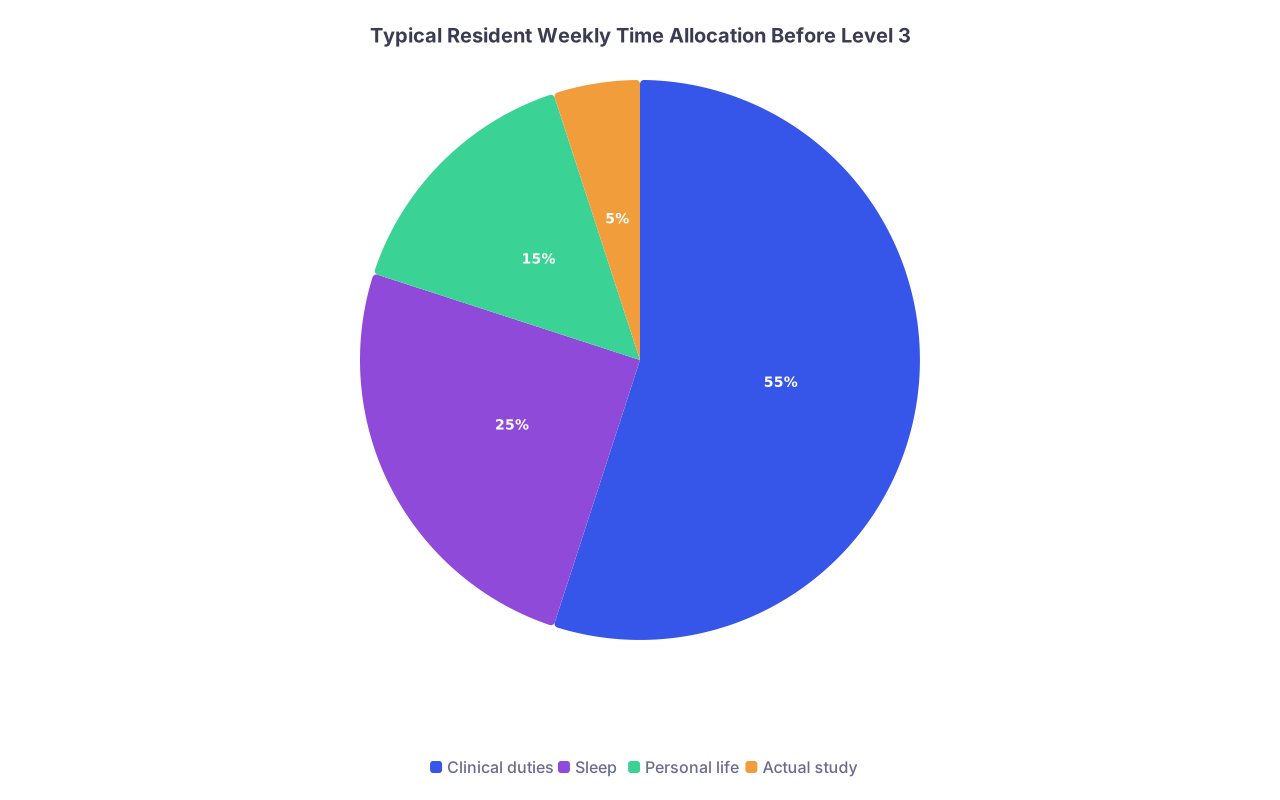
| Category | Value |
|---|---|
| Clinical duties | 55 |
| Sleep | 25 |
| Personal life | 15 |
| Actual study | 5 |
That 5% study slice? It is why good residents fail.
How to avoid this:
You cannot fix residency hours. You can fix scheduling.
- Choose a test date during your lightest rotation (clinic month, elective, or the least malignant part of the schedule).
- Block 2–3 weeks where you reliably protect at least 60–90 minutes a day for real studying. Not “scrolling through explanations half-asleep in bed.”
- Front-load your studying. Do not count on the final 3 days; life and call schedules do not care about your plans.
If you know you will be crushed on nights in August, you schedule your exam for late September and start studying in early September on a lighter block. Stop pretending the month will magically get easier.
Error #5: Treating CCS Cases as an Afterthought
This one is brutal. I have seen brilliant interns walk out of Level 3 looking confident, then admit: “I didn’t really do many CCS practice cases; I figured I’d wing it.”
Then they fail.
The mistake is two-fold:
- Underestimating how much format familiarity matters.
- Not appreciating how NBOME’s case logic differs from their day-to-day residency reflexes.
On the wards, you can:
- Order a ton of labs and imaging at once
- Consult early and often
- Adjust orders as you go with feedback from nurses, labs, and seniors
On the CCS interface, you:
- Have a constrained, artificial environment
- Need to pick the right orders in the right sequence
- Lose points for unnecessary, expensive, or harmful orders—even if you “cover your bases”
Residents who do well clinically sometimes bomb the cases because they practice “real life” medicine, not “NBOME-acceptable” medicine.
Red flags you are under-preparing CCS:
- You “skimmed someone’s CCS notes” instead of doing interactive practice.
- You have not practiced cases under timed conditions.
- You still fumble around the order menu or forget routine stuff like pregnancy tests or consent for surgery.
How to avoid this:
Treat CCS like its own mini-exam.
You need:
- A structured list of common case types (chest pain, abdominal pain, vaginal bleeding, stroke, DKA, trauma, psych emergencies, pediatric fever, etc.).
- At least 10–15 full practice cases in realistic conditions.
- A checklist reflex: stabilize → assess → labs/imaging → targeted therapy → monitoring → disposition.
If you are telling yourself, “I am good clinically, so I’ll be fine,” that is exactly the mindset that fails CCS.
Error #6: Blindly Copying USMLE Step 3 Study Plans
This is a DO-specific landmine.
You look up “Step 3 study plan,” find a million posts about UWorld, CCS, maybe AMBOSS. Then you copy-paste that plan and slap “COMLEX” mentally over “USMLE.”
Here is the problem: COMLEX Level 3 is not just USMLE Step 3 with a logo swap.
COMLEX:
- Emphasizes OMM and osteopathic principles
- Loves primary care, continuity, and holistic framing
- Sometimes tests weirder, more vague stems with less cleanly written questions
- Gives you questions where every answer is imperfect and you pick the “least bad” option
USMLE:
- Is more tightly edited, more biomedicine-focused
- Lacks OMM entirely
- Has different patterns of favorite topics and style
I am not saying UWorld or other USMLE resources are useless. They are quite good for honing management thinking. But the mistake is believing that doing a heavy USMLE plan alone is “enough” for COMLEX Level 3.
How to avoid this:
Blend, do not copy.
- Use a strong Qbank with good general medicine content (yes, UWorld is fine) for management training.
- Integrate at least one COMLEX-specific resource (questions or review material) to calibrate to NBOME’s style and to capture OMM.
- Pay attention when you miss COMLEX-style questions—even if you “knew this from real life”—because that shows you where NBOME’s expectations differ from your habits.
If your entire prep is USMLE-based and you have not touched OMM, you are walking into the wrong exam with the right toolbox.
Error #7: Over-Relying on Passive Learning and “Background Osmosis”
Another repeat offender: residents who believe reading is studying.
You know the type because you might be them:
- Screenshotting Qbank explanations “to read later” and never actually revisiting them
- Watching long video lectures at 1.5x speed after a 12-hour shift and calling that “study time”
- Telling themselves that clinic and inpatient management “count as Level 3 prep”
Your brain does not learn complex decision-making from passive exposure. It learns from making decisions, being wrong, and correcting under pressure.

| Step | Description |
|---|---|
| Step 1 | Read/watch content |
| Step 2 | Feel productive |
| Step 3 | Forget details in 48 hours |
| Step 4 | Repeat cycle |
| Step 5 | Do timed questions |
| Step 6 | Make decisions |
| Step 7 | Review mistakes deeply |
| Step 8 | Adjust approach next time |
The top reason strong residents underperform: they overestimate how much clinical work automatically translates into exam performance. It does not. The exam is structured, artificial, and demanding in a way your day-to-day flow is not.
How to avoid this:
You need an active-first study plan:
- Timed blocks of questions (even 10–15 at a time) several days a week.
- Written or spoken reflection on why each wrong answer was wrong.
- Short, focused content review only to patch specific weaknesses you uncover in questions.
Ask yourself weekly: “How many actual questions did I answer under time pressure this week?” If the number is under 100 and all your time went into reading or watching, you are doing soft prep. And soft prep fails harsh exams.
Error #8: Refusing to Confront Weaknesses Because “I Already Passed Levels 1 and 2”
This one is psychological, and it kills more DOs than you think.
You have already passed COMLEX Level 1 and Level 2-CE. Maybe even with good scores. You are functioning fine as an intern. Patients are not dying because of your decisions.
So when practice questions or self-assessments start revealing consistent weak spots:
- You downplay them. “I was just tired.”
- You rationalize. “These questions are poorly written anyway.”
- You avoid content areas that sting your ego (pediatrics, OB, psych, OMM, etc.) and instead keep doing the material you find easy.
This ego-protection strategy is incredibly common. And it is horribly dangerous.
NBOME does not curve Level 3 for your feelings. If you are weak on outpatient OB or pediatric vaccine schedules or geriatric polypharmacy, the exam will find you.
Patterns I see that should alarm you:
- Consistently missing triage and disposition questions (admit vs discharge; floor vs ICU).
- Weak performance on “bread-and-butter” primary care issues (DM management, HTN, hyperlipidemia, contraception, screening guidelines).
- Avoiding psych, substance use, or domestic violence questions because they are “annoying” or “too wishy-washy.”
How to avoid this:
Every week of studying, you should:
- Identify your bottom two content areas (by Qbank performance or gut honesty).
- Spend 75–80% of your focused review time on those weak areas.
- Repeat questions in those domains until your mistake patterns change.
If your study block is filled entirely with what you enjoy or find easy, I will say it bluntly: you are studying to feel good, not to pass.
Your Next Step Today
Do not just nod along and move on. That is how people walk right into these mistakes anyway.
Here is one concrete action to take right now:
Open your Qbank or exam planner and write down three things:
- Your scheduled Level 3 date (or the month you realistically will take it).
- Your weakest two domains based on recent questions or honest self-assessment (for most: OMM and a clinical area like OB/peds/psych).
- A specific 14-day plan that includes:
- At least 500–700 total questions, timed
- 10–15 CCS cases
- 5–7 hours of focused OMM review
If you cannot write that plan today, you are already drifting toward one of the errors above.
Fix the plan now. Then follow it. Let the other DOs be “fine” and wing it. Your job is to make COMLEX Level 3 the last licensing exam you ever think about—not the one you are forced to retake while pretending everything is okay.