
The biggest lie residents tell themselves is: “I’ll just take Step 3/Level 3 when things calm down.” They do not calm down. You just fall further behind.
You’re PGY2, maybe edging into mid-year or late-year, and Step 3 or COMLEX Level 3 is still hanging over your head. Programs start asking. Credentialing offices start hinting. And you’re stuck between call schedules and a giant exam that you were “definitely” going to do last winter.
Let’s fix it with a hard timeline. Week-by-week. Day-by-day at the end. No fluff.
Where You Are Right Now: Reality Check (Week 0)
At this point you should stop pretending this will resolve itself.
You’re probably in one of these buckets:
| Situation | Risk Level |
|---|---|
| Never registered, no plan | High |
| Registered, canceled once | High |
| Registered, pushed test 2+ times | Very High |
| Took 1 day, failed or voided | Critical |
| Program now hinting it's “required soon” | Critical |
Here’s what’s usually true by PGY2 if you’ve delayed too long:
- Your basic science memory is rusted.
- You’re clinically sharper but test stamina is garbage.
- Your program is starting to track this. Quietly at first, then less quietly.
- Your anxiety about the exam is now worse than the actual studying would be.
So Week 0 is decision week. Not study week. Decision week.
By the end of this week you should:
- Confirm program deadlines.
- Ask your PD or coordinator directly:
“By what date do I need to have Step 3/Level 3 passed to avoid issues with promotion or board eligibility paperwork?”
- Ask your PD or coordinator directly:
- Choose a test window within 6–10 weeks.
- Not “sometime this year.”
- A real month and a 3–4 day span you’ll request off or keep lighter.
- Register and pick dates.
- USMLE Step 3: 2 test days, usually within a 2–4 week span.
- COMLEX Level 3: 1 test day but just as draining.
- Tell at least one co-resident your date.
Accountability beats vibes.
Only after this do we talk about content.
The Big Picture: 8-Week PGY2 Catch-Up Plan
You’re not a full-time student anymore. You’re a tired PGY2 with maybe 8–12 usable hours a week if you’re honest.
So the schedule is built for:
- 1–1.5 hours on most weekdays
- 3–5 hours across the weekend
- 6–8 weeks total prep (4–6 if you’re very strong / retaker with solid base)
Here’s the high-level structure:
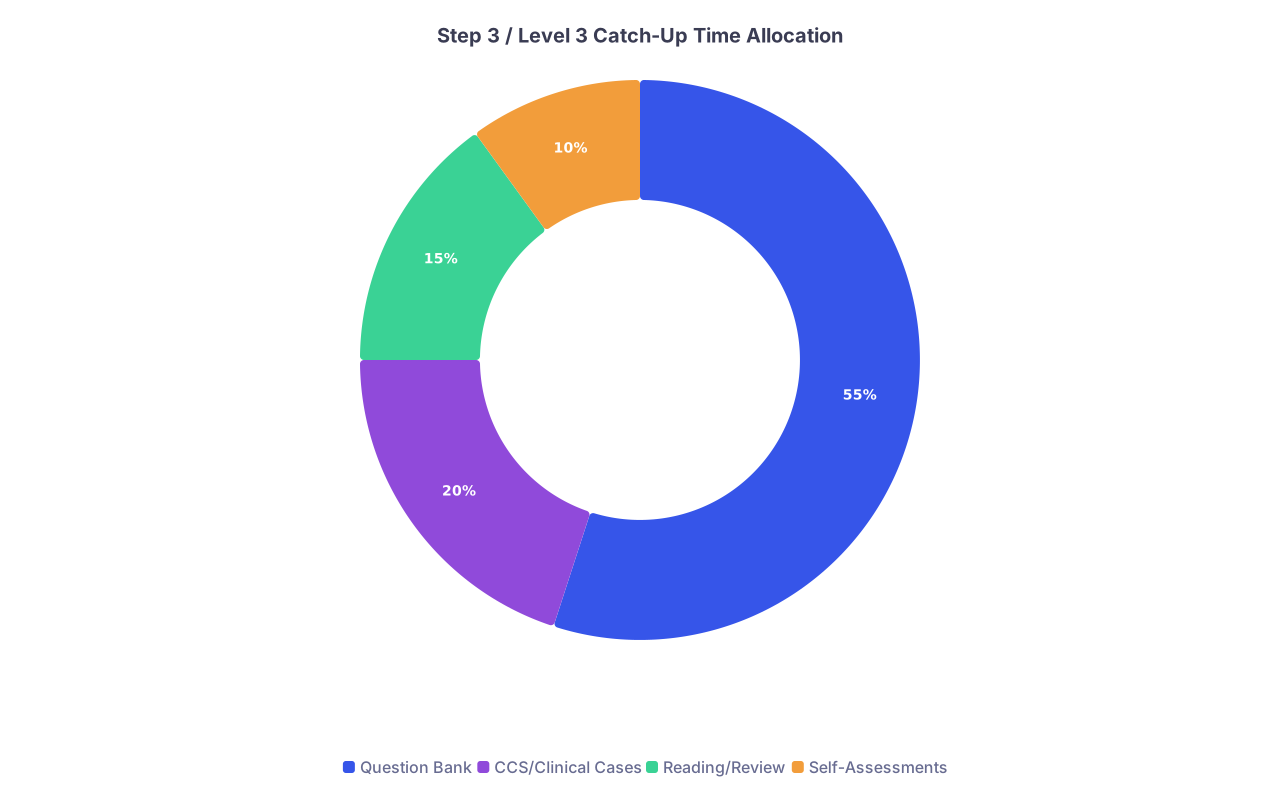
| Category | Value |
|---|---|
| Question Bank | 55 |
| CCS/Clinical Cases | 20 |
| Reading/Review | 15 |
| Self-Assessments | 10 |
- ~55%: Timed questions (UWorld/AMBOSS for Step 3, COMQUEST/TrueLearn for Level 3)
- ~20%: Cases (CCS for Step 3, OMT/management emphasis for Level 3)
- ~15%: Targeted reading (weak areas only, not full textbooks)
- ~10%: Self-assessments / practice tests
Now let’s walk through it week by week.
Weeks 1–2: Stabilize and Restart Your Brain
At this point you should focus on getting back into test mode, not mastering everything.
Primary goals for Weeks 1–2:
- Reactivate your question-taking muscles.
- Identify your worst 3–4 content areas.
- Prove to yourself that you can do daily, small chunks even on brutal days.
Study structure:
On regular weekdays (non-call, non-24s):
- 60–75 minutes total:
- 10 questions timed, mixed, on your exam’s Qbank.
- Immediate review of all 10 (10–15 minutes).
- Quick notes: only on patterns or rules you keep missing.
On heavy days (post-call, long shifts):
- Bare minimum:
- 5 questions untimed, or
- One short CCS case (for Step 3), or
- 2–3 OMT/ethics/OMM-specific questions (for Level 3).
On weekends:
- One 40-question block, timed, random.
- 1.5–2 hours review, same day.
By the end of Week 2 you should:
- Have completed:
- Step 3: ~150–200 questions
- Level 3: ~150–200 questions
- Have a running list (physical or digital) of:
- Top 3 weak systems.
- Top 2 weak question “types” (e.g., biostats, ethics, peds, OB, OMT).
Do not start with every system in order. That’s how you waste time. Mixed blocks show you where you’re actually bleeding points.
Weeks 3–4: Structured Attack on Weaknesses
Now your brain remembers what a test block feels like. At this point you should start deliberate repair.
Week 3: Focused Systems + Continued Mixed Questions
Pick your 2–3 worst systems. Common culprits:
- Step 3: Peds, OB, psych, biostatistics, CCS strategy
- Level 3: OMT, OB, peds, outpatient management nuance
Plan for each weekday:
- 10–15 mixed questions, timed.
- 5–10 questions targeted in your weak system (or 1 short CCS case).
- 20–30 minutes reading from a high-yield source:
- Step 3: UWorld explanations, OnlineMedEd notes, or Step-Up style concise review.
- Level 3: COMBANK/COMQUEST explanations, Savarese for OMT, or concise COMLEX-oriented review.
Weekend of Week 3:
- 40–50 question timed block, mixed.
- Start CCS (if Step 3) seriously:
- Aim for 2–3 interactive cases.
- Focus: how to order tests, timing re-evaluation, advancing the clock.
Week 4: First Self-Assessment
At this point you should be ready to take some pain honestly.
- Step 3: Take a self-assessment (UWSA or NBME if available).
- Level 3: Use a long practice block that simulates exam length (or two 50-question blocks back-to-back).
Schedule it like a mini-test day:
- Morning: 4-hour block (or equivalent).
- Afternoon/evening: Review just the missed and guessed questions.
Do not obsess about the score. Look for patterns:
- Missing easy management steps?
- Panicking in long stems?
- Completely destroyed by one system?
Refine your weak list based on this.
Weeks 5–6: Simulate and Polish
By now, you should have:
- 40–60% of your Qbank done.
- At least some exposure to CCS (for Step 3).
- Clear knowledge of your bad zones.
At this point you should shift from learning to proving you can survive test conditions.
Week 5: Volume with Purpose
Weekdays:
- 20–25 questions/day, mostly timed, mixed.
- 1–2 CCS cases or 5–10 OMT/ethics-heavy questions spread through the week.
Weekend:
- Two 40-question timed blocks with short breaks in between.
- 2–3 CCS cases (Step 3) OR dedicated OMT/clinic-style cases (Level 3).
Focus your review:
- Why did I miss this?
- Knowledge gap?
- Misread the stem?
- Time pressure?
- What is the ONE rule or takeaway I should remember from this question?
Write those rules in one running document. Not a 200-page notebook. One lean list.
Week 6: Full Simulation + Second Checkpoint
Set up a near-full exam simulation:
For Step 3:
- Day-style practice:
- 3–4 blocks of 30–40 questions.
- Scattered CCS cases later that weekend.
For Level 3:
- 2–3 longer blocks in one day (or split across 2 days if your schedule is brutal).
Also in Week 6:
- Take a second self-assessment if:
- Your first one was shaky, and
- You’ve actually improved your weak areas.
The point: you need at least one data point showing you can pass, not guess.
Weeks 7–8: Final Prep and Test Week
If your test is at Week 8, Weeks 7 and 8 are about tapering and sharpening, not cramming everything you ever missed.
Week 7: Targeted High-Yield and Stamina
At this point you should:
- Finish 70–90% of your Qbank.
- Have done:
- Step 3: at least 15–20 CCS cases.
- Level 3: significant OMT + outpatient management review.
Focus this week on:
- Re-doing your incorrects in:
- Your weakest 2–3 systems.
- Biostatistics/ethics (for both exams).
- Running at least one more long test day:
- Multiple consecutive blocks with realistic breaks (10–15 minutes, not “I’ll just nap for an hour”).
Don’t get cute and start new resources this week. That’s how people fail.
Week 8: Test Week
3–4 days before the exam:
- Light-moderate question load:
- 10–15 mixed questions/day, review same day.
- Quick review of:
- CCS strategies (Step 3): opening moves, when to admit, common orders.
- OMT/ethics/principles (Level 3): repeat high-yield tables and charts.
- Sleep schedule: shift it toward test-day reality. No 3 a.m. doom-scrolling the night before.
Day Before the Exam:
At this point you should not be doing heavy lifting.
- 1–2 hours max:
- Re-read your short rule list.
- Maybe a couple CCS cases or light questions if that calms you.
- Pack everything:
- ID, snacks, water, earplugs, comfortable clothes.
- Hard cutoff in the evening: no more exam content.
Special Case: You’re Already Late and Under Pressure
Some of you aren’t in the “planning for 8 weeks” camp. You’re more in the “PD just told me I need this done in 4–6 weeks or promotion might be an issue” camp.
For you, compress the timeline:
| Scenario | Recommended Duration |
|---|---|
| Solid Step 2 / Level 2, PGY2 mid-year | 4–6 weeks |
| Weak Step 2 / Level 2, PGY2 late | 6–8 weeks |
| Prior Step 3/Level 3 fail | 6–10 weeks |
4–6 Week Crunch Version:
- Double the weekday questions:
- 20–25/day minimum.
- Start CCS/OMT in Week 1, not Week 3.
- Self-assessment at end of Week 2 and Week 4.
- Weekend = at least one “mini test day” every week.
You’re going to be tired. It’s not ideal. But it’s survivable, and I’ve watched residents pull it off repeatedly when they finally stopped kicking it down the road.
Day-by-Day: Final 7-Day Micro-Plan
You’re a week out. Here’s what each day should roughly look like, assuming test on Day 7.
Day 1 (7 days out)
- 2 timed blocks of 20 questions.
- Review all missed and flagged.
- 1–2 CCS cases (Step 3) or 10–15 OMT-heavy questions (Level 3).
- 20–30 minutes: re-read your high-yield rules document.
Day 2
- 40-question timed block.
- Targeted review of your worst system.
- Light biostatistics/ethics/OMT reading for 20–30 minutes.
Day 3
- Practice “mini test”:
- 2 consecutive 40-question blocks.
- No new topics. Only consolidation.
Day 4
- 20–25 questions, mostly in weaker systems.
- 1–2 CCS cases or more OMT/management scenarios.
- Start to wind down the volume.
Day 5
- 10–15 easy-medium mixed questions, untimed.
- Quick pass over CCS strategy notes or OMT principles.
- Do something normal after work: walk, dinner, anything non-medical.
Day 6 (Day Before Test)
- 30–60 minutes maximum:
- Skim your rule list. That’s it.
- Confirm logistics:
- Route to test center, arrival time, ID, snacks.
- Protect your sleep.
Day 7 (Test Day)
At this point you should only be executing:
- Light breakfast.
- Arrive early, avoid last-minute cramming.
- Block-by-block:
- One question at a time.
- Use breaks strategically; don’t burn all of them early.
What To Do If You Already Failed Once
If you’re a PGY2 retaker, your problem isn’t just knowledge. It’s approach.
You should:
- Get your score report and categorize your failure:
- Was it one or two catastrophic areas?
- Or low-average in everything?
- Extend the timeline:
- Minimum 6–10 weeks, even if you feel “close.”
- Change something major:
- New Qbank or at least reset + change your method of review.
- More long simulations—most retakers die on stamina, not IQ.
- Talk to someone:
- PD, trusted faculty, or senior who’s been through it.
- You’re not the first PGY2 to be here. Not even close.
Protecting Yourself With Your Program
One last piece residents underestimate: communication buys you grace. Silence looks like avoidance.
At this point you should:
- Email your PD or APD:
- Tell them: registered, date scheduled, and your study plan in 3 bullets.
- Example:
“I’m scheduled for Step 3 on March 14–15, doing 20–25 UWorld questions a day plus CCS cases on weekends, with a full self-assessment planned for mid-Feb.”
- Ask for:
- Lighter days around the exam if possible.
- Avoiding 28-hour calls immediately before test days.
Most PDs are far more supportive when they see you being concrete and proactive, even if you’re behind.
The Core Takeaways
- Delay is your biggest enemy, not the exam itself. Once you’re PGY2, Step 3/Level 3 has to become a scheduled event, not a vague intention.
- An 8-week, question-heavy, simulation-focused plan works—even on a resident schedule—if you commit to daily small chunks and 1–2 weekly long sessions.
- Communication with your program and honest self-assessment (via Qbanks and practice tests) will keep you from drifting into “quiet crisis” territory where promotion and credentialing get threatened.
You’re already doing the work of a doctor every day on the wards. This is just the paperwork exam that proves it. Treat it like a deadline, not an option, and move.