
It’s 11:47 p.m. You’re staring at an OMM question about sacral torsions and your brain just… freezes. You’re pretty sure you used to know this. Back when you crammed for Level 1. Now? You’re halfway into residency, you haven’t actually treated anyone with HVLA in months, and your hands feel more like they’re built for EMR clicks than for diagnosing an innominate shear.
Your COMLEX Level 3 test date is on the calendar. You’ve been drilling IM, EM, peds, OB, psych like a rational person. But every time you see “OMT/OMM content is integrated into exam,” you get that little chest-tightening:
“What if I’m way too underprepared for OMM? Like fail-the-whole-exam underprepared. How bad is too bad?”
Let’s be honest: nobody is losing sleep over the asthma question with albuterol vs steroids. They’re losing sleep over remembering what the hell a left-on-left sacral torsion looks like.
I’m going to be blunt and specific here, because vague reassurance doesn’t help anyone at 11:47 p.m.
How Much OMM Is Actually on COMLEX Level 3?
You can’t calm down about OMM if you have no idea what percentage of your score it actually is.
Rough realistic ballpark (not official NBOME numbers, but based on what residents report and practice questions feel like):
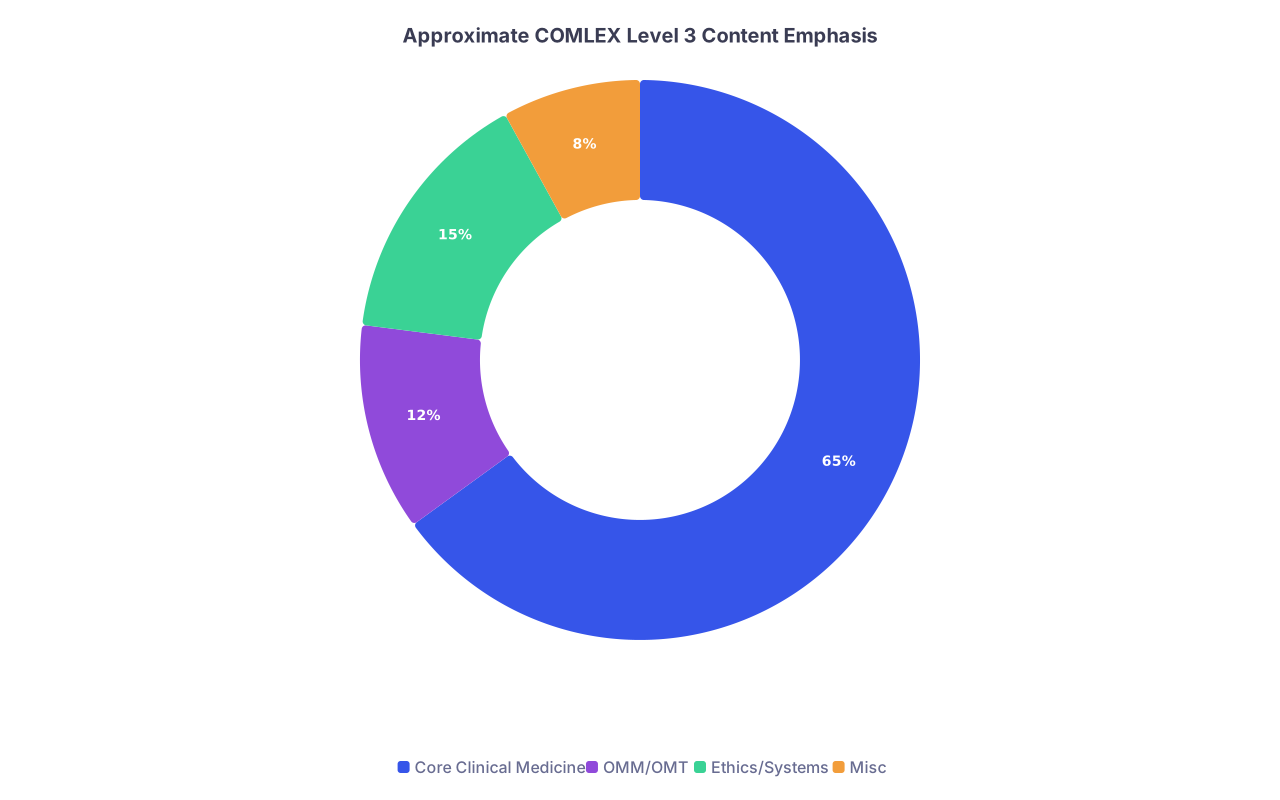
| Category | Value |
|---|---|
| Core Clinical Medicine | 65 |
| OMM/OMT | 12 |
| Ethics/Systems | 15 |
| Misc | 8 |
So yeah, OMM is not 50% of the exam. It’s not even 25%. It is enough that if you completely bomb it, it can absolutely drag you below the pass line if the rest of your exam is only mediocre.
Where OMM shows up on Level 3:
- Standalone OMM questions (identify diagnosis, choose treatment, contraindications)
- Integrated into clinical vignettes (e.g., low back pain, pregnancy, post-op ileus where one answer option includes OMT)
- Occasional questions basically testing “do you remember this osteopathic jargon at all”
What it’s not:
- A pure anatomy lab exam on every Fryette’s law sub-variation
- A practical where you have to demonstrate counterstrain to the Prometric camera (thank God)
So the fear that “if my OMM is weak, I’m definitely going to fail Level 3” is exaggerated. But the fear “if I ignore OMM completely, I might fail” is… actually valid.
What “Dangerously Underprepared” for OMM Looks Like
Let me be direct: here’s where I start to worry for someone.
You’re probably in the danger zone if:
- You can’t describe what TART stands for without pausing
- You look at “Type I vs Type II dysfunction” and feel your soul leave your body
- You have no idea which OMT techniques are clearly contraindicated in fractures, cancer, osteoporosis, DVT, etc.
- You see “HVLA to the C-spine in patient with rheumatoid arthritis” and don’t immediately slam “NOPE”
- You genuinely haven’t opened an OMM resource since Level 1
- You’re planning to “just skip OMM questions and focus on what I know”
That last one? That’s a failing strategy. Literally.
Because this is what happens: you miss easy OMM questions that you could have gotten with minimal review, and those points are gone forever. And Level 3 is already more chaotic than the earlier exams because you’re taking it while exhausted, working, and maybe post-call.
On the other hand, you are not in the danger zone just because:
- You don’t remember every sacral torsion configuration
- You mix up viscerosomatic levels sometimes
- You need a table/chart to remember chapman’s points
- You can’t recite the entire cranial strain zoo from memory
Those things are “eh, mildly underprepared.” Annoying. Anxiety-provoking. Not “I am doomed.”
How Little OMM Can You Get Away With and Still Be Safe?
Let’s talk bare minimum. Not ideal. Not aiming for 700+. Just: “I want to pass and not have my career set on fire by sacral mechanics.”
You probably pass Level 3 even with weak OMM if:
Your general medicine is solid
If you’re scoring comfortably above passing on COMSAEs / UWorld / TrueLearn equivalents for the non-OMM stuff, that buys you a ton of safety margin.You’re not totally blank on OMM
You know:- What’s clearly dangerous (OMT in trauma, fractures, severe osteoporosis, unstable neuro deficits, etc.)
- High-yield patterns: rib mechanics, basic sacrum, lumbar, SI joints
- Red-flag conditions where you treat medically and not with OMT
You’ve seen enough OMM questions to not panic on exam day
Panic makes you miss questions you actually know. Even a basic OMM question set (COMBANK/TrueLearn/COMQUEST, etc.) helps normalize the style.
But there is a floor. That “how underprepared is too much?” line.
If your situation sounds like:
“I barely passed Level 1 and 2, my clinical medicine is just so-so, and my OMM is nonexistent”
→ You can’t afford to ignore OMM. You need it for points.“I failed Level 2 once and then passed borderline, haven’t done OMM in 2+ years”
→ Very high risk if you don’t deliberately patch OMM gaps.
That’s the crowd that truly can’t treat OMM as optional fluff.
The OMM Topics That Are Actually High-Yield for Level 3
You don’t have to resurrect your entire first-year OMM binder. But you do need a targeted list.
Here’s where I’d absolutely focus. If you’re shaky on these, that’s when I get nervous.
Contraindications to OMT
If you only had 1 hour for OMM, I’d spend 20 minutes here.
You must be able to answer: “Is OMT safe here or stupid?”Absolute or strong no-go situations you need burned into your brain:
- Suspected fracture / dislocation / severe trauma
- Unstable cervical spine, RA with C-spine involvement, Down syndrome with atlantoaxial instability
- Osteomyelitis / active bone infection
- DVT for lymphatic techniques on that limb
- Severe osteoporosis for thrust HVLA
- Spinal malignancy, metastasis
- Acute cauda equina / cord compression signs (this is a surgery/ER problem, not OMT time)
Somatic dysfunction basics
Just enough to not choke:- Naming: e.g., “L3 F Rl Sl” or “neutral, rotated right, sidebent left”
- Type I = neutral, group curves; Type II = flexion/extension, single segment
You don’t have to love it. But you need to recognize it and not stare at the letters like hieroglyphics.
Rib mechanics
High-yield as hell on Level 2 and still shows up on Level 3:- Pump-handle vs bucket-handle ribs (upper vs lower)
- “Key rib” in inhalation vs exhalation dysfunction
- General sense of which way you treat (don’t obsess over every single step, but know the logic)
Pregnancy & post-op OMT
They love:- Safe techniques in pregnancy: soft tissue, muscle energy, lymphatics, gentle techniques
- Avoiding supine positions late in pregnancy (IVC compression)
- Lymphatic techniques for post-op ileus (as long as no contraindications)
These are easy points if you’ve reviewed them once.
Sympathetic/parasympathetic levels – just the big ones
Don’t try to memorize a phone book. Memorize the ones that show up constantly:- Heart, lungs, upper GI, lower GI, pelvic organs
Just enough that if they say “T1–T4 dysfunction with chest pain” you think “heart/sympathetic” and can sort through an answer set.
- Heart, lungs, upper GI, lower GI, pelvic organs
Very basic cranial
Level 3 doesn’t go insane here usually. Just:- If they mention CN dysfunction with temporal bone stuff, think cranial
- Don’t use cranial HVLA on a kid with increased ICP / trauma / shunt issues
Is this everything? No. Is this enough to avoid being dangerously underprepared? Yes, combined with decent medicine scores.
“But I Really Haven’t Studied OMM in Years—Now What?”
Here’s the part you’re probably dreading: “Do I need to do a full OMM bootcamp before the exam?” No. You don’t. That’s overkill for Level 3.
You need structured, time-limited damage control. Think of it as: “How do I become minimally competent in OMM again in 7–10 hours total?”
Something like this:
| Session | Focus Area | Time (hrs) |
|---|---|---|
| 1 | Osteopathic principles, contraindications | 1.5 |
| 2 | Somatic dysfunction basics, Type I/II | 1.0 |
| 3 | Ribs, thoracic, lumbar | 1.5 |
| 4 | Sacrum, innominate, pelvis (just the basics) | 1.5 |
| 5 | Pregnancy, post-op, lymphatics, Chapman’s overview | 1.5 |
| 6 | Mixed OMM question blocks + review | 1–3 |
You can spread this over 1–2 weeks without destroying your sanity or your residency schedule.
Resources that don’t waste your time:
- COMBANK / COMQUEST / TrueLearn OMM-only filters
- A condensed OMM review book or PDF from your school (you definitely have one collecting dust somewhere)
- Sketchy/online OMM videos only if they’re short and focused
The point isn’t to become an OMM genius again. It’s to go from “I panic at any OMM word” to “I can answer 60–70% of OMM questions competently and guess reasonably on the rest.”
How to Tell If You’re Actually in Trouble (Not Just Anxious)
You’re sleep-deprived, your baseline anxiety is high, so your internal radar is not reliable. Use external checks:
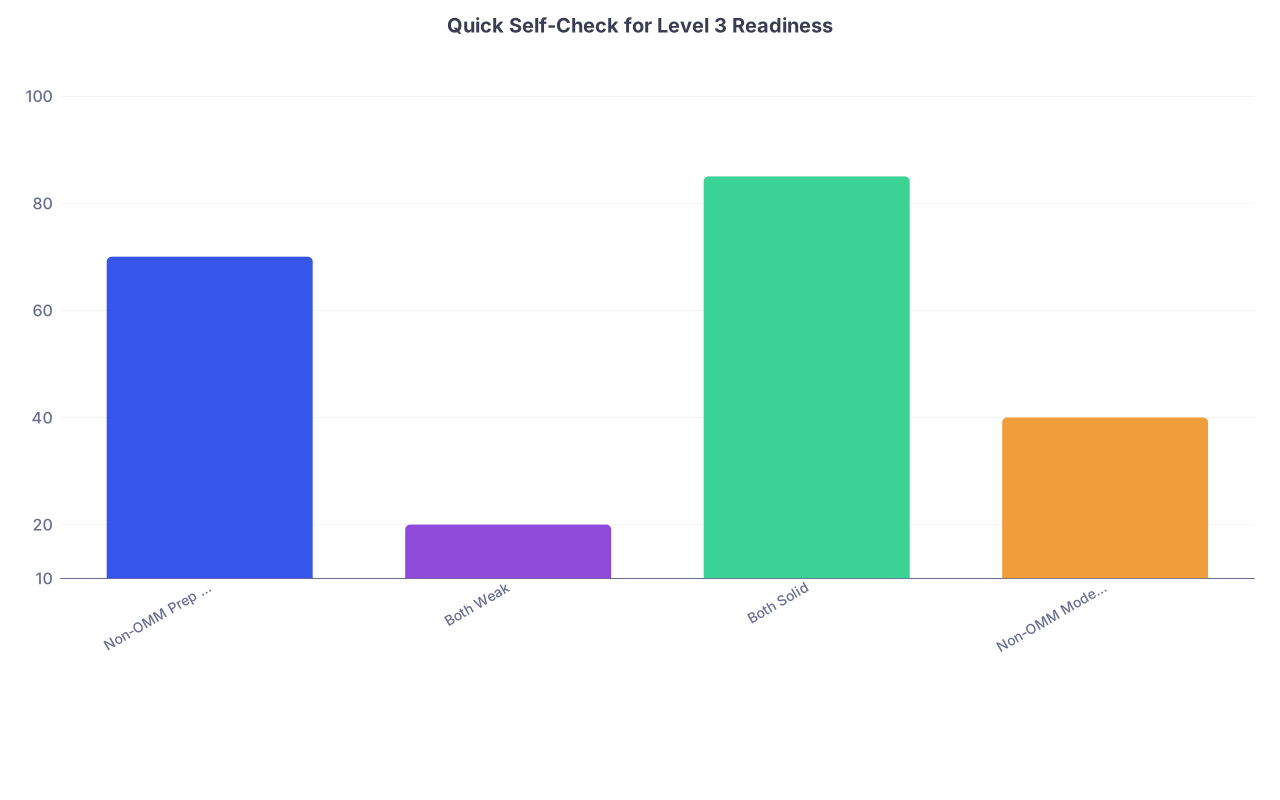
| Category | Value |
|---|---|
| Non-OMM Prep Strong, OMM Weak | 70 |
| Both Weak | 20 |
| Both Solid | 85 |
| Non-OMM Moderate, OMM Nonexistent | 40 |
Use a rough mental checklist:
Are you consistently passing practice material for general medicine (even if not crushing it)?
- Yes → your margin is better.
- No → you cannot afford to whiff OMM.
If you did a 30–40 question OMM-only block right now, would you:
- Recognize most terms and get ~50–60% right?
- Or stare at the screen like it’s a foreign language?
Can you, from memory, list:
- 3–5 clear contraindications to OMT?
- 2–3 safe techniques in pregnancy?
- Rough idea what “T3–T6 somatic dysfunction” points you toward?
If the answer to those is “yes-ish,” you’re anxious but not destroyed. If all those answers are no, that’s when I’d say: yeah, you should prioritize 1–2 solid evenings of OMM triage before more random medicine review.
Exam-Day OMM Survival When You Still Feel Underprepared
Let’s say you’ve done some review but still feel like an OMM imposter. That’s normal. Here’s how you don’t let that wreck your whole exam.

| Step | Description |
|---|---|
| Step 1 | See OMM Question |
| Step 2 | Focus on stabilizing patient first |
| Step 3 | Choose non-OMT medical/surgical answer |
| Step 4 | Pick safe OMT option |
| Step 5 | Use pattern recognition / best guess |
| Step 6 | Move on |
| Step 7 | Understand the clinical situation? |
| Step 8 | Any contraindications to OMT? |
| Step 9 | Is there a clearly gentle/safe technique? |
Some rules of thumb that save points:
- If the patient is unstable, in acute trauma, or needs surgery → do not pick OMT. Ever. Stabilize, image, consult.
- If they give you a scenario and one answer is “Cervical HVLA in frail old lady with osteoporosis” → that’s a trap. Don’t fall in.
- If there’s a reasonable medical management option vs some obscure OMT thing that sounds risky → pick the safe, boring answer.
- When in doubt with pregnant patients: gentle, side-lying, lymphatic, myofascial = safer.
- Don’t overspend time. If you’ve thought for 45–60 seconds and you’re stuck between two OMT techniques that both seem plausible, pick one and move on. Don’t let OMM steal time from bread-and-butter medicine.
Even being underprepared, you can probably avoid catastrophic OMM misses just by following safety logic and not choosing crazy aggressive treatments in fragile patients.
The Ugly Truth: Most People Feel Underprepared for OMM
I’ve watched residents walk into Level 3 with:
- Step-style prep 95% done
- OMM 5% “I skimmed something once”
And they still passed. Not heroically, but solidly.
The ones who ran into real trouble:
- Skipped OMM entirely out of resentment (“I don’t use this in real life, I refuse to study it”)
- Were borderline on Level 2 and didn’t improve their core medicine knowledge
- Took Level 3 while not sleeping and basically clicked through questions in a fog
So no, you don’t need to become your school’s OMM fellow to be safe. But you can’t pretend it’s not on the exam at all.
Quick Reality Check Before You Spiral
If you’re still spiraling at this point, pause and answer these honestly:
- Have you already built a reasonable base in medicine for Level 3?
- Could you dedicate 6–10 hours total to focused OMM review in the next couple weeks?
- Are you willing to at least learn contraindications and the most common patterns?
If yes to those, then you are not “too underprepared to pass.” You’re just less prepared than you wish you were. Different thing.
If your answers are mostly no, then your anxiety is actually doing you a favor. It’s warning you that you need a short, concentrated push before the exam. Annoying, but fixable.
Bottom Line: How Underprepared Is Too Much?
Here’s where I land:
- “Too much” underprepared is: you haven’t touched OMM since Level 1, your core medicine is shaky, and you plan to basically guess on all OMM questions. That’s dangerous.
- Annoyingly underprepared but still likely to pass: you hate OMM, remember only basics, but do a focused 6–10 hour refresh and your general medicine is decent.
- Perfectly prepared is unnecessary. Competent and safe is enough.
If you use that small window of time before Level 3 to shore up OMM just a bit instead of catastrophizing endlessly, you move yourself out of the danger category and into the “nervous but fine” category.
Key points to walk away with:
- You do not need to master every OMM detail, but you do need contraindications, core patterns, and safe technique logic.
- Roughly 6–10 hours of targeted OMM review can turn “I know nothing” into “I can safely get most OMM questions right or close.”
- You’re only truly in trouble if both your general medicine and your OMM are weak and you’re not willing to patch either before test day.