
What if blocking off a full “dedicated month” for Step 3 is actually the worst move you could make for your career, your wallet, and even your score?
Let me cut straight through the residency folklore: the idea that you “must” take a full 3–4 weeks off to cram for Step 3 is mostly dogma, not data. It’s a meme that got passed down from older residents who studied for Step 1 like it was the MCAT times ten and never really updated their mental model.
Step 3 is not Step 1. It’s not even Step 2, really. And the people who prepare for it like it’s another all-consuming “dedicated” exam often waste time, money, and vacation for very marginal gain.
You do need a plan. You do need reps with NBME‑style questions and CCS cases. But you probably do not need a pristine, month‑long monastery retreat from clinical work.
What Step 3 Actually Is (And Isn’t)
Step 3 is a two‑day exam:
- Day 1: Foundations of Independent Practice (FIP) – more Step 2‑ish, heavy on biostats, ethics, ambulatory, “what’s the best next step” type questions.
- Day 2: Advanced Clinical Medicine (ACM) – more management, prognostication, multi‑step cases, and of course CCS (computer‑based case simulations).
The pass rate data from the NBME/USMLE tells you a lot:
| Group | Approx Pass Rate |
|---|---|
| US MD (first attempt) | 96–98% |
| US DO (first attempt) | 94–96% |
| International grads (first) | 85–90% |
| Repeat takers (all groups) | 55–65% |
This is not a 75% pass rate, career‑defining filter. For US grads with a reasonable track record, Step 3 is designed to be passable while working. The exam is checking: “Can this person practice independently without being dangerous?” Not “Is this person in the top 1% of pathophysiology nerds?”
That design intent matters. Because it informs how much time you actually need.
Where Did the “Dedicated Month” Myth Come From?
The dedicated-month religion is leftover debris from:
The Step 1 era of hyper‑competition
People built their identity on locking themselves in a cave for 6 weeks and coming out with a 250+. That story is addictive. It bleeds into everything—Step 2, Step 3, in‑training exams. The assumption: more time off = more serious = better outcome.IMGs/visa pressure cases
If you’re an IMG needing Step 3 for visa, or trying to overcome weak Step 1/2 scores, you’ll hear horror stories and see people doing 4–6 weeks dedicated. That specific situation got generalized into “everyone needs this.”Program culture and attendings’ nostalgia
You’ll hear: “When I took Step 3, I took a month and just did UWorld all day.”
Translation: they could take a month; there wasn’t data showing it was necessary; it just felt safer.
Here’s the actual question you should ask:
Is there evidence that taking off 3–4 weeks produces higher pass rates or better scores than a well‑planned 2–3 weeks of part‑time studying while working?
Short answer: we don’t have anything showing that. And what data we do have cuts the other way.
What the Data and Patterns Actually Show
No, there isn’t a randomized trial of “dedicated month vs no dedicated.” But we do have:
- NBME pass rates by group
- Correlation of Step 2 to Step 3 performance
- Real‑world patterns from large residency programs and Qbank analytics
1. Step 2 is the best predictor of Step 3
Program data sets (I’ve seen them internally) show a tight relationship between Step 2 CK and Step 3. If you scored:
- ≥ 240 Step 2 CK: most residents pass Step 3 with moderate prep, even with busy rotations.
- 220–240: need more deliberate prep, but still do fine without a full month.
- < 220 or multiple fails: higher risk group; here, extra time or a quasi‑dedicated block may actually make sense.
If your Step 2 was solid and recent, you’re not suddenly going to forget how to manage sepsis, DKA, and ACS just because you’re on wards.
2. Question volume needed is much smaller than people think
Look at the main Qbanks. Rough ballpark:
| Resource | Total Questions/Cases | Realistic Pass-Oriented Use |
|---|---|---|
| UWorld Step 3 Qs | ~1,600–1,800 | 800–1,200 questions |
| CCS cases (UW/CCSx) | ~40–100 | 25–40 well-reviewed cases |
You do not need to religiously finish every single question and every single case to pass or to score decently. Most residents who end up in the 220s–230s did somewhere between 800–1,200 questions, plus 20–40 cases, over 3–6 weeks. Usually while working.
Do the math:
1,000 questions over 4 weeks = ~35–40 questions/day. That’s one focused hour, maybe 90 minutes if you’re reviewing thoroughly.
You don’t need a monastery. You need one disciplined hour, most days.
The Real Constraints: Rotations, Fatigue, and Life
The question isn’t “Do I need a month?” It’s “Given my actual life, what’s the least disruptive way to reach a safe question volume and CCS familiarity?”
This is where the dogma breaks down.
Who doesn’t need a full dedicated month?
You probably do not need a full month off if:
- You’re a US grad with:
- Step 2 CK ≥ 230 (and taken within 2–3 years)
- No prior USMLE failures
- You’re currently in:
- IM, FM, EM, Peds, or similar fields where you’re constantly seeing bread‑and‑butter management
- You can realistically carve out:
- 60–90 minutes most days for 4–6 weeks
Residents in this category routinely pass with 10–14 total days of “lighter” work or vacation spread around the exam, not 30 continuous days off.
Who might benefit from more dedicated time?
Let’s be honest, there are higher‑risk profiles:
- Step 1/2 CK near passing or with failures
- Long gap since last standardized exam (3+ years)
- Less clinically intense specialty (pathology, psych early in training, etc.)
- IMGs needing Step 3 for visa before residency or early PGY‑1
For these groups, a 2–3 week heavier prep period, possibly including 1–2 weeks of actual vacation, can make sense. Still not always a full month, and certainly not automatically.
The Big Hidden Cost: Wasting Your Best Resource
A full month of vacation is not free. You’re trading it away for:
- Time you could actually rest
- Time for family or sanity
- Flexibility for interviews, fellowships, or emergencies
- A padding buffer for rough rotations
And there’s another problem: people glorify “dedicated” but then use it badly. I’ve seen this play out over and over:
You carve out 4 weeks. The first week you’re “setting up resources” and “easing into it.” The second week you ramp a bit. Third week is good. The last week you’re burned out and just marking questions correct in your head.
Net yield? Maybe 2 weeks of solid work.
Here’s what usually outperforms that: 3–4 weeks of solid, scheduled, 60–90 minute blocks while you’re still thinking clinically, plus 4–5 lighter days off right before the test for CCS and full practice blocks.
Less heroic. More effective.
A Data-Consistent Study Strategy (Without Burning a Month)
Let’s talk concrete. Assume:
- You’re a PGY‑1 in IM with a Step 2 CK of 235
- You’re 12–18 months out from CK
- You have a reasonably busy schedule, but not q2 call hell every week
You want ~1,000 questions + 30 CCS cases over 4–5 weeks.
Baseline structure
5–6 days/week: 40 questions/day, timed, random
That’s about 1–1.5 hours including review if you don’t go down rabbit holes on every explanation.3–4 days/week: 1 CCS case/day
Early on, just get comfortable with the interface and general flow. Later, work more deliberately on management nuance.
That’s it. That total load is heavy but doable alongside most rotations, except maybe ICU with brutal call. You stretch to 6 weeks if rotation is insane.
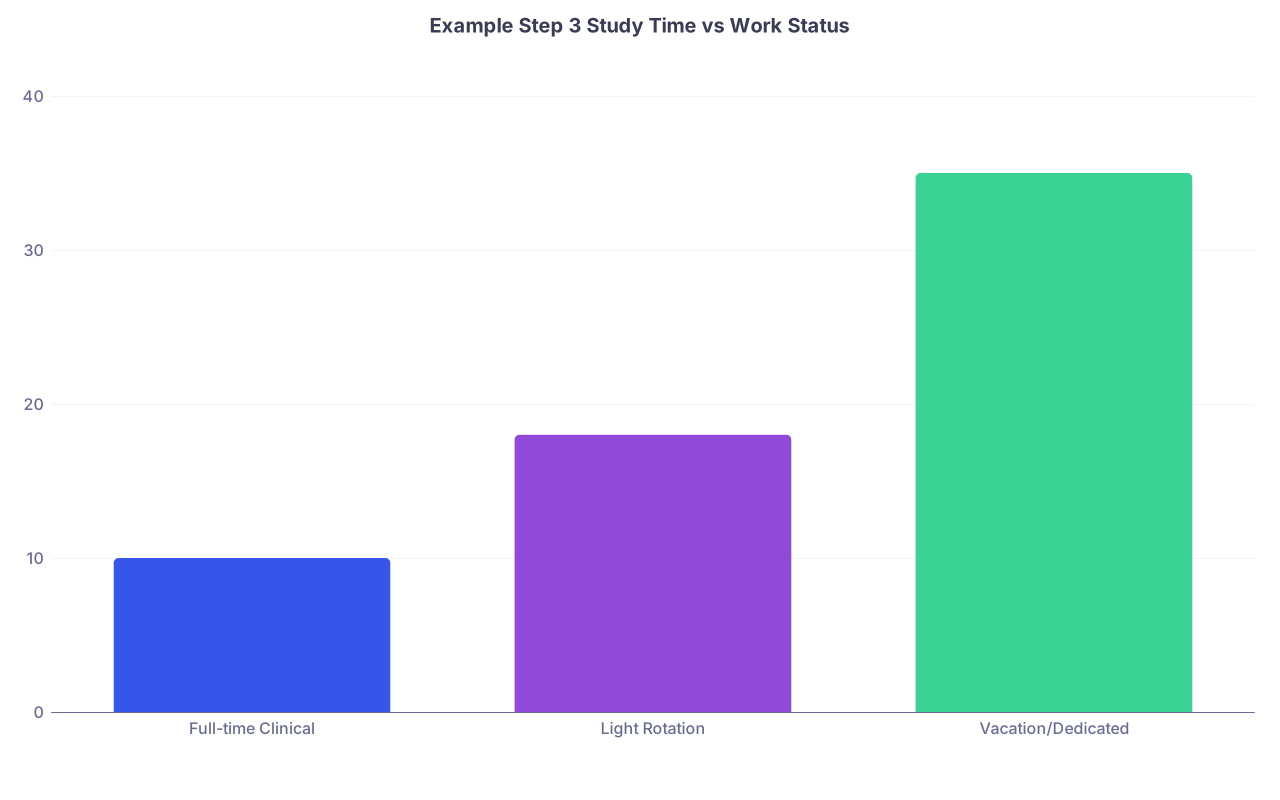
| Category | Value |
|---|---|
| Full-time Clinical | 10 |
| Light Rotation | 18 |
| Vacation/Dedicated | 35 |
This is what I actually see: people do ~10 hours/week during full‑time clinical work, 15–20 hours/week on a light rotation or elective, and maybe 30–35 in a truly dedicated week. You do not need four of those 35‑hour weeks.
When to add time off
If you can swing it, I’d rather see:
- 1 week lighter rotation + 3–4 weeks of steady studying
then - 3–5 days of actual vacation right before the exam
to:- Do CCS cases in longer blocks
- Run through a couple of practice exams
- Normalize your sleep schedule
This pattern fits the reality of Step 3: it’s a marathon of attention and pattern recognition, not a memorization sprint.
What About People Who Did Take a Month?
You’ll always find the person who says, “I took a full month and I’m glad I did.” That doesn’t prove it was necessary. It proves it was psychologically comforting.
Most of them:
- Were anxious about prior scores
- Had poor habits and needed the structure
- Or they simply had vacation to burn and no life outside the hospital yet
In Qbank performance data, what matters is not “days off” but:
- Total question count
- How spaced out the practice was
- How many full practice blocks you did in timed mode
- How many CCS cases you walked through properly
Question bank companies love the myth of “dedicated” because it keeps you locked into their platform for longer. Programs rarely fight it because it sounds responsible and risk‑averse.
But look at outcomes: US grads with reasonable Step 2 scores pass at 96–98% without any formal requirement for a month‑long study break. If a full dedicated month was essential, you wouldn’t see those pass rates across thousands of residents who don’t get that luxury.
Timing Step 3: The Hidden Variable That Matters More
Here’s a place where people actually screw themselves: when they schedule Step 3, not how many weeks off they take.
Three patterns that work better than “an arbitrary month somewhere”:
After a run of general inpatient or outpatient
Your brain is full of bread‑and‑butter: chest pain, pneumonia, hyperkalemia, diabetes. That maps directly to Step 3. Studying then is high‑yield.Not right after an ICU or brutal rotation
Being cognitively fried and sleep‑deprived is more harmful than shaving 10 days off your Qbank timeline.Within 1–2 years of Step 2 CK
The longer you wait, the more you genuinely need extra time because your test‑taking muscles atrophy.
If you get the timing and the question volume right, your need for a “dedicated month” evaporates very quickly.

| Step | Description |
|---|---|
| Step 1 | Start Planning Step 3 |
| Step 2 | Higher-Risk Group |
| Step 3 | 4-6 weeks part-time, no full month off |
| Step 4 | Consider 1-2 weeks lighter schedule |
| Step 5 | Increase prep to 6-8 weeks total |
| Step 6 | Consider 1-2 weeks vacation near exam |
| Step 7 | Step 2 CK >= 230 and no fails? |
| Step 8 | Within 2 years of Step 2? |
When a Full Month Actually Makes Sense
There are cases where I’ll agree with the maximalists.
A true 3–4 week heavy prep block is reasonable if:
- You’ve failed another USMLE before
- You’re an IMG who’s been out of clinical practice for several years
- Step 2 was barely passing or several SDs below your peers
- You literally have zero bandwidth on rotations (malignant call, no post‑call rest) and your only realistic shot at sustained focus is vacation
Even then, I’d still build spaced practice in the months before. A cold‑start 4‑week cram from zero is risky and miserable.
The Bottom Line: Data vs Dogma
Here’s the uncomfortable truth for the “month dedicated” crowd: most residents who take a full month could have achieved the same or better outcome with 3–4 weeks of smart, part‑time study plus a short pre‑exam break.
The exam’s design, the pass‑rate data, and actual Qbank usage patterns all point in one direction:
- Volume and quality of practice matter.
- Evenly spaced studying while clinically active helps, not hurts.
- A full dedicated month is occasionally helpful, often wasteful, and massively oversold.
Use your vacation like a scarce, valuable resource. Because it is.