
The biggest lie about Step 3 in intern year is that “no one really cares when you take it as long as you pass.” That is not what actually happens behind closed doors.
Let me tell you what really happens in program director offices, chief meetings, and semi-ranting attending conversations when your name and “Step 3” show up on the radar.
What Step 3 Actually Signals To Your Program
Step 3 isn’t just a licensing test to them. It’s a diagnostic test on you.
Anyone who’s sat in program leadership meetings has heard some version of this:
- “Did they get Step 3 done yet?”
- “We can’t put them on that elective if they still haven’t passed Step 3.”
- “I’m worried. They keep pushing it back. That usually means trouble.”
They’re not obsessed with your 3‑digit score. They’re watching three things:
- Timing – When did you take it?
- Number of attempts – Did you pass on the first try?
- Collateral damage – Did your prep disrupt your clinical work?
Behind the scenes, Step 3 during intern year is being used to silently answer these questions:
- Are you reliable and proactive or someone they’ll have to babysit?
- Can you juggle clinical work and exams without imploding?
- Are you going to be a board problem in a few years when they’re being judged on board pass rates?
Most interns think: “Step 3 is just another test.”
Most program directors think: “Step 3 is an early warning system.”
That disconnect is where people get burned.
The Hidden Timeline: What Programs Expect (Even When They Don’t Say It)
Every program has an unofficial Step 3 clock. They may not write it in the handbook, but they absolutely talk about it.
Let me show you the pattern I’ve seen repeated at big university IM programs, community FM programs, and even surgery:
| Specialty | Quietly Preferred Timing | Red Flag Timing |
|---|---|---|
| Internal Medicine | By end of January PGY-1 | After start of PGY-2 |
| Family Medicine | By March PGY-1 | Any time in PGY-2 |
| Pediatrics | By Spring PGY-1 | After fellowship apps start |
| General Surgery | During lighter rotations PGY-1 | Pushing into PGY-2 |
| Psychiatry | By mid PGY-2 (if allowed) | Close to graduation |
Official policy: “Must complete Step 3 by X date (often end of PGY-2 or before promotion).”
Real expectation in many places:
“If you’re solid, you’ll get it done in intern year, preferably in the first half.”
Why?
Because the PDs, chiefs, and schedulers know how this usually plays out:
- Intern year: Painful but somewhat protected. You don’t have major leadership roles. You’re still forgiven for being “new.”
- PGY‑2 and beyond: More responsibility, more autonomy, more evaluations, more chances to crash and burn if you’re distracted by a high‑stakes exam.
So when you push Step 3 into PGY‑2, leadership starts asking “why.”
I’ve literally heard an APD say: “If they can’t get Step 3 done in intern year, what’s going to happen when it’s real boards?”
They won’t say that to your face. But it will show up in how much rope you get.
What Different Stakeholders Secretly Care About
The hospital isn’t one monolithic brain. Different people are watching different parts of your Step 3 story.
Program Director
The PD cares about one thing above all: risk.
- Risk to accreditation (board pass rates).
- Risk to service coverage (suspensions, remediation time).
- Risk to reputation (“That resident who failed Step 3 twice from XYZ program”).
When they see: “Step 3 passed on first attempt during intern year, no drama,” that’s green. Very green. They move on.
When they see: “Late Step 3, extensions, request for days off on short notice, complaining about the exam constantly,” they start mentally categorizing you as “potential problem.”
They will never put that label in your file. But I’ve heard: “I’m not writing them a fellowship letter until they clear Step 3.” Or: “Let’s keep them on more supervised rotations for now.”
Timing + behavior around Step 3 subtly affects:
- Who gets the early “strong resident” reputation
- Who gets trusted with chief track, elective flexibility, fellowship letters
Chiefs
Chiefs care about one thing: coverage.
You know what they hate? Interns who “suddenly remember” they need 3–4 days off for Step 3 in the middle of:
- ICU month
- Night float
- A service that’s already short one person
I’ve watched chiefs roll their eyes and say: “They had six months of lighter rotations and choose now to do this?” That sticks.
Take Step 3 during a chill elective, give plenty of notice, don’t dump swaps on people last minute, and chiefs barely think about you.
Make it chaotic, and they remember. And chiefs 100% influence which rumors about you float up or down.
Attendings
Most attendings don’t care when, unless:
- You’re checking UWorld questions while you should be writing notes, or
- You’re asking for time off at the worst possible moment, or
- You keep talking about Step 3 as the reason you’re behind on everything
Then you become “the intern who’s always studying” instead of “the intern who gets things done.”
Ironically, some attendings quietly respect the ones who grind Step 3 early and move on. Particularly those who remember failing Step 3-era exams themselves or watching co-residents tank because of procrastination.
The Real Red Flags (That No One Writes Down)
Failing Step 3 is obviously a problem. You already know that.
What people underestimate are the behavioral red flags that quietly get attached to delayed or messy Step 3 stories.
Here’s what gets you labeled in the background:
- Repeated Delays Without a Clear, Adult Reason
When someone schedules Step 3, cancels, reschedules, cancels again… leadership notices.
They interpret it as:
- Poor planning
- Anxiety management issues
- Lack of follow-through
If you need to delay because of legit reasons (family crisis, serious health issue, brutal rotation with 6+ calls), and you explain that professionally, no one cares. But the combination of “I’m just not ready yet” + vague stories + constant shifting? Bad look.
- Step 3 Studying Interfering With Basic Intern Duties
If you’re late on notes but somehow up to date on UWorld, people will talk. I’ve seen faculty say, “If they spent half the time on their notes as they do on studying, we’d be fine.”
Step 3 is supposed to be invisible to the team. When it starts leaking into your clinical reliability, trust drops fast.
- Needing Special Treatment For Step 3
Needing 1–2 days of rearranged shifts? Normal.
Needing:
- A completely protected 2–3 week block because “I can’t study while on service”
- Coverage for your call because you “didn’t realize” your test is near
- Separate exceptions from what co-residents get
That brands you as high-maintenance.
- Passing Late
You can absolutely pass Step 3 in PGY‑2 and have a fine career. But there’s a difference between:
- “Program policy requires it by end of PGY‑2, so I took it fall PGY‑2 and passed.”
- Versus: “I kept postponing and finally scrambled to pass right before the deadline.”
Programs mentally sort those differently.
The Sweet Spot: When Interns Earn Quiet Respect
There’s a pattern among residents who are perceived as “on top of their shit” regarding Step 3. They:
- Decide on a general window early (before intern year starts or in July).
- Pick a block that’s not ICU, not nights, not heavy wards.
- Tell chiefs early: “I’d like to take Step 3 during this elective month; I’ll request the test days now so it doesn’t mess with coverage.”
- Study in a way that doesn’t wreck their team performance.
- Take it once. Pass. Move on. Never make it a topic again.
You know what happens when that’s your story? People forget about your Step 3. In residency, no news about you is actually very good news.
How Much Studying Interns Really Do (Not What They Claim)
Let’s be honest about the studying itself. There’s what people post on Reddit (6000+ UWorld questions, 3 full read-throughs of some Step 3 book, etc.), and then there’s how residents actually study while exhausted.
Here’s the pattern I see repeatedly among successful first‑time passers:
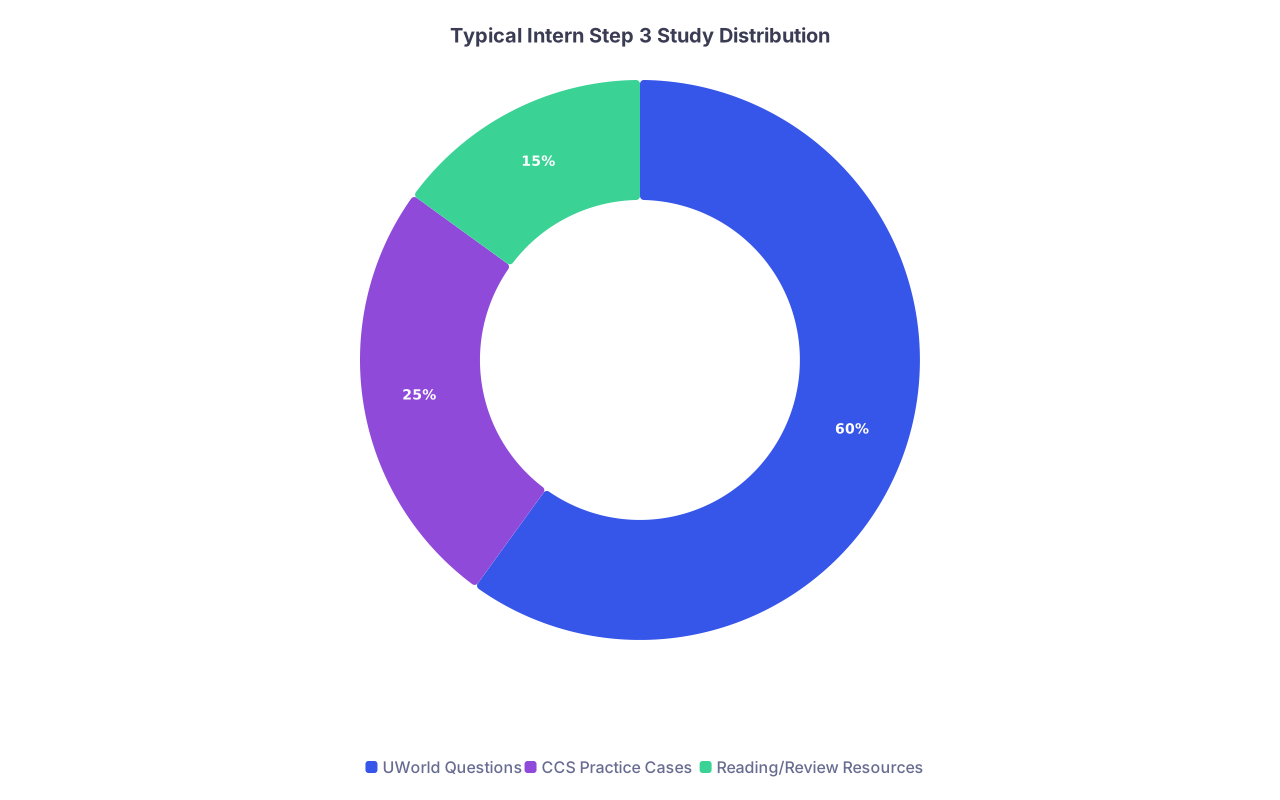
| Category | Value |
|---|---|
| UWorld Questions | 60 |
| CCS Practice Cases | 25 |
| Reading/Review Resources | 15 |
Most of them:
- Do one solid pass of UWorld Step 3 (or a big chunk of it), often starting midway through intern year.
- Sprinkle CCS practice in the last 3–4 weeks before the exam.
- Use something light (AMBOSS, OnlineMedEd Step 3 videos, random notes) as filler.
The critical detail you won’t see publicly: the ones who do well treat Step 3 like a B‑priority that runs in the background, not an all-consuming Step 1‑style crusade.
They accept that:
- Their percentage won’t be perfect.
- Their study schedule will be imperfect.
- Some days they’ll do 0 questions because the hospital destroyed them.
And they keep going anyway.
The ones who get into trouble are usually:
- Perfectionists who say, “I’ll start once my schedule calms down” (spoiler: it doesn’t).
- People who wait until they “feel ready,” then realize no such feeling is coming.
- People who try to turn intern year into another dedicated Step period and crumble.
Intern year rewards consistency over intensity. Step 3 prep is no different.
Where Step 3 Timing Quietly Affects Your Future
You won’t see this in any official policy, but it matters.
Fellowship Applications
For competitive fellowships (cards, GI, heme/onc, some academic psych programs), faculty talk. I’ve heard versions of:
- “Are their boards all squared away?”
- “Do we know if they had any issues with Step 3?”
If your application lands on someone’s desk and there’s even a whiff of “board struggle,” you’d better have a strong explanation and superb letters.
Passing Step 3 cleanly, early, with no drama lets your file be about your rotation performance, research, and letters—not about damage control.
Internal Reputation
This is subtle but real.
Programs have a mental list of:
- “This person is high-performing and low drama.”
- “This person is good clinically but kind of chaotic.”
- “This person is a potential headache.”
Your Step 3 story is one of those quiet data points that pushes you up or down that spectrum.
I’ve sat in meetings where they’re choosing who gets a particular elective or leadership role and someone says, “They’ve consistently handled everything on time, including their boards.” People nod. That matters.
Contract Renewal / Promotion
Most programs require Step 3 by a specific PGY level for promotion or contract renewal. But here’s the inside truth:
If they already see you as reliable, proactive, and low-risk, and you need a small technical extension for some reason? They’ll help you figure it out.
If you’re already on thin ice clinically, behind on documentation, or struggling with professionalism, and your Step 3 is late? That becomes one more nail they can use to justify limiting your progression.
Same test. Completely different consequences depending on your pattern.
A Practical, No-Nonsense Intern-Year Step 3 Strategy
Let me cut through the noise and give you the version that actually works for most interns without wrecking their lives.
1. Pick a Season, Not an Exact Date (At First)
Decide before or early in intern year:
- “I’m a Fall test-taker” (October–December), or
- “I’m a Winter test-taker” (January–March)
Then, once your schedule is finalized, lock in an actual 2–3 week window inside that season during an easier month.
2. Start Low-Key, Not Perfect
When your brain has adapted a bit to intern year (usually by month 2–3), start:
- 10–20 UWorld questions on non-murderous days.
- Random CCS case or two every week once you’re ~6–8 weeks out.
You do not need a spreadsheet. You do need momentum.
3. Protect Just Enough Time
Interns who avoid headaches generally:
- Ask for 1–2 days off around their test date (not 7–10).
- Avoid ICU/night float/exam tripling in the same week when possible.
- Tell chiefs well in advance: “I’m planning Step 3 this month; can we aim to put my days off around then?”
You are not asking for special treatment. You’re making it logistically painless for everyone else.
4. Do Not Talk About Step 3 Constantly
Prep quietly. Ask for what you need professionally and briefly.
You don’t want to be “the Step 3 intern.” You want to be “the intern who gets stuff done and also, yeah, passed Step 3 somewhere in there.”
How Attendings Actually React To Your Score
One more unspoken truth: past a certain point, no one cares about your exact Step 3 number.
What they care about:
- First attempt: pass or fail
- Any bizarrely low performance: does it match how you function clinically?
- Any huge mismatch: 270s on Step 3 but chronically unsafe on the wards? They’ll question your judgment or integrity more than your intelligence.
Step 3 is not where you “prove your brilliance.” It’s where you prove you are not a liability. That’s it.
You do not get a promotion, a raise, or extra vacation days for a 250+ Step 3. You might get a “nice job” comment from someone who still cares about scores. Then everyone goes back to watching whether you can handle cross-cover without falling apart.
If you’re aiming for competitive fellowships, fine, don’t bomb it. But the days of Step 3 being a major flex point are fading. Programs mostly just want it done, passed, and forgotten.
The Mental Game: What You Must Not Do To Yourself
The worst damage I see around Step 3 in intern year isn’t professional. It’s internal.
People quietly destroy themselves with thoughts like:
- “If I fail this, my career is over.”
- “Everyone else seems fine; why am I struggling?”
- “I can’t ask for time off or they’ll think I’m weak.”
The truth is harsher and simpler:
- Your career isn’t over if you fail—but your reputation takes a hit and the road gets steeper. You want to avoid that.
- Many interns are quietly drowning; they’re just not broadcasting it.
- Mature residents ask for reasonable help early instead of melting down later.
You’re allowed to:
- Admit you’re tired and study imperfectly.
- Need two days in a row for Step 3 and not be a martyr.
- Take the exam when you’re reasonably prepared, not superhuman.
But you’re not allowed (if you care about your future self) to pretend Step 3 doesn’t exist until it’s a five-alarm fire.
FAQs
1. What if I genuinely can’t handle Step 3 in intern year?
Then be an adult about it instead of silently hoping it’ll vanish.
Talk to your program director or chief resident early—ideally midway through intern year, not in June. Say something like:
“I’m adjusting slower than I expected. I’m worried that forcing Step 3 this year will hurt both my performance and my chances of passing. Can we map out a realistic plan to do it early PGY‑2 with some structure?”
Programs are much more reasonable when you’re proactive and honest than when you show up three weeks before promotion with nothing scheduled.
2. Is it better to take Step 3 early and risk a lower score, or wait until I feel more prepared?
In the real world of residency, a timely, clean pass almost always beats a delayed “higher” score.
If you’re not grossly underprepared, it’s usually better to take it during a reasonable intern-year window and pass, than to keep pushing into PGY‑2 chasing some imaginary optimal prep that never comes. Remember, no one is handing out medals for a 240 versus 225 on Step 3. They just care that you passed and didn’t make it a circus.
3. How much UWorld do I really need to do to be safe?
Most successful intern-year test-takers land somewhere around 60–80% of the UWorld Step 3 bank, plus some CCS practice. The ones who say they did every single question twice usually started earlier or had lighter rotations. Use that as a rough target, not a religion.
If you’ve done a solid majority of questions with honest review, understand common inpatient/outpatient scenarios, and have run enough CCS to not be shocked on test day, you are probably in a safe zone—especially with fresh clinical experience from intern year.
Bottom line: Programs use Step 3 timing and behavior as a quiet personality and reliability test. Take it seriously, but don’t fetishize it. Pick a reasonable window in intern year, prepare in the background, make it logistically easy on your chiefs, pass once, and then disappear it from everyone’s consciousness.
You want your legacy at your program to be the work you did on the wards—not a messy, dragged-out Step 3 story people still remember two years later.