
It’s 1:47 a.m. You just finished admitting your third septic patient of the night. Your shoes are sticky, your brain feels like oatmeal, and your co-intern just asked you, “Wait… what day is your Step 3 again?”
You check your phone. The Prometric confirmation email is still there. Two weeks.
So you open your laptop in the call room. Because this is what “serious” residents do, right? Grind through Step 3 prep between codes and cross-cover. You convince yourself: “I’m tired, but I can push. Everyone else does.” You start a UWorld block. By question seven your eyes blur; by question fifteen you’re guessing. You keep going anyway.
This is the trap.
Not failing Step 3. Burning out around it. Quietly. Slowly. While pretending you’re “fine.”
Let me be blunt: the biggest Step 3 mistake residents make is not under-studying. It’s treating fatigue like an inconvenience instead of a hard limit. That’s how people wreck their sleep, their mood, their relationships…and sometimes their performance too.
Let’s walk through the specific ways residents fall into the Step 3 burnout trap—and what you’re going to do differently.
The Lie You Tell Yourself: “I’ll Rest After Step 3”
Here’s how it usually goes.
PGY‑1 or PGY‑2. You’re on wards, nights, or ICU. Your program “recommends” taking Step 3 in your first year or early second. GME sends a nice little email about deadlines for full licensure. Your seniors casually drop lines like:
- “I just got it over with on nights.”
- “If you wait, it only gets harder.”
- “I did UWorld once and walked in. You’ll be fine.”
So you tell yourself the classic lie: “I’ll grind for a few months, then I’ll rest.”
That “few months” stretches because:
- You’re on 60–80 hour weeks.
- You’re switching rotations and schedules every 4 weeks.
- You’re still learning how to be a doctor.
And that promised “rest after Step 3”? It never really shows up. There’s always something: a new rotation, more responsibility, fellowship apps, research, real-life obligations.
The mistake is assuming your body will politely “hold on” until some imaginary future break. It doesn’t. It starts collecting interest on that sleep debt and stress now—and the bill always comes due.
How Ignoring Fatigue Actually Wrecks Your Step 3 (Not Just Your Sanity)
Everyone worries about under-preparing. Almost no one worries about over-preparing in the wrong physiologic state. But that’s exactly what’s killing a lot of people’s performance.
There are three big ways ignoring fatigue sabotages your Step 3 outcome.
1. You’re practicing doing questions in a brain state you don’t want on test day
If every UWorld block you do is:
- At the end of a 14-hour shift
- On post-call when you’ve slept 3 hours
- At 1 a.m. with your cortisol through the roof
You’re training your brain to associate Step 3 questions with:
- Slowed processing
- Poor working memory
- Emotional reactivity (“I suck at this” after every miss)
That’s not theoretical. I’ve seen residents whose average UWorld performance went down after “intense” prep because they only ever studied exhausted. Then they internalized those low percentages as “I’m not strong enough,” instead of “I’m trying to run a marathon on no fuel.”
On test day, in a quiet testing center with a full night’s sleep…they still feel like they’re bombing. Because they’ve rehearsed that feeling 50 times.
2. You convert normal stress into full-blown burnout
Run-of-the-mill anxiety about Step 3 is normal. What’s not normal is:
- Dreading every shift and every question block
- Feeling depersonalized with patients (“I don’t even care, just write the note”)
- Snapping at nurses, co-residents, family
- Sitting in your car before work thinking, “I could just not go in”
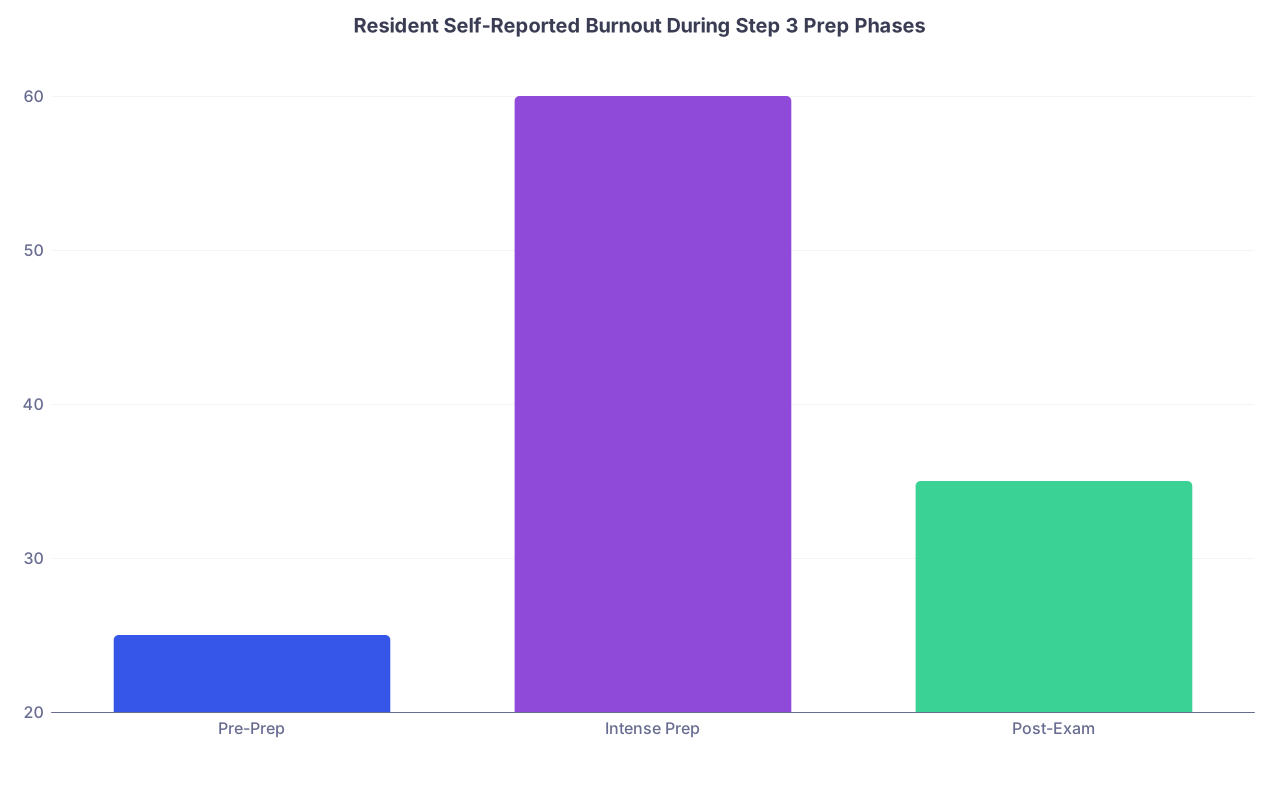
That’s burnout. And cramming Step 3 on top of an already maxed-out schedule is lighter fluid on that fire.
| Category | Value |
|---|---|
| Pre-Prep | 25 |
| Intense Prep | 60 |
| Post-Exam | 35 |
I’ve watched residents go from “tired but functioning” to “I hate all of this and want out” in the 6–8 weeks around Step 3. Same program. Same workload. The variable? They decided to ignore every signal their body gave them and “push.”
3. You think more hours always equal better scores
Big one. Wrong one.
There is a point of diminishing returns where:
- Each extra hour at night contributes minimal new learning
- Retention tanks because of sleep deprivation
- Your question review becomes shallow, rushed, and emotional
You don’t rise to the level of your ambition; you fall to the level of your recovery. Two residents can both “study 3 hours a day.” One does 90 focused minutes post-nap on elective. The other does 3 half-conscious hours post-call. The first one learns. The second one just accumulates guilt and mediocre recall.
The Specific Traps Residents Fall Into (That You Need to Side-Step)
Let’s dissect the most common patterns I’ve seen that push people straight into Step 3 burnout.
Trap 1: Booking the Exam on an Insane Rotation “To Get It Over With”
I’ve lost count of how many times I’ve heard:
“I’m on ICU nights but then I have my golden weekend, so I just put Step 3 on the Monday after. It’ll suck, but then it’s done.”
This is how you design your own personal nightmare.
You walk into a 2‑day exam:
- With a flipped sleep schedule
- Slightly delirious
- Having done 80% of your prep half-asleep between codes
Then you spend the rest of residency wondering if you underperformed your potential.
Here’s how different choices stack up:
| Timing Choice | Burnout Risk | Performance Risk |
|---|---|---|
| During ICU nights | Very High | High |
| During heavy wards months | High | Moderate-High |
| During lighter elective/clinic | Moderate | Low-Moderate |
| After 1 week of true vacation/rest | Low | Lowest |
If your program gives you any flexibility, avoid the “just rip off the band-aid” mindset when the band-aid is attached to your central nervous system.
Trap 2: Studying Every Single Day “No Matter What”
Residents love streaks. 30‑day streak. 60‑day streak. “I did questions every day for 3 months.”
That sounds impressive until you look closer and see:
- Days with 5 barely-read questions counted as “streak intact”
- Post-call days where you literally fell asleep mid-item
- No true rest days, so your baseline fatigue just creeps upward
What you’re really doing is teaching your brain that Step 3 is an unending, joyless obligation with no off-switch. That’s how you poison motivation.
You don’t need a perfect streak. You need a sustainable pattern.
A better rule: “I study on X days per week, and at least one of those days is protected, higher-energy study. I also have at least one true no-Step-3 day.”
Trap 3: Turning Every Free Minute Into Study Time
“I do UWorld on my 30‑minute lunch break.”
“I read CCS cases on the shuttle home.”
“I listen to explanations during sign-out if it’s slow.”
Stop. This is how people lose their minds.
Not every unoccupied minute must be monetized into productivity. Brains need actual quiet time to consolidate and to not be “on” constantly.
I watched a resident once pull out their phone to do a question while waiting for an elevator—on 28‑hour call. When I asked why, they said, “I can’t waste time.”
That’s not dedication. That’s compulsion.
Trap 4: Using Other People’s Study Flex as Your Benchmark
Your co-resident who:
- Did UWorld twice
- Took Step 3 during a QI elective
- Has no kids, no dependents, and a light call schedule
…is not your benchmark if you’re:
- Working 6 nights in a row
- Covering an understaffed service
- Trying to coordinate child care and paying rent in an expensive city
Comparing study volume without comparing actual life load is a recipe for shame and burnout. You have to plan for the life you actually live, not the imaginary schedule of that one PGY‑3 who “just ground it out.”
How to Recognize You’re Slipping Into the Burnout Trap
Most residents don’t wake up one day and say, “I’m burned out by Step 3.” It creeps.
Watch for these early red flags specific to this season:
- You resent every Step 3 question block before you even open it.
- You start skipping meals or bathroom breaks to “fit in” studying.
- You have intrusive thoughts like, “If I fail, my career is over,” on repeat.
- You feel guilty resting, even when you’re post-call.
- On days off, you’re too exhausted to meaningfully study or enjoy anything.
If that sounds familiar, you’re already in the trap.
Your brain is telling you, “We’re at capacity.” You can ignore that warning, but there’s always a cost: score, mental health, physical health, relationships. Usually all four.
Designing Step 3 Prep That Doesn’t Destroy You
Now the part you actually need: how to avoid these mistakes without sabotaging your score.
This is not about being “soft.” It’s about training for a marathon instead of sprinting the whole thing and then vomiting at mile 10.
1. Choose Timing With Brutal Honesty, Not Ego
Ask yourself two questions:
- For the next 2–3 months, what’s my actual schedule?
- On which rotations do I reliably get at least 3 real evenings or a weekend day to study?
Then map your Step 3 date backward from your best 6–8 week window, not your worst.

| Step | Description |
|---|---|
| Step 1 | Check Program Deadline |
| Step 2 | Delay until lighter rotation |
| Step 3 | List next 3 rotations |
| Step 4 | Schedule exam in that block |
| Step 5 | Protect 6-8 weeks for focused prep |
| Step 6 | Need Step 3 in next 3 months? |
| Step 7 | Which has most predictable time? |
If everything looks terrible, then your priority is not “How can I do max studying?” but “How can I do enough studying without burning out or endangering patients?”
Sometimes that means:
- Taking it a bit later than your ego wants.
- Asking your PD for scheduling flexibility.
- Accepting that you’re aiming for “pass solidly,” not “crush with a 260.”
2. Cap Your Daily Cognitive Load
You already have a 60+ hour/week cognitive job. Step 3 studying is extra load, not neutral background.
A rough ceiling that works for most residents:
- On heavy rotations: 60–90 minutes of focused Step 3 work, max.
- On lighter rotations/electives: 2–3 hours, with real breaks.
- Post-call: zero. Yes, zero. You don’t get smarter at Qbank on 3 hours of fragmented sleep.
If you find yourself zoning out, rereading explanations three times, or doom-scrolling between questions, you’re past the point of useful study. Stop. That’s not discipline; that’s ineffective suffering.
3. Protect Sleep Like It’s Part of Your Study Plan (Because It Is)
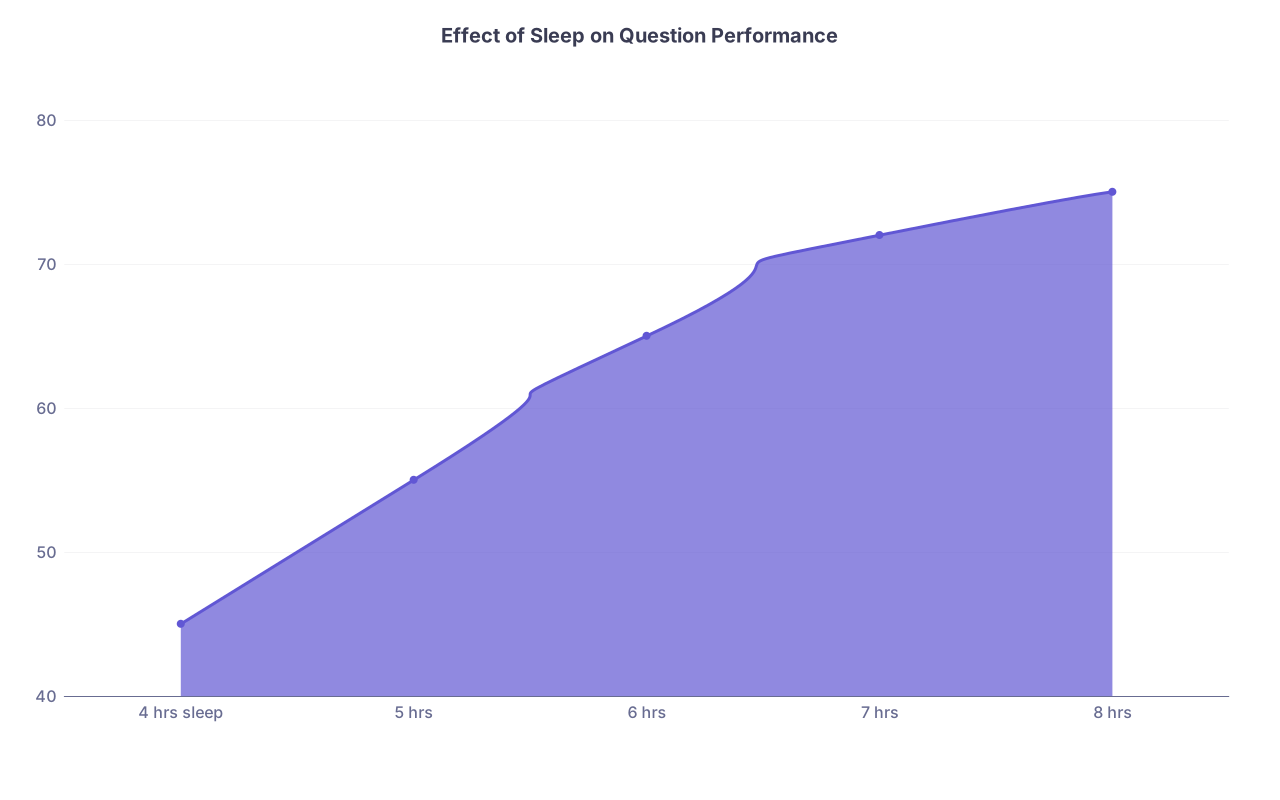
Sleep isn’t a “nice to have” during Step 3 prep. It’s literally when your brain consolidates everything you’re trying to learn.
| Category | Value |
|---|---|
| 4 hrs sleep | 45 |
| 5 hrs | 55 |
| 6 hrs | 65 |
| 7 hrs | 72 |
| 8 hrs | 75 |
No, those extra 30 questions at 1:00 a.m. do not outrun the 20–30% hit in cognitive performance from sleep debt. You just feel more tortured and less effective.
Baseline non-negotiables during your main prep window (as much as your schedule allows):
- Prioritize 6+ hours of sleep before any significant study days.
- Don’t start question blocks if you can barely keep your eyes open.
- Don’t use caffeine as a disguise to override obvious exhaustion every day.
You can cheat fatigue for a few days. Not for months.
4. Build Rest Days Into Your Study Calendar
You need days each week where Step 3 doesn’t exist in your head.
Not “light day.” Not “just a quick block.” Actual zero.
This lets your nervous system downshift. People who do this don’t lose ground—they come back sharper and less resentful. Which, ironically, lets them absorb more per hour.
Think: 4–5 study days per week during heavy months, 1–2 lighter study days and 1 true off-day during electives.
5. Refuse to Let Step 3 Colonize Your Entire Identity
The fastest way to burn out is to convince yourself that:
- Your worth as a resident = your Step 3 score.
- Your future fellowship = this one test.
- Your competence as a physician = how many UWorld blocks you finish.
That mindset makes every missed question feel like a moral failure. That’s how people end up catastrophizing:
- “I missed 10 in that block; I’m going to fail.”
- “My percentiles are garbage; I’m not cut out for this.”
- “I’m behind everyone; I’m lazy.”
You’re not lazy. You’re tired.
Keep at least one domain of life alive and non-negotiable during prep:
- A standing weekly call with family.
- A workout 2–3 times a week.
- A hobby that has nothing to do with medicine.
Not because “balance is nice,” but because it’s psychological armor against total Step 3 identity takeover.
What You Should Do When You’re Already Burned Out and the Exam Is Close
Let’s say you’re reading this too late. You’re 3–4 weeks out. You’re exhausted, cynical, and your UWorld performance is flat or dropping.
You have two levers: timing and intensity.
Lever 1: Consider moving the date—strategically, not impulsively
Ask:
- Am I so exhausted that my practice test scores are probably underestimating my true baseline?
- Am I actively unsafe at work because of this fatigue?
- Is there a better rotation 4–8 weeks from now where I could seriously regroup?
If yes across the board, moving the date is not weakness. It’s damage control.
The wrong move is pushing it back 2 weeks when your schedule remains exactly the same. All that does is prolong the stress without fixing the underlying problem.
Lever 2: If you keep the date, tighten focus and lower volume
When you’re this tired, broad brute-force studying is useless. You need precision.
Shift to:
- Content triage: hit high-yield systems and topics Step 3 loves (ambulatory care, ethics, OBGYN, peds, psych, basic emergency management).
- Shorter, higher-quality blocks: 10–20 questions fully reviewed > 40 half-checked.
- Minimal new resources: pick one Qbank and one slim reference. No panicked resource-hoarding.
And most importantly: sleep as well as you can in the final 5–7 days. Two rested hours of review beat six hours of zombified clicking.
The Quiet Consequences No One Talks About
Ignore fatigue long enough and Step 3 stops being “just another test” and becomes the thing you associate with:
- The month your relationship fell apart
- The period you started drinking more after call
- The time you first thought seriously about quitting medicine
I have seen residents pass Step 3 with decent scores and still regret how they did it, because the personal cost was too high. They got through the exam but came out the other side empty.
That’s the real trap.
Step 3 is not worth destroying your residency experience over. It’s not worth alienating everyone around you. It’s not worth digging such a deep fatigue hole that you spend the next year trying to climb out of it.
Your Non-Negotiables Going Forward
Let me strip this down to what actually matters.
First: You cannot study your way out of chronic exhaustion. You will just turn Step 3 prep into another source of harm.
Second: Timing matters. A mediocre rotation choice with reasonable energy will beat a “heroic” ICU-nights cram every single time.
Third: Protect sleep and rest like they’re part of the exam blueprint. Because for your brain, they are.
Do not make the mistake of treating fatigue like background noise. It’s the main variable determining whether Step 3 is a manageable hurdle or the thing that breaks you.