
It is 11:45 p.m. You just finished a brutal call. You open your Step 3 Q‑bank “performance” dashboard because self-punishment is apparently a hobby now.
Percentile: 28th.
Blocks: “Below average” in CCS-heavy topics. Your confidence: somewhere under the desk next to the cold coffee.
You start doing the usual mental gymnastics:
- “Maybe everyone else is just over-preparing.”
- “Step 3 barely matters, right?”
- “I will magically improve later when I ‘have more time.’”
Let me stop you there.
If your Q‑bank percentiles are low for Step 3, you do not need more vague motivation. You need a fix-first strategy: concrete, ordered steps that actually move your scores. Not hand-waving about “trust the process.”
This is that strategy.
1. First: Stop Misreading Your Q‑Bank Percentiles
Most people stare at percentiles and draw the wrong conclusions.
Here is what low Step 3 Q‑bank percentiles usually mean in real life:
20–40th percentile:
- You are getting hammered by test format, not raw knowledge alone.
- Weakness in CCS thinking, multi-step management, or outpatient nuance.
- Often minimal targeted review; mostly “random blocks and vibes.”
<20th percentile:
- There are content gaps big enough to be dangerous.
- You are probably rushing questions, not reading stems deeply.
- Explanations are skimmed, not studied.
And no, “but UWorld is hard” is not a plan.
You need to convert these fuzzy dashboard numbers into an action map.
| Percentile Range | Likely Issues | Primary Focus |
|---|---|---|
| 0–20th | Big content gaps + poor test habits | Fix foundations + slow down |
| 20–40th | Mixed: format issues + spotty knowledge | Systems-based repair |
| 40–60th | Average but inconsistent | Tighten weak topics + timing |
| >60th | On track, but CCS may lag | Refine strategy + targeted CCS |
If you are sitting in the 20–40th range, this article is written exactly for you. If you are below that, nothing here is optional.
2. Snapshot Assessment: 2-Day “Diagnostic Bootleg”
Before you “study harder,” you need to know what is actually wrong.
Set aside 2 days for a structured diagnostic. Yes, even on a tight rotation schedule. You waste far more time spinning in circles.
Day 1: Reality Check Block + Autopsy
- Do one 38–40 question block in timed, random, mixed mode.
- Treat it exactly like the real thing:
- No pausing every question.
- No phone.
- Use the same break timing you would for Step 3.
Then do a ruthless post-mortem:
- For every wrong question, label one primary cause:
- Content gap (did not know key fact).
- Misread stem / rushed.
- Management error (knew disease, chose wrong next step).
- Overthinking / second-guessing.
- Never seen this format / CCS-style reasoning failed.
Make a quick tally. Do not overcomplicate it.
Day 2: Pattern Extraction
You are looking for patterns, not random misery.
Scan your missed questions and sort them into buckets:
- System-based: cards, pulm, endocrine, OB, peds, psych, etc.
- Phase-of-care: initial ED stabilization, inpatient day 3+ management, outpatient chronic follow-up, preventive care.
- Decision-type: diagnosis choice, next test, next treatment, disposition, long-term monitoring.
You are trying to answer this:
“Is this mostly a knowledge problem, a thinking/algorithm problem, or a test-taking problem?”
Most low percentile Step 3 performers are a blend:
- 40% knowledge.
- 40% management / algorithm reasoning.
- 20% test-taking sloppiness.
Once you know your mix, you can fix in the right order.
3. Build a Fix-First Study Structure (Not Just More Questions)
Random questions + random reading = random outcomes.
Step 3 is beatable with a simple structure that prioritizes repair before volume. Here is the framework I have seen work over and over for residents with ugly Q‑bank dashboards.
Step 3 Study Skeleton (You Adapt the Hours)
Each week, you need four components:
Core Question Work (Non‑negotiable)
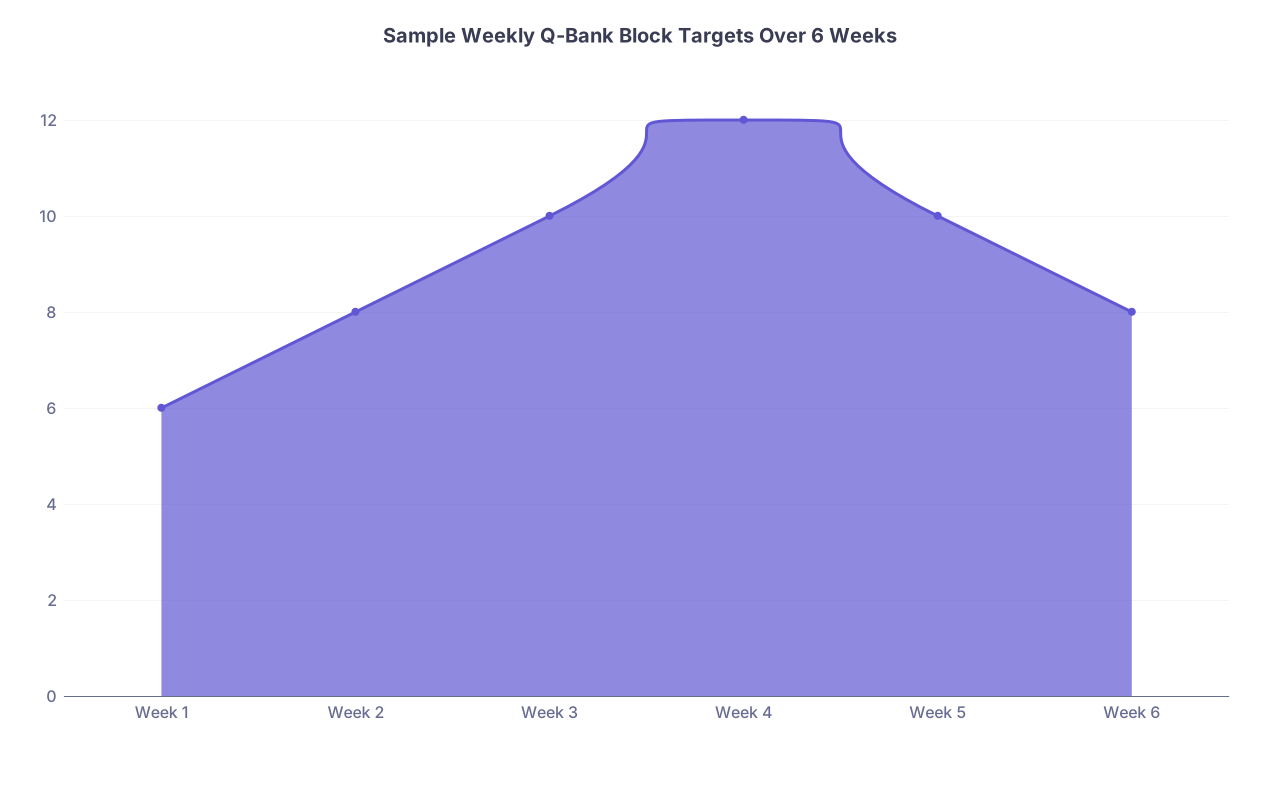
- 10–14 timed, mixed blocks per week if you are 3–4 weeks out.
- 6–8 blocks per week if you are 6–8+ weeks out with busy rotations.
- Focus on mixed blocks, not “I only do cardiology this week.” Step 3 is mixed.
Deliberate Review Block (The Fix Zone)
- 3–4 sessions per week where you:
- Revisit marked questions.
- Re‑do questions you missed cold after 3–5 days.
- Summarize recurring errors into short notes.
- 3–4 sessions per week where you:
Targeted Content Repair
- 30–60 minutes per day:
- One system or theme.
- From a short, high-yield resource, not a full textbook.
- 30–60 minutes per day:
CCS Practice
- 3–5 cases per week (more if your CCS percentiles are trash).
- Use NBME sample CCS + UWorld CCS (or whatever you have).
- Practice timing and sequencing, not just “click random things.”
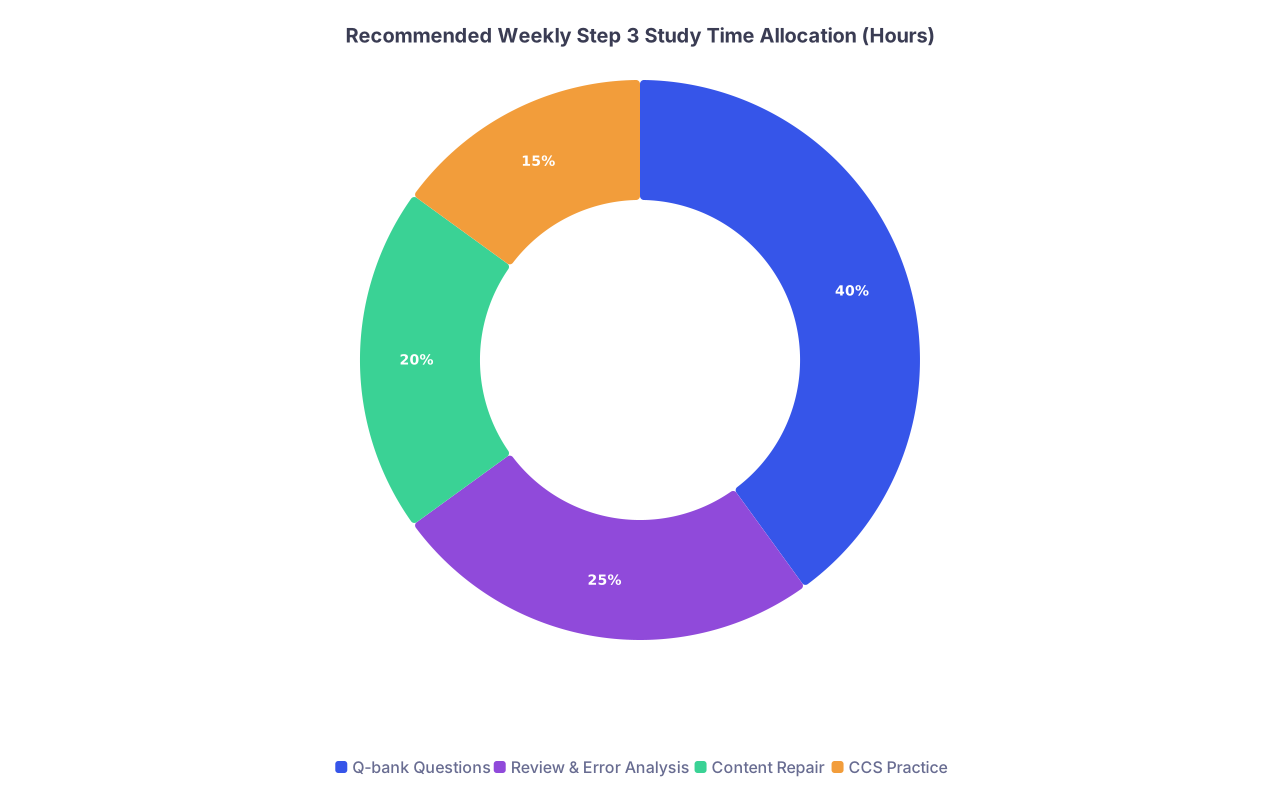
| Category | Value |
|---|---|
| Q-bank Questions | 8 |
| Review & Error Analysis | 5 |
| Content Repair | 4 |
| CCS Practice | 3 |
If your percentiles are low, the “review & error analysis” slice needs to be real. Not magical thinking: “I’ll just read explanations quickly and it will sink in.”
4. Fixing the Three Core Failure Modes
Low Q‑bank percentiles usually come from one or more of these:
- You do not know enough.
- You do not think in Step 3’s management style.
- You are bleeding points on test mechanics.
I will walk through how to fix each, concretely.
A. If You “Just Do Not Know Stuff”
You see questions and feel like you have never heard of half the answer choices. That is not a subtle pattern.
Protocol: Minimalist Content Repair
You are not going to read a Step 2 book cover-to-cover as a resident. You fix the 20% that yields 80%.
Pick one lean anchor resource:
- Examples: OnlineMedEd notes, a concise Step 3 review book, or high-yield PDFs your program recommends.
- Do not collect three. One.
Use your Q‑bank to drive what you read:
- For each block, pick 1–2 topics you repeatedly miss (e.g., perioperative management, diabetic meds, asthma step therapy).
- Read only those sections that night.
- Create micro-notes or a one-page “management snapshot.”
Build a “must-know” list:
- No more than 50–70 items total by test day.
- Each item is a specific decision point, not generalities:
- “When to start statin (age + risk factors).”
- “BP cutoffs for preeclampsia with severe features.”
- “First-line therapy for PTSD vs acute stress disorder.”
You are not assembling an encyclopedia. You are assembling a decision toolbox.
B. If You Know the Facts but Miss the “Next Best Step”
Very common in residents. You diagnose correctly, pick a reasonable test or therapy, but not the one the exam wants.
This is a Step 3 thinking problem: exam expects aggressive, guideline-based, risk‑stratified management.
Protocol: Algorithmization
Identify your top 5 “algorithm” pain points:
- Chest pain evaluation.
- Stroke workup and timing (tPA/windows).
- Sepsis bundles and fluid/pressors.
- Pregnancy triage / preeclampsia / labor management.
- Diabetic medication escalation.
For each, draw a simple decision tree by hand:
- Start with presentation (e.g., “Chest pain, stable vs unstable”).
- Branch by vitals, EKG, troponin, red-flag symptoms.
- Write actual Step 3 moves:
- “Unstable → immediate EKG + oxygen + IV + monitor.”
- “STEMI → emergent cath, not stress test.”
- “Low-risk chest pain + normal EKG and enzymes → outpatient stress.”
After drawing, test yourself on 5–10 related Q‑bank questions:
- Did your tree predict the correct “next best step”?
- If not, refine it.
Do this for 1–2 algorithms per week. That is enough to move percentiles.
C. If You Are a “Rush and Regret” Test-Taker
This is the person who reviews explanations and says “I knew that” to half the misses.
That is not knowledge. That is poor execution.
Protocol: Forced Slow-Down + Process Checklist
For your next 3 blocks, enforce a stem-first, options-second rule:
- Read the question stem and the exact task (“best next step,” “most likely diagnosis,” “most appropriate test”).
- Cover the answer choices with your hand/sheet.
- Predict what you expect to see.
- Then uncover and pick the closest.
Add a 10-second “anti-stupid” check on any uncertain question:
- Ask:
- “Is the patient unstable? If yes, do stabilization before fancy testing.”
- “Am I skipping basic tests and jumping to MRI/PET?”
- “Is there anything dangerous I have not ruled out?”
- Ask:
Track avoidable errors:
- After each block, count how many questions you got wrong where:
- You misread age/gestational week.
- You missed a word like “first-line” vs “most appropriate.”
- You ignored a contraindication in the stem.
- After each block, count how many questions you got wrong where:
Those are free points. Your initial goal is to cut those by half within 2 weeks.
5. Fix-First CCS Strategy (Because This Can Tank You Quietly)
People love to ignore CCS until 10 days before Step 3.
Then they find out that:
- They have no idea how to order insulin changes over 24 hours.
- They do not know when to advance the clock.
- They miss key initial orders (monitoring, nursing, consults, etc.).
Low performance on CCS-style questions in the Q‑bank is a big warning sign.
CCS Fix Protocol (2–3 Weeks Minimum)
Learn the interface using official practice cases first.
- NBME practice CCS is ugly but accurate.
- Do not go in blind. The software itself is a test.
Build an “Initial Orders Template” for:
- Unstable ED patient.
- Stable inpatient admission.
- Outpatient chronic disease follow-up.
- Pregnant patient triage.
Each template should include:
- Vitals, monitor, IV access, O2 if needed.
- Basic labs (CBC, BMP, LFTs, etc. when appropriate).
- Imaging if indicated.
- Necessary consults.
- Nursing orders (I&Os, NPO status, bedrest vs ambulation).
- Prophylaxis (DVT, GI in ICU, etc.).
Practice full-length CCS cases with a fixed workflow:
- First 2 minutes::
- Read stem fully.
- Decide: ED vs inpatient vs outpatient.
- Decide: stable vs unstable.
- Next 5 minutes:
- Fire off all initial orders you know are needed.
- Do not under-order. The exam does not charge “cost.”
- Then:
- Advance clock logically: when results would return, or clinical changes expected.
- Reassess vitals and symptoms regularly.
- First 2 minutes::
Debrief each case:
- List 3 things you missed or delayed.
- Add them to a “CCS moves” one-page sheet (e.g., “Always order prenatal vitamins + folate in pregnant patients,” “Check microalbumin in diabetics”).
Three CCS sessions per week, 2–3 cases each, for 3 weeks is enough to go from chaos to competent.

| Step | Description |
|---|---|
| Step 1 | Read Case Stem |
| Step 2 | ABCs + Immediate Orders |
| Step 3 | Focused H&P + Baseline Orders |
| Step 4 | Reassess Vitals |
| Step 5 | Review Results |
| Step 6 | Advance Clock + Continue Plan |
| Step 7 | Escalate Care / New Orders |
| Step 8 | Disposition Decision |
| Step 9 | Finalize Case & Checklist Review |
| Step 10 | Stable or Unstable? |
| Step 11 | Improving? |
6. Turn the Percentiles Around: 4–6 Week Game Plan
Let me put this into a realistic timeline. Assume you are:
- In residency.
- Have 4–6 weeks to Step 3.
- Currently sitting in the 20–40th percentile on your main Q‑bank.
Here is the fix-first schedule that actually works.
Week 1: Diagnosis and Stabilization
- 4–6 mixed, timed blocks (38–40 questions).
- After each block:
- Full review of wrongs + half of the “guessed right” ones.
- Tag each miss by cause (knowledge vs management vs sloppiness).
- Identify your top 3 systems and 3 algorithms that are truly weak.
- Start CCS with:
- 2–3 simple NBME practice cases to learn the interface.
- Write your initial order templates.
Week 2–3: Focused Repair + Consistency
- 8–10 blocks per week.
- Always timed, always mixed.
- Each day:
- 1–2 focused topics for content repair (linked to recent misses).
- 30–45 minutes of reading + adding to your high-yield sheet.
- CCS:
- 3 sessions per week, 2 cases each.
- After each case: write 3 “never forget again” moves.
- By end of Week 3, your percentile should start creeping into the 35–50+ range if you are actually doing the review and not just blasting questions.
Week 4–5: Refinement and Stress Testing
- 10–12 blocks per week if your schedule allows.
- Introduce two “full exam” days:
- 6 blocks in a row (with breaks) to simulate fatigue.
- 3–4 CCS cases on a separate session.
- Prioritize:
- Reducing preventable errors.
- Nailing your core algorithms.
- Speed + accuracy under realistic timing.
Week 6 (If You Have It): Light Polish, Not Cram Madness
- Decrease volume slightly.
- 6–8 blocks total.
- Focus on:
- Re-doing previously missed questions.
- Reviewing your 50–70 “must-know decisions.”
- CCS practice for tricky case types (OB, peds, ICU).
You are not chasing perfection here. You are ensuring you do not walk into Step 3 with the same structural weaknesses your Q‑bank percentiles revealed 4 weeks earlier.
| Category | Value |
|---|---|
| Week 1 | 6 |
| Week 2 | 8 |
| Week 3 | 10 |
| Week 4 | 12 |
| Week 5 | 10 |
| Week 6 | 8 |
7. Mindset: What To Ignore, What To Care About
You will hear a lot of noise:
- “Step 3 does not matter.”
- “Programs never look at the score.”
- “Everyone cruises through with minimal prep.”
I have watched residents scramble for fellowships, visas, or competitive jobs where suddenly that Step 3 score is not invisible anymore.
You do not need a 260. You do need to:
- Pass comfortably.
- Avoid a red-flag fail.
- Not burn your life down in the process.
Here is what matters:
- Trend > snapshot. Daily fluctuation in percentiles is normal. Two weeks of trending from 25th to 40th to 50th is what you want.
- CCS competence. Not mastery, competence. The curve is kind.
- Stupid mistakes shrinking. That is the fastest path to real improvement.
Here is what you can ignore:
- Getting every esoteric zebra correct in the Q‑bank.
- Comparing your percentiles to that co-resident who has not touched a patient in weeks.
- Perfectly finishing the Q‑bank if it means rushing and not learning from it.
You are not trying to win the Q‑bank. You are using it as a tool to fix specific problems.
8. Quick Triage: If Your Exam Is Very Soon
If Step 3 is ≤10 days away and your Q‑bank percentiles are still low, you do not have time for the full rebuild. You need a damage-control plan.
10-Day Emergency Plan
Prioritize CCS
- 2–3 CCS sessions, 3–4 cases each.
- Focus on:
- ED unstable management.
- Common inpatient (CHF, COPD, pneumonia, DKA).
- Bread-and-butter OB/peds.
Stop adding new resources
- Commit to one Q‑bank + one short content source.
- No new books or video series.
Focus Q‑bank on mixed blocks + review of past misses
- Alternate:
- New mixed timed block.
- Re-do older incorrect questions (timed or tutor mode).
- Alternate:
Review your checklists and management trees daily
- Especially:
- Sepsis.
- ACS and chest pain.
- Stroke.
- Pregnant patient complications.
- Diabetic emergencies.
- Suicide risk / psych emergency.
- Especially:
Will this magically turn a 20th percentile into a superstar? No. But it will prevent easy failures and stabilize your performance.

FAQ (Exactly 2 Questions)
1. My Step 3 Q‑bank percentile is ~25th but I am passing self-assessments. Should I postpone my exam?
Postponement is not automatic at 25th percentile. It depends on:
- How close you are to the exam (if you have 4–6 weeks, improvement is realistic).
- Whether your self-assessments (NBME or UWSA) predict a pass with a safe margin.
If you are:
- Within 2–3 weeks of the exam, and
- Your predicted score is hovering just above the pass line, and
- Your Q‑bank percentiles are not trending upward,
then postponing is reasonable if:
- Your program and visa/job situation allow it.
- You will actually use the extra time according to a structured plan (like the one above), not just “do more questions randomly.”
If you have ≥4 weeks and can follow a fix-first strategy—targeted content repair, CCS practice, and error analysis—I would usually not rush to postpone. I would re-check with a self-assessment 7–10 days before the date and make the final call then.
2. I failed Step 3 once and my Q‑bank percentiles are still low. How should I adjust this strategy?
A prior fail changes the stakes. You cannot afford another borderline performance.
Three modifications:
More aggressive content repair
- Double the daily content block (e.g., from 30 to 60 minutes).
- Systematically hit your weakest systems from the fail score report first.
Documented error log
- After each block, write down:
- Question #.
- Topic.
- Exact reason you missed it.
- Review this log every 3–4 days. Patterns will jump out—e.g., you keep undertreating, missing age cutoffs, or choosing imaging over labs.
- After each block, write down:
Earlier self-assessment checks
- Instead of waiting until 1–2 weeks out, take a self-assessment 3–4 weeks before your planned date.
- If that score is not at least 10–15 points above the passing threshold, push the exam and retool intensively.
Do not treat a repeat attempt like a “small adjustment.” You need a deliberate rebuild: structured study, CCS practice, and ruthless focus on the exact mistakes that sank you the first time.
Key points:
- Low Q‑bank percentiles are not a personality trait. They are a signal of specific fixable problems—knowledge gaps, management thinking, or sloppiness.
- A fix-first strategy means: diagnose your weak spots, build a simple weekly structure, attack CCS early, and shrink preventable errors.
- You do not need to be perfect. You do need to stop pretending Q‑bank misery is random. It is not. And now you know exactly how to fix it.