
The usual Step 3 advice is backwards. You do not need another textbook or a 300-page CCS manual. You need to squeeze every last drop of value out of the question data you are already generating and turn it into a systematic score engine.
I am talking about raising your Step 3 score by 20+ points using nothing but question data: your Q‑bank performance, timing logs, error patterns, CCS results, and a few simple tracking tools. No new resources. No 8-hour “content review” days. Just disciplined, targeted work based on what the numbers are screaming at you.
Let me walk you through how to do this like an adult with limited time, not a preclinical student with color-coded binders and endless free hours.
Step 1: Diagnose Your Baseline Using Brutal Data, Not Vibes
First problem: most residents “feel” where they are weak. Feels are useless. Step 3 does not care how you feel about cardiology.
You start with hard data from what you already have:
- NBME / Free 120 / UWSA / Q‑bank self-assessment
- Question bank performance reports
- Timing data
- CCS case performance (if your Q‑bank has simulations)
You are going to build a baseline picture that you can actually act on.
A. Pull Your Current Numbers
If you have done at least ~400–600 questions, you have enough data to start.
From your Q‑bank dashboard, extract:
- Overall percent correct
- Percent correct by:
- Discipline (IM, peds, OB, surgery, psych, etc.)
- System (cardio, pulm, GI, etc.)
- Task (diagnosis, management, prognostic factors, preventive care, ethics)
- Average time per question
Then from any practice test (NBME/UWSA/Free120 if done):
- Predicted 3-digit score (or conversion estimate)
- Score by system / content area if available
Put this into a simple table or sheet. Nothing fancy.
| Metric | Value |
|---|---|
| Overall Q-bank % correct | 63% |
| Internal Medicine | 58% |
| OB/GYN | 49% |
| Pediatrics | 68% |
| Psychiatry | 74% |
| Avg time/question | 87 seconds |
| Latest self-assessment | 205 (est.) |
If you have not started any questions yet, start a Q‑bank and hammer out 300–400 mixed, timed questions over 3–4 days. Then do this baseline pull. You cannot plan from zero.
B. Look for the Real Problem Zones
You are not just looking for “weak subjects.” You are looking for:
- Consistent underperformance: Anything <55–60% that stays low across blocks
- High variance: Systems where you swing from 40% to 80% between blocks
- Timing issues: Constantly finishing with <3 minutes left, or rushing the last 5–10 questions
Also mentally note:
- Questions you “almost changed” but did not
- Questions where you had no idea what they were asking
- Questions where you misread the stem
Those patterns matter more than “I am bad at OB.” Everyone thinks they are bad at OB.
Step 2: Build a Minimal Tracking System That Actually Changes Behavior
If you do not track errors, your brain will happily forget them. Then you will repeat them on test day.
You need one lean, brutally practical tracking system. Not a 12-tab spreadsheet you abandon in 3 days.
A. The One Spreadsheet That Matters
Create a simple sheet with columns like this:
- Date
- Q‑bank / Test (e.g., UWorld block 12, Amboss block 5)
- Question ID or brief tag
- Topic (e.g., “OB – gestational diabetes management”)
- Type of error:
- Knowledge gap
- Misread question
- Poor test-taking / overthinking
- Timing/rushing
- CCS process error (for cases)
- Why I missed it (1–2 short lines)
- Correct takeaway (the rule / principle in 1–2 lines)
- “Fix” category:
- Flashcard made
- Added to daily review list
- Need to read brief reference (1–2 pages max)
You are not writing essays. You are encoding rules.
For example:
“OB – gestational diabetes management – chose metformin instead of insulin; forgot that insulin is preferred if diet fails during pregnancy; knowledge gap; takeaway: in pregnancy, insulin is first-line when lifestyle fails for GDM; made 1 flashcard.”
This is the backbone of your 20‑point jump.
B. Classify Your Errors Ruthlessly
There are really only four types of errors that matter. You must know which ones dominate your score loss.
Pure knowledge gap
- You just did not know the fact or guideline
- Fix: micro-content review + 1–3 flashcards
Misinterpretation / misread
- Skimmed the age, missed a keyword like “pregnant,” or ignored vitals
- Fix: stem-reading protocol (we will build this later)
Test-taking / reasoning error
- You knew the facts but failed to prioritize risk, missed contraindication, or fell for a distractor
- Fix: pattern recognition training and explicit decision rules
Timing error
- Rushed, guessed, or did not finish
- Fix: question pacing protocol and “two-pass” thinking
If you do not label the error type, you will default to “I need to read more” which is almost always wrong and almost always a time sink.
Step 3: Turn Question Data Into a Targeted Study Map
Now the fun part: using your data to decide exactly what to do each day.
A. Prioritize By Score Impact, Not Emotion
You are going to rank your weak areas by how often they show up and how much they cost you, not by how much you hate them.
From your Q‑bank analytics:
Identify:
- Top 3 systems you are weakest in (by % correct)
- Top 3 task types you struggle with (e.g., emergency management, chronic management, counseling, ethics)
Within each of those, use your error log to list the specific recurring topics. Example:
- OB: preeclampsia management, postpartum hemorrhage, contraception in breastfeeding moms
- IM: CHF meds optimization, diabetic complications, COPD management escalations
Your goal is to end up with a short “high-yield fix” list of about 10–20 concrete topics, not “I need to review OB.”
Those 10–20 topics are where a big chunk of your 20‑point gain will come from.
B. Build a Weekly Plan Focused on Question-Derived Topics
You do not need a fancy 8-week schedule. You need 1–2 weeks at a time, driven by your data.
Example for a busy resident aiming for a 20-point bump in 4–5 weeks:
Per weekday
- 20–30 mixed, timed Qs (one block)
- 45–60 minutes detailed review and error logging
- 10–15 minutes flashcard review (only the ones from your misses)
Per weekend day
- 40–60 Qs (two blocks)
- 90–120 minutes review
- 20–30 minutes flashcards
- 1–2 short topic reviews (only from your “high-yield fix” list)
You are not doing broad content review. You are doing:
“I have missed postpartum hemorrhage protocols 4 times this week → I spend 20 minutes with a concise summary and then do 10 OB questions focusing on that scenario.”
That is how you move scores.
Step 4: Build a Rock-Solid Question Review Protocol
People waste 70% of the value of Q‑banks by reviewing them lazily. “Read the explanation and move on” is how you stay stuck at 210.
You need a system.
A. During the Block: Timing and Discipline
Use mixed, timed blocks as much as you can. That is what Step 3 feels like.
Your pacing rule:
- Aim for ~75 seconds per question on average
- Hard cap: do not cross 90 seconds on any one question unless you are ahead of time
- If stuck at 60 seconds: eliminate obvious wrongs, pick your best answer, move on
If you constantly end with <2 minutes remaining, you are too slow. That is fixable.
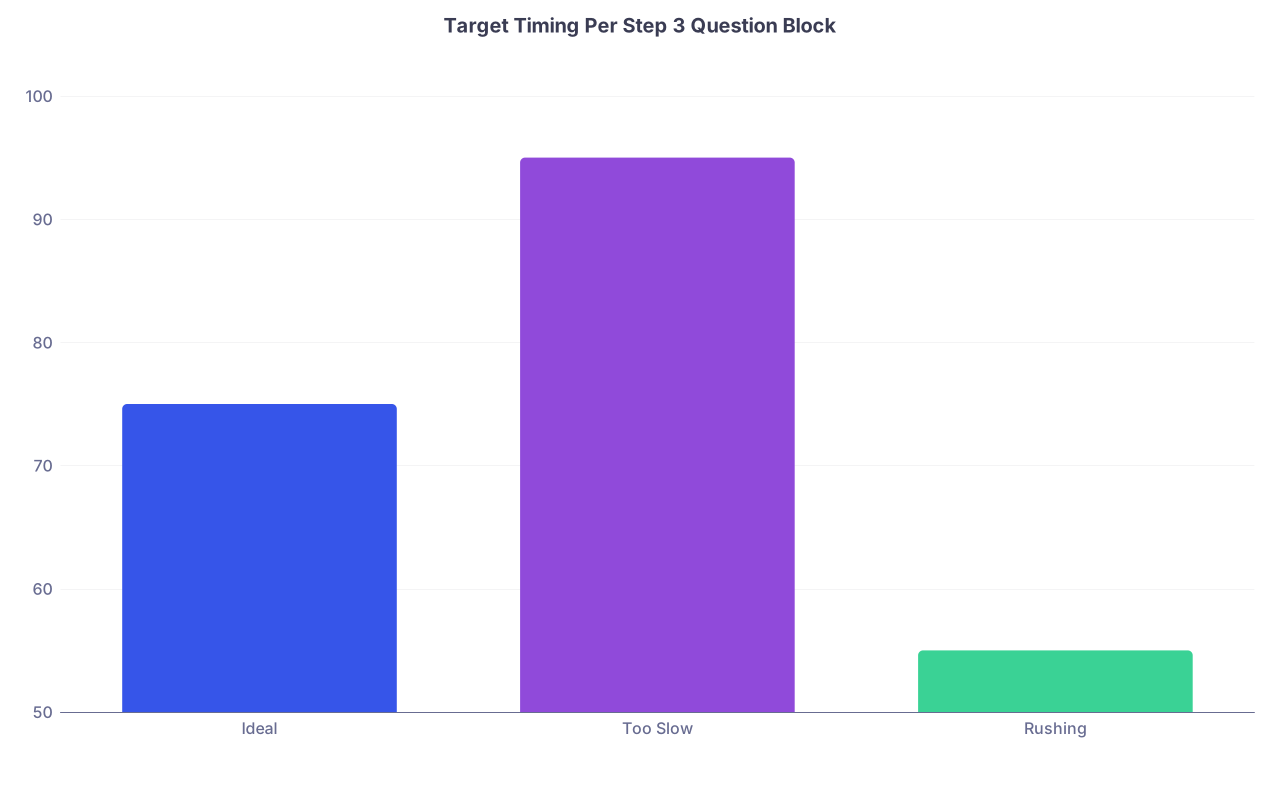
| Category | Value |
|---|---|
| Ideal | 75 |
| Too Slow | 95 |
| Rushing | 55 |
B. After the Block: The 4-Pass Review
For each block (say 20 questions), your review should follow this pattern:
Quick score + timing check (2–3 minutes)
- Overall correct %
- Any time you went >90 seconds?
Triage questions into 3 piles
- “I was confident and right”
- “I was unsure / guessed (right or wrong)”
- “I was confident and wrong” (these are gold)
Spend almost no time on “confident and right.” The other two piles are where you gain points.
Deep review of “unsure” and “confident wrong” (main time sink) For each question:
- Rephrase the stem in your own words. One sentence: “35-year-old with acute shortness of breath, postpartum, risk factors for PE, stable vitals.”
- Articulate what the question is really asking: “Next best step in management?” or “Most likely diagnosis?”
- Recall your thought process and why you chose your answer. Not “I guessed.” What did you think was happening?
- Compare with the explanation and identify:
- Knowledge gap vs process error
- Single key detail you missed (e.g., age, pregnancy, time course, red flag)
- Write the 1–2 line takeaway in your sheet
Convert to a permanent rule / flashcard if
- You can imagine seeing this scenario again on Step 3
- It highlights a guideline, contraindication, or stepwise management rule
If you never say out loud (or write) why you missed a question, you will miss it again. The explanation alone does not update your internal algorithm.
Step 5: Use Question Data To Fix Your Clinical Reasoning, Not Just Memory
Step 3 is not Step 1. The exam is not only “do you know the fact,” it is “do you know what to do next and in what order.”
Your data will highlight recurring reasoning failures:
- Ordering tests before stabilizing the patient
- Overtesting low-risk patients
- Escalating care too early or too late
- Choosing the wrong level of care (clinic vs ED vs ICU)
You need explicit decision rules.
A. Create Micro-Algorithms from Missed Questions
Example from error log:
You keep getting chest pain triage questions wrong. Sometimes you send to ED, sometimes outpatient, sometimes miss inpatient admission.
You construct a 5-line algorithm from your misses:
- Unstable vitals or suspected ACS with concerning EKG → ED + possible admission
- Classic anginal symptoms with risk factors → stress testing or cardiology referral
- Atypical, reproducible chest wall pain in young healthy adult → outpatient follow-up
- Pleuritic chest pain after immobilization / surgery → evaluate for PE
- Never send home chest pain with red flags just because troponin is “normal” once
You do this for:
- Syncope
- GI bleeding
- Pregnancy bleeds
- Pediatric fevers
- Headaches with red flags
Every cluster of 3–4 similar missed questions should become a mini-heuristic.
B. Spot Over- and Under-Treatment Patterns
Your question data often shows this pattern:
- You over-treat benign conditions (too much CT, too many antibiotics)
- You under-treat dangerous ones (send high-risk patients home, delay imaging)
When you see this in your error log, write blunt rules:
- “Do not CT every headache. Reserve CT/MRI for red flag features: age >50, sudden onset, neuro deficits, immunosuppression, cancer history, trauma.”
- “Do not send home a 70-year-old with exertional chest pain and risk factors, even if initial tests are not conclusive.”
You are training your brain to default to safe, evidence-aligned decisions under time pressure.
Step 6: Treat CCS Like Another Question Bank, Not a Mystery
Most people treat CCS as this mystical beast. It is not. It is just a long, interactive “what is the next best step” engine.
Same principles apply: track your mistakes, extract rules, and practice the pattern.
A. Log Every CCS Case
Every CCS case you do, you log:
- Case title / chief complaint
- What went well
- What you missed:
- Key initial orders you forgot
- Wrong setting (clinic vs ED vs inpatient)
- Wrong timing (delayed treatment, unnecessary delay)
- Forgetting monitoring (vitals, repeat labs, follow-up imaging)
- 2–3 line “ideal flow” of the case
Example:
“Case: 65-year-old man with fever, productive cough, pleuritic chest pain. I admitted him but forgot to order blood cultures and did not start antibiotics early. Fix: in suspected CAP with systemic signs, ED → oxygen, vitals, CBC, CXR, blood cultures, empiric IV antibiotics, then admit.”
B. Extract CCS-Specific Rules
From 10–20 CCS cases, you should start to build a CCS “playbook”:
- Standard admission order bundles (CBC, CMP, CXR, EKG, IV access, etc.)
- When to move the patient:
- Clinic → ED
- ED → inpatient vs ICU
- When to advance the clock vs stay and monitor
- Pain management and supportive care basics you repeatedly forget
You do not need CCS books if you treat each case as a data point and build your own playbook from your mistakes.
Step 7: Use Practice Test Data to Course-Correct, Not Panic
You should use at least one, preferably two, self-assessments to measure progress and re-aim your efforts.
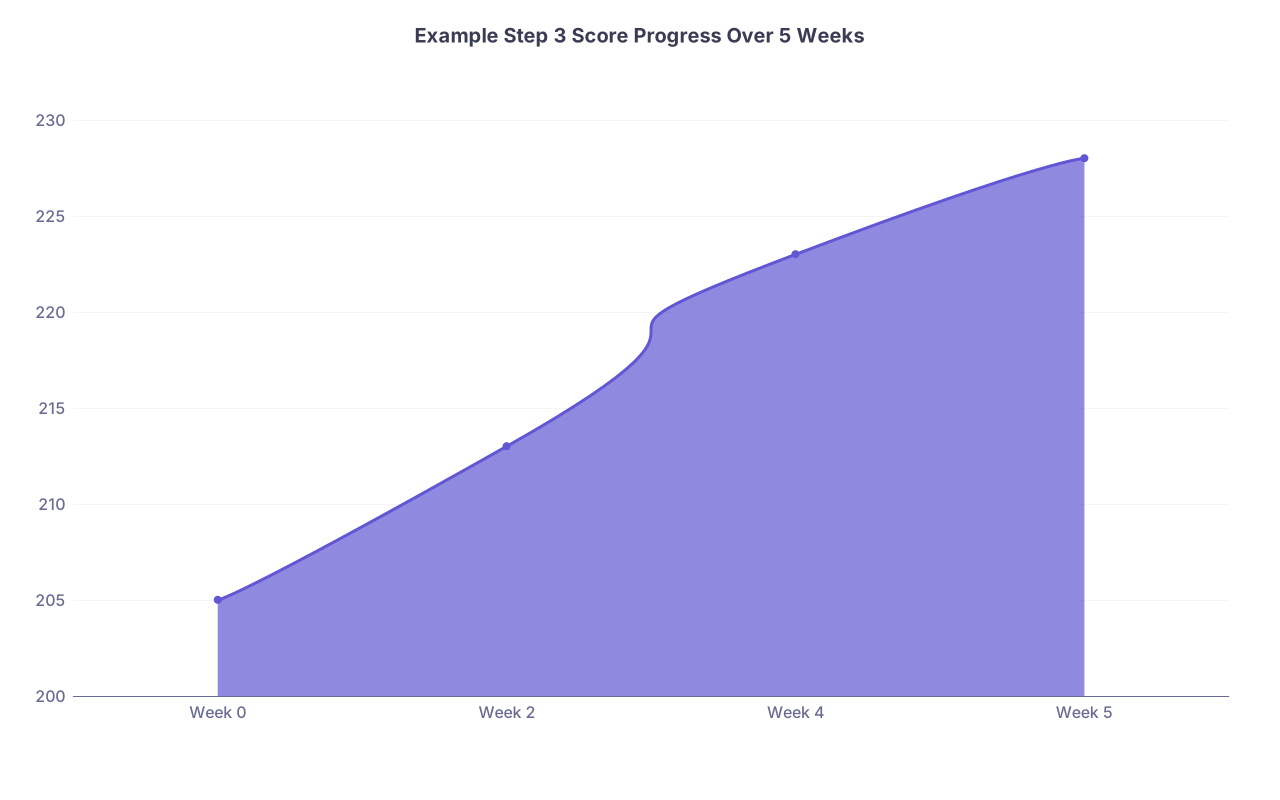
| Category | Value |
|---|---|
| Week 0 | 205 |
| Week 2 | 213 |
| Week 4 | 223 |
| Week 5 | 228 |
A. When to Take Them
Rough guide:
- Week 0 (or baseline): if you already have one in the last 4 weeks, use that
- Week 2–3 of serious study: one self-assessment
- Week 4–5 (7–10 days before exam): final self-assessment
Then you treat the score report like any other question dataset.
B. How to Mine the Score Report
Do not obsess over the exact score. Instead:
- Identify 2–3 content domains where you are below average
- Identify task types (diagnosis vs management vs prognostic) where you are lagging
- Compare with your Q‑bank patterns:
- Are the same domains weak in both? Good, that is a clear target.
- If not, your question bank may not be mirroring test content; focus more on the test’s weak domains.
Every self-assessment should produce:
- 5–10 specific topics added to your “high-yield fix” list
- 1–2 reasoning or timing patterns to work on
Step 8: Tighten Your Exam-Day Behavior Using Data
Your question data tells you how you behave under pressure. You then write explicit rules for exam day so you do not fall back into bad habits when the clock is running.
A. Build a Personal Pacing Protocol
From your timing data and practice tests, define:
- Your target question number at each time checkpoint
Example for a 38-question block in 60 minutes:
- At 15 minutes: ~10 questions done
- At 30 minutes: ~20 questions done
- At 45 minutes: ~30 questions done
If you are behind at a checkpoint, you consciously speed up on the next 5–10 questions by:
- Skipping long calculation questions on first pass (marking them)
- Not obsessing over two close answer choices for more than 15–20 seconds
You have already trained this behavior in your Q‑bank blocks. Exam day is just running the same script.
B. Stem-Reading Protocol
If your error log is full of “missed the word pregnant / elderly / acute / chronic,” you need a hard rule:
For each question:
- Read the last line (the actual question) first: “What is the next best step in management?”
- Then read the stem with three things in mind:
- Who? (age, sex, pregnancy, comorbidities)
- How long? (acute vs chronic)
- How sick? (vitals, red flags)
Underline or mentally tag those three. Those are what Step 3 punishes you for ignoring.
Step 9: Put It All Together – A 4–5 Week 20-Point Plan
Let me give you a concrete outline of how this might look for a typical resident starting at ~205–210 aiming for 225–230+.
Week 1: Baseline and System Setup
- 400–500 mixed, timed Qs
- Build and start using your error log
- Identify top 10–20 “high-yield fix” topics
- 1 CCS practice session (3–4 cases), basic logging
Focus: getting honest data and installing habits for question review.
Week 2: Targeted Repair and Reasoning
- 300–400 mixed, timed Qs
- Daily error logging and flashcard creation
- 1 self-assessment at the end of the week → update your weak-topic list
- 1–2 CCS sessions (3–6 cases total)
Focus: turn patterns of misses into explicit rules and micro-algorithms.
Week 3: Compression and Refinement
- 300–400 mixed Qs
- Focused review on recurring weak domains from both Q‑bank + self-assessment
- Cut any broad reading; only micro-targeted topic reviews
- CCS practice focusing on scenarios you repeatedly mishandle (shock, sepsis, pregnancy complications, peds emergencies)
Focus: consistency. Fewer “swing” blocks, fewer silly errors.
Week 4 (and 5 if you have it): Exam Simulation and Polishing
- 200–300 mixed Qs (more full blocks back-to-back to build stamina)
- Final self-assessment 7–10 days before exam
- Tighten pacing / stem-reading / decision rules
- Light CCS practice, mostly to keep flow fresh
- Reduce new flashcard creation; mostly review existing ones
If your data-driven work has been honest, your predicted score should be up by 15–25 points from baseline. Not magic. Just accumulating fewer avoidable errors on every block.
The Three Big Levers That Actually Move Your Step 3 Score
Let me end this cleanly.
If you strip everything else away, your 20+ point Step 3 jump using only question data comes from doing three things better than most people around you:
You stop guessing why you are weak and let the numbers tell you.
You look at your Q‑bank and self-assessment reports, build a simple error log, and let recurring patterns dictate your study priorities.You treat every missed question as a rule to be written, not a wound to be licked.
You explicitly label error types, convert them into 1–2 line principles, and revisit those principles until they are automatic.You train exam-day behavior directly from practice data.
Timing, stem-reading, CCS flow, escalation decisions—all refined through hundreds of practice questions and logged cases, then enforced by simple personal protocols.
You do not need more resources. You need to respect the question data sitting in front of you and use it like a professional, not a panicked student.