
Last week, an exhausted PGY-1 sat in a hospital lactation room scrolling through her UWorld stats with one hand and holding a breast pump with the other. Her Step 3 permit window was closing in three months. She’d just come back from maternity leave. And she was honestly one more night float away from cancelling the exam and pretending it didn’t exist.
If that feels uncomfortably familiar, this is for you. You’re not just “a resident studying for Step 3.” You’re a pregnant or postpartum resident trying to pass a 2-day exam while your body, schedule, and life are all on hard mode.
Let’s walk through what actually works in this situation—not in theory, but in real residency life.
Step 3 Reality Check When You’re Pregnant or Postpartum
Here’s the blunt truth: Step 3 is absolutely passable in this phase of life. I’ve seen residents do it pregnant with twins, nursing a 4-week-old, on nights, on ICU. But they all had one thing in common: they treated Step 3 like a logistics problem, not a knowledge problem.
You’re not failing Step 3 because you’re not smart enough. You’re at risk of failing because:
- You’re chronically sleep-deprived, making long test days brutal.
- Your schedule is chaotic—call, clinic, pumping, newborn nights.
- Your brain is split between “patient list” and “did I pack enough milk / diapers / snacks?”
- You underestimate how much exam-day stamina you’ve lost postpartum.
So the approach has to change. Less “perfect full content review”. More “strategic minimum work that gets you over the bar”.
Step 1: Decide When to Take Step 3 (Pregnancy vs Postpartum)
The timing decision is huge. And it’s probably stressing you out more than the actual exam.
The three realistic windows
| Timing Option | Pros | Cons |
|---|---|---|
| Late pregnancy (2nd/early 3rd trimester) | Brain still relatively sharp, no newborn yet | Physical discomfort, unpredictable complications |
| Early postpartum (6–12 weeks) | Some leave time, content somewhat fresh | Sleep chaos, emotional rollercoaster |
| Later postpartum (3–9 months) | Baby’s schedule slightly more predictable | More work demands, harder to get days off |
Now, how to choose.
If you’re pregnant
Ask yourself:
How is your pregnancy actually going? Not the Instagram version.
- Hyperemesis? Complications? Contractions with standing?
- Or moderate fatigue but functioning on the wards?
What’s your rotation schedule?
- Easy elective or outpatient block in 2nd trimester? That’s prime.
- Heavy ICU in late 3rd trimester? Forget it. Move the exam.
For most people, the sweet spot is:
- Second trimester or very early third trimester.
- During a lighter rotation (clinic, consults, elective), with guaranteed post-call days honored.
- Book the 2 days of Step 3 at least 2–3 weeks apart from 36 weeks onward if there’s any hint of instability in your pregnancy.
If you’re having a complicated pregnancy or you’re already mentally and physically underwater, stop trying to be a hero. Push the exam postpartum.
If you’re postpartum
Be honest about this: the first 4–6 weeks are not a “study window.” They’re survival.
Good timing choices:
8–12 weeks postpartum, if you have:
- Some kind of leave / lighter re-entry rotation.
- Another adult who can protect 2–3 hour study blocks a few times a week.
3–6 months postpartum, if:
- You’re back at work, you’ve stabilized child care.
- Your brain feels less foggy and your mood is reasonably steady.
I get asked a lot: “Is it worse to take it postpartum?” It’s not worse. It’s just different. Your issue won’t be knowledge; it will be fatigue and focus. Those are fixable with planning.
Step 2: Build a Realistic Study Plan for a Sleep-Deprived Brain
If someone hands you a 12-week, 3-hours-per-day Step 3 plan, throw it out. That might work for a single PGY-2 with no kids. It’s fantasy for you.
You need to think in minimum viable plan terms.
Your realistic weekly target
Most pregnant/postpartum residents can pull off:
- 150–200 UWorld questions per week
- 3–5 short study blocks (30–75 minutes each)
- One longer “catch-up” session on a lighter day, if partner/help present
You do not need to complete every resource on Earth. You do need:
- One primary question bank (UWorld Step 3 is standard)
- Basic CCS practice (UWorld CCS cases or CCS-specific tool)
- A quick high-yield review of topics you’re weak on
That’s it.
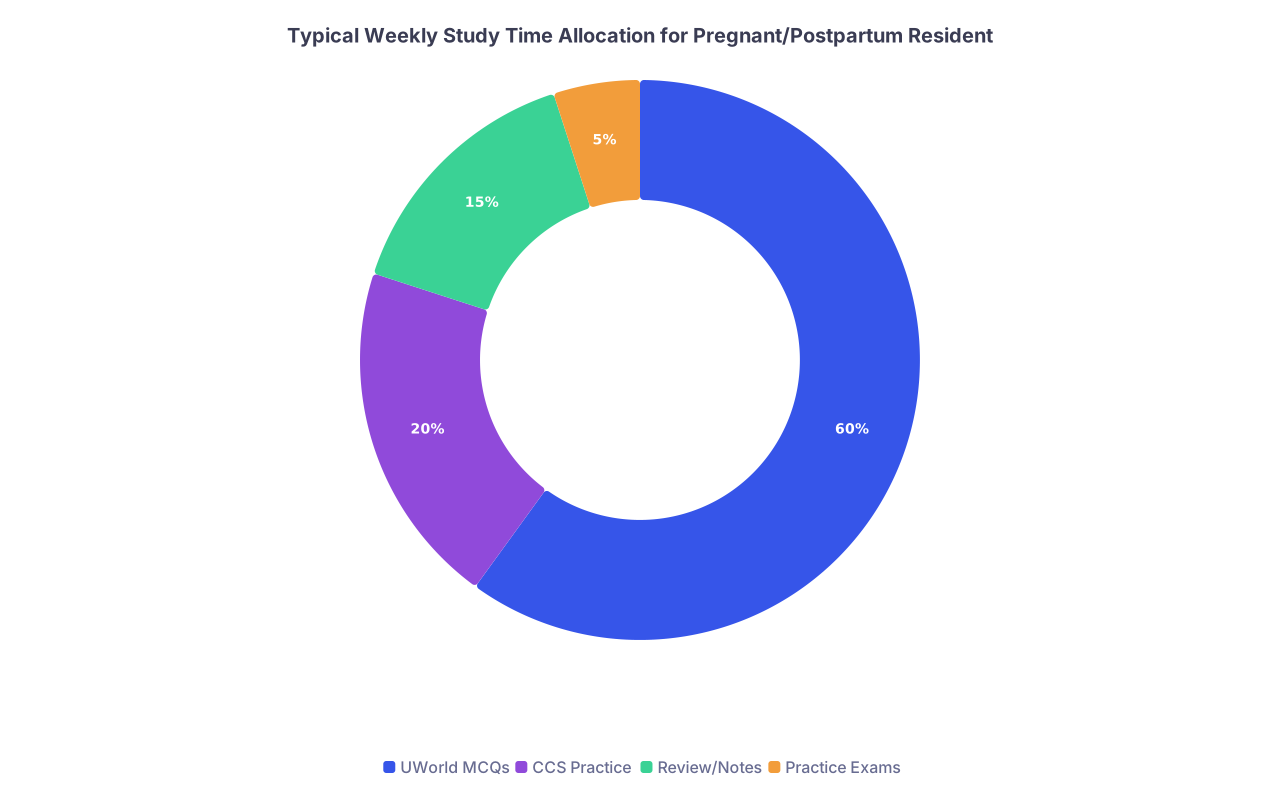
| Category | Value |
|---|---|
| UWorld MCQs | 60 |
| CCS Practice | 20 |
| Review/Notes | 15 |
| Practice Exams | 5 |
Micro-block study strategy
Pregnancy and postpartum destroy uninterrupted time. So stop pretending you’ll have it.
Here’s how to break it down:
20–30 minute blocks:
- 10–15 timed or tutor questions + rapid review.
- Great for:
- Pump breaks (if you’re OK combining that mentally).
- Sitting in your parked car before/after shift.
- During baby’s short nap if you can actually think.
45–60 minute blocks:
- 15–20 questions + review or
- CCS practice + reading key teaching points.
One 90–120 minute block a week (if possible):
- Practice exam chunk (NBME style, UWorld self-assessment).
- Or cumulative review of incorrects.
You’re not trying to recreate Step 1 study camp. You’re building stamina and pattern recognition in small bites.
Step 3: Protecting Study Time in Residency While Pregnant or Postpartum
No one is going to hand you time. You have to carve it out and defend it.
Use your schedule, not your feelings
Do this once you know your exam month:
Pull your call/clinic/rotation schedule.
Mark:
- Post-call days (often good for 1 small block once you’ve slept).
- Lighter clinic days.
- Days off.
On each of those, pre-assign:
- “20–30 UWorld questions”
- “1 CCS case”
- “Review weak area: diabetes in pregnancy, asthma, etc.”
If your brain is toast on a given day, you can swap tasks, but you’re not deciding from scratch every time. That’s how you avoid the “I’ll start tomorrow” spiral.
Boundaries you actually say out loud
If you have a partner, family member, or childcare support, you must say:
“On Tuesdays and Saturdays from X–Y, I’m not on baby duty. That’s Step 3 time. Non-negotiable unless there’s an emergency.”
In residency, you tell your seniors/PD something like:
“I’m scheduled for Step 3 in [month]. I’m working through practice questions now. On post-call days I’ll be leaving by [time] unless there’s a true emergency so I can maintain my study schedule.”
Not asking permission. Just setting expectations.
Step 4: Picking Resources That Don’t Waste Your Time
You do not have bandwidth for five resources. Choose ruthlessly.
Core resources
UWorld Step 3 Qbank
Non-negotiable. Do as many questions as you reasonably can, ideally all, but I’d rather see you do 70% well than 100% half-asleep and rushed.CCS practice
At least:- 15–20 interactive cases
- 10–15 “real-time” practice runs to get used to the interface and thinking quickly
One high-yield outline or short text (optional, but helpful)
- Many residents like a condensed Step 3 review book or online step-up-style outline.
- Use it mostly to clarify weak spots revealed by questions, not as a “read cover to cover” task.
Skip the giant video course unless you truly have time. I’ve watched too many residents binge videos at 1.5x speed at midnight and retain nothing.
Step 5: Managing Pregnancy/Postpartum Symptoms While Studying
Your body is not neutral here. That matters.
If you’re pregnant
Common issues and fixes:
Nausea/fatigue:
- Do questions during your “least bad” time of day.
- Use audio review (podcast-style) for low-energy periods if that helps you.
Back pain / swelling:
- Study in supportive seating, not slumped on the couch balancing a laptop on your belly.
- Set a timer to stand/stretch every 25–30 minutes.
Brain fog:
- Emphasize repetition over perfection. It’s fine if you don’t “feel sharp.” Pattern recognition still builds.
If you’re postpartum
Sleep fragmentation:
- Accept that you’re never at 100% alertness. The game is “good enough.”
- Avoid high-stakes practice exams late at night. They’ll tank your confidence more than they help.
Breastfeeding / pumping:
- Decide intentionally if you’ll study while pumping or keep that separate:
- If you combine: use that as predictable 20–30 minute question blocks.
- If you separate: use pumping as pure downtime. No guilt.
- Decide intentionally if you’ll study while pumping or keep that separate:
Mood:
- If you have any suspicion of postpartum depression or anxiety, get that treated first or alongside Step 3 prep.
- A barely-treated mood disorder will sabotage your concentration more than missing 200 questions of practice will.
Step 6: Exam Logistics for Pregnant/Postpartum Residents
This part is where a lot of people quietly suffer because they don’t realize they can ask for accommodations or plan details.
Talk to your doctor early
Get a note if needed for:
- Extra break time (for frequent bathroom trips in late pregnancy or pumping).
- Ability to bring snacks, water, or medical supplies.
- Back support cushion if sitting long hours is an issue.
- If high-risk pregnancy or postpartum complication makes two long exam days problematic, document it.
Then talk to Prometric/USMLE accommodations office early. These wheels turn slowly.
Pumping during Step 3
If you’ll need to pump during the exam days:
Contact Prometric ahead of time:
- Ask about a private space (not a bathroom) for pumping.
- Confirm policies: can you store milk in a cooler? Where?
Build pumping into your break strategy:
- You get limited break time total. Pumping may use a big chunk of it.
- Practice at least one long block of questions + timed pump break at home to see how it feels.
Practical trick: if supply allows, pump right before you go in and immediately after, so you might need only one pump session mid-day per exam day.
Physical comfort on exam days
Plan like a pregnant/postpartum athlete:
- Wear layers and comfortable shoes.
- Bring:
- Safe snacks you know won’t wreck your stomach.
- Tylenol or approved pain meds (cleared by your OB if pregnant).
- Compression socks if you’re in late pregnancy or have leg swelling.
Do a “mock exam day” at least once—wake at exam time, sit and do 4–5 hours of questions with scheduled breaks. You’ll discover dumb things early: wrong coffee, wrong shoes, wrong snack, etc.
Step 7: Mental Game—Managing Guilt, Fear, and Unrealistic Standards
You’re going to feel pulled in every direction.
Pregnancy guilt: “Shouldn’t I be resting, bonding, preparing?”
Postpartum guilt: “If I’m studying, I’m not with the baby. If I’m with the baby, I’m not studying.”
Here’s the mental framework that keeps people sane:
- Step 3 is a short-term project, not your full identity.
- Passing Step 3 protects your future income, schedule, and stability—your kid benefits from that.
- You’re not aiming for a 270. Passing solidly is a perfectly respectable goal in this phase.
Stop doom-scrolling score reports from childless PGY-1s flexing their 250s. Different life stage = different expectations.
Create one written sentence for yourself, something like:
“For the next 8 weeks, I’m allowed to be a ‘good enough’ mom/partner/resident so I can be done with Step 3.”
Stick it where you study. When the guilt spiral starts, read it and go back to your 10-question block.
Step 8: Red Flags—When You Should Consider Postponing
I’m not a fan of endless postponing. But I’m also not a fan of walking into a guaranteed failure.
You should seriously consider moving the exam if:
- You’re consistently scoring well below passing range on UWorld and self-assessments (e.g., <55–60% on UWorld, very low predicted chance of passing) in the 2–3 weeks leading up to test day.
- Your pregnancy becomes high-risk with frequent monitoring/hospital stays.
- You’re in a severe postpartum mood episode, or you’ve just started treatment and are still acutely symptomatic.
- You haven’t done any CCS cases and your exam is in less than 1–2 weeks.
Postponing once for a clear, concrete reason is fine. Postponing repeatedly without changing anything about your prep is not.
Sample 6-Week Minimalist Study Plan (Pregnant/Postpartum)
Assume full-time residency, baby at home, moderate fatigue.
Week 1–2:
- 25–30 UWorld questions, 4–5 days/week (100–150/week) in 2–3 short blocks.
- 2 CCS cases per week in tutor mode, no timer.
- Make rapid notes/anki only for “I had no clue” topics.
Week 3–4:
- 30–35 questions, 5 days/week.
- 3–4 CCS cases per week.
- One 3–4 hour block on a day off: do a mini mock exam (3–4 blocks back-to-back) + review.
Week 5:
- Finish remaining high-yield UWorld blocks (focus on IM, ambulatory, OB, peds, psych).
- Do at least 5–6 more CCS cases, some timed, minimal pausing.
- One self-assessment to gauge readiness.
Week 6 (exam week):
- Light review of incorrects and flagged questions.
- 1–2 CCS sessions just to keep the interface fresh.
- Two days before: no new hard material. Review formulas, drug toxicities, emergency management algorithms.
- Day before: rest, pack exam bag, arrange childcare / pumping plan, aim for sleep.
Quick Comparison: Ideal vs Realistic Study Picture
| Aspect | Ideal (No Pregnancy/Baby) | Realistic (Pregnant/Postpartum) |
|---|---|---|
| Daily study | 3–4 hours | 30–90 minutes, most days |
| Resources | 2–3 qbanks + video + book | 1 qbank + CCS + brief review source |
| Sleep | 7–8 hours | 4–6 fragmented hours |
| Goal score | Maximize, aim 240+ | Solid pass, margin of safety |
| Strategy | Comprehensive content review | High-yield questions + CCS practice |
You’re not doing a worse version of Step 3 prep. You’re doing a different, highly optimized one.
FAQs
1. Should I take both Step 3 days back-to-back or split them up?
If you’re pregnant or postpartum, splitting can be a lifesaver. Back-to-back is brutal when you’re already sleep-deprived or physically uncomfortable. I like this pattern: Day 1 early in the week, Day 2 the following week or at least 3–5 days later. Use the gap to rest, not to cram entire new topics.
2. How many UWorld questions do I really need to finish to feel safe?
If you’re already clinically solid and not far removed from Step 2, 1,200–1,400 well-reviewed questions can be enough. If it’s been a while or you barely passed Step 2, you want as close to 100% as you can manage. But quality trumps quantity. Fully reviewing 40 questions properly beats skimming 80 just to see the number go up.
3. Is it a bad idea to schedule Step 3 during maternity leave?
It’s not automatically bad, but you need to be honest. First 4–6 weeks? Usually a terrible idea—your brain and body are wrecked. Around 8–12 weeks, if you have some childcare help and you can carve out 1–2 hours a few days a week, it can actually work well because you’re not in the hospital yet. Just don’t count on naptime alone; build in real coverage.
4. What if I fail Step 3—does that hurt my future career badly?
One failure is not career-ending, but it is a headache. Program directors do not love it, but most care far more that you pass on the second attempt and keep pushing. If you do fail, treat the retake as a technical project: analyze weak areas, tighten up CCS, adjust timing, and give yourself a calmer window. Do not take it again half-prepared just to get it over with.
Open your calendar right now and mark the next 3 weeks. On at least 4 specific days, block a 45–60 minute window and label it “Step 3 – 20 questions + review.” That’s your starting move. Not a perfect master plan. Just four protected blocks that signal: you’re taking this exam seriously, even in the middle of pregnancy or postpartum chaos.