
What actually happens if you try to study for Step 3 using only your old Step 2 CK notes?
Here’s the blunt answer: you can lean heavily on your Step 2 CK notes, but you should not use them as your only or primary Step 3 resource. If you do, you’ll miss exactly the parts of the exam that make Step 3 different: management nuance, multi‑day care, and CCS-style thinking.
Let me walk you through how to use those notes intelligently instead of lazily.
Step 2 vs Step 3: What’s Actually Different?
If you treat Step 3 like “Step 2 but more,” you’re already off track.
Step 2 CK is mainly:
“Do you know what’s wrong and what the next best step is right now?”
Step 3 is:
“Can you manage this adult over time, safely, efficiently, and in the real world?”
Core differences:
Time horizon
Step 2: ED/acute decisions, one-visit outpatient management.
Step 3: Longitudinal care: titrating insulin, follow-up intervals, screening schedules, managing chronic meds over years.Setting and responsibility
Step 2: You’re a senior student or new intern in theory.
Step 3: You’re the doctor. You write the orders. You own consequences.Format
Step 2 CK: MCQs only.
Step 3: MCQs + CCS cases (computer-based patient simulations). CCS is where pure Step 2 notes fail you.Content emphasis
Step 2: Broad clinical knowledge across systems.
Step 3: Same content base, but heavy on:- Ambulatory adult medicine
- Preventive care and screening
- Chronic disease management
- Risk/benefit and practice guidelines
- Safe prescribing and monitoring
So your Step 2 CK notes are excellent for core content recall. They’re poor at training you to think like Step 3 wants: “What do I do with this patient over the next 24 hours, 3 months, and 5 years?”
How Useful Are Step 2 CK Notes for Step 3?
Let’s be precise about what carries over and what does not.
High‑value overlap (strong reuse)
Your Step 2 notes are very useful for:
- Pathophysiology and disease basics
- Classic presentations and initial workup
- Interpreting labs and imaging
- Acute management algorithms (ACS, stroke, sepsis, GI bleed)
- OB/peds fundamentals (labor stages, neonatal resuscitation, vaccine schedules)
If you took reasonable Step 2 notes and you’re not years removed, this base will absolutely shorten your Step 3 prep time.
Partial overlap (needs upgrading)
Subjects where Step 2 notes help, but Step 3 expects more:
Diabetes – You probably wrote down initial treatment. Step 3 cares about:
- Intensifying therapy
- Choosing GLP-1 vs SGLT2 vs insulin
- Adjusting for CKD, CAD, cost, hypoglycemia risk
- Follow-up intervals and monitoring
Hypertension and lipids – On Step 3, it’s:
- Which drug for which comorbidity
- What to change when BP is still high
- When to add therapy vs lifestyle alone
- How guideline thresholds shift with age and risk
Preventive medicine – Your Step 2 notes might have cancer screening ages. Step 3 pushes:
- Strength of recommendations
- Real-world risk stratification
- Vaccines in immunocompromised, pregnant, or older patients
Ethics, systems, patient safety – On Step 2, these are “soft” questions. On Step 3, they’re frequent and more nuanced.
Weak overlap (Step 2 notes are not enough)
Stuff Step 2 notes almost never cover well:
CCS structure and strategy
How to:- Decide what tests to order now vs later
- Advance the clock smartly
- Move patients between settings (ED → ward → ICU → discharge)
- Manage follow-up and counseling in the case interface
Order entry mindset
Your notes don’t train you to:- Write admission orders coherently
- Tick all the boxes: DVT prophylaxis, pain control, diet, code status
- Use monitoring orders properly (telemetry, serial labs)
Nuanced outpatient management
Things like:- Adjusting psychiatric meds over months
- Chronic pain management boundaries
- Managing multi-morbidity (CHF + CKD + DM + COPD in one person)
So if you’re thinking, “I’ll just reread my Step 2 notes and bang out Step 3,” that’s lazy planning. And lazy planning shows up in your score.
A Practical Framework: How to Use Step 2 Notes Correctly for Step 3
You don’t throw your notes away. You repurpose them.
Step 1: Audit your Step 2 notes by Step 3 priorities
Take a 30–45 minute pass through your notes with this lens:
Mark each section:
- “Solid – can reuse almost as is”
- “Needs Step 3 upgrade (management depth)”
- “Barely relevant / low-yield for Step 3”
In general:
- Solid reuse: Cardiology, nephrology, GI, pulm, basic ID, OB intrapartum, peds vaccines
- Needs upgrade: Endocrine (DM, thyroid), adult psych, geriatrics, rheum, ambulatory medicine
- Lower yield: Micro bug-drug minutiae, rare zebras, detailed biostats derivations (Step 3 is more conceptual)
This pass alone clarifies what you should not waste time rewriting.
Step 2: Build a Step 3‑focused layer on top
Take your existing notes and add a “Step 3 layer” to the high-yield topics. Literally use a different color or new section header: “Step 3 management.”
For each:
- Diabetes: add adjustment strategies, monitoring timelines, special populations
- HTN: add stepwise drug escalation, resistant HTN, side effect-driven changes
- Depression/anxiety: add time course of medication response, when to augment, safety issues
- Preventive care: add updated age cutoffs, intervals, risk factors that modify screening
You’re transforming your notes into a management‑first document, not a disease‑definition document.
Step 3: Use Step 2 notes only for quick refreshers, not primary learning
Daily routine during prep should look more like this:
- Do a timed block of Step 3-style questions (UWorld Step 3 or equivalent).
- Review explanations in depth.
- When you hit a topic you feel rusty on, then open your Step 2 notes:
- Read that section quickly (2–5 minutes)
- Update it with Step 3 nuances from UWorld or current guidelines
- Move on
This keeps your notes alive and evolving instead of static.
What You Must Add Beyond Step 2 Notes
If you rely on notes alone, you’ll be underprepared for test format and real-world decision-making. Here’s what you have to add.
1. A dedicated Step 3 Qbank (non-negotiable)
If you skip this and only reread notes, you’re doing it wrong.
You need:
- UWorld Step 3 (or a comparable bank; honestly, UWorld is still the standard)
- Timed, random blocks to simulate the exam
- Full review with a focus on:
- Why each wrong answer is wrong
- Outpatient vs inpatient differences
- Guideline-based “next step” over gut feeling
Your notes never show you how Step 3 phrases questions or traps you.
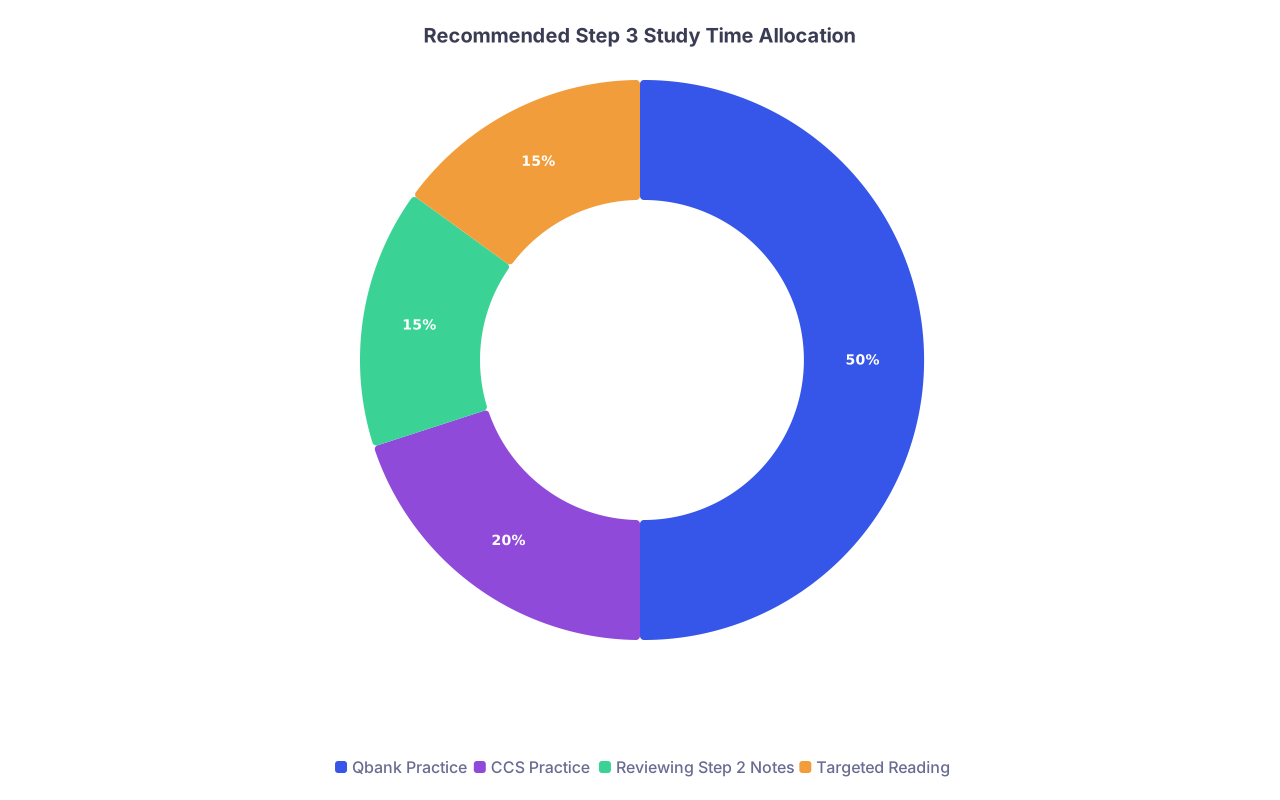
| Category | Value |
|---|---|
| Qbank Practice | 50 |
| CCS Practice | 20 |
| Reviewing Step 2 Notes | 15 |
| Targeted Reading | 15 |
2. CCS-specific practice
Your Step 2 notes are almost irrelevant here.
You need to:
- Run multiple CCS practice cases with the official software or a good simulator
- Learn:
- Admission orders structure
- Reassessment timing
- When to advance clock vs wait for results
- Discharge criteria and follow-up plans
This is a skill set. Not a memorization problem.
3. A concise Step 3‑oriented text or outline
You do not need a massive textbook. But you should have something Step 3‑specific for:
- Preventive care tables (screening, vaccines)
- Drug choices in comorbid patients
- Geriatrics / polypharmacy
- Ethics and patient safety scenarios
People often use things like:
- Online Step 3 notes compilations
- High-yield Step 3 review PDFs
- The ambulatory sections of resources like Master the Boards (if you already have them)
Your Step 2 notes won’t have this structure.
4. Updated guidelines
If your Step 2 notes are more than 1–2 years old, some management has shifted:
- Statin intensity and ASCVD risk emphasis
- Hypertension thresholds and first-line drugs by race/CKD/age
- Diabetes meds with CV/renal benefit
- Cancer screening (age cutoffs, intervals)
Don’t obsess over this, but spot-check high-yield guidelines against a current source or UWorld explanations.
Example: How to Upgrade a Step 2 Topic for Step 3
Let’s take a classic: Type 2 Diabetes.
Your Step 2 note probably looks like:
- Dx: A1c ≥ 6.5%, fasting ≥ 126, random ≥ 200 + symptoms
- First-line: lifestyle + metformin
- Add insulin if A1c very high/symptomatic
- Screen for nephropathy, retinopathy, neuropathy
That’s good. For Step 2.
For Step 3, you’d build on top:
- Choice of second agent:
- ASCVD or high CV risk → SGLT2 or GLP-1
- CKD → SGLT2 preferred
- Cost issues → sulfonylurea
- Weight loss desired → GLP-1 or SGLT2
- Follow-up:
- A1c every 3 months until controlled, then every 6 months
- Annual microalbumin, eye exam, foot exam
- Targets:
- Most non-pregnant adults: A1c < 7%
- Looser goals (e.g., < 8%) in frail elderly or multiple comorbidities
- Safety:
- Hold metformin in AKI/contrast, eGFR thresholds
- Monitor for hypoglycemia with sulfonylureas/insulin
That “Step 3 layer” is what your original notes are missing.

When You Can Rely Heavily on Step 2 Notes
Lean more on your Step 2 notes if:
- You took Step 2 CK within the last 6–12 months
- You scored well (e.g., 240+ on the old scale) and your foundation is solid
- You’re in residency actually doing adult medicine daily
- You supplement notes with:
- A full pass of a Step 3 Qbank
- At least 15–20 CCS cases worth of practice
In that situation, your notes become an accelerator, not a crutch.
When you cannot rely on them as your main resource:
- Step 2 was >2–3 years ago
- You scraped by or felt weak on management
- You’re in a non‑IM adult specialty (e.g., pathology, radiology) with limited clinical exposure
- You never really used your notes in the first place
In those cases, trying to make old Step 2 notes your “main” resource is just procrastination dressed up as strategy.
Simple 4‑Week Integration Plan
If you want a concrete structure, here’s a straightforward 4‑week approach using your notes properly.
| Week | Primary Focus | Role of Step 2 Notes |
|---|---|---|
| 1 | Qbank + CCS basics | Quick refresh, light edits |
| 2 | Ambulatory & chronic | Add Step 3 management layer |
| 3 | High-yield systems | Target weak topics only |
| 4 | Full review & CCS | Skim for final touch-ups |
Rough daily pattern:
- 1–2 timed qbank blocks
- 1–2 CCS cases or practice runs
- 30–60 minutes selectively using Step 2 notes to:
- Clarify misunderstood topics
- Add Step 3‑specific details from explanations
That’s it. Structured, realistic, and doesn’t pretend notes can do the heavy lifting alone.

| Step | Description |
|---|---|
| Step 1 | Start Study Day |
| Step 2 | Timed Qbank Block |
| Step 3 | Review Explanations |
| Step 4 | Open Step 2 Notes |
| Step 5 | Add Step 3 Mgmt Details |
| Step 6 | Next Block or CCS Practice |
| Step 7 | End of Day Quick Review |
| Step 8 | Weak Topic? |
FAQ: Step 2 Notes and Step 3
1. Can I pass Step 3 using only my Step 2 CK notes and a Qbank?
Yes, many people do, especially if their Step 2 foundation is strong and recent. But the Qbank is doing most of the real work. The notes are a supplement. If you skip CCS practice and rely only on notes + Qbank, you’re taking an unnecessary risk.
2. Do I need to rewrite all my Step 2 notes for Step 3?
No. Don’t waste time rewriting everything. Upgrade selectively. Only add a Step 3 layer to topics that:
- Show up often in UWorld
- You consistently miss
- Are heavily management focused (diabetes, HTN, lipids, psych, geriatrics, ambulatory)
3. How many CCS cases should I do if I already know the medicine from Step 2?
Aim for at least 15–20 full practice cases, plus reading through additional sample cases/strategies. Even if your knowledge is good, you need to understand case timing, order entry, and disposition flow. This is exam format, not content.
4. My Step 2 score was mediocre. Should I still use those notes?
You can, but do not treat them as gospel. Use them as a rough framework, then aggressively correct and augment them based on Step 3 explanations and more reliable resources. If your notes are disorganized or incomplete, it might be faster to start a fresh, concise Step 3 outline.
5. How much time should I spend rereading notes vs doing questions?
Flip the usual instinct. At least half your time should be on Qbank and CCS. Use notes as a targeted tool: when a question exposes a gap, then go to the notes to patch it. If you’re spending more time passively reading notes than actively doing questions, your Step 3 prep is backwards.
Key Takeaways:
- Your Step 2 CK notes are a useful foundation, not a complete Step 3 resource.
- Step 3 demands management depth, CCS skills, and ambulatory focus that your Step 2 notes almost certainly lack.
- The right move is to pair a Step 3 Qbank + CCS practice with targeted upgrades to your existing notes—not to rely on them alone.