
Taking Step 3 before intern year is either a power move or a terrible idea. Very little in between.
Here’s the blunt answer:
For most graduating U.S. MD/DO seniors going into a standard residency (IM, peds, FM, psych, etc.), taking Step 3 before starting internship is usually not necessary and often not worth the stress.
But there are clear situations where it is a smart, strategic move.
Let’s break it down so you can stop crowdsourcing this from random Reddit threads and actually make a decision.
The Core Question: Who Should Consider Step 3 Before Internship?
You should seriously consider taking Step 3 before starting residency if at least one of these is true:
- You’re an IMG, especially going into a competitive field or prelim year.
- You had borderline or low Step 1/Step 2 scores and want to show an upward trend.
- Your visa, state license, or specific program explicitly wants Step 3 early.
- You’re between graduation and residency with several months mostly free.
If none of those describe you, the default answer is:
Do it during intern year, not before.
Let’s be more concrete.
| Situation | Early Step 3 Worth It? |
|---|---|
| U.S. MD, solid Step 1/2, categorical IM | Usually no |
| IMG, prelim surgery, wants categorical spot | Often yes |
| Low Step 1, better Step 2, wants strong application | Maybe yes |
| Visa-dependent, program suggests early exam | Yes |
| Gap months between MS4 and residency, low workload | Often yes |
The Real Pros and Cons (No Sugarcoating)
Pros of Taking Step 3 Before Internship
- You get it out of your life.
Step 3 hanging over your head during intern year is annoying. You’re exhausted, working 60–80 hours/week, learning EMR systems, getting paged nonstop, and someone’s telling you to “just squeeze in some UWorld.”
If you take it before residency, you:
- Go into intern year exam-free.
- Can say yes to more electives/moonlighting later.
- Avoid begging chiefs for a golden “Step 3 week” later on.
- You might help your residency or fellowship chances.
This applies most to:
- IMGs trying to move from prelim to categorical.
- People with weaker Step 1 scores looking to show improvement.
- Applicants to competitive fellowships (cards, GI, heme/onc) at programs where they quietly care that you passed early.
No, Step 3 won’t magically erase a 210 on Step 1. But a solid Step 3 (say, 225–235+ if your prior scores were weaker) shows:
- You can handle U.S.-style exam content
- Your clinical reasoning is decent
- You’re trending in the right direction, not collapsing
- You can study with a “student brain” instead of an “intern brain.”
You just took Step 2. You still remember:
- UWorld style
- Bread-and-butter IM, OB, peds, psych
- How to sit and study for 6–8 hours without collapsing
Before internship, you probably:
- Have more control over your schedule
- Can do focused 4–6 week prep
- Aren’t charting until 10 pm
- You might solve licensing/visa hassles upfront.
Some states or hospitals:
- Want Step 3 done early for a full license instead of a training license.
- Prefer it completed for visa renewals (especially H-1B folks).
- Strongly “suggest” you finish it in PGY-1 and then never give you protected time.
If your program or visa situation is hinting strongly, doing it before you even start may be the cleaner path.
Cons of Taking Step 3 Before Internship
Now the flip side. These are the reasons most people shouldn’t rush into this.
- You’re burning your last USMLE with minimal clinical experience.
Step 3 questions are less “What’s the bug?” and more:
- What do you do first?
- What’s the next best step if this fails?
- Who do you discharge vs admit vs ICU?
You’ll be better at that after even 3–6 months of real intern work.
People who wait usually say something like:
“Half those questions were literally stuff from my last week on wards.”
Taking it too early means you lean harder on memorizing algorithms and less on actual pattern recognition from patient care.
- You risk a mediocre score or, worse, a fail.
Failing Step 3 is way uglier than taking it “late.”
- Programs can tolerate you taking it PGY-2 or even PGY-3.
- They’re much less chill about a failure on your record.
If you’re:
- Burned out from Step 2
- Going straight from sub-I to graduation chaos
- Dealing with moving, finances, housing
…cramming Step 3 in there raises your risk of phoning it in and underperforming.
- You might wreck what should be your least stressful months.
Fourth-year spring and early summer are:
- Your last real break.
- Time to travel, see family, breathe.
Turning that into 6–8 weeks of “Wake up, UWorld, repeat” isn’t always smart. You’ll be working hard for the next 3–7 years. Protecting your mental health now is not laziness. It’s strategy.
- Most programs don’t actually care when, as long as you pass.
Reality:
- Many internal medicine, peds, FM programs say “Take Step 3 by end of PGY-2.”
- Some even schedule a “Step 3 elective” with lighter call.
- Some require it before PGY-3 promotion. That’s still plenty of time.
If your future program’s policy is something like “sometime in PGY1 or PGY2, whatever” and they do not give extra points for early completion, you’re doing this for you, not for them.
If “for you” means more anxiety and less rest, that’s a bad trade.
How Hard Is Step 3 Compared to Step 1 and Step 2?
Short version: It’s clinically flavored Step 2 with more emphasis on management and endurance.
You’ve got:
- Day 1: Foundations — like a long Step 2 day. Heavy IM, some OB/peds/psych.
- Day 2: Advanced clinical — more CCS cases + long question blocks.
The content difficulty isn’t wildly higher than Step 2. What hits people:
- The length (two full days)
- The CCS cases (if you haven't practiced them)
- The mental fatigue on day 2
If you just finished Step 2 with a decent score and you still remember management guidelines, a dedicated 3–5 weeks of study before intern year is usually enough.
If Step 2 was a struggle, or it’s been 8–12 months, I’d lean toward giving yourself more clinical time (and maybe taking it early in PGY-1 with some exam-focused planning).
When Taking Step 3 Before Internship Makes the Most Sense
Here’s where early Step 3 is actually a strong move:
- You have a 2–3 month gap and no major obligations.
Example: Graduate in early May. Start residency July 1. You’re staying in the same city, already locked down housing, no board exams left except this one.
That’s prime time for:
- 4–6 dedicated weeks of UWorld + CCS
- 1–2 practice exams
- 1–2 weeks to rest pre-residency
- You’re an IMG with something to prove.
If:
- Step 1 was <220 or pass/fail but underwhelming
- Step 2 is okay but not stellar
- You want to compete for a better categorical or fellowship spot later
Then a solid Step 3 taken early can be part of your rescue strategy. Programs do notice when IMGs crush Step 3. Especially if it contrasts with earlier weaker scores.
- Your program/visa basically pushes you into it.
If your incoming PD or coordinator tells you:
“We strongly recommend having Step 3 done by the time you start.”
or
“For H-1B, it’s much easier if you’ve already passed Step 3.”
Then it’s not really a philosophical question anymore. It’s logistics. Study, schedule, finish it.
A Simple Decision Framework
Here’s the clean decision tree most people actually need.

| Step | Description |
|---|---|
| Step 1 | Do you have 4-6 relatively free weeks before residency? |
| Step 2 | Plan for PGY1 or PGY2 Step 3 |
| Step 3 | Are you IMG, low prior scores, or visa-dependent? |
| Step 4 | Strongly consider Step 3 before internship |
| Step 5 | Does your future program care about early Step 3? |
| Step 6 | Do you feel burned out and need a real break? |
| Step 7 | Optional but reasonable to take before internship |
If You Decide to Take Step 3 Before Internship: How to Do It Right
If you’re going for it, don’t half-commit. Here’s a sane approach.
Timeline
3–6 weeks is typical. Closer to 4–6 if:
- You’re rusty on OB/peds/psych
- Step 2 wasn’t recent
- You work slowly through questions
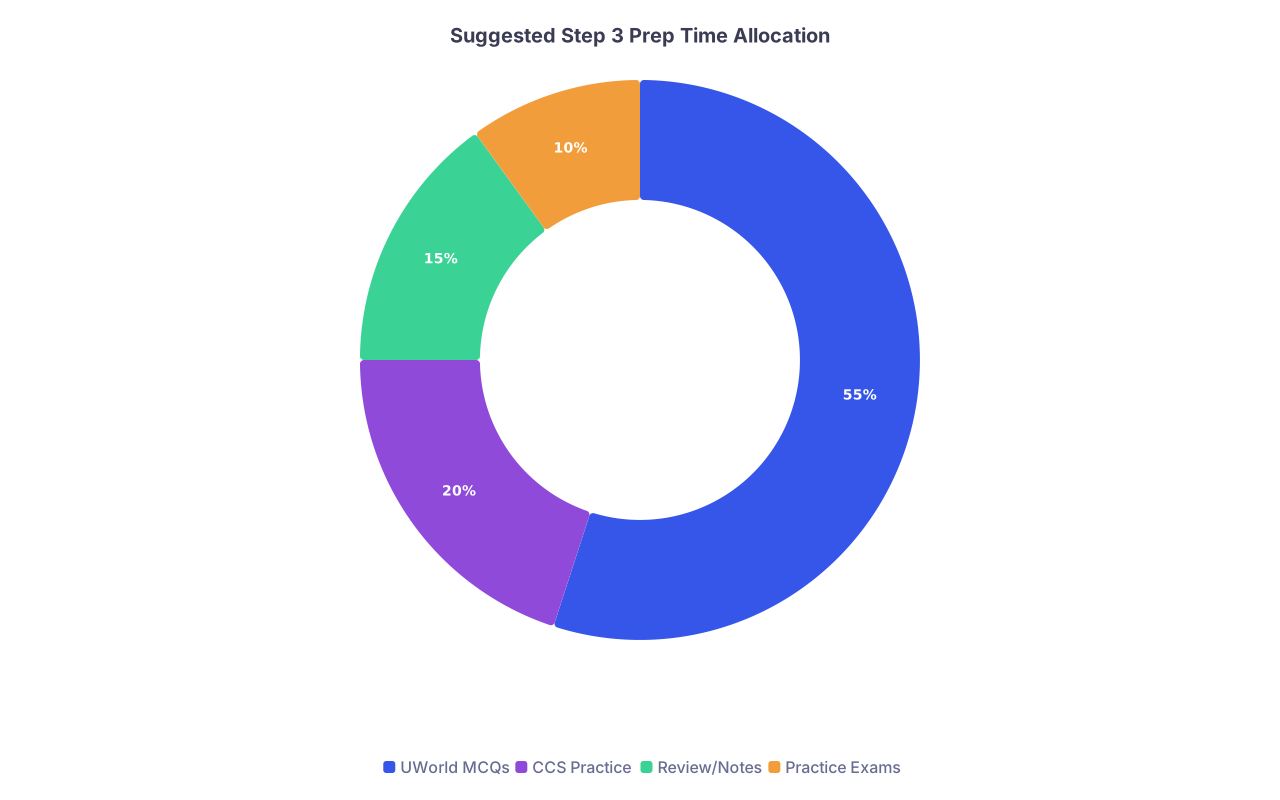
| Category | Value |
|---|---|
| UWorld MCQs | 55 |
| CCS Practice | 20 |
| Review/Notes | 15 |
| Practice Exams | 10 |
Resources
You don’t need a library. You need discipline.
- UWorld Step 3 QBank – non-negotiable
- CCS Cases – either UWorld CCS or a dedicated simulator (CCS Cases, etc.)
- One light reference (Online MedEd videos or quick notes) only if you truly need scaffolding
Don’t re-read big textbooks. Don’t try to memorize every rare disease. Stay focused on:
- “What’s the next best step?”
- Inpatient vs outpatient decisions
- Who goes home vs floor vs ICU
- Basic pharm and dosing strategies in common conditions (DKA, sepsis, ACS, PE)
Strategy
- Aim to finish UWorld once, ideally timed, mixed blocks.
- Flag missed/guessed questions and quickly review those topics.
- Do at least 15–20 CCS cases so you’re not learning the interface live on test day.
- Take at least one full-length simulation day a week or two before the exam to test your stamina.
If You Wait Until Internship
Totally fine. Here’s how to not let it drag you under.
- Pick a lighter rotation (clinic, elective, ambulatory, research block) and claim that as your Step 3 window.
- Tell your chief/senior early:
“I’m planning to take Step 3 in November. I’ll use October clinic month to prep.” - Same basic plan:
- 1–2 blocks of UWorld/day
- CCS practice on post-call or weekend
- 4–8 weeks of part-time prep
Interns pass Step 3 every year from brutal rotations. It’s doable. It’s just unpleasant. That’s the real reason people try to take it early.
Bottom Line: Is It Worth Taking Step 3 Before Starting Internship?
Here’s my honest stance:
- If you’re U.S. MD/DO, solid Step 1/2, categorical spot locked, and your program doesn’t care about early Step 3 → It’s usually not worth sacrificing your last real break. Take it early in PGY-1 on a lighter month.
- If you’re an IMG, had weaker earlier scores, or your visa/program strongly prefers early completion → Taking Step 3 before internship can be very worth it, as long as you give it a real dedicated effort.
- If you have 2+ months of low-stress time and you’re not mentally fried, and you like the idea of starting residency exam-free → Totally reasonable to do it now.
Don’t do it because “everyone on my class GroupMe is thinking about it.”
Do it because it fits your scores, situation, and sanity.
FAQ (Exactly 7 Questions)
1. Is it risky to take Step 3 very early, like right after Step 2?
It’s only risky if your clinical foundation is weak or you don’t prep seriously. If Step 2 is recent and you give yourself 4–6 focused weeks with UWorld and CCS, you’re not inherently at higher risk. The bigger issue is burnout and under-preparing because you’re tired of exams.
2. Do residency programs actually care about Step 3 timing, or just that I pass?
Most care only that you pass by a certain point (often end of PGY-2). A minority quietly like seeing it done early, especially in competitive or academic IM programs and for IMGs. If you’re U.S. MD/DO with decent prior scores, timing usually doesn’t move the needle much.
3. What’s a “good” Step 3 score? Does it matter like Step 1/2?
Step 3 is mostly a pass/fail checkbox. People rarely quote their Step 3 score on applications. That said, a fail can hurt you, and a strong upward trend (e.g., 215 Step 1 → 230 Step 2 → 235 Step 3) can help repair your narrative, especially for IMGs or borderline applicants. Don’t chase a 260. Chase a solid pass with no drama.
4. How many weeks do I really need if I take Step 3 before internship?
For most people with a recent Step 2: 4–6 weeks of focused study is plenty. If Step 2 was >1 year ago or you struggled significantly, aim for the higher end or consider waiting until you’ve had some intern experience. Trying to brute-force it in 1–2 weeks is where people get burned.
5. Can I work or travel and still prep for Step 3 pre-residency?
Yes, but be honest. If you’re doing full-time work or traveling nonstop, your study time will evaporate. If you can reliably protect 4–5 hours/day for 5–6 weeks, you can combine light work or some travel with studying. If this is your last big trip before life gets intense, I’d lean toward enjoying it and taking Step 3 later.
6. How important is CCS practice really? Can I just wing it?
You can wing it and still pass, but it’s dumb to. CCS has its own interface and logic, and a handful of cases can swing your score. Doing even 15–20 practice cases makes you faster, smoother, and less panicked. That’s low-hanging fruit. Don’t skip it.
7. What if I start studying before internship and realize I’m too burned out?
Then stop. Seriously. You’re allowed to change your mind. If 1–2 weeks in you’re miserable, not retaining much, and dreading each question block, pause and reschedule for early PGY-1. One bad decision is forcing yourself through a half-baked prep and risking a fail. A much better decision is pivoting to protect your mental health and taking it when you can actually focus.
Key takeaways:
- Early Step 3 is optional for most U.S. grads but strategic for some IMGs, low-scorers, and visa-dependent folks.
- Don’t trade away your last real break unless the upside is real for you—not just because your classmates are panicking.