
The biggest threat in Step 3 CCS prep isn’t ignorance. It’s false confidence.
You can feel “ready” for CCS, score decently on some practice cases, and still walk into the real exam dangerously unprepared—because the way you practiced trained the wrong habits.
Let me walk you through the traps I’ve watched people fall into again and again. These are the mistakes that make you think you’re good at CCS when you’re actually just good at your practice tool.
Mistake #1: Treating CCS Like a Question Bank, Not a Simulation
Most people secretly approach CCS practice like a slightly weird multiple-choice question. That’s wrong. And it’s expensive on test day.
In CCS, you’re not “picking the right answer.” You’re managing time, prioritizing, and thinking like the primary team.
The classic bad pattern looks like this:
- You open a case
- Scan it
- Immediately start clicking orders you remember from a similar case
- Throw in a dozen tests “just in case”
- Watch the time jump forward
- Skim the feedback, feel okay, move on
You feel good because:
- The case often ends early (seems like a win)
- The feedback doesn’t scream at you
- You recognize the diagnosis
But here’s what’s really happening: you’re rehearsing sloppy, reflexive ordering based on pattern recognition, not deliberate, structured management.
On the real exam, that kind of “click fast, think later” approach kills you in subtle ways:
- You miss critical initial stabilizing steps (airway, IVF, pain control)
- You order things in the wrong sequence (CT before stabilizing a GI bleed)
- You jump days ahead without timely re-evaluation
- You forget to monitor or escalate when the patient deteriorates
Do not let your practice devolve into order-spamming.
Safer approach: Before you place a single order in practice:
- Say out loud (or in writing): “What are my immediate goals in the next 5–10 minutes of simulated time?”
- Identify:
- Life threats to stabilize
- One or two key diagnostics to confirm your leading diagnosis
- Basic supportive care measures
- Only then start ordering—deliberately, not reactively
If your CCS practice feels like UWorld multiple choice with extra clicks, you’re doing it wrong.

Mistake #2: Using Only One CCS Platform and Memorizing Its Quirks
Another confidence trap: mastering the quirks of one simulator and assuming that means you’re good at CCS in general.
Different CCS platforms (NBME practice, UWorld, test prep company simulators) do not behave identically. They have different:
- Interfaces
- Order phrase matching
- Acceptable order variations
- Tolerance for unnecessary tests
- Time advancement behavior
I’ve seen this pattern repeatedly:
- Student practices 20+ cases on one platform
- Learns exactly how that system likes orders typed
- Learns that “over-ordering” doesn’t hurt their score much
- Walks into the real exam and suddenly:
- Orders don’t appear where they expect
- Time advances when they didn’t intend
- The system isn’t forgiving when they’re too broad or too slow
They come out saying, “The interface threw me off,” which is code for: I practiced for a tool, not for the exam.
Don’t make that mistake.
You should absolutely have a primary CCS resource, but you need at least:
- The official practice CCS from NBME
- One other major platform (e.g., UWorld CCS)
You’re not doing this to see more content. You’re doing it to de-couple your skills from a single interface.
How to use multiple platforms without burning time:
- Do the full NBME/official CCS cases early enough to adapt (not the week before)
- Notice what’s different:
- How search works
- How time advances
- Where orders are located (ER vs floor vs ICU)
- Practice a few cases explicitly focusing on:
- Finding orders you know should be there
- Reaching the same management plan through a different interface
If your confidence comes mainly from “I know where everything is in [Resource X],” that’s not confidence. That’s familiarity, and it will evaporate on test day.
Mistake #3: Ignoring the Clock or Misusing Simulation Time
People either ignore the clock or obsess over it. Both extremes are dangerous.
Common bad habits in practice:
- Letting the case run for hours of simulated time without reassessment
- Jumping ahead in big chunks just to “see what happens”
- Ending the case early just because it lets you click “Finish”
- Not practicing time-sensitive scenarios properly (e.g., sepsis, MI, stroke)
You know what the CCS software heavily rewards? Appropriate, timely interventions and re-evaluations.
On the exam, this looks like:
- Ordering IVF in sepsis within minutes, not simulated hours
- Giving ASA, nitrates, beta-blockers (when appropriate) early in ACS
- Activating stroke protocols immediately, not after a long diagnostic wandering
When you casually let hours tick by in practice “to see labs come back” without reassessing or acting, you’re teaching yourself to be lazy with the simulated clock.
Safer time habits to build in practice:
- Always reassess shortly after:
- Any major intervention
- Any significant change in vitals
- ICU to floor transfers, or vice versa
- Use small jumps in time:
- 30 mins to 1 hour in critical cases
- 2–4 hours for stable but evolving inpatient
- Longer only once you’re confident no urgent interventions are pending
- Get used to using:
- “Re-examination”
- “Review vital signs”
- “Check I/O” as explicit orders or actions at logical intervals
If your practice cases are full of 8-hour jumps just to hit the endpoint, you’re rehearsing dangerous time management.
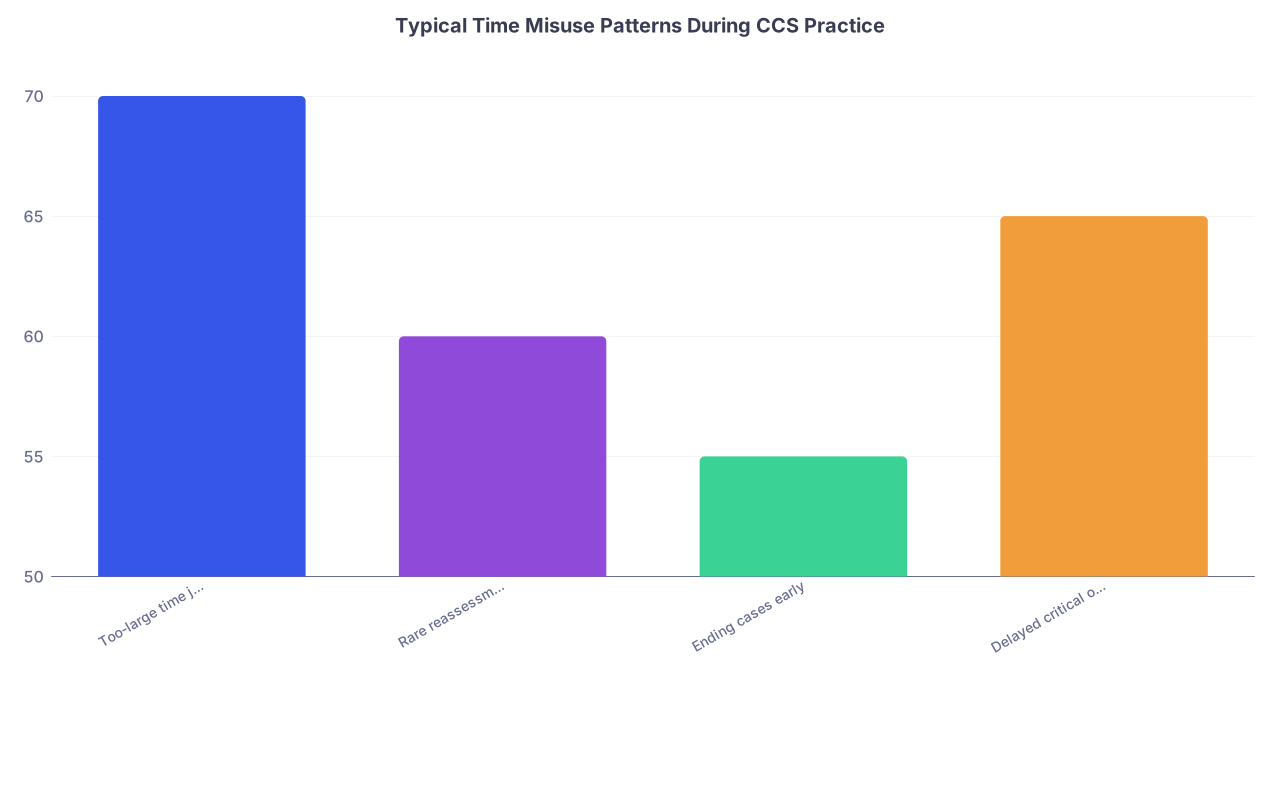
| Category | Value |
|---|---|
| Too-large time jumps | 70 |
| Rare reassessment | 60 |
| Ending cases early | 55 |
| Delayed critical orders | 65 |
Mistake #4: Only Practicing “Easy” or Familiar Case Types
People naturally gravitate toward cases that feel comfortable.
So what gets over-practiced?
- Uncomplicated pneumonia
- Simple DKA
- Straightforward CHF exacerbation
- Routine prenatal visits
You do enough of those and your confidence skyrockets. “I’m crushing CCS.” No, you’re crushing pneumonia. That’s not the same thing.
On test day, it’s the tricky variants and less-loved settings that trip people up:
- Outpatient preventive care with multiple chronic conditions
- Psychiatric emergencies with safety issues
- OB complications (pre-eclampsia, postpartum hemorrhage, ectopic)
- Pediatric cases with dosing, vaccines, and developmental considerations
- Trauma/acute surgical abdomen
If your practice history is biased toward your comfort zone, your confidence is fake.
You need a system that forces you into discomfort. Something like:
- Week 1–2: Heavy inpatient, bread-and-butter IM
- Week 3: OB/GYN + Pediatrics–dedicated CCS practice
- Week 4: Outpatient + psych + mixed/chronic disease management
And here’s the key: don’t just do those cases—slow down and build a checklist of:
- Setting-specific basics (OB: fetal monitoring; Peds: weight, vaccines; Outpatient: cancer screening, lifestyle counseling)
- Common traps (e.g., forgetting pregnancy test before imaging or certain meds)
If your CCS prep log doesn’t clearly show OB, peds, psych, outpatient, ICU/ED variety, you’re lying to yourself about being ready.

Mistake #5: Focusing on Diagnosis Only and Neglecting Longitudinal Management
Huge mistake: treating CCS like “guess the diagnosis, then throw in the textbook treatment.”
The exam is less impressed by your quick diagnosis and more impressed by:
- Do you stage the disease properly?
- Do you risk-stratify?
- Do you appropriately follow up?
- Do you address comorbidities and prevention?
Common practice failure pattern:
- You recognize the diagnosis early (say, NSTEMI)
- You order:
- ECG
- Troponin
- ASA
- Heparin
- You feel done, so you fast-forward
What you should’ve done:
- Decide level of care (telemetry vs ICU)
- Risk-stratify (e.g., TIMI, though not always explicit in software)
- Order secondary prevention:
- High-intensity statin
- Beta-blocker
- ACEi if indicated
- Smoking cessation counseling
- Arrange follow-up and long-term management
Many practice tools will let you “pass” on diagnosis + partial initial management. That inflates your confidence dangerously.
You need to train yourself to always ask: “If this were my real patient, what happens after I fix the acute issue?”
Build this habit in practice: For each case you complete, review:
- Did I:
- Control symptoms?
- Identify the cause?
- Treat the cause?
- Arrange appropriate monitoring?
- Address prevention, lifestyle, and follow-up?
- What did I forget that I’d be embarrassed to miss on a real ward?
If your practice ends the second the vital signs normalize, you’re strengthening the exact weakness Step 3 targets.
Mistake #6: Not Practicing Documentation and Counseling Orders
CCS doesn’t only care about orders like “ceftriaxone IV.” It silently scores you on softer, more “annoying” things:
- Smoking cessation counseling
- Alcohol/drug cessation
- Diet and exercise recommendations
- Vaccinations
- Screening tests (Pap, colonoscopy, mammogram, HIV, etc.)
- Safety counseling (seat belts, suicide risk, domestic violence)
What do most people do in practice? Ignore them. Because:
- They’re easy to forget
- The practice tool feedback rarely punishes you visibly
- They feel ”non-urgent”
Then they act shocked when their CCS performance isn’t stellar.
You must normalize these as automatic, reflex orders when appropriate:
- Any patient who smokes? “Smoking cessation counseling”
- Alcohol misuse? “Alcohol cessation counseling,” possibly “thiamine,” and social work
- Obese diabetic? Nutrition + exercise counseling, eye exam, foot exam, etc.
- Age-based preventive care? Vaccines, screening tests
Treat these as part of the core of CCS, not decoration. Because they are.
| Scenario | Must-Consider Orders |
|---|---|
| Smoker | Smoking cessation counseling |
| Heavy alcohol use | Alcohol cessation counseling |
| Obese with comorbidities | Diet + exercise counseling |
| Adult with no vaccine hx | Tdap, influenza, pneumococcal (age-based) |
| Older adult | Colonoscopy, mammogram, DEXA (age/sex-based) |
If your practice notes and checklists don’t explicitly list these, you’ll keep forgetting them.
Mistake #7: Practicing Without a Repeatable Framework
This is the silent killer: people approach each CCS case as a brand-new puzzle instead of using a stable structure.
Result:
- You’re inconsistent
- You miss basics when the case feels “weird”
- Your mental load is higher than it needs to be
On test day, that inconsistency shows up as:
- Forgetting pregnancy test in a reproductive-age woman
- Forgetting pulse ox or oxygen in a dyspneic patient
- Forgetting pain control or antiemetics
- Forgetting basic labs in any acutely ill patient
You can’t “wing it” with CCS and expect consistency.
You need a simple, brutal framework. Something like:
First 30 seconds:
- Identify setting (ED, clinic, floor)
- Scan vitals for instability
- Quick ROS + key exam findings
Immediate stabilization if needed:
- Airway/breathing: O2, pulse ox, ABG if appropriate
- Circulation: IV access, fluids, cardiac monitor
- Pain: analgesia
- Fever/sepsis: IVF, cultures, broad abx (if indicated)
Fast, focused diagnostics:
- Basic labs: CBC, CMP, UA, etc.
- One or two high-yield imaging/tests
Location decision:
- ED discharge vs admit floor vs ICU
Longitudinal plan:
- Daily labs, monitoring
- Consultants (if needed)
- Prevention and counseling
- Follow-up
Then you drill this framework on every practice case until it’s automatic.
If your CCS prep is a series of ad-hoc improvisations, your “confidence” is just luck that hasn’t been stress-tested.

| Step | Description |
|---|---|
| Step 1 | Open Case |
| Step 2 | Stabilize ABCs |
| Step 3 | Focused H&P |
| Step 4 | Initial Labs/Imaging |
| Step 5 | Decide Location: ED/Floor/ICU |
| Step 6 | Definitive Treatment |
| Step 7 | Monitoring & Reassessment |
| Step 8 | Prevention & Counseling |
| Step 9 | Discharge & Follow-up |
| Step 10 | Stable or Unstable? |
Mistake #8: Over-Trusting “Green Checkmarks” and Score Estimates
A lot of CCS tools give you:
- Green checkmarks
- Percent completion
- “Excellent / Good / Average” labels
- Score estimates
Those are fine as feedback, but they are not truth. They’re an approximation made by a company trying to model the exam.
People make two bad assumptions:
- “I’m getting mostly ‘excellent’ in practice; I’ll crush CCS.”
- “I scored X on this CCS simulator; that means I’ll get Y on the real exam.”
Wrong on both counts.
What these tools often over-reward:
- Over-ordering (they still give credit for the few correct things amid the flood)
- Delayed-but-eventual diagnosis
- Partial management that looks okay on paper
What they don’t fully reflect:
- Timing sensitivity
- Real Step 3 weighting of CCS vs MCQ
- The penalty for unnecessary or harmful orders on the actual exam
You should treat any in-practice “score” as a rough progress marker, not a promise.
Better self-assessment questions than “What was my percent?”
- Did I:
- Stabilize the patient quickly and appropriately?
- Have a clear differential and target my tests?
- Reassess at logical time points?
- Address chronic issues and prevention?
- Avoid harm (unnecessary radiation, wrong meds in pregnancy, etc.)?
If your confidence is based primarily on the simulator’s “Excellent!” badge, you’re building your plan on sand.

Mistake #9: Not Doing Full, Timed CCS Blocks Under Real Conditions
This one is brutal and very common.
You do:
- Single cases here and there
- Untimed
- With snacks, your phone nearby, maybe a podcast in the background
You never simulate:
- Fatigue
- Time pressure
- Back-to-back CCS cases after a full MCQ block
So on exam day:
- The CCS interface feels slower
- Your brain is tired
- You’re suddenly aware of the clock
- You make mistakes you never made in “relaxed practice mode”
You do not really know your CCS readiness until you:
- Run several full-length practice blocks (cluster of cases)
- With a hard time limit
- With no pausing, no checking answers mid-case
- After doing questions earlier that same day
You’ll quickly see:
- Where your framework breaks down under stress
- Which case types collapse when you’re tired
- Whether you can still remember to do counseling and prevention on your 4th or 5th case
Schedule at least:
- 2–3 full, timed CCS “mini-exams” in the last 2–3 weeks before your real test
If all your CCS practice has been casual, isolated, and untimed, your confidence is fiction.
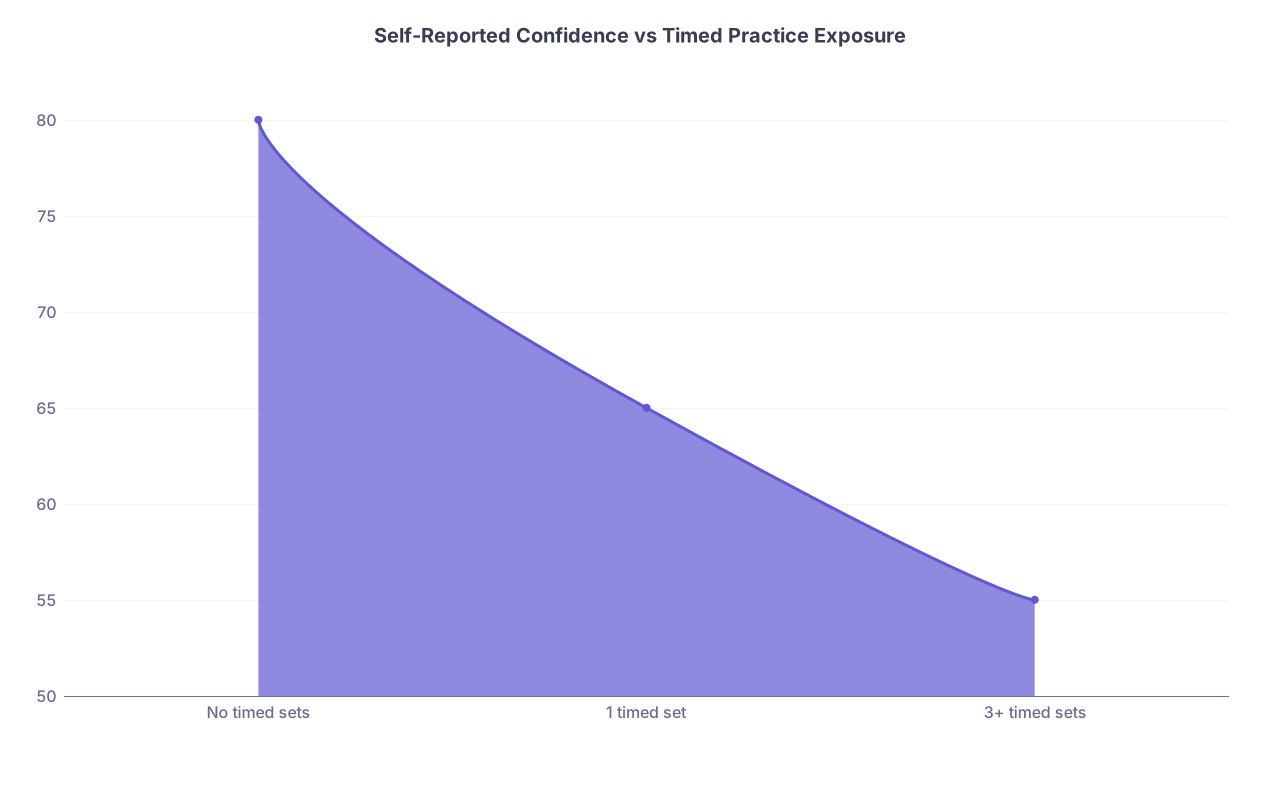
| Category | Value |
|---|---|
| No timed sets | 80 |
| 1 timed set | 65 |
| 3+ timed sets | 55 |
You’ll feel “less confident” as you expose your weaknesses. That’s actually safer. You fix them before it counts.
Let me close this bluntly.
The CCS part of Step 3 doesn’t just test whether you know medicine. It tests whether you behave like a safe, organized, time-aware clinician under pressure.
False confidence comes from:
- Practicing CCS like a quiz game instead of a patient simulation.
- Relying on one platform’s quirks and its happy green checkmarks.
- Avoiding your weak case types and never testing yourself under realistic timing and fatigue.
If you fix those three, your confidence won’t just feel better. It’ll be earned. And Step 3 will feel like an exam you’re managing—not an ambush you walked into blind.