
It’s 10:45 p.m. You’re post-call, still in your scrubs, scrolling a group text. One of your co-interns drops it: “Lol it’s just COMLEX Level 3, I’m not really studying. Everyone passes if you just show up.”
You stare at your calendar. Exam in six weeks. Your plan so far: vague. “Do some questions,” “review OMT,” and mostly… hope.
This is exactly where people talk themselves into one of the worst decisions of early residency: treating COMLEX Level 3 like a formality you can just wing.
Let me be blunt: that myth is dangerous. People fail this exam. Smart people. Hard-working residents. And when they do, it hurts them more than they thought possible.
You’re here to avoid being one of them.
The Myth: “Everyone Passes Level 3 If You Just Show Up”
This is the first trap.
The logic usually sounds like this:
- “Level 1 and 2 were the hard ones.”
- “Programs don’t care about Level 3 scores, just pass/fail.”
- “I’m already practicing this stuff every day in residency.”
- “I don’t have time to study anyway.”
All four of those lines? Half-truths at best. At worst, they’re how you end up rescheduling rotations and explaining a failure to your PD.
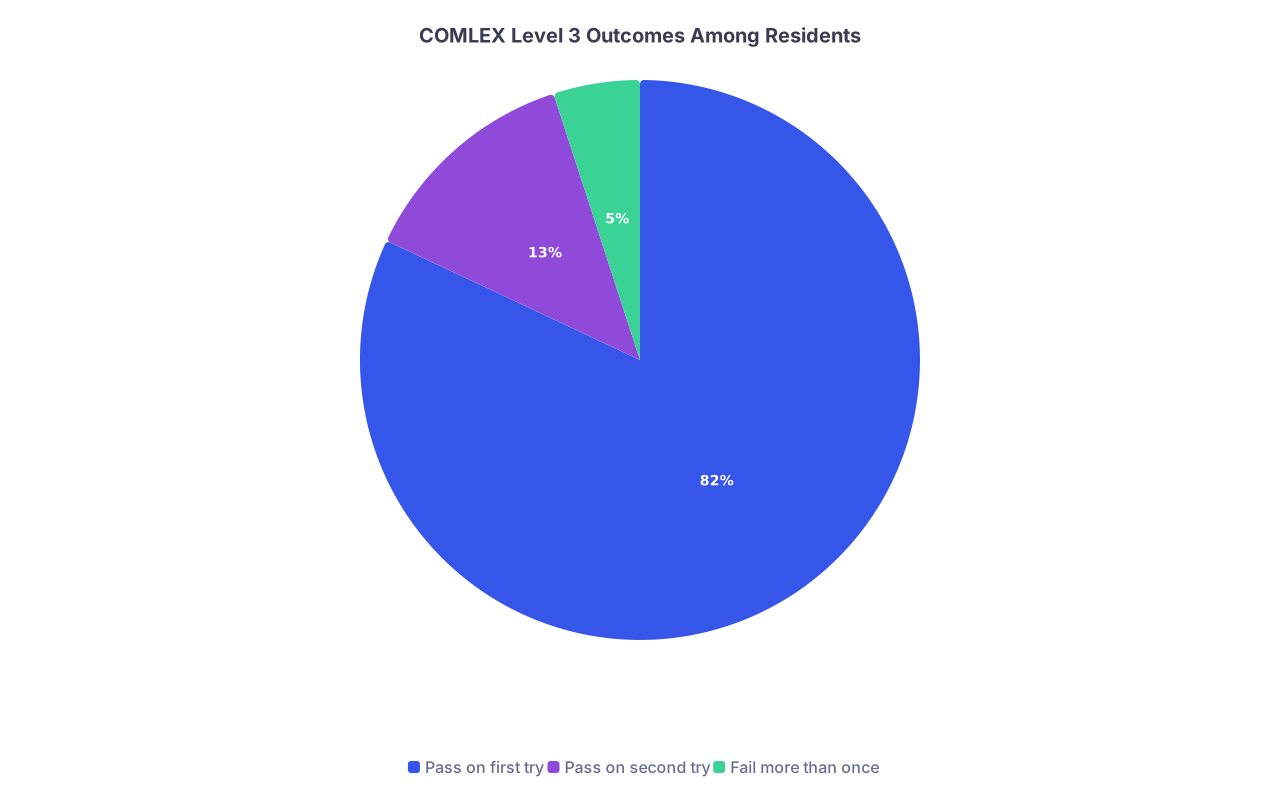
| Category | Value |
|---|---|
| Pass on first try | 82 |
| Pass on second try | 13 |
| Fail more than once | 5 |
Look at those numbers. Most pass on the first try, yes. But that 18% that doesn’t? They almost always thought they were “fine.” I’ve never once heard someone who failed say, “Yeah, I took it super seriously and really prepared and still bombed.” What I hear is:
“I figured my clinical experience would carry me.”
“I just didn’t realize how specific the questions would be.”
“I ignored OMT and got crushed.”
Do not comfort yourself with the idea that passing rate equals automatic pass. It doesn’t. There’s a difference between:
- Residents who used a focused, efficient 4–6 week plan
- Residents who “reviewed a little” and hoped for the best
You know which group fills that 18%.
Mistake #1: Treating COMLEX 3 as “Just Another Shift”
I see this all the time. People convince themselves that residency = studying. That being in the hospital is enough.
Here’s the problem: clinical work and standardized exams are not the same skill.
At work you:
- Follow your attending’s style and threshold for testing
- Lean heavily on EMR prompts, order sets, and checks
- Ask colleagues: “What do you usually do here?”
- Rarely sit and think uninterrupted for 4 hours
On Level 3 you:
- Have zero EMR safety nets
- Must recall guidelines precisely, not “roughly what my senior does”
- Get punished for “I think this is probably okay” answers
- Need stamina for long blocks + CCS style cases
I’ve seen residents say, “I’m a solid clinician; I’ll be fine.” Then the exam starts asking:
- The exact next best step in management, not three acceptable options
- The first test to order, not the fifth one you click in the EMR bundle
- Very specific OMT and osteopathic principles that you haven’t thought about in 2–3 years
Your day-to-day practice will help a bit. But it will not carry you through poorly prepared content or weird test logic. If you rely on work alone as your studying, you’re asking to get blindsided.
What to do instead
You don’t need a 3-month bootcamp. But you do need:
- A structured 4–6 week plan
- Deliberate question practice (COMLEX-style, not just USMLE)
- Targeted review of weak content (especially OMT)
You’d never show up to an ACLS mega-code having only watched others run one six months ago. Don’t treat Level 3 with less respect than a single hospital course.
Mistake #2: Ignoring the COMLEX-ness of COMLEX Level 3
Another common move: using only USMLE-style Step 3 materials and assuming they’re enough.
Wrong.
USMLE-style resources help with general medicine. They do not cover:
- OMT techniques and indications
- Osteopathic principles in patient management
- The specific “COMLEX voice” and question structure
If you’re unlucky, you’ll walk out of day one of the exam thinking, “Why were there so many OMT/OPP questions? I didn’t see that in my bank.” Because your bank was built for a different test.

The COMLEX examiners love:
- Overlong stems with subtle osteopathic clues
- Questions that want the “most osteopathic” answer
- Testing whether you actually understand OPP beyond buzzwords
If you’ve spent twelve months pretending OMT never existed after COMLEX Level 2, they’ll find out.
How to avoid this trap
You do not need to drown in OMT textbooks. But you absolutely should:
- Use at least one COMLEX-focused Qbank or CCS-style resource
- Review high-yield OMT: HVLA, counterstrain, FPR, viscerosomatic reflexes, lymphatics, Chapman points basics
- Practice reading questions through an “osteopathic lens”
If you’re doing 100% USMLE-style prep, you’re essentially training for the wrong sport. Same ballpark, different rules.
Mistake #3: Underestimating the Timing and Logistics
A very sneaky mistake: delaying Level 3 until you’re “less busy” and then realizing that magical month doesn’t actually exist.
Here’s what I’ve seen go wrong:
- Residents pushing the exam into late PGY-1 or even PGY-2
- Hospital requiring a passing Level 3 before signing contracts or advancing
- State licensing deadlines approaching faster than expected
- Failed attempt + 90-day retake wait = disaster for scheduling

| Step | Description |
|---|---|
| Step 1 | Start PGY-1 |
| Step 2 | Busy rotations fill year |
| Step 3 | Push exam to late PGY-1/PGY-2 |
| Step 4 | Minimal prep time |
| Step 5 | 90-day wait & PD meeting |
| Step 6 | Book during lighter rotation |
| Step 7 | Dedicated study weeks |
| Step 8 | Higher chance of passing |
| Step 9 | Plan timing? |
| Step 10 | Fail attempt |
People tell themselves, “I’ll take it after intern year when I’m more comfortable.” Then:
- They end up on ICU, nights, or wards right before test day
- They’re too burned out to study
- They get one week “off” that’s really catch-up on life, not focused prep
Then they wing it. Then they regret it.
What a smarter plan looks like
You avoid this by:
- Picking a 6–8 week window early where your rotations are relatively lighter
- Scheduling the exam before residency ratchets up into full chaos
- Committing to a realistic question-per-day target during that window
If you keep telling yourself “later, later, later,” you’re building a trap you’ll fall into.
Mistake #4: Disorganized, Random “Studying”
Let me describe what most “I’ll review a bit” prep looks like:
- Doing random questions on your phone in between pages
- Flipping through old OMT notes when you feel guilty
- Watching a couple of review videos with half attention
- Never tracking performance or adjusting plan
This is not studying. It’s anxiety management disguised as effort.
The exam doesn’t care how anxious you feel about it. It cares what you can recall and apply under pressure.
| Feature | Wing-It Approach | Structured Approach |
|---|---|---|
| Question Volume | 10–20/day, inconsistent | 40–60/day, consistent |
| OMT Review | Occasional, random | Targeted, high-yield list |
| CCS/Clinical Cases | Rarely practiced | Several sessions per week |
| Performance Tracking | None | Uses % correct & notes |
| Weak Areas Addressed | Ignored or avoided | Specifically targeted |
Guess which side consistently passes on the first try.
A minimal but real study structure
You don’t need a perfect color-coded spreadsheet. You do need:
- A clear daily question goal (e.g., 40–60 questions on days off, 20–40 on work days)
- A focused list of topics you will not ignore: OMT, ethics, biostats, preventive care, pregnancy, peds emergencies
- Regular review of incorrects—not just breezing past them
If your “plan” fits into a single sentence like “just do questions when I can,” you do not have a plan.
Mistake #5: Forgetting That Failing COMLEX 3 Has Real Consequences
This is the part people downplay until it’s too late.
A COMLEX Level 3 failure can:
- Trigger a meeting with your program director you did not want
- Force rescheduling and delay of rotations or electives
- Complicate state licensing and moonlighting opportunities
- Raise quiet doubts about your reliability, even if you’re clinically strong
I’ve watched smart residents cry in call rooms because they failed Level 3 and:
- Had to explain it for every future credentialing step
- Lost planned moonlighting income for months
- Felt humiliated after telling people “I’m not really studying for it”
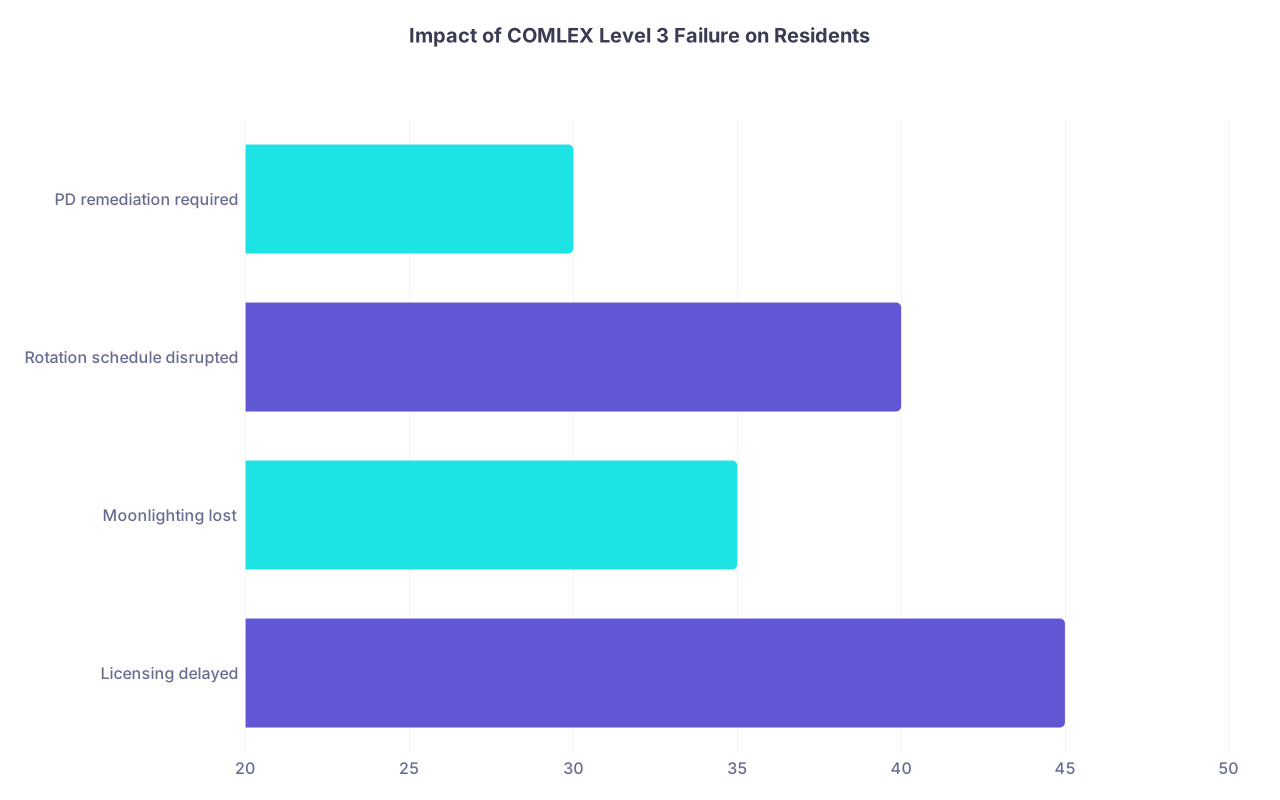
| Category | Value |
|---|---|
| Licensing delayed | 45 |
| Moonlighting lost | 35 |
| Rotation schedule disrupted | 40 |
| PD remediation required | 30 |
Those numbers aren’t fake scare tactics. They’re a rough snapshot of what I’ve actually seen residents dealing with.
And here’s the thing: almost all of them could have passed with a modest, structured 4–6 week prep. They didn’t need 3 months. They just needed not to wing it.
What Solid, Non-Overkill COMLEX Level 3 Prep Actually Looks Like
You might be thinking, “Okay, I get it, don’t wing it. But I seriously don’t have Step 1-level time to study.” Good. You don’t need that.
You do need to avoid the lazy extremes.
Here’s a realistic, not-insane approach:
6–8 weeks out
- Schedule the exam on a day that doesn’t fall right after nights or a brutal call block.
- Commit to 20–40 questions per day on work days, 40–60 on days off.
- Use a COMLEX-focused Qbank, or at least one that has a COMLEX mode.
4 weeks out
- Add 2–3 focused OMT/OPP sessions per week (even 30–45 minutes).
- Start doing some longer question blocks to build endurance.
- Identify your chronic weak areas (OB, peds, psych, ethics, biostats) and hit them directly.
2 weeks out
- Simulate test conditions at least once: several blocks back-to-back, timed, no interruptions.
- Brush up on osteopathic principles, reflexes, and common OMT set-ups.
- Clean up guesswork: for any pattern you “kind of know,” turn it into something you can answer consistently.
Week-of
- Light review of OMT and weak topics.
- Prioritize sleep and shift arrangement as much as possible.
- Do not cram until 2 a.m. the night before. You will pay for it on test day.
This is not heroic. It’s simply deliberate. The opposite of winging it.
Red Flags That You’re Secretly Planning to Wing It
If any of these are true, you’re headed into the danger zone:
- You haven’t picked an exam date; it’s just “sometime this year.”
- Your only concrete resource is “a question bank,” but you haven’t opened it regularly.
- You say “I’ll review OMT” but can’t name what, specifically, you’ll review.
- You tell co-residents “I’m not too worried; they just want us to pass.”
- You’ve looked at the exam content outline exactly zero times.
Be honest with yourself. If you’re checking multiple boxes here, your “plan” is just a hope.
And hope is not a prep strategy.
Quick Reality Check: You Don’t Need Perfection—You Need Respect for the Exam
Let me balance this out.
No, you do not need:
- A 3-month annotated syllabus
- To re-do all of med school
- To know every OMT technique from every lab you ever slept through
You do need:
- To respect that this is a real, high-stakes licensing exam
- To give it 4–6 weeks of consistent, modest effort
- To target the exam’s quirks: OMT, osteopathic framing, long stems, guidelines
Treat Level 3 like a minor hurdle? You risk making it a major problem.
Treat it like a real but manageable exam? You’ll move on with one more box checked and a lot less drama.
FAQ (Exactly 4 Questions)
1. Is it actually common to fail COMLEX Level 3 if you “just wing it”?
Yes. Residents don’t brag about it, so you don’t hear the numbers, but I’ve seen plenty of “I barely reviewed” people get burned. The pass rate is high, but the failure rate is not trivial, especially among those who rely solely on clinical experience and do minimal dedicated prep.
2. Can I prep using only USMLE Step 3 resources and still pass COMLEX Level 3?
You might, but you’re stacking the deck against yourself. USMLE resources won’t cover OMT or osteopathic principles in the way COMLEX tests them. If you insist on using mostly USMLE-based materials, at least add a COMLEX-style question bank and a dedicated OMT/OPP refresher.
3. When’s the best time during residency to take COMLEX Level 3?
Ideally within the first year, during or right after a lighter rotation when you can consistently do questions and some dedicated review. Waiting too long tends to mean less recall of OMT and preclinical material, more scheduling conflicts, and more exhaustion. Early but prepared beats late and desperate.
4. How many questions should I realistically aim to do before the exam?
There’s no magic number, but I’d be very nervous going in with fewer than 1,000–1,500 high-quality questions completed. More is better, as long as you’re actually learning from them. Quantity without review is just clicking. Aim for consistent daily practice rather than huge last-minute binges.
Key points, so you don’t make the classic mistake:
- COMLEX Level 3 is not a free pass; “just wing it” fails far more people than you think.
- Modest, structured prep (especially for OMT and COMLEX-style questions) beats random, guilt-driven “review.”
- Respect the exam, schedule it wisely, and prepare like your license—and sanity—actually depend on it. Because they do.