
Most Level 3 failures are not about medicine – they are about underestimating OMM.
You are not missing questions because you never learned sacral mechanics. You are missing them because you are making the same predictable OMM mistakes almost every Level 3 taker makes. And no one in your program is actually talking about them.
Let me walk you through the traps that quietly kill COMLEX Level 3 OMM scores – and how to avoid joining that statistic.
1. Treating OMM on Level 3 Like It Is Still Level 1
This is the first and biggest mistake: studying OMM like you are back in first year.
Level 1 OMM = anatomy, definitions, Fryette rules, “which muscle energy setup is correct?”
Level 3 OMM = clinical integration:
- A hospitalized COPD exacerbation patient with rib dysfunction
- An OB patient in latent labor with sacral issues
- A postop patient where OMT might be contraindicated
If you are still doing:
- Flashcards of Chapman points with zero clinical context
- Random viscerosomatic charts without actual cases
- Memorizing every HVLA setup but not when you would avoid HVLA
You are studying for the wrong exam.
What Level 3 actually tests in OMM
You will see:
- OMM as part of a case (hospital, clinic, ED)
- Questions like:
- “What is the next best step?” where one of the options is OMT
- “Which somatic dysfunction pattern is most consistent with this presentation?”
- “Which OMT technique is most appropriate / safest?”
Not:
- “Which of the following is a counterstrain point for ___?” in isolation
- “Which is a Type II somatic dysfunction?” with no patient context
Do not make the mistake of divorcing OMM from the clinical picture.
Your OMM prep has to be case-based, not flashcard-based only.
2. Ignoring OMM in CCS-Style and Case-Based Questions
You already know this: Level 3 is heavy on management and cases. But most people forget that OMM is management for COMLEX, not just trivia.
So they do this:
- Crush UWorld for Step 3
- Half-heartedly skim a COMLEX OMM PDF the week before
- Never do a single full COMLEX-style OMM-integrated case
Then they are confused when a question says: “A 48-year-old with pneumonia on hospital day 3 develops decreased rib excursion on the right, mild increased work of breathing, and back pain. Which of the following is the most appropriate next step?”
Options:
A. Rib-raising right side
B. HVLA to T7
C. Thoracic pump with activation
D. No OMT; continue current management
If you have only trained your brain on UWorld-style allopathic questions, you will miss the OMM logic:
- When OMT is reasonable
- When OMT is contraindicated
- When OMT is low-yield theater compared to fixing the medical problem first
Do not train exclusively in an NBME/USMLE world and expect to think like NBOME.
You need OMM integrated into decision-making, not memorized in isolation.
3. Over- and Under-Using OMT: The “Everything is a Nail” Problem
Here is an error I see constantly: people think NBOME wants them to pick OMT every single time it appears in the options. That is wrong.
OMT is not magic. It is:
- Adjunctive
- Supportive
- Sometimes contraindicated
- Rarely the only answer
Where people get burned:
- Choosing OMT instead of antibiotics, anticoagulation, or emergent imaging
- Selecting HVLA in patients where it is an obvious no-go
- Using thoracic pump in someone with an acute pulmonary embolism or severe hemodynamic instability
- Choosing OMT before addressing ABCs or life threats
Here is the rule you must not break:
If the patient is unstable, decompensating, or has a serious untreated medical problem – treat the medical issue first, not the somatic dysfunction.
Red-flag OMT contraindications you must not miss:
- Suspected or confirmed fracture (spine, rib, long bone) → no HVLA, no aggressive soft tissue
- Metastatic bone disease or severe osteoporosis → avoid HVLA
- Acute DVT or PE → no vigorous pumping or mobilization that could dislodge clot
- Postoperative patients with dehiscence risk → avoid direct manipulation near incision
- Suspected cauda equina, spinal cord compression → treat medically/surgically, not with OMT
If you see a patient:
- Febrile, hypotensive, tachycardic, undiagnosed infection
- With red flag back pain (cancer, infection, trauma, neurologic deficits)
Your answer is not OMT. It is imaging, antibiotics, admission, etc.
Do not let the word “OMT” hypnotize you into forgetting basic medicine.
4. Memorizing Techniques, Forgetting Patterns
Another huge pitfall: obsessing over individual technique setups (hand positions, vectors, precise angles) while ignoring the clinical patterns COMLEX actually loves.
On Level 3, you are more likely to see:
- Pregnancy + low back pain → lumbar, sacral, pelvic issues
- COPD or pneumonia + rib dysfunction → pump handle / bucket handle motion changes
- GERD or gallbladder disease + right-sided upper back pain → sympathetic viscerosomatic patterns
Less often:
- “Where will your cephalad hand be placed during HVLA for C5 FRSR?”
NBOME is not testing you as an OMM lab TA.
Focus on:
- Recognizing viscerosomatic reflex patterns (e.g., T5–T9 for upper GI, T10–L2 for lower GI/GU)
- Sympathetic vs parasympathetic patterns and how they relate to disease
- Common facilitated segments for chronic disease
If you do not know these, OMM questions will feel like random noise.
5. Being Sloppy with Autonomics and Viscerosomatic Reflexes
This is the “silent killer” of a lot of OMM scores. People think: “I kind of remember T1–T4 is heart and lungs, T5–T9 is GI, right?”
Then they get six questions that hinge on:
- Which segments show somatic dysfunction given a particular organ issue
- Which area to treat to modulate sympathetic or parasympathetic tone
- Which side (right vs left) is commonly involved with specific organs
Guessing your way through this is a bad plan.
Here is what you must not botch:
| System / Organ | Sympathetic Levels | Side Bias (Classic) |
|---|---|---|
| Heart | T1–T5 | Left |
| Lungs | T2–T7 | Bilateral |
| Stomach | T5–T9 | Left |
| Liver / GB | T6–T9 | Right |
| Small Intestine | T9–T11 | Bilateral |
| Colon / Pelvic Organs | T10–L2 | Mostly Left (sigmoid/rectum) |
If a case says: “A 55-year-old with RUQ pain, positive Murphy sign, and T6–T9 somatic dysfunction on the right…”
You should immediately think:
- Liver / gallbladder involvement
- Sympathetic hyperactivity in that region
- Likely biliary disease, not MI
Do not mix up sympathetic levels or side dominance.
Level 3 expects you to see these patterns almost instinctively.
6. Forgetting Cranial and Obstetrics OMM – Then Paying for It
Many residents secretly stop taking cranial and OB OMM seriously after second year. Level 3 punishes that.
Cranial: you cannot completely ignore it
No, Level 3 is not a cranial exam. But completely skipping:
- Basics of cranial strain patterns (torsion, sidebending-rotation, vertical, lateral)
- Clinical relevance (e.g., cranial treatment after birth trauma in neonates)
Can easily cost you 3–5 questions. That is not trivial.
You should at least:
- Know classic patterns (e.g., right torsion vs left torsion descriptions)
- Remember that cranial OMT is often used in neonates or post-head trauma patients when stable
- Know that you avoid cranial OMT immediately in acute intracranial hemorrhage or unstable neurologic situations
Obstetrics: high-yield and often neglected
This one is worse. I have heard residents say:
“I’ll just use my OB/GYN knowledge, I do not need to study OB OMM.”
That is a mistake.
You need to be able to:
- Recognize common pregnancy-related somatic dysfunctions (lumbar lordosis changes, sacroiliac strain, pelvic floor tension)
- Select safe OMT techniques in pregnancy:
- Avoid HVLA to lumbar/thoracic in late pregnancy
- Use gentle, indirect, muscle energy, myofascial release
- Avoid OMT when:
- There is placental abruption, preterm labor risk, or unstable OB condition
Do not walk into Level 3 having completely ignored OB OMM and cranial.
You do not need fellowship-level knowledge. You do need baseline, test-appropriate competence.
7. Over-Relying on USMLE Resources and Ignoring COMLEX-Specific OMM
I see this pattern every year:
- Resident buys UWorld, maybe AMBOSS.
- Cranks 2,000+ questions.
- Barely touches any COMLEX-specific OMM resource.
- Walks into COMLEX thinking, “I did great on Step 3 stuff; I’ll be fine.”
Then their COMLEX score is mediocre or borderline. Why? Because NBOME still expects you to be an osteopathic physician, not just a generic MD.
Here is the trap:
- UWorld is fantastic for medicine, but practically worthless for COMLEX OMM.
- Most Step 3 resources do not cover autonomics, viscerosomatic reflexes, cranial, obstetric OMM, or OMT contraindications in the way NBOME asks them.
You must:
- Use at least one solid COMLEX/OMM resource (e.g., Savarese OMT Review, COMBANK/COMQUEST OMM sections, TrueLearn’s OMM content)
- Do question blocks specifically for OMM, not just hope the information from M1–M2 magically resurfaces
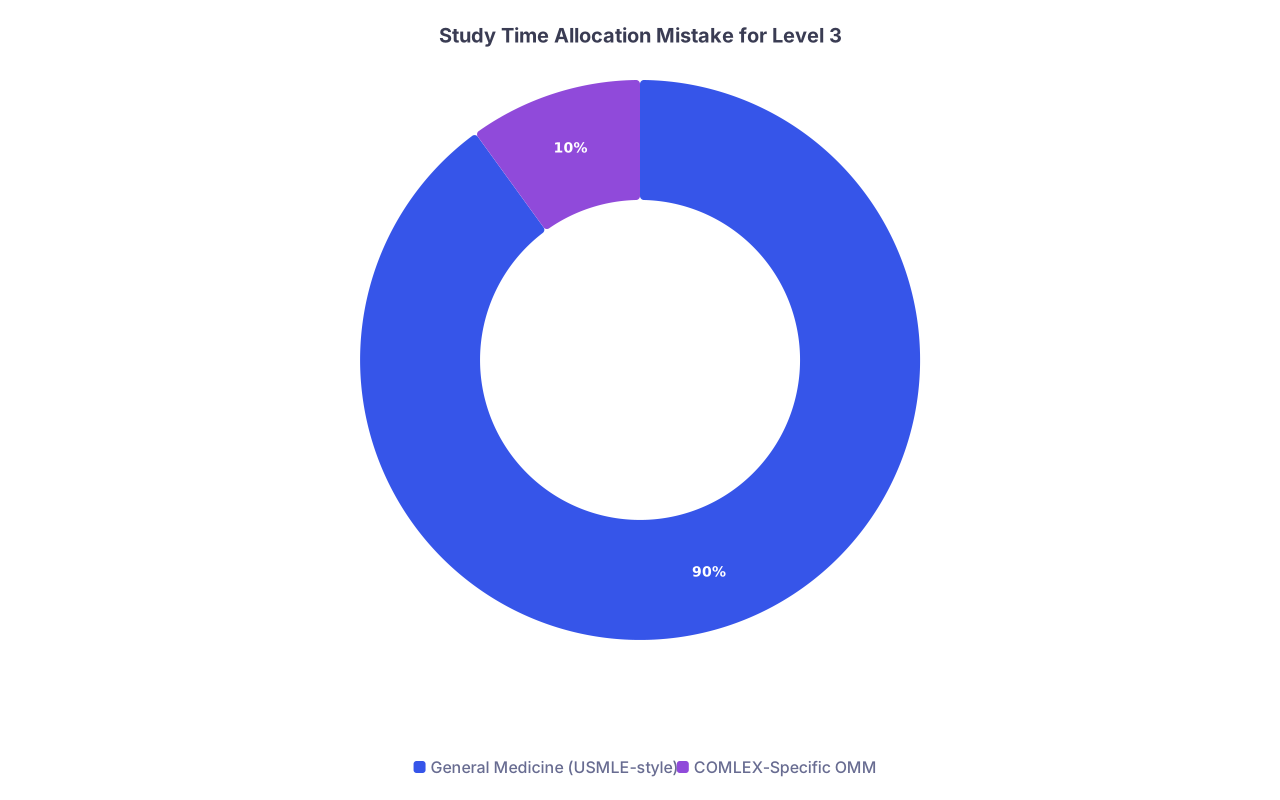
| Category | Value |
|---|---|
| General Medicine (USMLE-style) | 90 |
| COMLEX-Specific OMM | 10 |
I routinely see people putting 90–95% of their prep into general medicine and a token 5–10% into OMM. Then act surprised when OMM drags down their total score.
Do not copy NBME strategy for an NBOME exam.
You must explicitly carve out time for COMLEX OMM.
8. Mismanaging Time on OMM Questions During the Exam
There is a subtler trap: treating OMM questions as if they require deep philosophical analysis.
They do not.
Where people bleed time:
- Obsessing over long, story-heavy OMM stems
- Overanalyzing every minor anatomic term
- Re-reading viscerosomatic paragraphs three times because “it must be a trick”
Most OMM questions:
- Have 1–2 truly relevant clues (e.g., level of somatic dysfunction, organ system, stability of patient)
- Want a straightforward answer: correct level, safe technique, or appropriate use/avoidance of OMT
Here is what you must avoid:
- Spending 3+ minutes on a single cranial or viscerosomatic question
- Double-guessing a simple “OMT is not appropriate; proceed with medical management” answer because it seems too easy
If you are not careful, you will:
- Burn time on medium-value OMM questions
- Then rush through complex CCS-style medical management cases that are worth a lot more
Do not let OMM derail your pacing.
Read once carefully, find the key clinical clue, pick the obvious safe answer, move on.
9. Not Practicing OMM Reasoning Before Test Day
Another silent but deadly mistake: keeping OMM prep purely passive.
What most people do:
- “Review” OMM by flipping through Savarese pages
- Highlight autonomic tables
- Call it a day
What they do not do:
- Actively talk through OMM decision-making out loud
- Explain to someone (or themselves) why a certain OMT technique is safe vs unsafe in a clinical scenario
- Practice identifying when OMT is supportive vs contraindicated vs irrelevant
You need active reasoning practice:
- Take a COMLEX-style vignette
- Ask yourself:
- Is OMT appropriate at all here?
- If yes, which technique and why?
- If no, what would make it appropriate later?

| Step | Description |
|---|---|
| Step 1 | Patient Scenario |
| Step 2 | Prioritize Medical/Surgical Care |
| Step 3 | No OMT Now |
| Step 4 | No OMT Indicated |
| Step 5 | Choose Gentle/Indirect or Defer |
| Step 6 | Select Appropriate OMT Technique |
| Step 7 | Stable or Unstable? |
| Step 8 | Somatic Dysfunction Present? |
| Step 9 | Any Contraindications? |
If you never rehearse this kind of clinical decision tree ahead of time, you will try to build it from scratch in the testing center. Under time pressure. Sleep deprived. That is how people miss easy OMM questions they technically “know.”
10. Emotional Trap: Letting OMM Anxiety or Cynicism Sabotage You
Last pitfall is psychological.
You have heard residents say:
- “OMM is a joke on the wards.”
- “No one actually uses that stuff.”
- “You only need that to pass boards.”
So you internalize:
- OMM = not serious medicine
- Studying it feels like a lower priority than “real” clinical topics
- You procrastinate it until the last 3–5 days
Result:
- You walk into Level 3 with solid medicine, sloppy OMM
- You get blindsided by more OMM content than you expected
- You come out angry at NBOME instead of admitting you underprepared this section
Let me be blunt:
You do not need to love OMM. You do not need to use it every day in residency.
But you are making your life harder if you let your annoyance with OMM turn into neglect.
Treat OMM like any annoying but testable topic:
- Immunology pathways
- Biostatistics formulas
- Drug side effect tables
You study it anyway because failing Level 3 over something you could have fixed in 2–3 focused weeks is a dumb way to suffer.
Quick, Practical Anti-Mistake Checklist
Use this as a reality check 2–4 weeks before your exam. If you answer “no” to several of these, you are at risk.
- Have you done at least 150–200 COMLEX-style OMM questions (COMBANK/COMQUEST/TrueLearn)?
- Can you, from memory, sketch sympathetic levels for heart, lungs, GI, GU, and reproductive organs and give classic side dominance?
- Can you name at least 3 major situations where OMT is clearly contraindicated or inappropriate?
- Have you reviewed obstetric and cranial OMM at least once specifically for Level 3?
- Have you practiced decisions where OMT is not the right answer, even though it is in the options?
If not, fix that before you walk into the testing center.
FAQ (Exactly 4 Questions)
1. How much of my Level 3 study time should I realistically dedicate to OMM?
Do not make the common error of giving OMM only the scraps of your schedule. A reasonable target is about 15–20% of your total dedicated study time, especially in the last 2–3 weeks. That typically looks like:
- 1–2 hours per day of OMM review or questions
- One focused pass through an OMM review book (e.g., Savarese)
- A few hundred OMM-focused questions from a COMLEX-specific Qbank
Less than that, and you are basically hoping prior-year knowledge will carry you. It usually does not.
2. Can I skip cranial OMM and still do well on Level 3?
You can do well, but you will probably miss easy points if you skip cranial entirely. You do not need to master every cranial strain pattern in excruciating detail. But you should:
- Recognize basic patterns (torsions, sidebending-rotation)
- Know simple clinical associations (e.g., birth trauma in neonates)
- Understand that cranial OMT is not done in acute unstable neurologic situations
A 1–2 day focused review is enough to avoid obvious mistakes. Skipping it completely is lazy and costly.
3. What is the single most dangerous OMM mistake on Level 3?
The most dangerous – as in “costs you the most points and looks bad if this were real life” – is choosing OMT instead of treating an unstable or high-risk medical condition. For example:
- Picking thoracic pump in someone with a likely PE or severe respiratory distress
- Choosing HVLA in a patient with suspected fracture, osteoporosis, or metastatic lesions
- Doing OMT instead of giving antibiotics in sepsis or imaging in red-flag back pain
Those are not just test errors. They are clinical judgment errors. NBOME absolutely tests that boundary.
4. I am in a busy residency and have almost no time. What is the minimum OMM prep I can get away with?
If you are truly time-poor, do not make the mistake of half-skimming everything. Focus sharply:
- Do 150–200 OMM-focused Qbank questions (COMLEX-specific) and carefully review explanations
- Rapidly review autonomic/viscerosomatic charts and contraindications to OMT
- Spend 1–2 evenings on OB OMM and cranial basics
That is the bare minimum “damage control” approach. Anything less, and you are rolling dice with your OMM performance, which can be the difference between a solid pass and an uncomfortable close call.
Remember:
- Level 3 OMM is clinical, not academic – it lives inside cases and management decisions.
- The most costly mistakes are not obscure strain patterns; they are bad judgment about when, how, and whether to use OMT.
- If you respect OMM enough to prepare for it seriously, it will quietly boost your score instead of quietly sinking it.