
“Just use one Q‑bank for Step 3” is lazy advice that survives mostly because people repeat what they did and happened to pass.
Let me be blunt: for most residents, “one Q‑bank only” is a harmful oversimplification. Not because you need to drown in resources. But because Step 3 is two different exams in one (Day 1 + Day 2 CCS), and no single Q‑bank reliably covers all the cognitive skills you’re tested on.
You do not need five Q‑banks. You probably do not need three. But blindly following the “one Q‑bank only” mantra can sabotage:
- Your timing and stamina for long, mixed blocks
- Your exposure to different question styles
- Your CCS (cases) performance, which is quietly high‑yield for passing
So let’s dismantle this myth properly.
What People Think “One Q‑Bank Only” Achieves (And Why They’re Wrong)
I’ve heard this line in call rooms a hundred times:
“Dude, just pick UW and grind it. More than one Q‑bank is overkill.”
There are three assumptions hiding under that:
- More than one Q‑bank = fragmented learning
- Repetition in one bank → deeper understanding
- All high‑quality Q‑banks are basically interchangeable
Two of those have a grain of truth. One is flat‑out wrong.
Fragmentation vs structured variety
Yes, five half‑used Q‑banks is worse than one fully used. But that’s not the real question. The real question is:
Is one Q‑bank enough to give you:
- content coverage
- question style variety
- CCS competence
- test‑day stamina?
For Step 3, the honest answer for most people: no.
Because:
- UWorld Step 3 is excellent for content and general style.
- It’s not enough by itself for CCS practice in the real interface.
- And if you only see one style of question stem and explanation, your performance can be brittle when NBME/Step 3 phrases things differently.
Variety used intentionally isn’t fragmentation. It’s inoculation against test‑day shock.
Repetition inside one bank helps – to a point
Doing a single Q‑bank twice can deepen pattern recognition. But residents use this as an excuse for tunnel vision:
- They end up memorizing answer patterns.
- They overfit to that bank’s quirks (length of stems, how often a “most likely next step” is a CT vs MRI, etc.).
- They never stress‑test their knowledge outside that comfort zone.
For Step 1 and even Step 2, you can sometimes get away with this. Step 3 is weirder, more clinical, and less standardized by the time you take it. Overfitting to one Q‑bank is riskier.
No, the big Q‑banks are not interchangeable
Here’s the part people gloss over. Different resources actually do different things well:
| Resource | Primary Strength | Weakness Area |
|---|---|---|
| UWorld Step 3 QBank | Core questions, depth | Limited CCS practice |
| NBME Sample Forms | Style calibration | Small number of Qs |
| UWorld CCS Software | CCS interface practice | Narrow case pool |
| AMBOSS / Others | Breadth & references | Sometimes too wordy |
If you tie yourself to a “one bank” dogma, you’re implicitly saying: “I don’t care about the parts this bank doesn’t do well.” That’s fine if you’re a 260 Step 2 scorer coasting through. For the median resident trying not to fail Step 3 while on nights? Not fine.
What the Data Actually Show (And What It Doesn’t)
NBME/USMLE doesn’t publish “Q‑bank combinations that passed,” so anyone quoting hard numbers is making them up.
But we do have:
- Program‑level pass rates (most >95% on first attempt)
- Individual stories matched to typical patterns
- Score predictor performance (UWorld % ranges, correlations)
And from the real‑world side:
- Residents who fail Step 3 are not typically those who used “too many” resources.
- They’re those who:
- underestimated the CCS and did almost none
- never built stamina for long 7‑hour days
- or half‑assed their way through a single Q‑bank without review.
I’ve sat in remediation meetings where the story was identical:
“I did UWorld once, untimed, system‑based, never reviewed thoroughly, and I barely touched the CCS cases. I just ran out of time.”
That’s not a “too many resources” problem. That’s a bad strategy with one resource problem.
What does correlate with doing fine on Step 3?
- Completing at least one solid Q‑bank (UWorld or comparable) in mixed, timed mode
- Doing realistic CCS practice in an emulator that behaves like the exam
- Exposure to exam‑style wording (NBME samples, CCS PDF cases, etc.)
- Actually reviewing questions thoroughly, not just cranking counts
Notice: that’s “at least one” Q‑bank. Not “only one.”
How Step 3 Is Built – And Why That Matters for Resources
You can’t talk resources until you admit what Step 3 really is.
Day 1 (Foundations of Independent Practice)
- Long, dense multiple‑choice blocks
- Mix of outpatient, inpatient, ethics, stats, risk prediction
- Feels like Step 2’s more grown‑up cousin
Q‑banks like UWorld handle this part well. If “one Q‑bank only” applied anywhere, it’d be here.
Day 2 (Advanced Clinical Medicine + CCS)
Day 2 is where the myth truly breaks.
You get:
- More MCQ blocks
- And then the CCS (Clinical Case Simulations)
The CCS is where residents die on the vine. Not because the medicine is exotic, but because:
- The interface is awkward if you’ve never used it
- The scoring quietly punishes mis‑prioritization and delays
- People severely under‑practice it
There is no single traditional Q‑bank that covers:
- high‑quality MCQs and
- realistic CCS interface practice and
- good explanations of CCS strategy
So the “one Q‑bank only” slogan basically forces you to neglect one part of the exam.
A Smarter Rule: One Primary Q‑Bank, Two Targeted Supplements
Instead of worshipping “one Q‑bank only,” use this much more honest rule:
One primary Q‑bank. One CCS practice resource. Optional light calibration resource.
That’s it. Not five subscriptions. Not every boutique niche product.
1. Primary Q‑bank: your workhorse
Most people: UWorld Step 3. Fine choice. Just use it correctly:
- Do it timed, random, mixed once you’re warm.
- Treat every block like a mini‑exam.
- Review explanations aggressively.
- Track patterns: what you keep missing isn’t random.
If UWorld bores you and you’re an AMBOSS person? Fine. But you still need CCS practice elsewhere.
2. CCS practice: non‑negotiable second resource
This is where “one bank only” truly falls apart. You need:
- A CCS emulator that actually functions like the real exam software
- Enough cases to see patterns in:
- airway management
- chest pain workup
- sepsis bundles
- pregnancy emergencies
- pediatric fevers
- psych admissions/discharges
UWorld’s CCS cases and software are a strong option. There are others, but the exact brand matters less than this: you must actually sit and practice in an interface that feels like Step 3.
Just reading through cases in a PDF or watching videos does not build the speed and ordering reflexes you need when the clock is ticking.
3. Calibration resource: minimal, high yield
This is short and sweet:
- Do the official NBME/USMLE sample questions on the USMLE site.
- If you want, a small 100–200 question chunk from a second Q‑bank to “stress test” your mastery.
That’s it. You are not starting a second full pass. You’re using it like a dress rehearsal under different lighting.
When “One Q‑Bank Only” Actually Makes Sense
There are a few scenarios where I’ll tolerate the classic advice.
Scenario 1: You’re very strong and just need to not fail
- Solid Step 2 score (250+ range)
- Currently in a cognitively heavy residency (IM, EM, anesthesia, etc.)
- Actively practicing the medicine Step 3 tests
- Decent performance on a diagnostic block
For you, a disciplined single‑Q‑bank + CCS practice approach is rational:
- UWorld Step 3 MCQs fully completed, timed, random
- UWorld CCS cases practiced thoroughly
- Official CCS practice from USMLE reviewed
Here, “one Q‑bank only” is fine because that one already includes the CCS practice you’re actually going to use. The myth looks true, but only because you quietly added CCS through the same vendor.
Scenario 2: Limited time, high baseline
You’re on ICU nights, exam is in 5 weeks, you’re exhausted. Buying extra resources you won’t open is pointless. In that constrained world:
- Full pass of primary MCQ Q‑bank
- Focused CCS practice only
- Light skim of NBME samples
You’re not rejecting additional Q‑banks because multiple is “bad.” You’re rejecting them because your calendar says “no.”
When “One Q‑Bank Only” Is Actually Dangerous
Now the other side. Times when that slogan can hurt you.
1. You’re borderline on prior exams
If your Step 1 and Step 2 scores were near the passing line, you are statistically at higher risk of failing Step 3. For you:
- One barely completed Q‑bank is not enough
- One casual CCS run‑through is not enough
You need deliberate redundancy:
- Full pass of a primary MCQ bank
- Thorough CCS practice in an emulator
- Possibly a curated set of extra questions in your weak areas (biostats, ethics, nephro, etc.)
That is not resource hoarding. That’s risk management.
2. You’re in a specialty far from general medicine
Derm, pathology, radiology, some psychiatry programs. Your day job does not constantly refresh inpatient management, OB triage, or sepsis. You can’t assume “clinical exposure” will carry you.
For you, seeing more ways to ask the same concepts is protective. A small second set of questions in your weak systems can be the difference between “barely enough” and “comfortable pass.”
3. You’re anxious and over‑rely on one metric
I see this a lot: people anchor on their UWorld percentage or cumulative graph as if it’s the USMLE score report. Then:
- They’re scared to admit they still miss patterns
- They refuse to test themselves with a different question style
- They walk into the exam having never seen anything but that one flavor of stem
When they sit Step 3 and the questions feel slightly “off,” panic does the rest.
A short “calibration” run with a second style of questions can break that dependence. It teaches you to trust your reasoning, not just one company’s patterns.
How to Use Multiple Resources Without Drowning
The real fear people have is this: “If I open a second resource, I’ll never finish anything.”
That’s not a resource problem. That’s a planning problem. Here’s a concrete, sane 8–10 week layout.
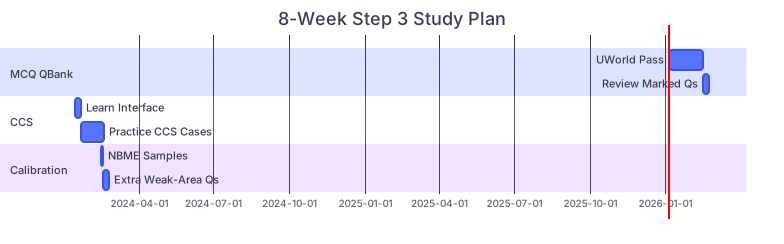
| Task | Details |
|---|---|
| MCQ QBank: UWorld Pass | a1, 2024-01-01, 42d |
| MCQ QBank: Review Marked Qs | a2, after a1, 7d |
| CCS: Learn Interface | b1, 2024-01-15, 7d |
| CCS: Practice CCS Cases | b2, after b1, 28d |
| Calibration: NBME Samples | c1, 2024-02-15, 3d |
| Calibration: Extra Weak-Area Qs | c2, after c1, 7d |
Notice what’s missing: a second full Q‑bank pass. You’re not double‑counting hours. You’re targeting:
- Depth with one main MCQ bank
- Breadth where you’re weak
- CCS competence with a focused case set
- A tiny bit of cross‑style exposure at the end
That’s how you avoid both extremes: the one‑bank myth and the resource hoarder trap.
A Quick Reality Check on “Overkill”
People love to say “multiple Q‑banks is overkill.” You know what’s actually overkill?
- Re‑taking Step 3.
- Explaining to your PD why you failed.
- Losing moonlighting opportunities or fellowship leverage because of a preventable failure.
If you’re sitting at a 45–50% UWorld average two weeks before the exam, you don’t have a “too many resources” problem. You have a “not enough mastery per resource” problem.
Sometimes that means delay the exam and do a proper pass. Sometimes it means:
- Triage: finish high‑yield systems, hammer CCS, do NBME samples, then go in.
- But it almost never means: “Good thing I stuck to one Q‑bank.”
So, Is “Just Use One Q‑Bank” Helpful Rule or Harmful Myth?
Let’s call it what it is.
“One Q‑bank only” is a harmful myth when it’s used as dogma that:
- justifies neglecting CCS
- prevents targeted extra practice
- or gives you a false sense of “I did the thing, so I must be fine.”
A better rule: one primary MCQ Q‑bank, plus mandatory CCS practice and a small amount of style calibration. Not hoarding. Just complete coverage of what Step 3 actually tests.
The residents who fail Step 3 rarely do so because they used two quality resources. They fail because they used one resource poorly, skipped CCS, and hid behind a slogan instead of an honest plan.
Stop asking, “Am I allowed to use more than one Q‑bank?”
Start asking, “Do my resources, together, actually prepare me for everything Step 3 will throw at me?”