
Step 3 will not forgive vague thinking about ethics and risk management. You either know the patterns cold, or you bleed points on questions that “feel” easy.
Let me break down the actual patterns you will see, how NBME frames them, and how to answer them fast and correctly.
1. How Step 3 Actually Tests Risk Management and Ethics
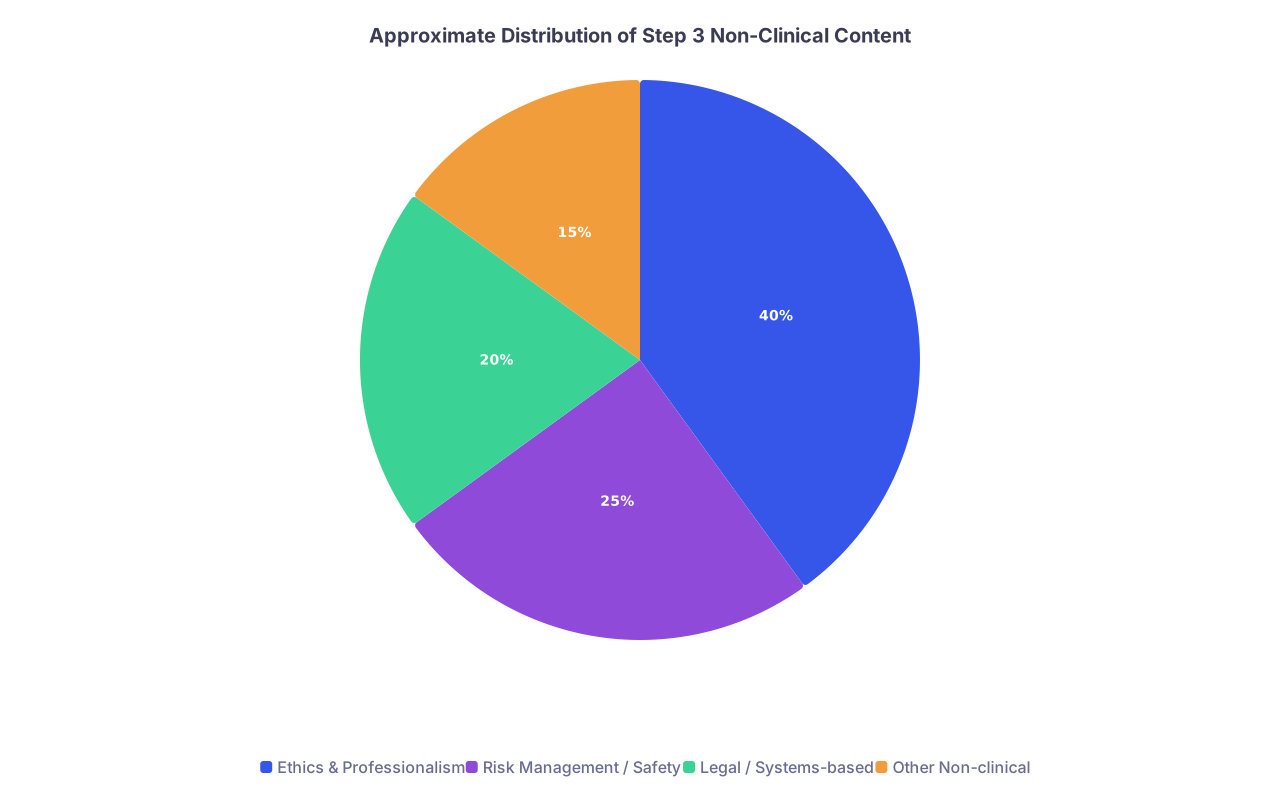
| Category | Value |
|---|---|
| Ethics & Professionalism | 40 |
| Risk Management / Safety | 25 |
| Legal / Systems-based | 20 |
| Other Non-clinical | 15 |
Step 3 does not give you a separate "ethics section." Instead, it buries ethics and risk management inside clinical vignettes. If you wait for obvious “ethics questions,” you will miss half of them.
Typical patterns:
- A straightforward clinical case with a twist: capacity, surrogate, confidentiality.
- A mundane systems issue: handoff error, medication error, unsafe discharge.
- A professionalism trap: impaired colleague, boundary violation, gifts, documentation games.
The test writers love:
- Forcing you to pick the most protective option for patient safety or rights.
- Penalizing answers that are technically true but incomplete (e.g., “document concern” without actually fixing the risk).
- Presenting emotionally provocative scenarios (angry family, stubborn attending, demanding patient) to see if you cave on principles.
If you understand this: Step 3 ethics is not philosophy. It is applied risk management. Reduce harm. Protect rights. Follow the law. In that order.
2. Core Ethical Structures You Must Recognize in Seconds

| Step | Description |
|---|---|
| Step 1 | Read vignette |
| Step 2 | Immediate safety action |
| Step 3 | Stabilize / Protect |
| Step 4 | Use surrogate / advance directive |
| Step 5 | Honor informed choice |
| Step 6 | Treat under implied consent |
| Step 7 | Follow hierarchy / prior wishes |
| Step 8 | Respect refusal/acceptance |
| Step 9 | Is patient safe now? |
| Step 10 | Decision-making capacity? |
| Step 11 | Life-threatening emergency? |
You need a mental algorithm you apply on every ethics-style stem. Here is the skeleton.
2.1 Capacity: The First Fork in the Road
Capacity is task-specific and clinical. Competence is legal and determined by a court. Step 3 almost always means capacity, even when they sloppily say “competent.”
Capacity is present if the patient can:
- Understand the information.
- Appreciate the consequences.
- Reason about options.
- Communicate a choice.
Patterns:
- Schizophrenia patient, off meds, refusing surgery but giving clear, logical reasoning for refusal. Capacity is usually intact → respect refusal.
- Hypoxic, septic, intoxicated, delirious, confused. Capacity is impaired → go to surrogate or treat emergently.
Common wrong choices:
- Calling psychiatry or ethics committee first instead of doing the right thing when the situation is clear.
- Forcing treatment on a capacitated patient because you think they are making a “bad” decision.
If capacity = yes → respect the decision, even if harmful, unless:
- It poses grave harm to others (e.g., active TB refusing isolation).
2.2 Surrogates and Advance Directives
When capacity is gone, follow this order:
- Explicit written directive / living will.
- Durable power of attorney for health care.
- Next of kin hierarchy (spouse > adult children > parents > siblings).
On Step 3, the correct pattern:
- If there is a clear advance directive that applies → follow it. Even if the family disagrees.
- If no directive → follow the legally appropriate surrogate who is acting in the patient’s best interests.
- If surrogates disagree → default is to what best reflects patient’s prior values and goals, not whoever yells loudest.
NBME loves:
- Family wanting “everything” despite a DNR/DNI.
- Children arguing among themselves about feeding tubes.
- Estranged but legally married spouse vs long-term partner.
You do not “split the difference.” You follow the legal/ethical hierarchy.
2.3 Emergency vs Non-emergency
This is where many people lose points.
- Life-threatening emergency + no capacity + no surrogate → treat under implied consent. You do not wait for ethics, family, or paperwork.
- Non-urgent, elective procedure + no capacity + uncertain surrogate wishes → delay, clarify, maybe get ethics or court.
If the question clearly states the patient will die or suffer major permanent harm without immediate action, the safest choice is almost always to proceed under implied consent.
3. High-Yield Ethics Question Archetypes
Let’s be blunt: Step 3 recycles certain question types over and over. Learn the pattern and you will answer in 20 seconds.
3.1 AMA-Style Informed Consent Questions
Core principles:
- Explain diagnosis, proposed treatment, alternatives, risks, benefits, and consequences of no treatment.
- Confirm understanding and voluntary decision.
- Use interpreters when there is a language barrier.
High-yield traps:
- Family member interpreting instead of a professional interpreter → wrong.
- Nurse obtaining consent for surgery → wrong; the physician performing the procedure or overseeing care should do it.
- Signing consent after premedication with sedatives → invalid; consent must be obtained prior to sedation.
On the exam:
- If the issue is comprehension (language, education level, hearing) → use strategies to ensure understanding (professional interpreter, visual aids, written materials at appropriate reading level).
- If the patient has capacity but the family is demanding you not inform the patient → you inform the patient anyway.
3.2 Confidentiality and Exceptions
Default: preserve patient confidentiality.
Acceptable breaches on Step 3:
- Risk of serious harm to identified others (Tarasoff-style, though they rarely name it).
- Mandatory reporting (child abuse, elder abuse, impaired drivers in some states, certain communicable diseases).
- Court orders / subpoenas (you provide relevant information, not everything).
Trick scenarios:
- Partner of an HIV-positive patient asking for results. The correct move: encourage disclosure, offer partner testing, but you do not directly disclose without permission or legal requirement.
- Employer asking about a worker’s condition. You provide work-related restrictions, not diagnoses, unless the patient consents.
- Parent of a mature minor (e.g., teen seeking contraception or STI treatment) demanding details. Usually you protect adolescent confidentiality for sexual health, substance use, and mental health, unless there is risk of harm.
3.3 Boundaries and Gifts
Ethics around gifts are painfully predictable:
- Small, culturally appropriate gifts with no strings → usually acceptable.
- Expensive, personal, or “conditional” gifts → decline politely.
- Gifts to obtain special treatment, narcotics, or documentation fraud → refuse clearly.
Sexual or romantic relationships:
- Absolutely do not start romantic or sexual relationships with current patients.
- For former patients, many ethics bodies say no or extremely cautious. Step 3 usually treats it as unacceptable.
Other boundary violations:
- Accepting “cash under the table” for altering records or writing unnecessary disability letters.
- Sharing your personal cell number and engaging in intimate, non-medical messaging.
- Treating close family members for non-minor issues.
The safest answer: maintain professional distance and direct to appropriate channels.
4. Risk Management and Patient Safety Patterns You Must Recognize
Risk management on Step 3 is basically: “What action here reduces future harm the most?”

4.1 Error Disclosure Questions
Pattern: A medication error occurs. The patient is harmed or potentially harmed. What do you do?
Correct actions:
- Stabilize and treat the patient first.
- Promptly disclose the error to the patient (or surrogate).
- Explain what happened, known consequences, and next steps.
- Apologize and outline how you will prevent recurrences.
- Report error through the institutional system (incident report).
Bad choices:
- “Document but do not tell the patient.” Wrong.
- “Blame the nurse / pharmacist / EMR.” Wrong.
- “Wait to see if harm occurs, then decide whether to tell.” Wrong.
Step 3 wants transparency + system improvement.
4.2 System vs Individual Blame
Another favorite trap: Are you supposed to punish someone or fix the system?
Example scenarios:
- Wrong medication pulled because look-alike vials in same drawer.
- Surgical site infection spike across multiple teams.
- Recurrent handoff failures at shift change.
The exam will push you towards:
- Root cause analysis.
- System-level interventions: protocols, checklists, standardized order sets, double-checks.
- Non-punitive reporting culture.
You are not the “punishment police.” You are a physician trying to reduce recurrence. If the stem hints at reckless or intentionally unsafe behavior (e.g., surgeon operating while intoxicated), then yes, individual remediation/discipline + reporting is appropriate. But most vignettes are about systems.
4.3 Handoffs, Checklists, and Protocols
They will shove you into these scenarios:
- Night float receiving incomplete sign-out and missing a critical lab.
- Post-op patient not getting VTE prophylaxis because no standardized protocol.
- ICU sedation vacations and spontaneous breathing trials not being consistently done.
Correct pattern answers:
- Implement structured handoff tools (e.g., SBAR, I-PASS).
- Use standardized protocols/order sets.
- Use checklists (surgery, central line insertion, etc.).
Avoid:
- “Remind the team to be more careful” as sole intervention.
- Purely educational fixes without structural support.
5. Professionalism and the “Impaired Colleague” Template
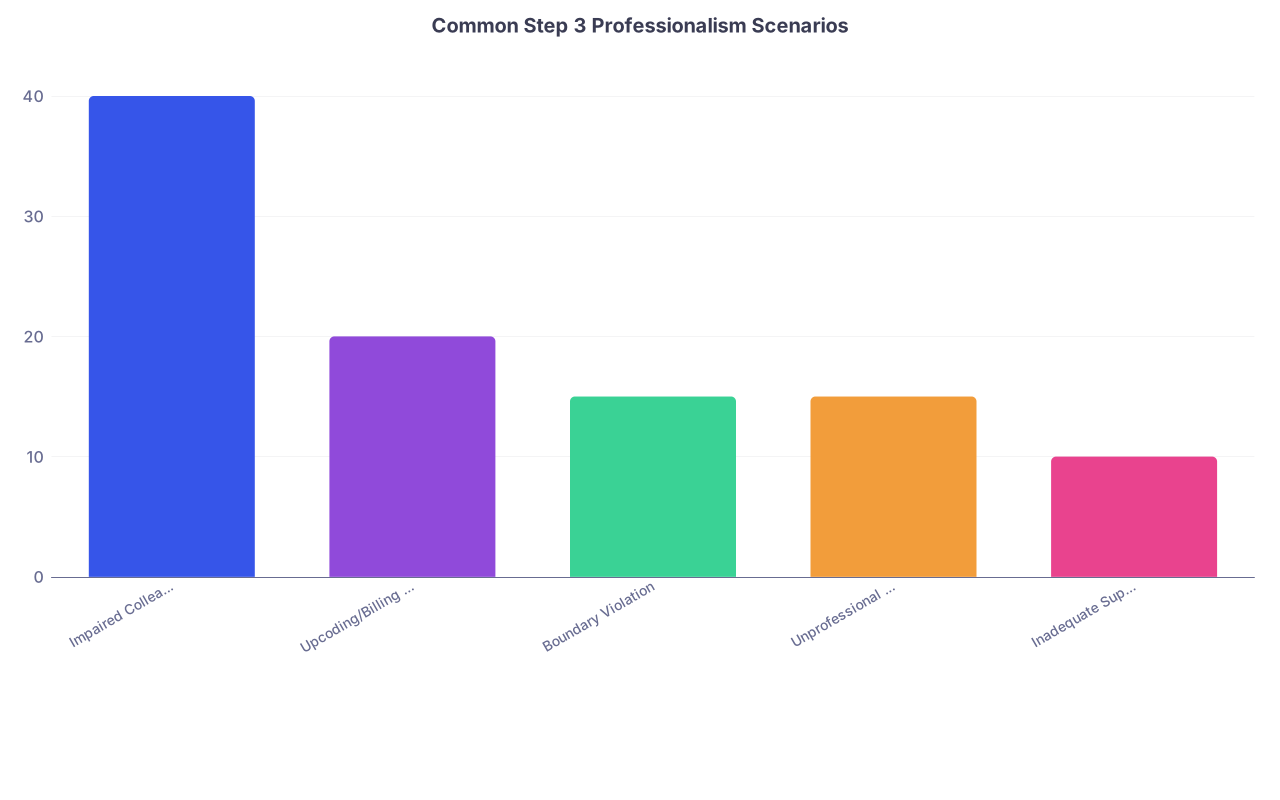
| Category | Value |
|---|---|
| Impaired Colleague | 40 |
| Upcoding/Billing Fraud | 20 |
| Boundary Violation | 15 |
| Unprofessional Communication | 15 |
| Inadequate Supervision | 10 |
These questions are almost formulaic. Once you see the pattern, it is mechanical.
5.1 Impaired Colleague
Classic stem: A senior physician seems intoxicated, falling asleep, or making repeated errors.
What you do:
- Remove them from patient care if imminent risk (have them relieved of duty).
- Report to appropriate institutional body (chief, program director, physician health program).
- Document factually, not judgmentally.
What you do not do:
- Cover for them and say nothing.
- Confront them privately and then drop it if they “promise” to improve.
- Go straight to police or licensing board without going through established hospital channels, unless explicit risk / ongoing harm not being addressed.
The risk management frame: protecting patients now and in the future.
5.2 Dishonesty and Documentation Games
Scenarios:
- Attending asking you to “adjust” a note to match a higher billing level.
- Colleague backdating consent or altering EMR after an adverse event.
- Documenting physical exam findings that you did not perform.
You must:
- Refuse to falsify.
- Correct inaccurate documentation.
- Escalate concerns if patient safety or fraud is at stake.
“Go along to learn the system and fix it later” is not the Step 3 answer. Ever.
6. Exam Technique: How to Attack These Questions Under Time Pressure

You pass Step 3 by pattern recognition, not by re-deriving ethical principles from scratch every time.
6.1 A 4-Step Quick-Filter for Every Ethics/Risk Question
When you see an obviously “non-clinical” stem, run this:
- Is there immediate danger to patient or others?
- Yes → Fix safety first (stabilize, isolate, remove impaired provider).
- Does the patient have capacity?
- Yes → Respect their informed choice.
- No → Surrogate / advance directive / implied consent.
- Is this about confidentiality?
- Default to protect; exceptions only for serious harm or mandated reporting.
- Is this about systems vs individual?
- Usually system fix, unless gross, reckless behavior.
If you reach the options and two look similar, ask:
- Which one most directly reduces risk and respects rights?
- Which one is more transparent and honest?
That usually separates the NBME answer from the “sounds reasonable but weak” distractor.
6.2 Common Distractor Patterns
Recognize and avoid these:
- “Do nothing and continue current management” when the stem screams risk or legal/ethical issue.
- “Document only” without action.
- “Discuss with attending and defer to their decision” in clear-cut safety violations.
- “Respect family wishes” when they directly conflict with the patient’s known wishes.
- “Order psychiatric evaluation” as a stall when capacity is already obvious from the vignette.
Also, be wary of options that sound “nice” but do not solve the underlying problem. Step 3 rewards decisive, ethically grounded action.
7. CCS: How Risk Management and Ethics Sneak into Cases
People underestimate this. CCS is not just about clicking the right antibiotics.
Ethics/risk patterns in CCS:
- You must isolate patients with suspected TB or meningococcemia early.
- You must report suspected abuse (child, elder) as soon as you are reasonably concerned.
- You must get informed consent for invasive procedures (central line, surgery, blood transfusion).
- You must monitor for and respond to adverse effects (e.g., heparin-induced thrombocytopenia) and disclose errors if you cause harm.
On CCS:
- Use order “CONSULT SOCIAL WORK” in abuse, unsafe home environment, or major social barriers.
- Use “CONSULT ETHICS” sparingly, but acceptable when there is genuine conflict without imminent harm.
- Do not delay life-saving treatment waiting for perfect consent when the situation is emergent.
Risk management in CCS is about:
- Doing the safe thing early.
- Not ignoring red-flag system issues (no VTE prophylaxis, missing monitoring).
- Using multidisciplinary support appropriately.
8. Targeted Practice: How to Get These Questions Right Consistently
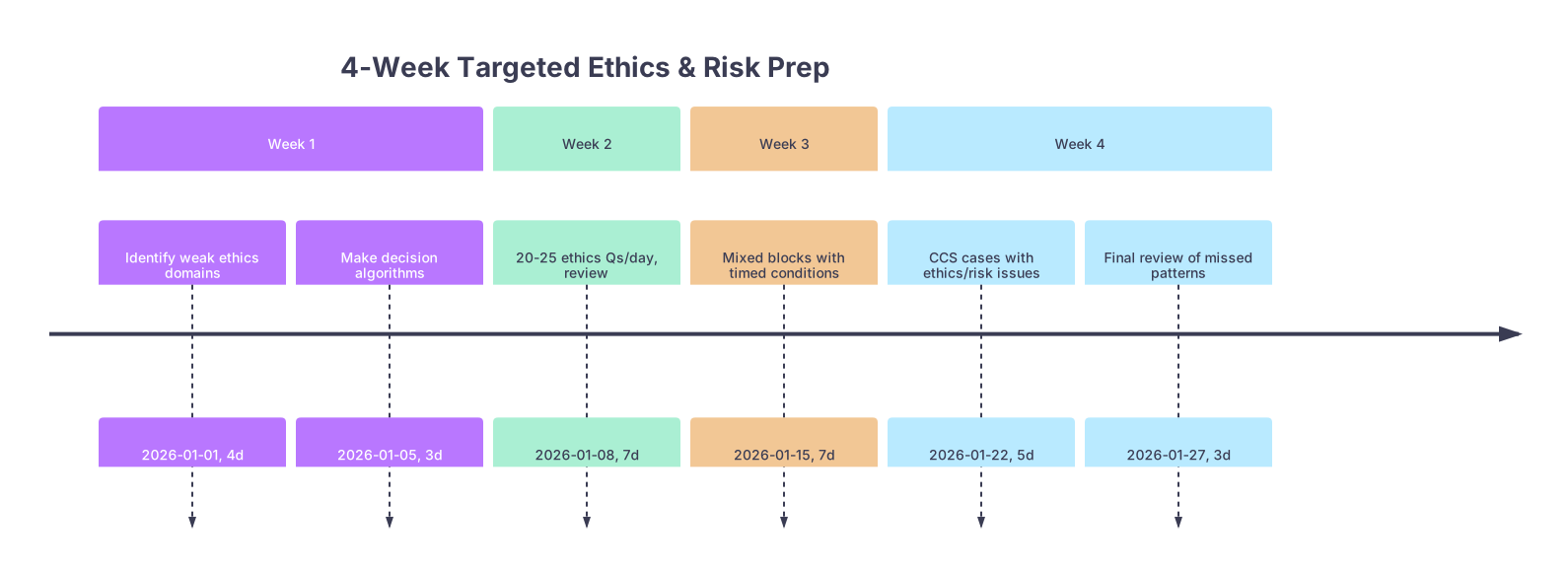
| Period | Event |
|---|---|
| Week 1 - Identify weak ethics domains | 2026-01-01, 4d |
| Week 1 - Make decision algorithms | 2026-01-05, 3d |
| Week 2 - 20-25 ethics Qs/day, review | 2026-01-08, 7d |
| Week 3 - Mixed blocks with timed conditions | 2026-01-15, 7d |
| Week 4 - CCS cases with ethics/risk issues | 2026-01-22, 5d |
| Week 4 - Final review of missed patterns | 2026-01-27, 3d |
Do not just “read about ethics.” That is useless.
You need question-based pattern training. A simple but effective approach:
- Pull out 50–100 ethics/professionalism/systems-based questions from your Qbank.
- Do them in dedicated blocks of 10–15 questions.
- For each missed or guessed question:
- Identify which algorithm step failed (safety, capacity, confidentiality, systems).
- Write a one-line rule: “In suspected child abuse, you must report, even if not 100% sure.”
- Build a 1–2 page “Ethics/Risk Rules” sheet and review it every few days.
For many residents I have worked with, this single sheet is what turned their “I just go with my gut” into a structured, consistent approach.
| Scenario Type | Default Correct Action |
|---|---|
| Questionable capacity | Assess capacity clinically; if intact, respect |
| No capacity, no surrogate | Emergencies: treat under implied consent |
| Medication error | Treat, disclose to patient, incident report |
| Suspected child abuse | Report to authorities; ensure child safety |
| Impaired colleague | Remove from care, report through proper channels |
FAQ (Exactly 5 Questions)
1. How many ethics/risk management questions are on Step 3?
There is no official number, but realistically you are looking at dozens across both days, often embedded in clinical stems. Between pure ethics/professionalism, patient safety, and systems-based practice, it easily reaches 10–15% of what actually determines your score.
2. Should I read a full ethics textbook for Step 3?
No. That is overkill and low yield. You need a concise review (a short chapter or dedicated Step 3 ethics summary) plus heavy question-based learning. Focus on patterns: consent, capacity, confidentiality, surrogates, error disclosure, and impaired colleagues.
3. How do I handle questions where the attending wants me to do something unethical?
You respect hierarchy for routine clinical judgment, but you do not obey unethical or unsafe orders. The correct Step 3 move is to refuse to participate in unethical behavior, protect the patient, and report or escalate through appropriate institutional channels if needed.
4. Are ethics questions on Step 3 more “legal” or “moral”?
They are closer to applied policy and risk management than philosophy. The test is anchored in AMA ethics opinions, standard US legal principles, and patient safety frameworks. You are not being asked what you personally believe. You are being asked what a reasonable US physician is expected to do.
5. Can I use “consult ethics” as a safe answer when I am unsure?
Only when the situation is genuinely complex and not immediately life-threatening. If there is clear harm, clear abuse, or clear capacity issues, you act first according to standard rules. “Consult ethics” is never a substitute for reporting abuse, disclosing errors, or stabilizing an unsafe patient.
Key takeaways:
You pass Step 3 ethics and risk management by running a simple, ruthless algorithm: safety first, capacity second, rights and confidentiality third, system fixes over blame. Recognize the recurring templates—impaired colleague, error disclosure, consent/capacity, abuse reporting—and you stop guessing and start answering these questions with precision.