
The way most people read Step 3 vignettes is wrong. They read them like stories, not like structured data.
Step 3 is not testing your patience for paragraphs. It is testing how quickly you can extract decision‑critical information from a noisy clinical narrative. If you keep reading every stem end‑to‑end “to be safe,” you will bleed minutes on each block and miss easy questions at the end.
Let me walk you through how efficient readers actually parse Step 3 questions.
(See also: Step 3 CCS cases: high‑yield orders and timing for acute scenarios for more details.)
Step 3 Is A Time Management Exam Disguised As A Clinical Exam
Step 3 has more text per question than Step 1 and 2, plus CCS. By the time you get to it, you are usually a PGY‑1 dragging through post‑call fatigue and clinic notes. Cognitive bandwidth is limited. The exam exploits that.
On the multiple‑choice side, the constraint is simple:
You do not have the luxury to fully “immerse” in every vignette.
Most examinees who struggle:
- Read the whole stem before looking at the question every time.
- Re‑read the stem multiple times because they did not anchor on the right data.
- Get seduced by red herrings (social details, extraneous labs, repeats of the same concept).
- Spend 90–120 seconds on questions that should take 35–40.
The point of parsing techniques is not to “trick” the exam. It is to force your brain into a clinically realistic, pattern‑driven workflow:
What is being asked? What is the decision point? What data changes that decision?
You are trying to turn each vignette from a 220‑word wall of text into 4–6 tagged, searchable data chunks.
The Core Framework: Question‑First, Data‑Second, Justification‑Later
There are three essential steps you must burn into muscle memory.
- Question‑first.
- Skim‑structure.
- Targeted extraction.
Everything else is flavor.
1. Question‑First Reading (Q‑First)
You start by reading the last line (and answer choices if needed) before touching the vignette.
Why? Because different question types demand different filters. If the question is “most appropriate next step in management,” you care about disposition, acuity, and decision thresholds. If it is “most likely diagnosis,” you care about pattern recognition and discriminating features.
Examples:
“Which of the following is the most appropriate next step in management?”
→ Your brain should immediately flip to: stable vs unstable, inpatient vs outpatient, test vs treatment first.“Which of the following is the most likely diagnosis?”
→ You are looking for classic triads, risk factors, timeline, and one or two differentiators from similar conditions.“Which of the following findings is most concerning?”
→ You are ranking red flags and prognostic factors.
Without this Q‑first step, you read blindly. You will read about a patient’s childhood trauma history with equal weight to their current vital signs. That is how you lose time.
Read the question stem line, glance quickly at the answer options’ “shape” (not necessarily every word), then go to the top. Now you know what to extract.
2. Skim‑Structure Before Content
The next step is not “deep reading.” It is structural skimming. You are scanning for:
- Age / sex / setting (clinic, ED, inpatient).
- Single sentence on chief concern and time course.
- A quick visual of where the “meat” of the vignette lies (PE paragraphs, labs block, imaging).
You are not trying to understand everything yet. You are mapping the terrain.
For example, you see:
- First line: “A 67‑year‑old man presents to the emergency department with… 3 hours of chest pain.”
- Middle: Systemic review, cardiac risk factors, some meds.
- Then: Vitals, PE, then a lab block with troponin, EKG description.
Your internal map:
This is an ED ACS case. The real decision probably depends on hemodynamics + EKG + troponin + timing. The detailed ROS paragraph is 80% noise.
So you orient, then decide where you will slow down.
3. Targeted Extraction: Read With A Filter
Only after Q‑first and structural skim do you read carefully. And you do not read everything equally.
You selectively attend based on the question type.
Here is how that looks in practice by question type.
Parsing By Question Type: Concrete Techniques
A. Diagnosis Questions: Spot the Pattern, Then One Key Differentiator
For “most likely diagnosis” questions, your filter is:
- Who is this (age, sex, comorbidities, exposures)?
- What is the main complaint and timeline?
- What three findings clinch or pivot the diagnosis?
- What are the 1–2 look‑alike diagnoses and what would distinguish them?
Diagnostic stems often try to confuse by:
- Giving you mixed chronic and acute issues in the same stem.
- Dropping one atypical detail that tempts you to overthink.
- Listing multiple abnormal labs where only one actually matters.
Your parsing rule:
- Extract age / sex and single‑phrase problem summary: “24‑year‑old postpartum woman with sudden SOB and pleuritic chest pain.”
- Identify the “diagnostic anchors” in the PE and labs: unilateral leg swelling, tachycardia, hypoxia → VTE pattern.
- Ignore irrelevant chronic noise: “history of mild asthma, seasonal allergies, and remote tonsillectomy.”
You should almost never re‑read an entire diagnosis stem. If you are tempted, pause and ask: “What piece of data do I actually need that I am not sure about?” Then skim for that only.
B. Next Step in Management: The Decision Tree Mindset
These are the bread and butter of Step 3. They are also where people waste the most time because they read for narrative, not for decisions.
The filter here is algorithmic. Clinical pathway. Once you read the question line (“most appropriate next step in management”), ask yourself silently:
- Is the patient unstable?
- Reversible emergency vs chronic optimization?
- Do I already have enough to treat, or do I need a confirmatory test first?
- Is there any contraindication to that test or treatment?
Then you mine the vignette specifically for:
- Vitals and key red flag signs.
- Acute vs chronic duration.
- Prior testing or treatments already tried.
- Contraindications: pregnancy, renal failure, allergies, anticoagulation, bleeding risk.
You are thinking in foreground: “What would I physically do first when I walk into this room?” Not “what is everything I can think of about this condition.”
Example:
Question line: “What is the most appropriate next step in management?”
You know: ED setting, older man, chest pain. As you read, before caring about every lab:
- Hit the vitals: hypotensive + tachycardic = unstable.
- Hit the EKG: ST elevations in II, III, aVF = inferior STEMI.
- Look for contraindications to thrombolytics or PCI.
- Decide: ASA + heparin + emergent cath vs thrombolytics vs something else.
The rest? Past medical history of BPH, toe fungus treatment, a childhood pneumonia? Noise.
You must practice consciously asking: “What piece of information in the stem is actually changing my next action?”
C. “Most Appropriate Test” / “Next Diagnostic Step”
Different, but related. The exam writers love to see if you jump too quickly to fancy tests when basics will do.
Your filter for diagnostic step questions:
- Do I already have enough to diagnose clinically? If yes → you do not order more.
- Is this test about ruling out dangerous diagnoses (high stakes) or refining low‑risk differentials?
- What is the least invasive, most cost‑effective test that changes management now?
When you read the stem, your targeted extraction is:
- Have they already given me a key diagnostic test result (clear EKG, classic spirometry, definitive imaging)?
- Did they mention prior negative tests?
- Is there any risk factor that would push me to a more aggressive rule‑out?
Slow down for those, speed through the fluff.
D. “Most Likely Explanation” / Risk / Prognostic Questions
These often feel wordy because they bake in psychosocial context, socioeconomic status, adherence issues. Step 3 leans into that.
Here, the filter is:
- Why is this patient having this outcome despite what appears to be reasonable clinical care?
- Which risk factor or behavior in the stem is actually causal vs merely descriptive?
You extract:
- Adherence clues (“misses appointments,” “forgets to pick up meds”).
- System issues (lack of insurance, language barriers, missed follow‑up).
- Behavioral health factors (substance use, depression, cognitive decline).
And you largely ignore repeated pathophysiology paragraphs that you already know. They are there to see if you get distracted.
Concrete Parsing Patterns: Where To Look First, Second, Third
The fastest readers use a consistent visual path through each vignette.
Here is a simple, replicable sequence for most questions:
- Read question line first.
- Eyes to the first sentence: age/sex + chief complaint + duration. Brief mental label: “58 F, new heart failure symptoms, subacute.”
- Jump to vitals and focused PE section. Mark stability and any obvious localizing signs.
- Glance at labs/imaging: identify only the 1–3 values that meaningfully alter decisions (e.g., troponin, creatinine, Hgb, PaO2, D‑dimer, BNP).
- Only then, if needed, skim the middle history paragraphs for specific details (recent surgery, travel, exposures, medication changes, psychosocial context).
You are not scrolling linearly top‑to‑bottom with equal attention. You are bouncing between anchor points.
For many “next best step” questions, a simplified pattern works:
- Question line → Vitals → PE red flags → Key lab/imaging → Answer.
If you train yourself to do this, 30–40% of stems will become one‑pass reads in 25–35 seconds.
Where Step 3 Specifically Wastes Your Time
Step 3 vignettes have some recurrent “time sink” patterns that I have seen over and over in UWorld, NBME, and real exam recalls.
Stop falling for these.
1. Overloaded Past Medical History Paragraphs
Paragraph with:
“Hypertension, hyperlipidemia, type 2 diabetes mellitus for 15 years complicated by peripheral neuropathy and retinopathy, chronic kidney disease stage 3, osteoarthritis, GERD, and depression treated with…”
Most of that is white noise. You care about:
- The one or two that change treatment choice: CKD for drug clearance, diabetes for infection risk, depression for adherence.
- Any med that would conflict with your prospective answer (warfarin, DOAC, recent steroids, MAOI, lithium, etc.).
Your approach: speed‑scan PMH purely for “deal breakers” to your likely intervention. If none, move on.
2. Laundry List Review of Systems
They love “all systems negative except…” paragraphs.
You should:
- Read the “except” phrase.
- Ignore the rest unless there is some hidden red flag (night sweats, weight loss, focal neurology).
You do not need to verify that every other system is negative. That is there for realism, not scoring.
3. Repetitive Lab Blocks
Multiple labs that are obviously normal plus 1–2 meaningful abnormalities.
Train your eyes to:
- Slide quickly down the left side of the lab block only reading the analyte names.
- Stop where your mental alarm rings: creatinine, anion gap, INR, troponin, LFTs, ABG numbers, etc.
- Glance just far enough right to read the value and compare to reference.
You do not need to re‑memorize every normal range during the exam. You know what a normal sodium looks like. If it is not obviously off, do not linger.
A Visual Comparison: Inefficient vs Efficient Parsing
| Aspect | Inefficient Approach | Efficient Approach |
|---|---|---|
| Order of reading | Top to bottom, question last | Question first, then structured skim |
| Attention distribution | Equal to every sentence | Focused on vitals, PE, key labs, key history |
| Re‑reading | Multiple full re‑reads | Targeted re‑check of specific details |
| Time per standard item | 90–120 seconds | 35–60 seconds |
| Cognitive load | High, easily overwhelmed | Lower, algorithmic, pattern‑based |
Training Yourself: You Have To Practice The Skill, Not Just Read About It
You do not become efficient by reading about efficiency. You need deliberate practice while doing question blocks.
Here is how I have seen residents successfully retrain.
Phase 1: Slow, Conscious Patterning (Untimed)
Use UWorld (or AMBOSS) in tutor mode. For each question:
- Force yourself to read question line first and say it quietly in your head: “next step in management” or “most likely diagnosis.”
- Before reading the stem, state what data you will look for: “I care about vitals, EKG, troponin,” etc.
- Then read the vignette following your chosen sequence.
- After answering, review the explanation and ask: “Which 2–3 pieces of data were actually necessary?” Mark those mentally. Ignore the rest.
You are building a mental list of “deciding data” for common scenarios.
Do this for a few hundred questions. Yes, it is slower upfront. That is fine.
Phase 2: Timed Blocks With Hard Time Caps
Once the pattern is semi‑automatic, go to timed blocks. Set strict micro‑goals:
- Average 60 seconds per question for a 38‑40 question block.
- If you hit 75 seconds on a question and still feel unsure, mark it, pick the best option, and move on.
Your metric here is not “percentage correct right away.” It is “am I reading stems in one pass and rarely re‑reading the entire thing?”
After each timed block:
- Identify 3–5 questions where you spent way too long.
- Look back at the vignette and highlight the exact decision‑critical lines.
- Ask yourself: “What did I waste time reading that did not change the answer?”
You will start to see patterns in your own inefficiency—maybe you always over‑focus on lab minutiae or psychosocial details.
Phase 3: Simulated Fatigue, Because Real Step 3 Is Not Taken Fresh
Step 3 is not a single pristine block. It is long. You will answer vignettes when tired, hungry, or bored. Efficiency matters most then.
Simulate that:
- Do a full 6–7 block day of mixed UWorld questions on a weekend.
- Maintain your parsing protocol all day (question‑first, structural skim, targeted extraction).
- Track blocks 5–7 specifically: are you reverting to top‑to‑bottom reading when tired?
If you are, the skill is not yet automatic. Keep training.
Applying Parsing To CCS Style Stems (Briefly)
Even though this article focuses on multiple‑choice, the same parsing principles help with CCS cases.
For CCS:
- Question‑first equivalent: “What is the likely case type (acute ED vs outpatient chronic vs ICU)?”
- Structural skim: age/sex + chief complaint + acuity.
- Targeted extraction: immediate threats to life, required immediate orders, then secondary issues.
You still do not read for entertainment. You read for sequence of actions.
A Process Map: What Your Brain Should Do On Every Question
Let me lay it out in a simple diagram you can mentally rehearse.

| Step | Description |
|---|---|
| Step 1 | Read Question Line |
| Step 2 | Plan diagnostic filter |
| Step 3 | Plan management filter |
| Step 4 | Plan test selection filter |
| Step 5 | Skim first line: age/sex + complaint |
| Step 6 | Check vitals & key PE |
| Step 7 | Scan labs/imaging for key values |
| Step 8 | Skim history only for relevant modifiers |
| Step 9 | Select answer |
| Step 10 | Targeted re-check one detail |
| Step 11 | Next question |
| Step 12 | Type? |
| Step 13 | Uncertain & time left? |
That is the loop. Every single vignette, same structure. You speed up by making this automatic.
Quantifying Your Improvement
People like numbers. Let’s be explicit.
Take a 40‑question UWorld block.
- Inefficient reader: ~80–90 seconds per question → 53–60 minutes for the block, often rushed at the end.
- Efficient reader: ~50–60 seconds per question → 33–40 minutes real reading time, leaving buffer for a few harder questions and quick review.
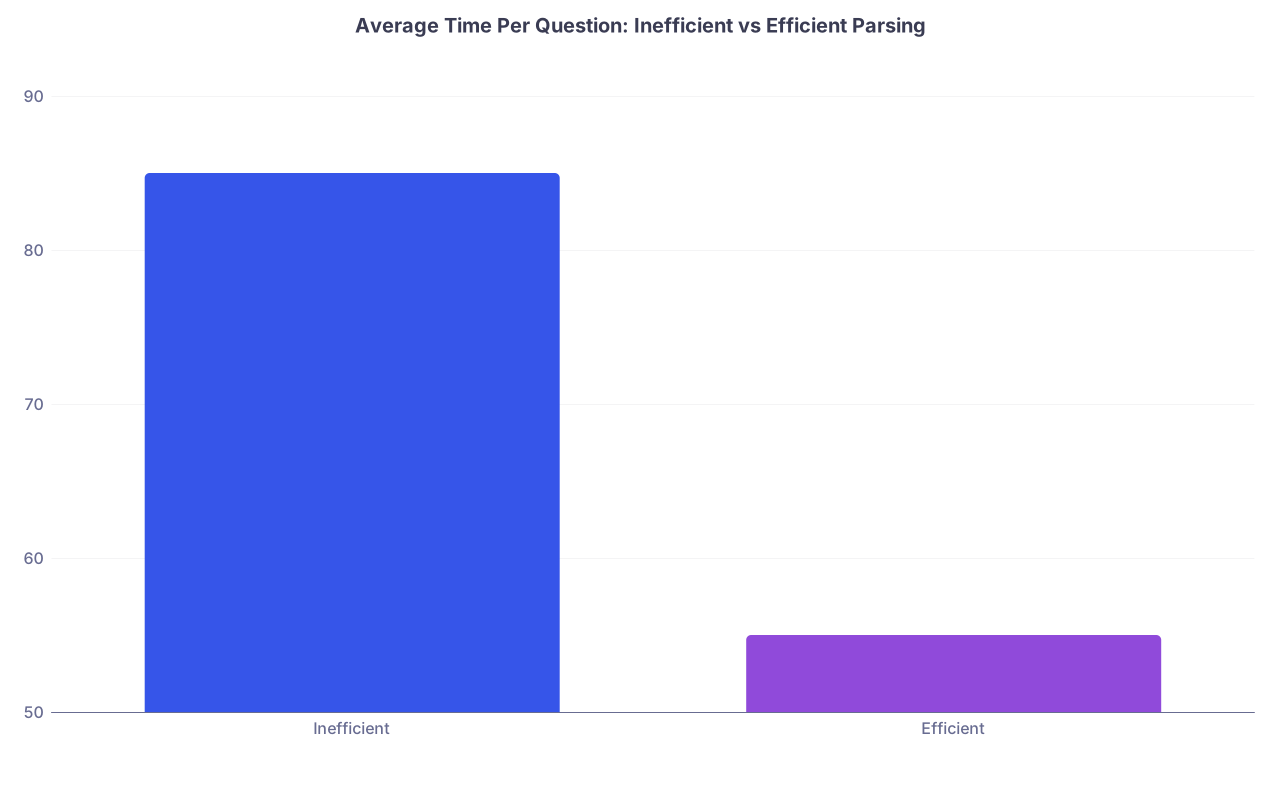
| Category | Value |
|---|---|
| Inefficient | 85 |
| Efficient | 55 |
That 30‑second difference per question is your entire safety margin on test day.
Common Bad Habits You Need To Kill
Let me be blunt about a few habits I see repeatedly that destroy performance:
“I read everything carefully because I am afraid of missing a detail.”
That is anxiety talking, not strategy. You are far more likely to miss the last 4–5 questions in a block than to miss a single obscure clue you might have caught by reading every sentence like scripture.“I do questions untimed because I want to focus on learning, not speed.”
During early content review, fine. But for Step 3, if you delay timed practice, your knowledge will not translate into exam performance. Speed is part of the tested skill.“I re‑read the stem whenever I feel unsure.”
No. When unsure, ask yourself: “Which decision‑critical parameter do I not know?” Then re‑check only that.“I write notes for each vignette on scrap paper.”
On Step 3, outside of CCS flow charts or rare multi‑step reasoning questions, this is usually wasted effort. You are not doing board‑style multi‑step Step 1 biochem. You are choosing a single next step in common conditions.
A Quick Example: Parsing Walkthrough
Let me show you exactly how this plays out in a sample style vignette.
Question line (you read this first):
“Which of the following is the most appropriate next step in management?”
Glance at options: they look like “start ACE inhibitor,” “loop diuretic,” “beta blocker,” “refer for device,” “order TTE.”
Now go to the top.
First line:
“A 63‑year‑old man presents to clinic with 3 months of progressive shortness of breath on exertion and bilateral lower extremity swelling.”
Mental tag: older man, chronic progressive dyspnea + edema → chronic heart failure is likely.
Vitals: BP 142/88, HR 88, RR 18, SpO2 96% RA.
PE: JVD to angle of jaw at 30°, S3, bilateral crackles, 2+ pitting edema.
Mental: stable vitals, clear signs of volume overload, likely HFrEF vs HFpEF.
Labs: BNP elevated, creatinine mildly up, troponin normal.
Past: history of MI 2 years ago, on aspirin and statin, no ACE inhibitor, no beta blocker.
Here is the key: You already have enough to clinically diagnose suspected chronic systolic HF. You do not need to “rule out” MI; troponin is normal and symptoms chronic.
Decision logic (which you apply in 10–15 seconds):
- Is he unstable? No.
- Do I need emergent hospitalization? No.
- Do I need echo to guide therapy? Yes, but guidelines often treat typical HFrEF clinically while you arrange echo.
- What is the “most appropriate next step” at this visit? Start guideline‑directed medical therapy.
If answer options include:
- “Order transthoracic echocardiogram”
- “Start ACE inhibitor therapy”
- “Admit for IV diuresis”
- “Cardiac catheterization”
- “Increase statin dose”
Your parsing tells you: the core Step 3 testing point here is initiation of evidence‑based HF therapy in a stable outpatient. So “start ACE inhibitor” is likely the answer, not “admit” or “cath.”
At no point did you need to re‑read the entire history paragraph. You anchored on question type, vitals, PE, key labs, and previous meds. Done.
If you find yourself scrolling back up multiple times, you are not trusting your framework.
How To Embed This During Clinical Work (Optional But Powerful)
If you are a PGY‑1 or late M4, you can actually rehearse this on real patients.
Every time you pick up a chart:
- Ask yourself the “question line”: What is the main decision on this encounter? Diagnose? Rule out something dangerous? Adjust meds? Discharge vs admit?
- Skim triage note / nurse note like a vignette: age, chief complaint, vitals.
- Extract only what you really need from the rest: focused history and exam.
You will notice fast that a lot of chart text is noise, even IRL. Vignette parsing is just formalizing what good clinicians do: pattern recognition, priority data, selective attention.
Final Tight Summary
Three takeaways and you are done:
- Reading Step 3 vignettes efficiently is a skill, not a personality trait. Use a fixed loop: question‑first → structural skim → targeted extraction.
- Not all data in the stem is equal. Train your eye to anchor on vitals, focused PE, 1–3 key labs/imaging results, and only the specific history elements that change your next step.
- You must practice this under time pressure. Timed UWorld blocks, deliberate post‑hoc review of “wasted reading,” and simulated fatigue days are how you hard‑wire efficient parsing before test day.