
Last winter, a PGY-2 sat in my office after sign‑out, Step 3 score report pulled up on his phone. He’d “just passed” with a mid‑190s. Two months later, his fellowship advisor told him cardiology at his home program was “probably unrealistic now.” Nothing else about his file had changed.
You are told Step 3 “just needs a pass.” Let me tell you what really happens once those scores land in program directors’ inboxes and fellowship meetings start.
The Lie You’re Sold About Step 3
Most residents hear the same script: “Step 3 doesn’t matter unless you fail. Just get it done before fellowship applications.”
That line usually comes from people who:
- Matched before Step 1 went pass/fail
- Applied when Step 3 reporting patterns were different
- Haven’t sat in a modern fellowship rank meeting in years
Or, frankly, from seniors who are trying to feel better about their own mediocre scores.
Do some programs truly ignore Step 3? Yes.
Do enough important programs quietly use it that you can get hurt by a bad score? Also yes.
Here’s the unfiltered version: in many competitive fellowships, Step 3 has become the only standardized test number left. With Step 1 pass/fail and Step 2 CK sometimes taken late, Step 3 is the last objective piece of evidence of your current cognitive level.
Program directors know this. They will not say it on the website. But they use it.
Where Step 3 Actually Shows Up in Fellowship Decisions
You won’t see “Step 3 cutoff: 220” printed anywhere. That’s not how this game works. But there are specific doors where your Step 3 number quietly gets checked.
1. Initial Fellowship Application Screens
For high‑volume fellowships—cards, GI, heme/onc, some pulm/crit—the first pass is brutal. Piles of ERAS apps, limited time, zero appetite for nuance.
In those rooms, something like this happens:
“We’ve got 600 applications for 5 cards spots. How are we cutting this down?”
“Okay: Step 2 above 240, Step 3 above 215, no fails on any Step. Then we look.”
Nobody advertises that. But I’ve watched that exact filter used.
Is Step 3 the only filter? No. But it’s absolutely used as one more lever when they’re drowning in applications.
Rough guideline from what I’ve seen:
| Tier | Step 3 Score Range | How Committees React |
|---|---|---|
| Strong | ≥ 230 | “Fine, move on; scores not a concern.” |
| Acceptable | 215–229 | “Okay, let’s see research/letters.” |
| Borderline | 200–214 | “What happened here?” needs offsetting strengths. |
| Red Flag (Pass) | 190–199 | “Keep only if something else is exceptional.” |
| Fail | Below passing | “Serious concern; needs explanation and big positives.” |
No one will tell you that 212 Step 3 knocks you out of consideration for some cards and GI programs from the start. But it does. Especially if your Step 2 was already soft.
2. When There’s a Discrepancy in Your Scores
Committees don’t just look at Step 3 in isolation. They look at the story your score trend tells.
Here’s the pattern PDs talk about behind closed doors:
Step 1 low → Step 2 up → Step 3 up
“Okay, this person matured. Great.”Step 1 good → Step 2 good → Step 3 mediocre
“Burned out? Checked out? Ceiling hit? Or got lazy?”Step 1 pass/fail → Step 2 solid → Step 3 weak
“So maybe Step 2 was a fluke or heavily coached.”
One conversation I overheard in a heme/onc selection meeting:
“She had a 246 on Step 2 but a 202 on Step 3. That’s not trending the right way.”
“And she took it mid‑PGY2 with no big life event. I’m not sure I trust the 246 now.”
Nobody emails you that they had that conversation. You just never get an interview.
3. Visa Candidates and Institutional Policies
If you’re on a visa, Step 3 matters more than people admit. Not for “competence.” For bureaucracy.
Some institutions have hard Step 3 requirements for sponsoring visas or renewing contracts. A few places quietly prefer that visa-dependent fellows already have a “comfortable” Step 3 score so they’re not sweating any future credentialing issue.
Also: some fellowships get burned once by a visa candidate who struggles with in‑training exams or barely passes Step 3, and then they overcorrect with unwritten rules.
I’ve sat in meetings where someone said:
“We had trouble getting hospital privileges for that IMG last cycle because of multiple low board scores. Can we just aim for folks with clean, strong Step profiles this year?”
You don’t win those battles with charm. You win them with numbers.
The Hidden Ways Step 3 Shows Up On Paper
You think Step 3 just lives in the “USMLE” section of ERAS. That’s where it starts. It doesn’t stay there.
In Your LoRs
Attending writing your fellowship letter knows your Step 3 score. They may not state the number, but they adjust tone based on it.
When someone is a strong test taker with a great Step 3, you see things like:
“He has consistently excelled on standardized examinations, recently scoring well above the national mean on Step 3.”
When the score is mediocre but they want to support you, they talk around it:
“She has passed all required USMLE examinations and her clinical performance far outstrips what her standardized scores might suggest.”
Yes, fellowship PDs can read subtext. That second line is code for “scores are not great.”
And if the LoR doesn’t mention boards at all while mentioning it for other applicants from the same program? That silence is its own message.
In Your MSPE / Program Director Letter
For fellowship, that program director letter is political currency. The PD is selling you. But they don’t want to damage their own credibility.
If your Step 3 is weak, they often pivot to language like:
“While his standardized scores are not truly reflective of his capabilities, his clinical acumen is among the best in his cohort.”
That phrase—“not reflective of his capabilities”—is used when Step 1/2/3 are dragging you down. You never want your PD forced into that corner.
Specialty by Specialty: How Much Does Step 3 Really Matter?
Let me break down what I’ve seen in rank meetings, informal PD calls, and those post‑conference bar conversations where people say the quiet part out loud.
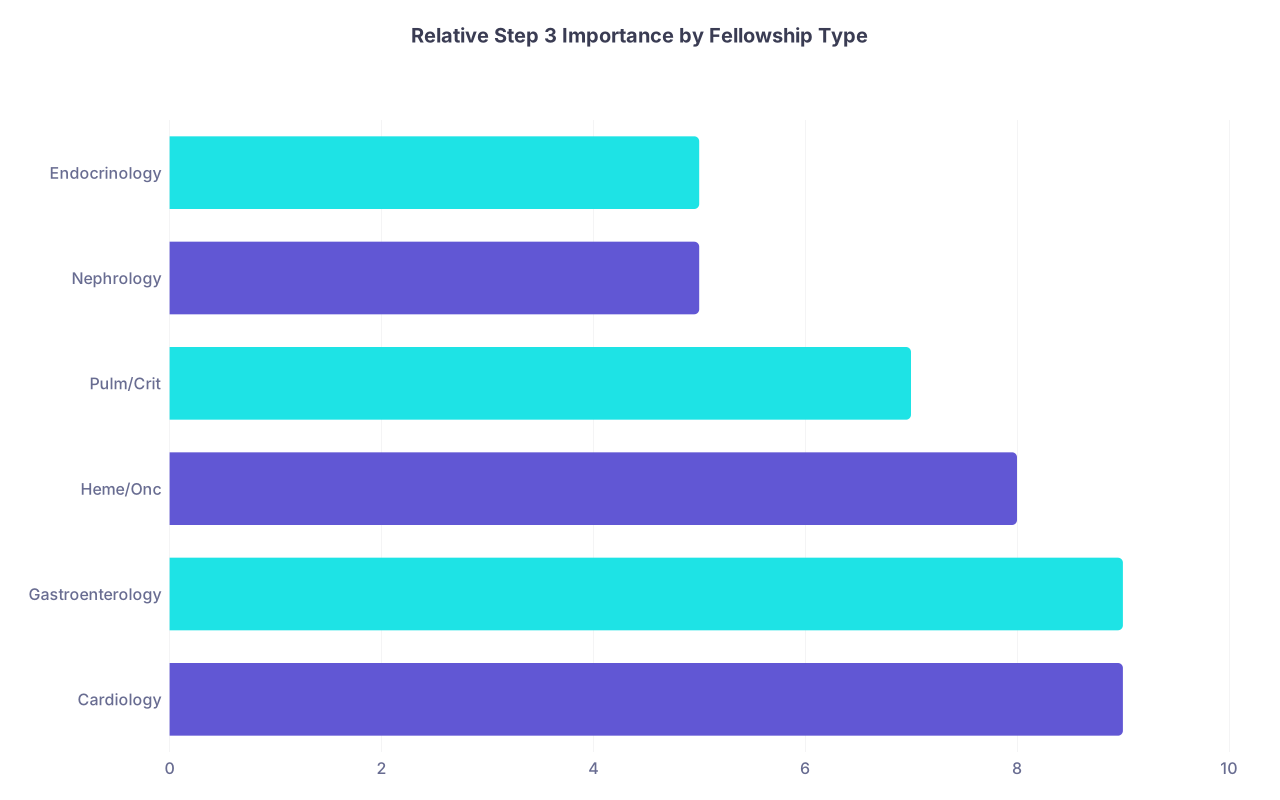
| Category | Value |
|---|---|
| Cardiology | 9 |
| Gastroenterology | 9 |
| Heme/Onc | 8 |
| Pulm/Crit | 7 |
| Nephrology | 5 |
| Endocrinology | 5 |
Scale: 1 = barely care, 10 = watch it like a hawk.
Cardiology & GI (8–9/10)
These are board‑exam heavy, guideline‑driven, fiercely competitive. PDs are very conscious of their board pass rates.
What they’re really asking about Step 3:
- “Will this person pass the cardiology/GI boards the first time?”
- “Do they have the horsepower to handle complex, protocolized medicine?”
You come in with Step 2 238 and Step 3 208 and an average IM ITE? They worry. Hard.
I’ve seen mid‑tier cards programs toss applications into the “maybe” pile just off a Step 3 below 210. Not because you’re doomed, but because they have 40 people with 230+.
Heme/Onc (7–8/10)
Research and letters carry a lot of weight. But once you’ve got a stack of applicants all with first‑author oncology papers and glamorous mentors, you know what they start checking?
Score trends. ITEs. Step 3.
They want someone who can parse complex chemo regimens and pass oncology boards, which are no joke. A weak Step 3 doesn’t kill you if your research is stellar, but you’ll be the first cut in a comparison between two similar CVs.
Pulm/Crit (6–7/10)
Pulm/crit PDs look a lot at clinical performance and how you handle ICU chaos. But they also know the critical care board exam is tough.
So they’ll use Step 3 as a surrogate, especially if your residency program is known for weaker board pass rates. Some will flat out say in committee:
“We’ve had trouble with boards the last three years; I’d like to see stronger Step 3s in our incoming fellows.”
Nephrology, Endo, Others (4–6/10)
In less competitive fields, Step 3 is less of a gatekeeper and more of a tie‑breaker. But don’t get complacent.
If applications are dropping in a field, PDs can be choosy with what they get. I’ve heard a nephrology PD say:
“We’re not cards, but I still don’t want someone who barely passed Step 3 if I can have someone stronger.”
The pool might be smaller, but they still stratify within that pool.
The Ugly Truth: Low Step 3 + Other Concerns = Door Slams
One low number alone doesn’t always sink you. PDs are not robots. They can forgive a lot. But patterns matter.
The combinations that really hurt:
- Borderline Step 3 + weak ITEs
- Step 3 fail + late retake + average letters
- Step 3 in the 190s + no standout research in competitive fields
- Step 3 drop of >15–20 points from Step 2
Programs quietly label those applications as “risk.” And in a 3:1 or 4:1 applicant‑to‑interview spot world, “risk” is usually not worth it.
I have literally heard:
“Her application is fine but not special, and that 197 Step 3 makes me nervous. Let’s use the spot on someone cleaner.”
They say that while your faculty mentor is still telling you “a pass is a pass.”
Timing: When to Take Step 3 If You Care About Fellowship
This is where strategy actually matters. Step 3 timing can help or hurt you.
Here’s how PDs tend to think:

| Step | Description |
|---|---|
| Step 1 | Entering PGY-1 |
| Step 2 | Take Step 3 PGY-2 when convenient |
| Step 3 | Take Step 3 late PGY-1 or early PGY-2 after brief but focused prep |
| Step 4 | Take Step 3 PGY-2 before applications |
| Step 5 | Highlight it on CV & in letters |
| Step 6 | Explain briefly in PS, lean on other strengths |
| Step 7 | Plans Fellowship? |
| Step 8 | Competitive field? Cards/GI/HemeOnc |
| Step 9 | Score Strong? |
Here’s the real play if you’re gunning for a competitive fellowship:
- Do not treat Step 3 like an afterthought.
- Do not push it to late PGY‑2 if you know you want cards/GI/heme-onc. By then, you’re busy, exhausted, and writing fellowship apps.
- Taking it too early (first 3–4 months of PGY‑1) before you’ve adjusted to intern year is also dumb. You’ll end up underperforming.
The sweet spot I’ve seen for strong candidates: late PGY‑1 to very early PGY‑2, with 3–4 focused weeks of prep around a lighter rotation.
How Much Prep Is “Enough” If You Want a Good Score?
If you truly only want to pass, you can wing Step 3 with a short question block warm‑up. But that’s not who you are if you’re reading this.
Realistic prep for a strong score while working:
- Total time: 3–4 weeks of real studying, not “I glanced at my phone on call.”
- Daily: 1–2 timed blocks of questions (UWorld, etc.) plus CCS practice.
- Focus on medicine‑heavy, ambulatory, and management‑oriented content—PDs care that you can make decisions, not just recite facts.
I’ve seen residents roll in with this attitude: “I crushed Step 2, I’ll be fine.” Then they take Step 3 after a brutal ICU month, half‑asleep, and drop 20 points.
They still pass. But when cards, GI, heme/onc look at that drop? It’s a quiet ding.
What If Your Step 3 Is Already Low?
This is the part most people don’t tell you, because it’s uncomfortable. But you deserve the real playbook.
If you have a weak Step 3 (let’s say <210) and you’re aiming high, here’s how PDs will evaluate you: can you drown that one red flag in a sea of green lights?
You can’t erase the number, but you can do three things:
Crush your ITEs.
Many fellowships do ask for or at least inquire about ITE performance. If your in‑training exam is consistently high percentile, PDs are more willing to excuse a weak Step 3 as bad timing.Load up on real, credible advocacy letters.
Not generic “hardworking and pleasant” fluff. You need at least one letter that basically says: “I do not care about this person’s Step scores. I would take them as my own fellow without hesitation.”
That kind of statement, from a known name, can override a number.Own it—once, briefly—and move on.
If it comes up in interviews or your personal statement, don’t grovel. Don’t write a long, tortured essay. Two or three lines: what happened, what you learned, and how your subsequent performance proves the exception, not the rule.
Something like:
“I sat for Step 3 during a difficult personal period and underperformed compared with my Step 2 CK. Since then, I’ve scored in the top quartile on my in‑training exams and consistently managed complex patients on the wards and in the ICU, which I believe better reflects my current capabilities.”
Then stop talking about it. Program directors respect concise ownership more than apology tours.
Why PDs Won’t Admit Any of This Publicly
You might be wondering: if Step 3 quietly matters this much, why don’t programs just say so?
Three reasons.
First, legal and PR risk. Nobody wants an email leaked saying “we don’t interview people below 215.” It looks discriminatory, overly rigid, and opens them up to battles they don’t want.
Second, flexibility. Some of the best fellows PDs have ever had had ugly board histories. They want the freedom to break their own “rules” when a truly outstanding candidate lands on their desk.
Third, politics with their own residents. Imagine telling your own PGY‑1s, “By the way, Step 3 actually matters a lot here.” Half of them will panic. Half will start negotiating for dedicated Step 3 study blocks. That’s not in the residency director’s interest.
So they keep the message simple: “Just pass.”
And then behind closed doors, they stratify you anyway.
The Bottom Line You Need To Hear
Step 3 will not rescue a weak application. It will not by itself land you a top‑tier fellowship. But it absolutely can:
- Quietly kill your chances at certain programs if it’s low or a fail
- Strengthen your narrative and calm PD fears if it’s solid and consistent
- Serve as the tiebreaker when committees are choosing between you and someone who looks almost identical on paper
If you’re serious about fellowship—especially cards, GI, heme/onc, pulm/crit—here’s the unvarnished truth:
Step 3 is not “just a pass.” It’s your last numerical impression. Treat it that way.
Key points to walk away with:
- Many competitive fellowships use Step 3 as a quiet screening and tie‑breaking tool, even if they deny having “cutoffs.”
- A low or dropping Step 3 score doesn’t automatically destroy you, but it forces you to be exceptional everywhere else—ITE scores, letters, clinical performance.
- If you care about fellowship, plan Step 3 timing and prep deliberately; it’s your final standardized chance to prove you’re as strong now as your application says you are.