
Failing Step 3 once does not end your career. Failing Step 3 without a hard, structured response is what derails people.
You do not need more motivation. You need a precise recovery protocol and the discipline to follow it. I am going to give you both.
You are juggling residency, call, notes, and a life that is probably already running on fumes. So this game plan is built for real residents with real time constraints, not fantasy-world “10 hours a day of studying” nonsense.
You will fix three things in 8 weeks:
- Your test-taking system
- Your knowledge gaps
- Your narrative for programs and credentialing bodies
Let us get to work.
Step 1: Face the Data, Not the Emotion (Days 1–3)
If you treat this like a moral failure, you will waste weeks. This is a performance problem. Every performance problem has a pattern. Your job is to find and fix it.
1. Pull Every Piece of Objective Data
From your score report and your memory, extract:
- Overall three-digit score
- Performance by content area (high, borderline, low)
- Performance by competency (diagnosis, management, prognosis, next step, etc.)
- Any big timing issues you remember (“I guessed on last 8 questions in every block,” “I rushed CCS,” etc.)
Now write this down on paper. Not in your head.
| Domain | Result |
|---|---|
| Overall Score | 193 (Fail) |
| Foundations of Medicine | Low |
| Diagnosis | Borderline |
| Management | Low |
| CCS Cases | Very Low |
| Timing | Consistently rushed |
You are building your “before” picture. Everything after this will target these weaknesses.
2. Do a Brutally Honest Autopsy
Ask and answer, in writing:
- How many quality hours per week did I actually study?
- What was my average UWorld QBank percentage, timed, random?
- Did I do all CCS practice cases (or barely touch them)?
- Did I time myself realistically on blocks (38–40 questions in 45 minutes)?
- How often did I review explanations vs. just checking the correct answers?
You will not like some of these answers. Good. That is your leverage.
Step 2: Choose a Realistic 8-Week Window
You must protect a time block. Trying to “squeeze in” Step 3 around brutal rotations is how people fail twice.
1. Look at Your Rotation Schedule
You want an 8-week period that is:
- Preferably includes at least 2 lighter rotations (clinic, elective, research, ambulatory)
- Avoids ICU, heavy inpatient wards, night float, or q4 call as much as possible
If you have no good blocks, you still choose the best of the bad options and build guardrails.
2. Commit to Weekly Study Hours
Realistic target:
- Minimum: 12–15 hours per week
- Ideal: 18–22 hours per week
That usually looks like:
- 1.5–2 hours on most weekdays
- 4–6 hours across the weekend
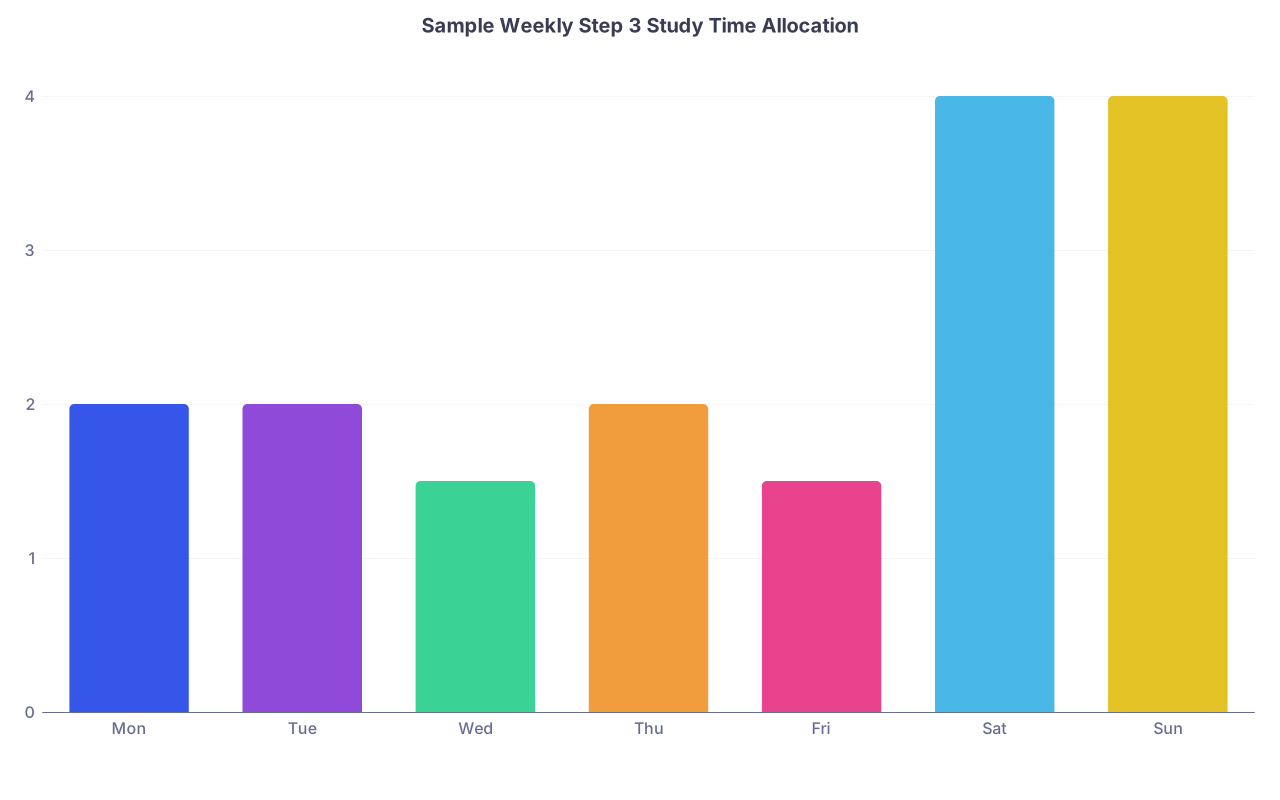
| Category | Value |
|---|---|
| Mon | 2 |
| Tue | 2 |
| Wed | 1.5 |
| Thu | 2 |
| Fri | 1.5 |
| Sat | 4 |
| Sun | 4 |
If you cannot commit at least 12 hours per week, postpone and rearrange your schedule with your program. Better to push than to collect a second fail.
Step 3: Build Your 8-Week Recovery Blueprint
You failed once. You do not get to “wing it” this time. You follow a structure.
Overall Framework
You will focus on four pillars:
- Question Bank: Timed, random, test-like
- CCS: Systematic, repetitive practice
- Weak Area Content Repair: Targeted, not general
- Test-Taking Strategy: Timing, stamina, decision-making
Here is the big-picture breakdown:
| Weeks | Focus |
|---|---|
| 1–2 | Assessment, ramp-up, system fix |
| 3–4 | Heavy QBank + Start CCS |
| 5–6 | High-intensity QBank + CCS |
| 7 | Full assessments + CCS polish |
| 8 | Taper, review, mental readiness |
Step 4: Week-by-Week Action Plan
Weeks 1–2: Set the Foundation and Fix the System
Goal: Stop doing what made you fail the first time. Build a new routine that actually matches the exam.
1. Take a Baseline Assessment (End of Week 1 or Start of Week 2)
- Use NBME / USMLE practice or UWorld self-assessment if available
- Simulate conditions: full block(s), timed, no interruptions
- Do not obsess over the exact score. You are mapping strengths and weaknesses for this attempt.
2. Start Controlled, Timed QBank Blocks
Daily (or near-daily):
- 1 block of 20–22 questions, timed (28–30 minutes)
- Mode: Random, all subjects, USMLE Step 3 difficulty
- Immediately after:
- Review every question
- For wrong answers: capture the reason in a notebook or digital doc:
- Did not know the content
- Knew content but misread question
- Knew content but fell for distractor
- Ran out of time and guessed
That “reason” log is pure gold.
3. Build Your Error Log (Non-negotiable)
Create a simple table or note with columns:
- Topic / Disease
- Question ID or brief description
- What I chose
- Why it was wrong (1 sentence)
- Key learning point (1–2 bullet points)
You will revisit this weekly.
4. Light CCS Exposure (End of Week 2)
Do not ignore CCS like last time (yes, I am assuming you did).
- Watch 1–2 tutorial videos (UWorld / other course) on CCS interface
- Do 2–3 practice cases in tutorial / practice mode
- Get comfortable with:
- Ordering immediate tests vs. delayed
- Moving the clock
- Admitting vs. outpatient management
You are not trying to master CCS yet. Just remove the “what is this interface” anxiety.
Weeks 3–4: Increase Volume, Start Real CCS Work
Goal: Build test-taking stamina and start structured CCS practice.
1. Increase QBank Volume
Target:
- 5–6 blocks per week of 20–22 questions each, timed and random
That is ~100–130 questions per week. At this stage:
- Morning or post-call: do 1 block
- Later that day: review that block deeply (takes 1.5–2 hours)
2. Start System-Based Mini-Blocks for Weak Areas
Once or twice a week:
- Do 1 focused block (10–15 questions) on a weak area identified from your score report or baseline test
- Example: endocrine, rheum, OB, psych, peds emergencies
Then spend 30–45 minutes reviewing just that block and updating your error log.
3. Begin Systematic CCS Training
Now CCS becomes mandatory, not optional.
Week 3:
- 3–4 CCS practice cases (mix of shorter and longer)
- After each:
- Write down:
- What you did well
- What you forgot (e.g., “I never ordered pulse ox or IV access”)
- Key steps you must always include (vitals, basic labs, monitoring)
- Write down:
Week 4:
- 4–6 CCS practice cases
- Focus on common high-yield themes:
- Chest pain
- Shortness of breath
- Abdominal pain
- Fever / sepsis
- Pregnancy-related complaints
Weeks 5–6: High-Intensity Push
Goal: Simulate exam pressure, close knowledge gaps, and make CCS automatic.
You should now be in a steady rhythm. Time to ramp.
1. QBank: Near-Exam Volume
Target:
- 7–9 blocks per week of 20–22 questions (140–200 questions per week)
- All timed, random, test mode
You are building:
- Speed
- Endurance
- Pattern recognition
Stop doing “tutor mode” for most blocks. Real exam is not tutor mode.
2. Weekly “Mini-Mock” Days
Once per week in Weeks 5 and 6:
- Do 2 consecutive blocks (40–44 questions, total 55–60 minutes)
- Minimal break between them (5–10 minutes)
This trains your brain to handle sustained load like the real exam day.
3. Aggressive Weak Area Repair
By now, your error log will show patterns. Use them.
Pick 2–3 major weak domains (for example):
- OB/GYN
- Infectious disease
- Biostats / ethics
For each weak area:
- Spend 2–3 focused hours per week:
- Review a concise resource (Boards & Wards, Step-Up to Medicine sections, or Step 2/3 style rapid review)
- Immediately follow with 10–15 targeted QBank questions
- Add serious misses to your error log
4. CCS: Repetition and Template Building
Now CCS practice is serious:
- 4–6 cases per week, no excuses
- Alternate:
- 2 cases one day
- 1–2 cases another day
For common case types, create templates you can run almost automatically. For example, chest pain:
- Immediate orders:
- IV access, O2, cardiac monitor, pulse ox, vitals
- ECG, troponin, basic labs, CXR
- Location: ED, then admit if needed
- Frequent reassessment and vital checks
You want CCS to feel like running a protocol, not reinventing the wheel each time.
Week 7: Full Simulation and Strategic Tweaks
Goal: Make your final corrections and ensure your score trend is safely in passing territory.
1. Take a Full-Length Practice Test
Use:
- Official USMLE practice forms if available, or
- UWorld self-assessment approximating test length
Simulate:
- Morning and afternoon blocks
- Standard break pattern
- Same snacks, hydration, environment style you will use on test day
2. Interpret the Result Like a Grown-Up, Not a Victim
Do not just stare at the three-digit number.
Break it down:
- How was your stamina?
- Did your performance drop off in later blocks?
- Any specific recurring weak areas?
- Timing panic or steady pace?
Then:
- Adjust your final week focus: top 2–3 weaknesses only
- Tighten your timing strategy (e.g., aim to be at Q20 by 22–23 minutes)
3. CCS Polishing
This week:
- 3–4 cases total, focusing on:
- Cases you historically mismanage
- Domains you are shaky in (OB CCS, pediatric CCS, ICU-level illness)
Not about quantity now. About quality and confidence.
Week 8: Taper, Consolidate, Execute
Goal: Enter the exam mentally sharp, not burned out and resentful.
1. Cut Volume, Increase Precision
Study time:
- 8–10 hours total this week
- Focus on:
- Reviewing your error log
- High-yield short notes you have created
- A few targeted QBank questions per day (10–15), not 40+
Avoid:
- Learning completely new resources
- Marathon study days that wreck your sleep
2. Final CCS Touch
- Run 2–3 cases early in the week
- Then stop 2 days before the exam
You want to go in with CCS fresh, not mentally exhausted by it.
3. Lock In Your Test Day Playbook
Decide ahead of time:
- Sleep schedule: 2–3 nights before, match your exam day wake time
- Food: simple, no surprises
- Break plan:
- For example:
- After Block 1: 5 minutes
- After Block 2: 10 minutes
- After Block 3: 5 minutes
- After Block 4: 15 minutes (lunch)
- For example:

| Step | Description |
|---|---|
| Step 1 | Start Exam |
| Step 2 | Block 1 |
| Step 3 | 5-min break |
| Step 4 | Block 2 |
| Step 5 | 10-min break |
| Step 6 | Block 3 |
| Step 7 | 5-min break |
| Step 8 | Block 4 |
| Step 9 | 15-min lunch break |
| Step 10 | CCS Blocks |
Walk into the exam with zero decisions left to make except for the questions themselves.
Fixing the Three Core Failure Modes
Most Step 3 failures I have seen fall into three big buckets. You need to identify which one (or combination) you are fighting and attack it directly.
Failure Mode 1: Knowledge Too Thin for Bread-and-Butter
You know the rare weird stuff from residency, but you whiff common ambulatory, OB, peds, and preventive care questions. Very common in IM and surgical residents.
Signs:
- Miss a lot of outpatient questions
- Unsure of basic screening guidelines, vaccines, prenatal care
- Score report shows weakness in Foundations of Independent Practice
Fix (Weeks 3–6 priority):
- Use one concise Step 2/3-style resource (not 10):
- Example: “Step-Up to Medicine” selected chapters, or a focused Step 3 review book
- Focus on:
- Diabetes management
- Hypertension, lipids
- Asthma/COPD
- Prenatal visits, pregnancy complications
- Pediatric well-child care, vaccines
- Immediately follow content review with targeted QBank micro-blocks
Failure Mode 2: Strategy and Timing Disaster
You sort of know the content, but the exam feels like a blur. You run out of time. You second-guess everything.
Signs:
- Frequently leave 3–6 questions blank or guessed per block
- Change answers from right to wrong often
- Feel rushed from Q1 instead of around Q30+
Fix:
- Strict time benchmarks during practice:
- At Q10: aim for ~11–12 minutes
- At Q20: aim for ~22–24 minutes
- Hard stop for overthinking: if >75 seconds and stuck, pick best and move
- Use “one-pass” strategy:
- Read stem once
- Decide the likely diagnosis / problem in your head
- Then look at the options and choose best fit
- Limit “marking for review”:
- If you are marking >5 questions per block, you are not committing. Force yourself to decide.
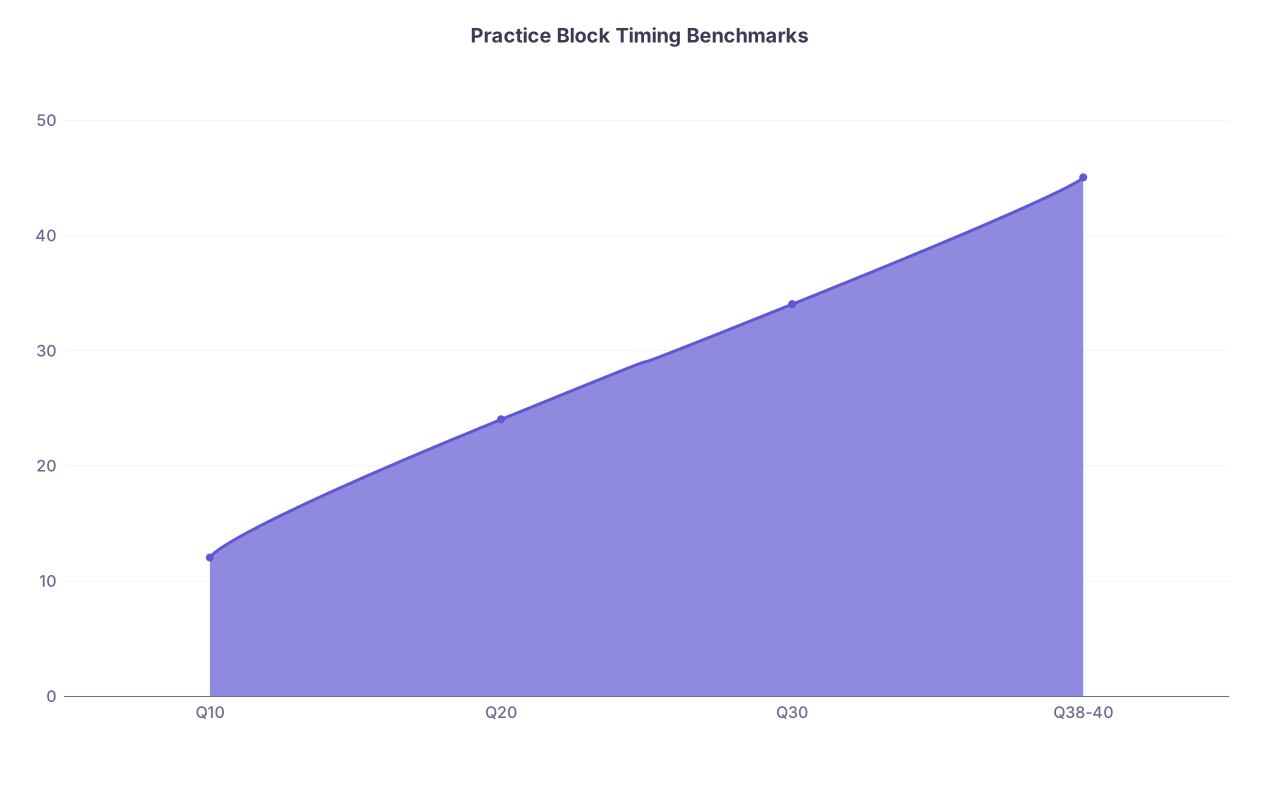
| Category | Value |
|---|---|
| Q10 | 12 |
| Q20 | 24 |
| Q30 | 34 |
| Q38-40 | 45 |
Failure Mode 3: CCS Dragging You Under
You know the multiple-choice side reasonably well, but you tank CCS.
Signs:
- Score report explicitly shows low CCS performance
- You panicked with the software the first time
- You under-ordered, forgot vitals, or never advanced the clock
Fix:
- Treat CCS like a procedure, not a guessing game.
- Immediate stabilization: ABCs, monitors, IV, vitals
- Diagnostics: labs, imaging guided by complaint
- Disposition: ED vs admission vs outpatient
- Reassessment: move the clock, repeat vitals, follow-up labs
- Use checklists you internalize during practice, like:
- For any acute case:
- Vitals, pulse ox, IV access, O2 if needed
- Focused exam
- Appropriate initial labs/imaging
- Pain/nausea control when appropriate
- For any acute case:
How to Handle the “I Failed Once” Narrative
You are not just passing a test now. You are also rebuilding your professional story. Programs and boards do not just look at the fail. They look at what you did about it.
1. Document Your Improvement Plan
Keep a simple log:
- Study hours per week
- QBank questions done and percentage correct
- CCS cases completed
- Practice test scores
Not for Instagram. For you and for any discussion with your PD if needed.
2. Be Prepared to Explain It Like an Adult
Your future script (for PDs, credentialing, maybe future applications):
- Acknowledge: “I failed Step 3 on the first attempt.”
- Context briefly: heavy rotation schedule, inadequate focused prep, or underestimating CCS (do not whine).
- Show correction: “I built an 8-week structured plan: completed the entire QBank timed and random, did X practice CCS cases, and used [self-assessments] to confirm readiness.”
- Outcome: “On the second attempt, I passed with a score of X, with improvement particularly in [areas].”
That is what responsible professionals sound like. Own the failure. Highlight the correction.
What About Burnout and Real Life?
Let me be blunt. If you are at the edge of burnout, you cannot just “add” 20 hours of Step 3 on top. Something else must give.
1. Streamline Your Life for 8 Weeks
- Cut optional commitments: extra committees, side projects, social obligations that can wait
- Batch errands once a week instead of scattered daily time leaks
- Protect sleep like a medication: 6.5–8 hours, non-negotiable where possible
2. Use Small Chunks of Time Intelligently
- 20 minutes between patients?
- Do 5 questions, not doomscrolling.
- Post-call when brain is fried?
- Review CCS templates or your error log, not fresh dense reading.

| Step | Description |
|---|---|
| Step 1 | Start Day |
| Step 2 | Pre-work 30 min: 10 Qs |
| Step 3 | Between patients: 5 Qs |
| Step 4 | Lunch: review 1 block explanations |
| Step 5 | Evening 45-60 min: CCS or targeted review |
You do not need giant uninterrupted blocks daily. You need consistent, intentional work.
Resources: What To Use (And What To Ignore)
Step 3 is not where you build a library. Too many resources is a form of procrastination.
Core Tools (Pick These, Not All the Internet)
Primary QBank:
- UWorld Step 3 (bread-and-butter choice, do it well before you even think about others)
CCS Practice:
- UWorld CCS cases
- Optional: additional CCS software if you really struggled, but not mandatory
Concise Content Review (if needed):
- A single Step 3 review book, or
- High-yield Step 2 CK style text you already like
| Need | Recommended Tool |
|---|---|
| Questions | UWorld Step 3 QBank |
| CCS Practice | UWorld CCS |
| Weak Content | One concise review |
| Assessment | NBME/USMLE practice |
Avoid stacking 3–4 question banks or 4–5 textbooks. That is how you feel busy and stay unprepared.
Concrete Daily Templates You Can Steal
Let me give you sample weekday and weekend schedules you can adapt.
Sample Weekday (Clinic or Lighter Rotation)
- 06:30–07:15 – 1 block (20–22 questions), timed
- 07:15–07:25 – Quick review of absolute misses (just mark them)
- Workday
- 19:30–21:00 – Full review of morning block, updating error log, + 1 CCS case
Total: ~2 hours focused work.
Sample Weekday (Heavy Inpatient, Non-Call)
- 05:45–06:20 – 10–12 questions, timed
- Workday
- 20:00–21:00 – Review those questions + 1 short CCS case or 5–10 more questions
Total: ~1.5 hours. Enough to maintain momentum.
Weekend Study Day (Heavier)
- 09:00–10:00 – 1 full block (20–22 questions), timed
- 10:00–11:00 – Review
- 11:15–12:00 – CCS case x1–2
- Break / life tasks
- 15:00–16:00 – Another block or targeted questions in weak areas
- 16:00–16:45 – Review
Total: ~4 hours, broken into chunks.
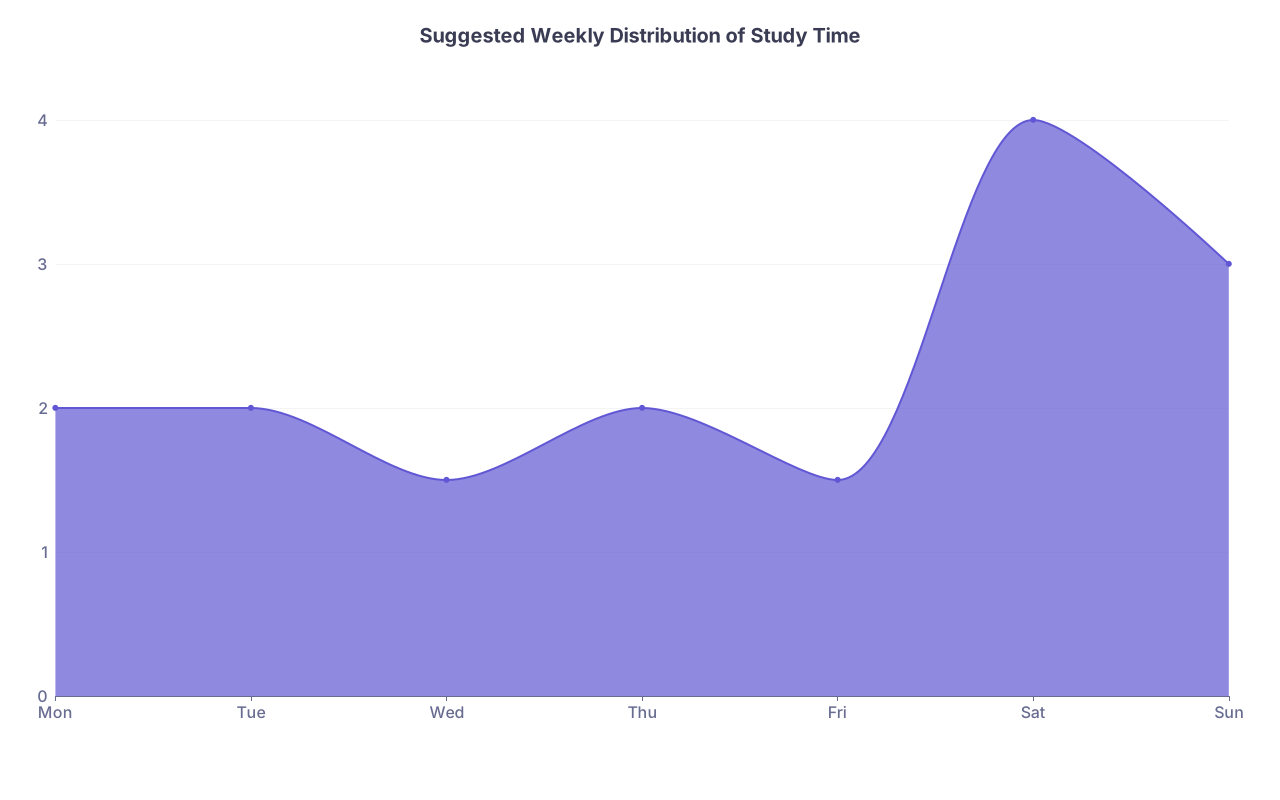
| Category | Value |
|---|---|
| Mon | 2 |
| Tue | 2 |
| Wed | 1.5 |
| Thu | 2 |
| Fri | 1.5 |
| Sat | 4 |
| Sun | 3 |
The Risk of Doing Nothing Different
One uncomfortable truth before we wrap.
Many residents who fail Step 3 once:
- Reuse the same weak “study when I can” approach
- Avoid CCS again because it is annoying
- Do not fix timing
- Tell themselves: “I know more now from residency, I will be fine”
Some pass. Many do not. A second Step 3 failure is much harder to explain and can affect:
- Fellowship competitiveness
- State licensing timelines
- How much your PD trusts your self-assessment
You are not just studying for a test. You are proving you can respond to a career-critical setback like a professional.
Your Next Move
Do not “bookmark this for later” and drift. You already know where that leads.
Right now, take 10 minutes and do three things:
- Print or open your Step 3 score report and write down your weakest content domains and competencies.
- Block off an 8-week window on your calendar, marking specific weekly study hours you will protect.
- Set up your error log document (paper or digital) with columns ready so tomorrow’s first block has somewhere to go.
Once those three are done, tomorrow morning, sit down and run one 20-question timed block. That is how the comeback starts.