
The standard advice about Step 3 question volume is misleading.
You don’t need “all the questions.” You need the right number, done the right way.
Let me answer the core question first, then I’ll break it down by scenario.
The Short Answer: How Many Questions For Step 3?
If you’re aiming for a solid, safe Step 3 pass with a decent cushion, here’s the target:
- Baseline target:
About 1,500–2,000 high‑quality MCQs (UWorld + possibly another bank)
Plus 40–60 CCS cases (through the official CCS software or a good simulator).
That’s the realistic “most people” answer.
If you want it more tailored:
| Goal / Situation | MCQs (Total) | CCS Cases |
|---|---|---|
| Bare minimum / high risk | 1,000–1,200 | 25–30 |
| Standard safe pass | 1,500–2,000 | 40–60 |
| Extra cushion / weak Step 2 CK background | 2,000–2,500 | 60–80 |
| Aiming for strong performance | 2,000+ | 60–80 |
If you want one sentence:
Do at least all of UWorld once (~1,600–1,900 questions) + 40–60 CCS cases. That covers the majority of successful Step 3 takers.
Now let’s talk about when you actually need more or less than that, and how to use those questions so they translate into points, not just time wasted.
Why “All of UWorld” Isn’t a Complete Answer
People love to say, “Just finish UWorld and you’re fine.” That’s lazy advice.
Here’s the problem:
- UWorld alone is usually enough question count
- But not enough coverage if:
- You’re far removed from Step 2 CK
- Your clinical reasoning is rusty
- You’ve never done CCS cases seriously
And “finishing UWorld” can mean two very different things:
Blasting through 80 questions per day, reading no explanations.
Translation: cosmetic studying.Doing 40–60 questions/day, timed, mixed, reviewing explanations, jotting quick notes.
Translation: real learning and pattern recognition.
Same number of questions. Totally different outcomes.
So instead of obsessing over “Do I need exactly 2,000 questions?” think in these buckets:
- Core mastery bank – usually UWorld Step 3 (non‑negotiable).
- Supplemental questions – Amboss, Rx, or random NBME-style questions if you have time/weaknesses.
- CCS practice – where a surprising chunk of your Step 3 score hides.
How to Set Your Personal Question Target
Your optimal number depends on three things: your background, your timeline, and your risk tolerance.
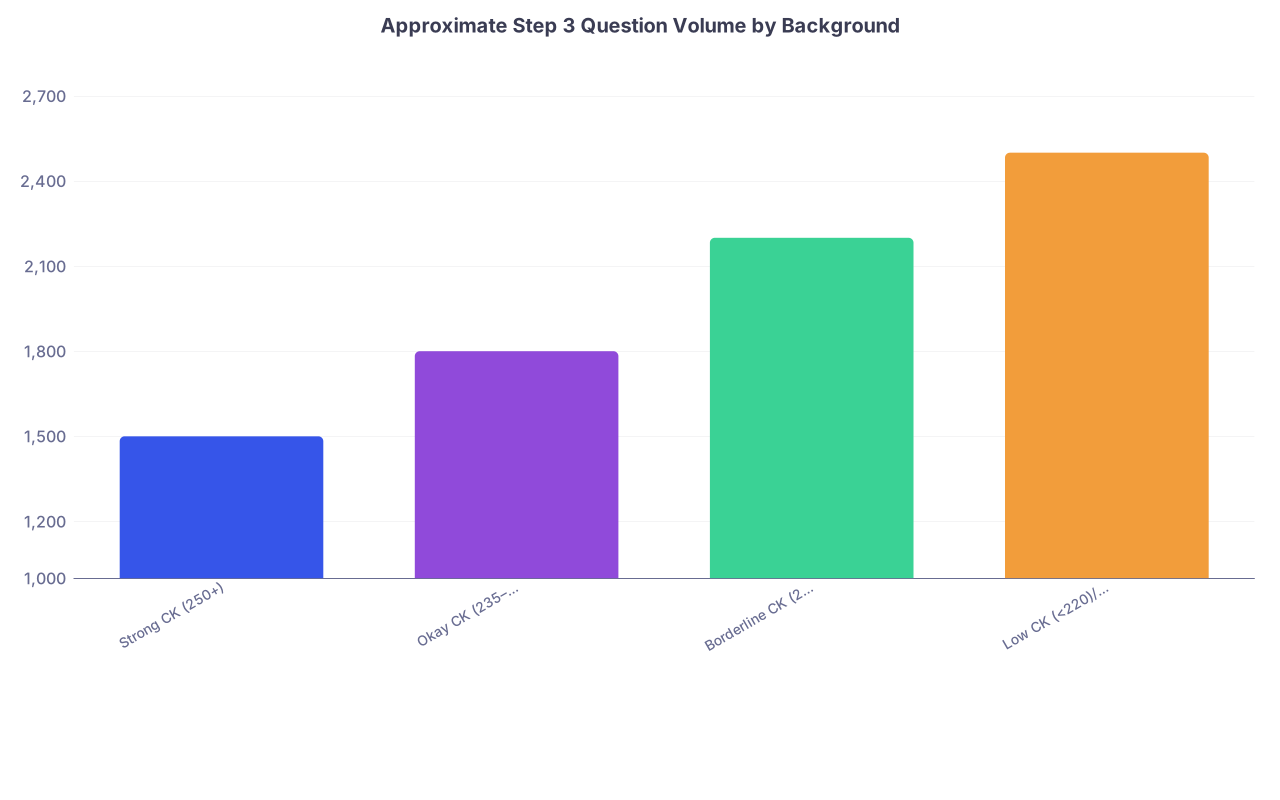
| Category | Value |
|---|---|
| Strong CK (250+) | 1500 |
| Okay CK (235–250) | 1800 |
| Borderline CK (220–235) | 2200 |
| Low CK (<220)/Old Grad | 2500 |
1. Look at your Step 2 CK and recent clinical performance
Here’s the blunt version:
Step 2 CK ≥ 250 and you took it within 1–2 years
You can usually get away with ~1,500 questions + 40 CCS cases if you’re engaged and timing is okay.Step 2 CK in the 230s–240s or >2–3 years ago
Aim for ~1,800–2,200 questions + 50–60 CCS cases.
You need extra reinforcement and more spaced repetition.Step 2 CK < 230, big gaps, or you barely passed
You’re in the higher‑risk group.
Plan on 2,000–2,500 questions + 60–80 CCS cases and more careful review.
This is not the time to be minimalist.
2. Factor in your timeline
Reality check: you’re probably in residency while doing this. Time is not your friend.
Here’s a sane ballpark:
4–6 weeks of part‑time studying (light rotation or elective):
1,500–2,000 questions is very doable at 40–60/day, with review.2–3 weeks on a lighter schedule:
You can still do ~1,200–1,500 questions, but you must be disciplined.On heavy inpatient or nights:
Don’t pretend you’re doing 80/day. You aren’t.
Either:- Push the exam date, or
- Lower quantity but raise quality and accept more risk.
How to Use Those Questions So They Actually Count
The method matters as much as the question count.
Daily structure that works
Here’s a very typical effective pattern over 4–6 weeks:
- 40–60 timed, mixed questions per day
- Review every explanation where:
- You guessed
- You got it wrong
- You were slow or confused by the wording
- Write short, ugly notes only on things you truly forget (not beautiful Anki decks you’ll never review)
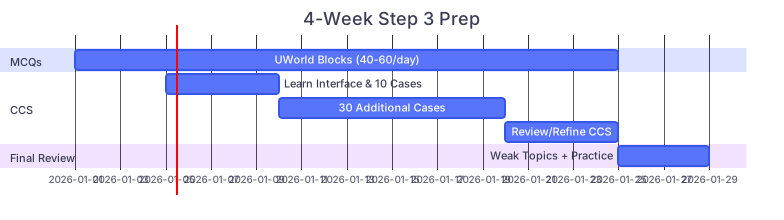
| Task | Details |
|---|---|
| MCQs: UWorld Blocks (40-60/day) | a1, 2026-01-01, 24d |
| CCS: Learn Interface & 10 Cases | b1, 2026-01-05, 5d |
| CCS: 30 Additional Cases | b2, after b1, 10d |
| CCS: Review/Refine CCS | b3, after b2, 5d |
| Final Review: Weak Topics + Practice | c1, after a1, 4d |
Should you do a second pass of UWorld?
For most people: no, not fully. It’s overkill and poor ROI if you’re crunched for time.
Better:
- Finish one full pass of UWorld.
- Then:
- Redo incorrects selectively in weak systems
- Do targeted blocks (e.g., OB, peds, ethics) in random/unused banks or Amboss.
The only people I’ve seen benefit from a true “second pass” are:
- Those with long timelines and significant anxiety
- Those who did UWorld very sloppily the first time
If you’re 2 weeks from your test and thinking, “Should I restart UWorld?” the answer is no. Focus on weak areas and CCS.
CCS Cases: How Many Before Step 3?
Here’s where a lot of otherwise strong test‑takers screw themselves. They ignore CCS, then get wrecked in the real thing because they can’t drive the software.
You need two things:
- Technical comfort with the CCS interface
- Clinical pattern recognition for common scenarios
Realistic, solid targets:
- Absolute minimum: 25–30 cases
- Standard safe: 40–60 cases
- If you’re anxious/weak in management: 60–80 cases
And no, reading CCS writeups doesn’t substitute for doing the cases.
Focus most of your cases on:
- Chest pain, SOB, ACS, CHF, COPD exacerbation
- Abdominal pain differentials
- Pregnancy, prenatal, postpartum issues
- Pediatrics: fever, respiratory, dehydration, developmental issues
- Neuro: stroke, seizure
- Endocrine: DKA, thyroid storm, adrenal insufficiency, hypercalcemia
- Psych: suicidality, depression, psychosis
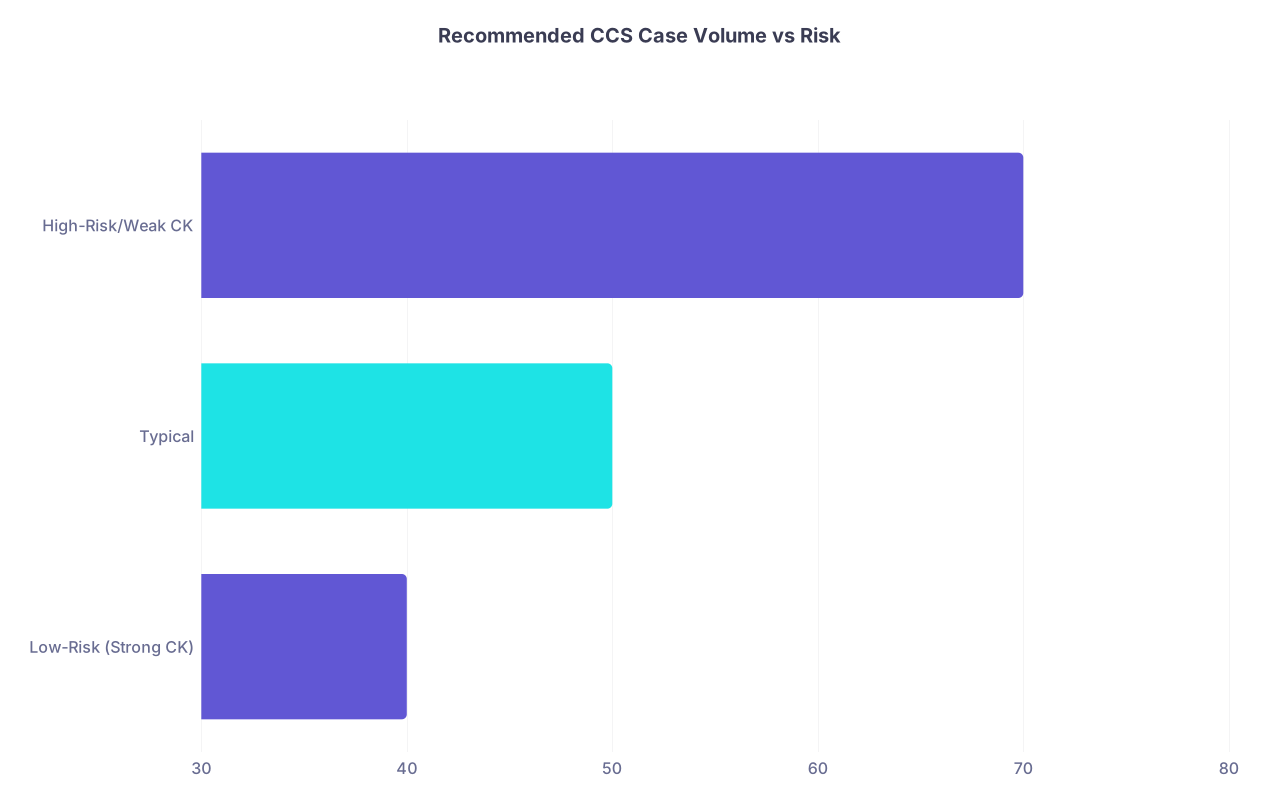
| Category | Value |
|---|---|
| Low-Risk (Strong CK) | 40 |
| Typical | 50 |
| High-Risk/Weak CK | 70 |
If you do 40+ varied cases and actually reflect on what you missed (tests, consults, disposition), you’re in solid shape.
Matching Question Count to Your Risk Tolerance
Your question volume should line up with how much risk you’re willing to accept.
Low risk tolerance / can’t afford a fail (visa, job, fellowship implications):
Err on more questions (2,000–2,500) and more CCS (60–80) plus a practice assessment (NBME/step-style self‑assessment, UWSA if/when available for Step 3).Moderate risk tolerance / average background:
Hit 1,600–2,000 UWorld questions, 40–60 CCS, one practice exam. Done.High risk tolerance / strong prior scores and good clinical performance:
1,400–1,600 questions and 30–40 CCS might be enough, but that’s your gamble. I wouldn’t recommend going lower.
If your practice performance (on self‑assessments or late UWorld blocks) is poor—like consistently <55–60% on timed mixed blocks—your “plan” doesn’t matter. You need more work. Usually more questions + more focused review + CCS.
How to Know When You’ve Done “Enough”
You don’t stop because you hit an arbitrary number. You stop when these are true:
- You’ve completed at least one full high‑quality Qbank (ideally UWorld).
- You’re scoring consistently at or above ~60% on timed, mixed blocks.
- You’ve done at least 40 CCS cases, and you:
- Know how to order urgent interventions fast
- Remember to move the clock appropriately
- Don’t freeze on disposition or follow‑up
If those three are true and you’re in the 1,500–2,000+ question range, you’re not under‑prepared from a question volume standpoint.
Final, No‑Nonsense Question Targets
If you just want a straight, scenario‑based answer, here’s your cheat sheet:
| Scenario | MCQs Total | CCS Cases |
|---|---|---|
| PGY1, Step 2 CK 250+, recent | 1,500–1,800 | 40–50 |
| PGY1–2, Step 2 CK 235–250 | 1,800–2,000 | 50–60 |
| PGY2–3, Step 2 CK 220–235 or old grad | 2,000–2,300 | 60–70 |
| Step 2 barely passed / big gap | 2,200–2,500 | 70–80 |
| Time‑crunched but strong clinically | 1,400–1,800 (high quality) | 40–50 |
If you’re below 1,200 total questions and <30 CCS cases going into Step 3, just be honest with yourself: you’re rolling the dice.

Key Takeaways
- For most people, 1,500–2,000 high‑quality questions + 40–60 CCS cases is the sweet spot.
- Your Step 2 CK score, recency, and clinical comfort should push you up or down from that baseline.
- Hitting a number means nothing if your review is shallow and CCS practice is weak. Method > vanity metrics.
FAQ (Exactly 6 Questions)
1. Is doing all of UWorld Step 3 once enough to pass?
For many residents with a decent Step 2 CK and active clinical exposure, yes—one full pass of UWorld (~1,600–1,900 questions) plus 40–60 CCS cases is usually enough for a safe pass. Where people get into trouble is blasting through UWorld without real review and completely neglecting CCS. If you’re weak on either of those, “finishing UWorld” alone is not enough.
2. Do I really need a second question bank for Step 3?
Usually not. UWorld covers the core content well enough for most takers. A second bank (like Amboss) is helpful if:
- You have a lower Step 2 CK
- You’re several years out from med school
- Your UWorld percentages stay stubbornly low (<55–60%) after a serious attempt
In those cases, an extra 300–600 targeted questions in weak areas can help. But don’t add a second bank just to chase vanity question counts.
3. How many questions per day should I do while working full-time?
If you’re on a lighter rotation, 40–60/day is realistic and effective. On a heavy inpatient month, 20–30/day with solid review might be all you can handle—just accept you’ll need a longer runway to get your total volume to ~1,500+. The worst move is planning 80/day, doing 15, and never reviewing explanations. Be honest about your schedule and pick a number you can actually sustain.
4. What UWorld percentage predicts I’ve done “enough” questions?
There’s no magic cut score, but patterns matter. If your last 400–600 questions in timed, mixed mode are averaging around 60–65% or higher, you’re typically in the safe zone for passing, assuming your CCS is reasonably prepared. If you’re sitting in the low 50s or below close to your test date, you probably either need more time, more questions, or a serious change in how you’re reviewing.
5. Can I pass Step 3 with fewer than 1,000 questions?
Some people do. Usually those with very strong Step 2 CK scores, recent test‑taking experience, and heavy clinical exposure in US training environments. But it’s a gamble, and for most people it’s a bad one. If you’re under 1,000 total questions and under 30 CCS cases, you’re simply not giving yourself much margin for error. Could you pass? Sure. Is it a smart strategy? No.
6. How many CCS cases should I repeat, if any?
You don’t need to obsessively repeat every case, but repeating 10–20 representative cases can be valuable, especially early on. The goal isn’t memorizing answers—it’s automating your workflow: stabilization, orders, monitoring, clock movement, consults, and disposition. If your second run through a case feels smooth and systematic instead of panicked and random, that’s exactly what you want on test day.
Bottom line:
Aim for 1,500–2,000 serious questions, 40–60 CCS cases, and consistent ~60%+ performance on recent mixed blocks.
If you’re weak, old‑grad, or anxious, push those numbers higher.
But don’t worship the counter—worship the quality of how you’re doing each question and each case.